
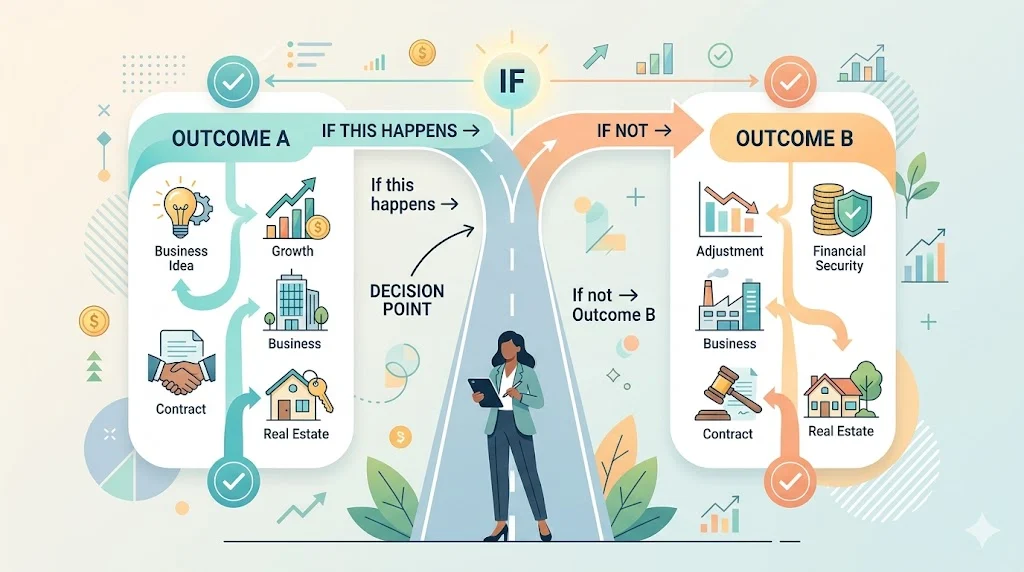
You’ve probably seen the word “contingent” in a contract, job listing, or property deal. It sounds formal. Maybe even confusing. But the idea behind it is actually simple. This is the perfect place to explore Contingent Means in Text.
Contingent means something depends on something else happening first.
That’s it.
If the condition is met, the outcome happens. If not, it doesn’t.
Think about this:
“I’ll go to the beach if it doesn’t rain.”
Your plan is contingent on the weather.
You didn’t promise anything outright. You added a condition.
You’ll find this word everywhere:
- Job offers
- Business deals
- Legal agreements
- Real estate listings
Understanding it helps you avoid costly misunderstandings.
Contingent Meaning in Simple Words
Let’s strip it down even further.
Contingent = dependent on a condition
In everyday language, it means:
- Something is not guaranteed
- It can change based on circumstances
- It only happens if something else happens first
Here’s a quick breakdown:
- You get a job if you pass the background check
- You buy a house if the bank approves your loan
- You travel if you get time off work
All of these are contingent situations.
Simple Analogy
Imagine flipping a light switch.
- If the power is on → the light turns on
- If the power is off → nothing happens
The light turning on is contingent on electricity.
Formal Definition of Contingent
In formal terms, contingent refers to something that is:
“Dependent on a future event or condition that may or may not happen.”
This definition highlights two key ideas:
- Dependency
- Uncertainty
Breaking Down the Meaning
| Concept | Explanation |
|---|---|
| Dependency | One thing relies on another |
| Uncertainty | The outcome is not guaranteed |
| Condition | A requirement must be met |
Certainty Comparison Table
| Term | Meaning | Certainty Level |
|---|---|---|
| Certain | Will happen | High |
| Contingent | Depends on conditions | Medium |
| Uncertain | Unknown outcome | Low |
You can see how contingent sits in the middle. It’s not random. It just isn’t locked in yet.
How to Use “Contingent” in a Sentence
Using the word correctly makes your communication sharper.
Everyday Examples
- “Our trip is contingent on the weather.”
- “Dinner plans are contingent upon your schedule.”
- “My decision is contingent on the final price.”
Professional Examples
- “The agreement is contingent on regulatory approval.”
- “Payment is contingent upon delivery completion.”
- “The bonus is contingent on performance targets.”
Business Tone Example
- “Project funding remains contingent on investor commitment.”
Common Mistakes
❌ Wrong: “The outcome is contingent.”
✔️ Better: “The outcome is contingent on market conditions.”
Always specify what the condition is.
Synonyms and Antonyms of Contingent
Understanding similar and opposite words strengthens your vocabulary.
Synonyms (With Subtle Differences)
| Word | Meaning | When to Use |
|---|---|---|
| Conditional | Based on a specific condition | Formal writing |
| Dependent | Relies on something | General use |
| Provisional | Temporary or not final | Agreements |
| Tentative | Not fully confirmed | Plans |
| Subject to change | Can be altered | Informal |
Antonyms
| Word | Meaning |
|---|---|
| Certain | Guaranteed outcome |
| Absolute | No conditions |
| Unconditional | No restrictions |
| Definite | Clearly decided |
Contingent vs Conditional vs Dependent
These words overlap. But they don’t mean the exact same thing.
Comparison Table
| Term | Meaning | Key Difference |
|---|---|---|
| Contingent | Depends on something else | Broad usage |
| Conditional | Based on a defined rule | More structured |
| Dependent | Relies on something | Simpler relationship |
Quick Example
- Contingent: “The deal depends on several factors.”
- Conditional: “The deal requires approval from X.”
- Dependent: “The outcome relies on funding.”
Subtle differences. Big impact in contracts.
Contingent Meaning in Different Contexts
The meaning stays the same. The application changes.
Contingent Meaning in Business
In business, contingent often signals risk or flexibility.
Companies rarely operate with certainty. They plan for possibilities.
Common Business Uses
- Contingent payments
- Contingent workforce
- Contingent contracts
Example
A company might say:
“Payment will be made contingent upon project completion.”
No completion. No payment.
Why Businesses Use It
- Reduces risk
- Protects investments
- Allows flexibility
Key Insight
Contingency is a strategy, not a weakness.
Contingent Meaning in Real Estate
This is where the word shows up a lot.
When a property is labeled “contingent,” it means:
The seller has accepted an offer, but certain conditions must be met before the sale is final.
Common Real Estate Contingencies
- Financing approval
- Home inspection
- Property appraisal
- Sale of buyer’s existing home
Example Scenario
You find your dream house. You make an offer.
The seller accepts it. But…
- You still need a mortgage approval
- The house must pass inspection
Until those happen, the deal is contingent.
Buyer vs Seller Perspective
| Role | Concern |
|---|---|
| Buyer | Wants protection from bad deals |
| Seller | Wants assurance the deal will close |
Contingent Meaning in Law
In legal terms, contingent defines obligations that depend on events.
Contingent Contract Explained
A contract becomes enforceable only if a specific event occurs.
Example
“If the shipment arrives on time, payment will be released.”
No shipment. No payment.
Legal Importance
- Reduces disputes
- Clarifies expectations
- Defines obligations
Contingent Meaning in Jobs & Employment
The modern workforce uses this term heavily.
What Is a Contingent Job?
A contingent job is not permanent. It depends on business needs.
Types of Contingent Workers
- Freelancers
- Contractors
- Temporary employees
- Consultants
Pros and Cons
| Pros | Cons |
|---|---|
| Flexible schedule | Less job security |
| Diverse experience | Limited benefits |
| Higher short-term pay | Uncertain income |
Reality Check
Companies love contingent workers. They reduce long-term costs.
Contingent Meaning in Finance & Accounting
Finance uses this term with precision.
Contingent Liability Meaning
A potential obligation that depends on a future event.
Examples
- Pending lawsuits
- Warranty claims
- Loan guarantees
Contingent Asset Definition
A possible gain that depends on an uncertain event.
Examples
- Winning a lawsuit
- Insurance claims
Why It Matters
Investors watch these closely. They affect financial health.
Contingent Offer Meaning
A contingent offer is not final.
It depends on conditions being met.
Where You’ll See It
- Real estate deals
- Job offers
- Business agreements
Example
“You’re hired, contingent on passing a background check.”
Why It Matters
- Protects the party making the offer
- Reduces risk
- Keeps options open
Contingent Contract Explained
Let’s simplify it.
A contingent contract follows this structure:
If X happens → Y occurs
If X doesn’t happen → No obligation
Real-Life Examples
- Insurance payouts
- Bonus agreements
- Sales commissions
Key Insight
Every contingent contract includes:
- A condition
- A possible outcome
- A trigger event
Common Real-Life Examples of Contingent Situations
You deal with contingent situations daily.
Everyday Examples
- “I’ll call you if I finish work early.”
- “We’ll go out if the weather improves.”
- “I’ll buy it if the price drops.”
Business Examples
- Product launch depends on funding
- Hiring depends on budget approval
Legal Examples
- Payment depends on contract terms
Contingent vs Guaranteed Outcomes
Understanding this difference can save you money and stress.
Comparison
| Type | Meaning |
|---|---|
| Contingent | Depends on conditions |
| Guaranteed | No conditions |
Why It Matters
- Helps you evaluate risk
- Improves decision-making
- Prevents false expectations
FAQs
What does contingent mean in simple words?
It means something depends on something else happening.
What does contingent mean in real estate?
The deal is not final. Conditions must be met first.
What does contingent mean in a job?
The job depends on requirements like background checks.
What does contingent mean in a contract?
The agreement activates only if a condition is fulfilled.
Is contingent good or bad?
It’s neither. It simply indicates uncertainty or conditions.
Conclusion:
Words shape decisions. This one shapes outcomes. When you hear “contingent,” pause for a second.
Ask yourself:
- What is the condition?
- What happens if it fails?
- Who benefits from the setup?
That simple shift in thinking can protect your time, money, and energy. Think of contingent situations like a bridge. You can cross it. But only if it holds. And whether it holds… depends.
Read More Related Articles:
- What Does Lice Look Like | Visual and Practical Guide In 2026
- What Does “Tralalero Tralala” Mean? Origin and Usage Explained In 2026
- What Does Ringworm Look Like | Complete Guide In 2026

Luna Hartley is a content creator at TextSprout.com, where she specializes in explaining word meanings, modern phrases, and everyday language used in texts and online conversations. Her writing focuses on clarity and context, helping readers understand how words are actually used in real communication.