
A torn meniscus does not usually look dramatic on the surface. You won’t see an open wound, and the skin often looks completely normal at first glance. That’s what confuses most people.
You twist your knee. It hurts. It swells a bit. But visually, it doesn’t look “broken.”
So you start asking the real question:
What does a torn meniscus look like on the outside?
The honest answer is simple.
It mostly looks like a swollen knee, not a visibly damaged one.
But that explanation alone isn’t enough. Let’s break it down properly so you understand exactly what your knee is telling you.
What a Torn Meniscus Looks Like on the Outside
If you are expecting a visible tear or obvious damage on the skin, you won’t find it in most cases.
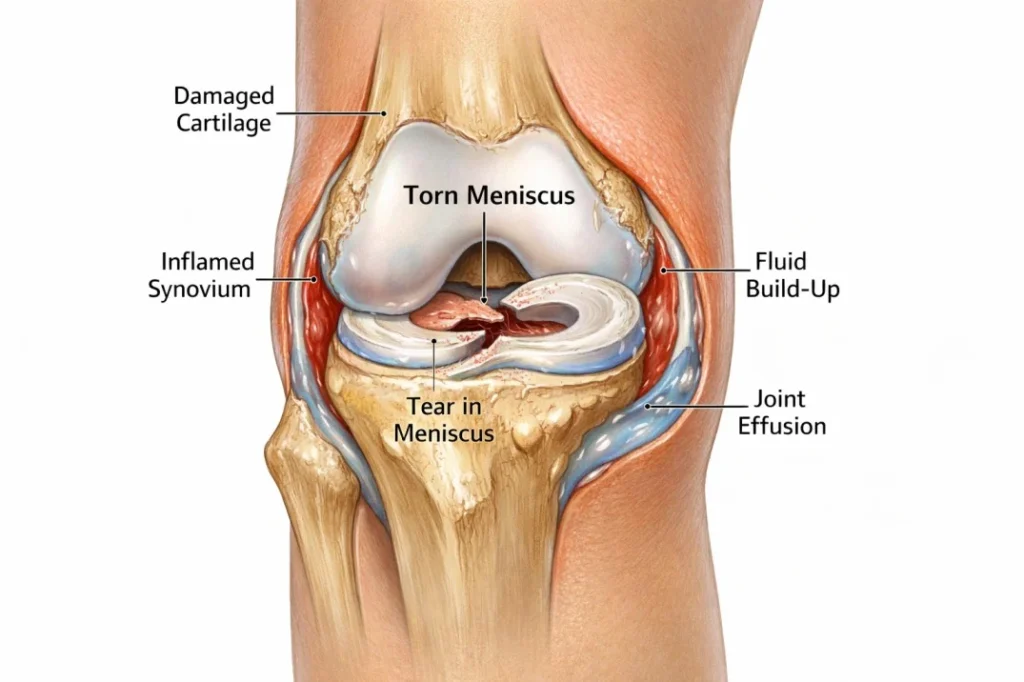
A torn meniscus is an internal cartilage injury inside the knee joint. The damage happens deep between the thigh bone and shin bone.
So externally, the knee may look:
- Slightly swollen
- Puffy around the joint line
- Warm compared to the other knee
- Mildly stiff or slightly bent
- Normal in skin color (in many cases)
Key truth most people miss
“The meniscus can be severely torn even when the knee looks almost normal from the outside.”
That’s why symptoms matter more than appearance.
Understanding the Meniscus Before You Look for Signs
To understand what you’re seeing externally, you need to understand what is actually injured.
The meniscus is a C-shaped piece of cartilage in your knee. You have two in each knee:
- Medial meniscus (inner side)
- Lateral meniscus (outer side)
These act like shock absorbers.
They:
- Stabilize your knee
- Reduce friction
- Spread body weight evenly
- Protect cartilage surfaces
When a tear happens, the damage stays inside the joint.
That’s why you don’t see a clean external “injury mark.”
What a Torn Meniscus Looks Like on the Outside in Real Life
Even though the injury is internal, your body still reacts. That reaction creates visible changes.
Let’s break down exactly what you can see.
Swelling Around the Knee Joint
Swelling is the most common visible sign.
It usually appears:
- Around the kneecap
- Along the joint line
- On one side more than the other
The swelling can look like a soft balloon effect.
Typical swelling timeline
| Time After Injury | What You See |
|---|---|
| 0–2 hours | Mild tightness, little visible change |
| 2–12 hours | Noticeable puffiness begins |
| 12–48 hours | Full swelling becomes visible |
| 2–7 days | Swelling may reduce or fluctuate |
Swelling often gets worse after walking or standing.
Knee Looks “Fuller” Than the Other Side
This is subtle but important.
You may notice:
- One knee looks rounder
- The injured knee lacks sharp bone outlines
- The area above the kneecap appears puffed
This difference becomes clearer when you stand straight.
Warmth Around the Joint
Touch matters here.
A torn meniscus often triggers inflammation, which increases blood flow.
So the knee may feel:
- Warmer than the other side
- Slightly tender when pressed
- Sensitive along the joint line
This is not visible visually, but it is an external sign you can feel.
Minimal or No Bruising in Most Cases
Unlike ligament injuries, meniscus tears often don’t cause bruising.
But there are exceptions.
When bruising may appear:
- Severe twisting injury
- Direct trauma during sports
- Combined ligament + meniscus injury
Most isolated meniscus tears do not show visible bruises.
External Signs of a Torn Meniscus You Can Actually Observe
Beyond swelling, there are movement-based visual signs.
These are more reliable than appearance alone.
Limping or Changed Walking Pattern
One of the clearest visible clues is how you walk.
You may notice:
- Shorter steps
- Favoring one leg
- Reduced knee bending
- Slight stiffness in stride
People often describe it as “protecting the knee without thinking.”
Slight Knee Flexion While Standing
When pain is present, the body tries to reduce pressure.
So you might stand with:
- A slightly bent knee
- Uneven weight distribution
- One leg taking more load
This posture helps reduce internal joint stress.
Difficulty Fully Straightening the Knee
This is a big clue.
A torn meniscus can block smooth motion inside the joint.
Visually, you may see:
- The knee doesn’t fully lock straight
- The leg stays slightly bent
- Movement looks “restricted”
This often indicates internal mechanical irritation.
Symptoms That Don’t Show Visibly But Are Strong Indicators
Not everything about a torn meniscus is visible. In fact, most key signs are internal.
Pain on Inner or Outer Knee Side
Pain location depends on the tear type.
| Tear Type | Pain Location |
|---|---|
| Medial meniscus tear | Inner knee pain |
| Lateral meniscus tear | Outer knee pain |
If pain often increases:
- Squatting
- Twisting
- Climbing stairs
Locking or Catching Sensation
This is one of the most important symptoms.
You may feel:
- Knee gets stuck mid-movement
- Sharp catch when bending
- Temporary inability to straighten
This happens when torn cartilage interferes with joint motion.
Clicking or Popping Sounds
Not every click is a problem, but in meniscus injuries:
- Clicking is painful or uncomfortable
- It happens during movement, not random rest
- It feels like something is “shifting” inside
Knee Instability Feeling
Some people describe this as:
- “My knee might give out”
- “It feels weak suddenly”
- “It doesn’t support me properly”
This is due to reduced internal stability from cartilage damage.
Why a Torn Meniscus Doesn’t Always Look Severe
This is where many people get confused.
The knee might look normal, but the damage inside can be significant.
Here’s why:
- The meniscus sits deep inside the joint
- Skin and muscle hide the injury
- No open surface damage occurs
- Inflammation varies by person
So appearance often underestimates severity.
What Causes the Visible Changes You See
The visible changes come from your body’s response, not the tear itself.
Fluid Buildup Inside the Knee
When injury happens, the body reacts.
It sends fluid to protect the area.
This leads to:
- Swelling
- Pressure feeling
- Reduced mobility
Inflammation Response
Inflammation is your body’s alarm system.
It causes:
- Heat
- Swelling
- Tenderness
- Stiffness
Joint Irritation During Movement
Every time you move:
- Torn tissue rubs inside the joint
- Irritation increases swelling
- Symptoms worsen after activity
That’s why the knee often looks worse at night.
Torn Meniscus vs Other Knee Injuries
It’s easy to confuse knee injuries because they look similar externally.
Meniscus Tear vs Ligament Injury
| Feature | Meniscus Tear | Ligament Injury |
|---|---|---|
| Swelling speed | Gradual | Rapid |
| Bruising | Rare | More common |
| Locking | Common | Rare |
| Instability | Moderate | Severe |
Why They Look Similar
Both cause:
- Swelling
- Pain
- Limping
But internal mechanics differ.
That’s why visual signs alone are not enough.
Meniscus Tear MRI vs Physical Appearance
External signs only tell part of the story.
An MRI shows the full picture.
What You Can See Without MRI
- Swelling
- Walking changes
- Pain patterns
- Reduced movement
What MRI Reveals
- Exact tear location
- Tear size
- Medial or lateral involvement
- Severity level
MRI is the only way to confirm diagnosis accurately.
When Visible Signs Mean You Should Take It Seriously
Some symptoms should not be ignored.
Warning Signs
- Swelling lasting more than 3–5 days
- Repeated locking
- Increasing pain over time
- Difficulty bearing weight
Movement Red Flags
- Limping that doesn’t improve
- Knee instability while walking
- Reduced range of motion
If these appear, the injury is more than minor strain.
Common Misunderstandings About How It Looks
People often misjudge knee injuries.
No bruise means no injury
False. Meniscus tears rarely bruise.
Small swelling means small injury
Not always true. Even small tears can cause swelling.
If I can walk, it’s fine
Walking does not rule out a tear.
Real-Life Example of a Torn Meniscus Appearance
Imagine this situation:
A football player twists their knee during a quick turn.
What happens next:
- Immediate mild pain
- Swelling develops over hours
- No visible wound
- Knee looks slightly larger
- Walking becomes uneven
- Clicking appears when bending
This is a classic meniscus presentation.
Conclusion:
Let’s bring everything together. A torn meniscus typically looks like:
- A swollen knee
- A slightly puffed joint area
- Normal skin without visible damage
- Sometimes warmth or stiffness
But the real signs are not just visual. They are functional:
- Pain during movement
- Locking or catching
- Limping
- Reduced flexibility
A torn meniscus hides well under the skin. That’s what makes it tricky. You won’t usually see a dramatic external injury. Instead, you’ll notice subtle but important changes in shape, movement, and comfort. So if your knee looks only slightly swollen but feels unstable or painful, don’t ignore it. The outside never tells the full story of a meniscus tear.
Read More Related Articles:
- What Does Encanto Mean | Cultural Meaning and Real-Life Usage In 2026
- PMO Mean in Text | Real Meaning in Digital Communication In 2026
- What Does ASL Mean | Examples and Complete Guide In 2026

Neon Samuel is a digital content creator at TextSprout.com, dedicated to decoding modern words, slang, and expressions. His writing helps readers quickly grasp meanings and understand how terms are used in real conversations across text and social platforms.