
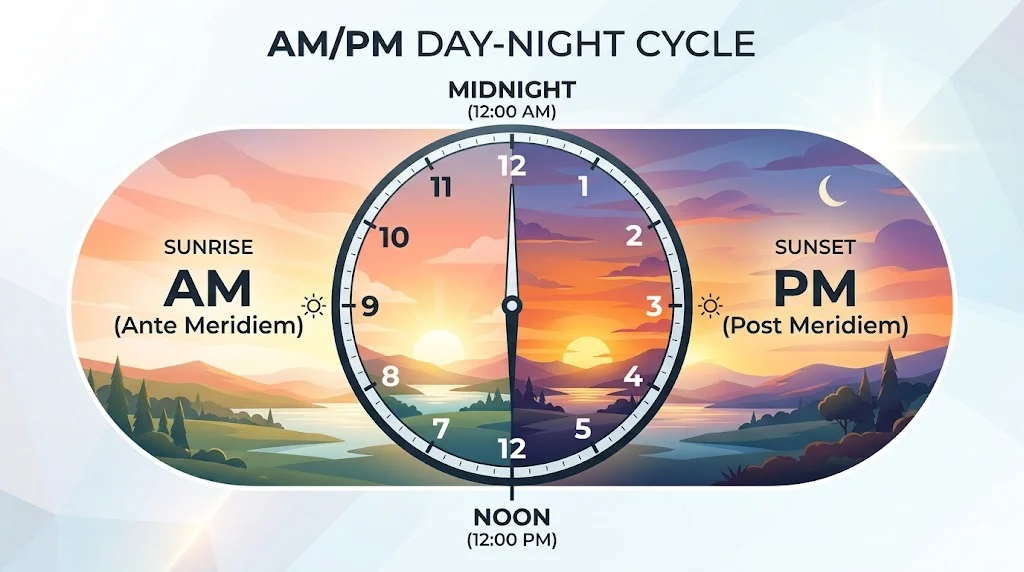
You’ve seen AM and PM on clocks your entire life. Yet, if you pause for a second, things can get fuzzy. Is 12 AM midnight or noon? Is 7 PM morning or evening? That tiny two-letter label has caused missed flights, late meetings, and alarm disasters.
Here’s the truth. AM and PM look simple, but they carry centuries of history and a very specific meaning. Once you understand the logic behind them, everything clicks.
In this guide, you’ll learn:
- The exact meaning of AM and PM
- The full form and origin
- How to use them correctly in real life
- Common mistakes and how to avoid them
- Easy tricks to remember forever
Let’s clear the confusion once and for all.
What Does AM and PM Stand For?
Let’s answer the main question directly.
- AM stands for Ante Meridiem
- PM stands for Post Meridiem
These are Latin terms, not English. That’s why they often feel unfamiliar.
What They Mean in Simple Words
- Ante Meridiem (AM) → Before midday (before noon)
- Post Meridiem (PM) → After midday (after noon)
So, the day splits into two halves:
- From midnight to noon → AM
- From noon to midnight → PM
Quick Breakdown
| Term | Full Form | Meaning | Time Range |
|---|---|---|---|
| AM | Ante Meridiem | Before noon | 12:00 AM – 11:59 AM |
| PM | Post Meridiem | After noon | 12:00 PM – 11:59 PM |
AM and PM Meaning in Simple Words
Now let’s strip away the Latin and make this practical.
Think of your day as two blocks.
AM Time (Morning Side)
- Starts at midnight (12:00 AM)
- Ends at 11:59 AM
- Covers:
- Night (early hours)
- Early morning
- Late morning
PM Time (Afternoon and Night Side)
- Starts at 12:00 PM (noon)
- Ends at 11:59 PM
- Covers:
- Afternoon
- Evening
- Night
Easy Memory Tricks
These tricks stick better than definitions:
- AM = After Midnight
- PM = Past Midday
They aren’t technically exact, but they work perfectly for memory.
AM vs PM Meaning: Key Differences Explained
Confusion disappears when you compare them side by side.
| Feature | AM | PM |
|---|---|---|
| Full Form | Ante Meridiem | Post Meridiem |
| Meaning | Before noon | After noon |
| Starts At | 12:00 AM (midnight) | 12:00 PM (noon) |
| Ends At | 11:59 AM | 11:59 PM |
| Time Type | Night + Morning | Afternoon + Evening + Night |
| Example | 8:00 AM = Morning | 8:00 PM = Night |
Simple Way to Think About It
Imagine a line at noon.
Everything before that line is AM.
Everything after that line is PM.
How the 12-Hour Clock System Works
To fully understand AM and PM, you need to understand the 12-hour clock system.
What Is the 12-Hour Clock?
Instead of counting hours from 0 to 23, the day splits into two cycles:
- First 12 hours → AM
- Second 12 hours → PM
Each cycle runs from 1 to 12.
Why This System Exists
The system comes from ancient timekeeping. People used the sun to measure time. Noon marked the highest point of the sun. That became the natural dividing line.
How It Works in Practice
- 1:00 happens twice a day
- 6:00 happens twice a day
- 12:00 happens twice a day
That’s why AM and PM are necessary. They remove ambiguity.
AM and PM Time Chart
Here’s a simple visual breakdown of the day.
| Time | Label | Description |
|---|---|---|
| 12:00 AM | AM | Midnight |
| 3:00 AM | AM | Late night |
| 6:00 AM | AM | Early morning |
| 9:00 AM | AM | Morning |
| 12:00 PM | PM | Noon |
| 3:00 PM | PM | Afternoon |
| 6:00 PM | PM | Evening |
| 9:00 PM | PM | Night |
| 11:59 PM | PM | Late night |
Midnight and Noon: The Most Confusing Part
This is where most people get stuck.
Is 12 AM Midnight or Noon?
- 12 AM = Midnight
That’s the very start of a new day.
Is 12 PM Noon or Midnight?
- 12 PM = Noon
That’s the middle of the day.
Why This Confuses People
The problem lies in the wording:
But 12:00 sits exactly at the boundary.
Best Practice
Avoid confusion by saying:
- 12 midnight instead of 12 AM
- 12 noon instead of 12 PM
How to Tell AM or PM Quickly
Sometimes you see a time without context. You need to figure it out fast.
Use Context Clues
Ask yourself:
- Is it daylight or dark?
- What activity is happening?
- What’s the usual routine?
Examples
- 7:00 → School? Likely AM
- 7:00 → Dinner? Likely PM
Use Devices
Modern devices make this easy:
- Phones display AM/PM clearly
- Settings allow switching formats
Examples of AM and PM in Daily Life
Let’s make this real.
Morning (AM Examples)
- 6:00 AM → Wake up
- 8:00 AM → School starts
- 10:00 AM → Office meeting
Afternoon (PM Examples)
- 1:00 PM → Lunch
- 3:00 PM → Work continues
Evening and Night (PM Examples)
- 7:00 PM → Dinner
- 9:00 PM → Relaxation
- 11:00 PM → Sleep
AM Time vs PM Time
Understanding time of day helps reinforce AM and PM.
AM Time Categories
- Midnight → 12 AM
- Early morning → 4 AM – 7 AM
- Morning → 8 AM – 11 AM
PM Time Categories
- Afternoon → 12 PM – 4 PM
- Evening → 5 PM – 7 PM
- Night → 8 PM – 11 PM
12-Hour vs 24-Hour Clock
The 24-hour clock removes AM and PM entirely.
Conversion Table
| 12-Hour Time | 24-Hour Time |
|---|---|
| 1:00 AM | 01:00 |
| 6:00 AM | 06:00 |
| 12:00 PM | 12:00 |
| 3:00 PM | 15:00 |
| 7:00 PM | 19:00 |
| 11:00 PM | 23:00 |
Simple Rules
- AM times stay the same
- PM times add 12 (except 12 PM)
- 12 AM becomes 00:00
Why We Use AM and PM Instead of 24-Hour Time
You might wonder why both systems exist.
Reasons AM/PM Is Still Popular
- Easy for daily conversation
- Matches natural day cycles
- Widely used in casual settings
Where 24-Hour Format Is Used
- Military
- Aviation
- Hospitals
- Technical systems
It removes ambiguity completely.
History of AM and PM
AM and PM didn’t appear randomly. They come from ancient timekeeping traditions.
Origins
- Derived from Latin language
- Used in early European clocks
- Based on solar positioning
Ancient Timekeeping
People relied on:
- Sundials
- Shadow tracking
- Sun position
Noon was the anchor point. That’s where AM and PM split.
Common Mistakes People Make with AM and PM
Even small mistakes can cause big problems.
Frequent Errors
- Setting alarms for PM instead of AM
- Confusing 12 AM and 12 PM
- Writing incorrect time formats
Example Mistake
Setting an alarm for:
- 6:00 PM instead of 6:00 AM
You wake up 12 hours late.
How to Avoid Mistakes
- Double-check before setting time
- Use 24-hour format for important events
- Write “noon” or “midnight” when needed
Digital Clock and AM PM Format Explained
Modern devices display time differently.
Digital Clock Features
- Shows AM or PM automatically
- Allows switching formats
- Syncs with time zones
Why Some Regions Avoid AM/PM
Many countries prefer 24-hour format because:
- It avoids confusion
- It’s precise
- It works better for official use
Quick Memory Tricks to Never Forget AM and PM
You don’t need to memorize Latin.
Use these instead.
Simple Tricks
- AM = After Midnight
- PM = Past Midday
Visual Trick
Imagine a day like a circle:
- Top half → AM
- Bottom half → PM
FAQs
What does AM and PM stand for in time?
AM stands for Ante Meridiem. PM stands for Post Meridiem.
Is 12 AM midnight or noon?
12 AM is midnight.
Is 12 PM afternoon or night?
12 PM is noon, the start of afternoon.
What is the difference between AM and PM?
AM is before noon. PM is after noon.
How do I convert AM to PM time?
Add 12 hours to PM times, except for 12 PM.
Why do we use AM and PM?
To divide the day into two clear halves in the 12-hour clock system.
Conclusion:
Let’s wrap it up clearly.
- AM = Before noon
- PM = After noon
- 12 AM = Midnight
- 12 PM = Noon
- AM covers night and morning
- PM covers afternoon and evening
- Use context to avoid confusion
- Use 24-hour format when precision matters
AM and PM seem small, but they control how we organize our entire day. Once you understand their meaning, time stops being confusing and starts making perfect sense.

Neon Samuel is a digital content creator at TextSprout.com, dedicated to decoding modern words, slang, and expressions. His writing helps readers quickly grasp meanings and understand how terms are used in real conversations across text and social platforms.