The human body runs like a highly coordinated machine. Every part has a job. Every organ plays a role that keeps you alive without you even noticing.
But if there is one organ quietly doing more work than most people realize, it’s the liver.
You don’t feel it working. You don’t hear it. Yet it processes everything you eat, drink, breathe, and absorb. It cleans your blood, manages your energy, builds essential proteins, and even helps you digest food.
Without it, survival becomes impossible within days. So let’s break it down in a simple, practical way.
What Is the Liver and Where Is It Located?
The liver is one of the largest and most important organs in the human body. It sits in the upper right side of your abdomen, just beneath your rib cage.
It is part of both the digestive system and the broader metabolic system known as the hepatic system.
Basic facts about the liver
- Average adult liver weight: 1.3 to 1.5 kg
- Color: reddish-brown due to rich blood supply
- Size: about the size of a football
- Blood flow: receives about 1.5 liters of blood per minute
- Location: upper right abdomen, under diaphragm
The liver connects closely with the digestive system because everything you eat eventually passes through it for processing.
You can think of it as a giant chemical factory that never shuts down.
Structure of the Liver: A Quick Look Inside
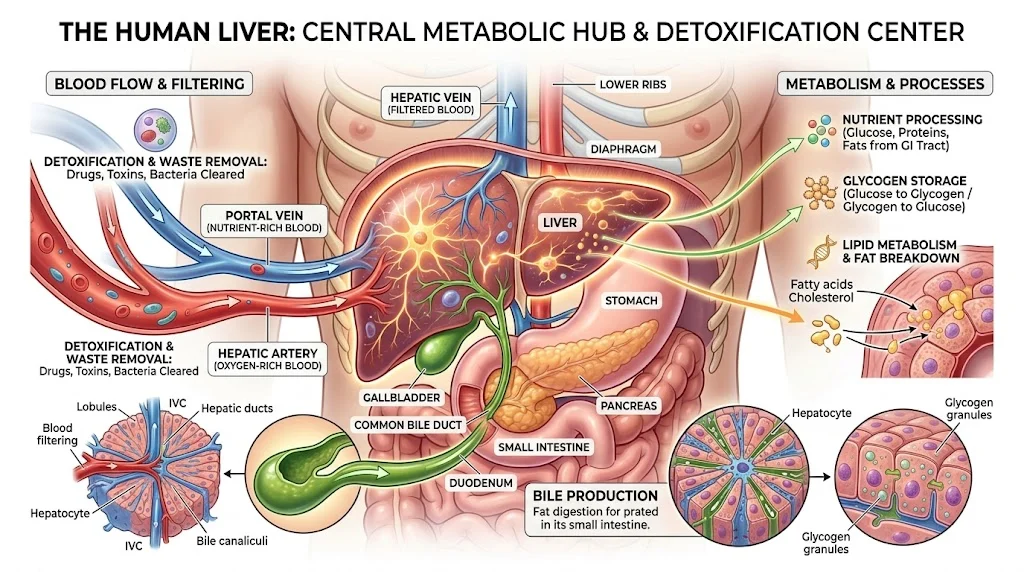
The liver is not a simple solid organ. It is made of thousands of small functional units called lobules.
Each lobule works like a mini processing unit.
Main structural features
- Right lobe (largest section)
- Left lobe (smaller section)
- Blood vessels (hepatic artery and portal vein)
- Bile ducts (carry bile to the digestive system)
Inside these lobules, billions of liver cells called hepatocytes perform every function.
These cells handle detoxification, metabolism, storage, and production tasks all at once.
Core Functions of the Liver in the Human Body
Now we reach the most important part. What does the liver actually do?
The liver performs over 500 known functions, but they can be grouped into key categories.
Let’s break them down clearly.
Detoxification of Blood: The Body’s Filter System
One of the liver’s most well-known roles is detoxification.
Every drop of blood from your digestive system passes through the liver before it reaches the rest of your body.
What the liver removes
- Alcohol and drugs
- Toxins from food
- Harmful metabolic waste
- Environmental chemicals
The liver breaks these substances down into safer compounds so the body can eliminate them through urine or bile.
For example:
- Alcohol is converted into acetaldehyde, then into harmless acetate
- Ammonia is converted into urea
Without this process, toxins would build up quickly and damage the brain and organs.
Metabolism of Nutrients: Turning Food into Energy
The liver plays a central role in metabolism. It decides how your body uses carbohydrates, fats, and proteins.
Carbohydrate metabolism
When you eat carbs, the liver:
- Converts glucose into glycogen for storage
- Releases glucose when blood sugar drops
This keeps your energy stable throughout the day.
Fat metabolism
The liver:
- Breaks down fatty acids
- Produces cholesterol (which your body needs in small amounts)
- Regulates fat storage and usage
Protein metabolism
The liver:
- Breaks down amino acids
- Removes excess nitrogen
- Builds essential proteins needed in blood
Glycogen Storage: Your Body’s Energy Backup
The liver acts like an energy battery.
When you eat more glucose than your body needs, the liver stores it as glycogen.
Later, when your blood sugar drops, the liver releases it back into the bloodstream.
Key fact
The human liver can store around 100–120 grams of glycogen at one time.
This system prevents sudden energy crashes.
Bile Production and Digestion Support
The liver produces bile, a yellow-green fluid that plays a key role in digestion.
What bile does
- Breaks down fats in food
- Helps absorb fat-soluble vitamins (A, D, E, K)
- Supports smooth digestion in the small intestine
The liver produces around 800–1000 ml of bile per day.
Bile is stored in the gallbladder and released when needed.
Without bile, fat digestion becomes very inefficient.
Blood Processing and Chemical Balance
The liver acts like a blood quality control system.
Every nutrient, toxin, and chemical from digestion passes through it first.
What it regulates
- Sugar levels
- Fat levels
- Protein breakdown products
- Hormones in the bloodstream
It ensures your internal environment stays stable even when your diet changes.
Urea Cycle: Removing Harmful Ammonia
When your body breaks down protein, it produces ammonia. Ammonia is highly toxic.
The liver converts it into urea through the urea cycle.
Why this matters
- Ammonia damages brain cells
- Urea is safe and removed through urine
Without this function, even normal protein digestion would become dangerous.
Blood Clotting Factor Production
The liver produces proteins needed for blood clotting.
These include:
- Fibrinogen
- Prothrombin
- Clotting factors II, VII, IX, and X
If the liver is damaged, even small cuts can bleed longer than normal.
This shows how deeply the liver affects survival systems.
Vitamin and Mineral Storage: The Nutrient Bank
The liver stores essential nutrients for future use.
Stored nutrients
- Vitamin A (vision and immunity)
- Vitamin D (bone health)
- Vitamin B12 (blood production)
- Iron (oxygen transport)
Think of the liver as a long-term pantry for your body.
It releases these nutrients when your diet lacks them.
Immune System Support and Defense
The liver also acts as part of your immune defense system.
It filters bacteria and pathogens from blood coming from the gut.
Immune functions
- Removes bacteria from blood
- Produces immune proteins
- Detects and clears harmful substances
This is why gut health and liver health are strongly connected.
Liver Regeneration: A Unique Ability
One of the most fascinating features of the liver is its ability to regenerate.
Even if up to 70% of the liver is removed, it can regrow back to near full size.
How regeneration works
- Remaining liver cells multiply rapidly
- Tissue rebuilds over weeks to months
However, repeated damage (like from alcohol abuse or hepatitis) can eventually stop this ability.
Daily Activities of the Liver Inside Your Body
The liver never rests. Even while you sleep, it keeps working.
Daily tasks include
- Processing nutrients from meals
- Filtering blood continuously
- Balancing hormones
- Producing bile
- Storing energy
It performs thousands of biochemical reactions every minute.
You don’t notice it, but your survival depends on it.
Why the Liver Is So Important for Survival
Without the liver, the body loses control over:
- Toxic buildup
- Energy regulation
- Digestion efficiency
- Blood chemistry balance
- Protein production
Key survival fact
Complete liver failure can become life-threatening within 24 to 72 hours depending on severity.
This shows how critical its role is.
Common Liver Functions Explained Simply
Here is a quick breakdown for easy understanding:
| Function | Simple Explanation |
|---|---|
| Detoxification | Cleans harmful substances from blood |
| Bile production | Helps digest fats |
| Metabolism | Turns food into energy |
| Storage | Keeps vitamins and minerals |
| Protein synthesis | Builds essential blood proteins |
| Urea conversion | Removes toxic ammonia |
Signs of Poor Liver Function
When the liver struggles, the body shows clear warning signs.
Common symptoms
- Constant fatigue
- Yellowing of skin or eyes (jaundice)
- Swollen abdomen
- Nausea or loss of appetite
- Dark urine
- Easy bruising
These symptoms indicate the liver is under stress.
How to Support Healthy Liver Function
Your lifestyle directly affects your liver health.
Healthy habits
- Eat balanced meals with fruits and vegetables
- Limit alcohol intake
- Stay hydrated
- Exercise regularly
- Avoid unnecessary medications
Helpful foods
- Leafy greens
- Garlic
- Turmeric
- Citrus fruits
- Nuts and seeds
Small daily choices protect your liver long-term.
Conclusion:
The liver is not just another organ. It is your body’s chemical control center, energy manager, detox system, and nutrient warehouse all in one. It works nonstop without asking for attention. Yet every second of your life depends on it. When you understand how much it does, taking care of it stops being optional. It becomes essential.
Read More Related Articles:
- What Does “It Mean” Mean: Usage and Real-Life Examples In 2026
- What Does Heartburn Feel Like | What You Should Know In 2026
- What Does DEI Stand For: Meaning and Real-World Use In 2026

Ivy Madison is a content creator at TextSprout.com, specializing in word definitions, internet slang, acronyms, and text abbreviations. She delivers clear and engaging explanations, helping readers quickly understand modern digital language and trending terms.