
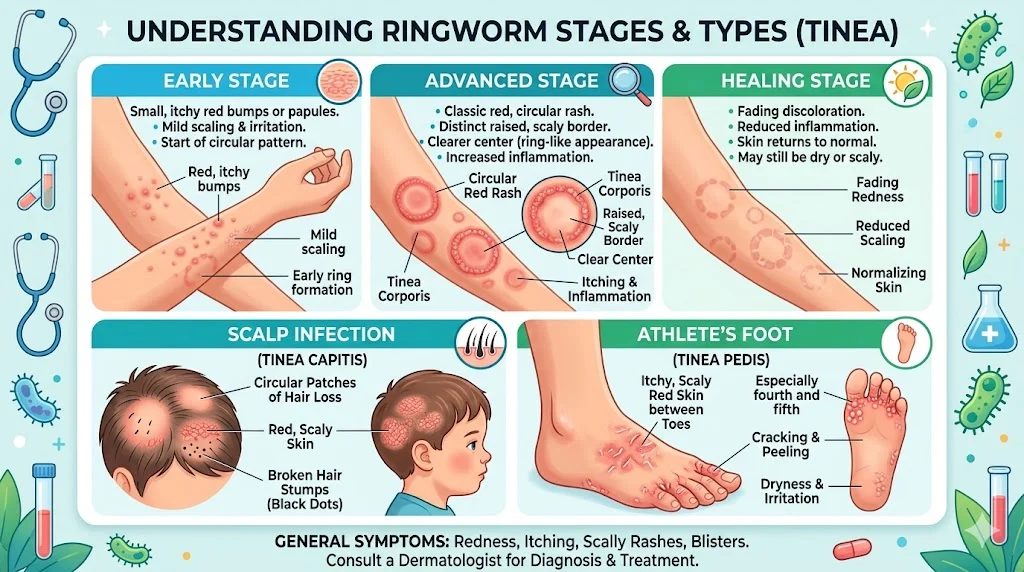
Ringworm is a common fungal infection of the skin that appears as a red, circular rash with clearer skin in the center and a raised, scaly border.
It often looks like a ring or circle, which is why it is called ringworm, even though it is not caused by a worm. The infection can appear on different parts of the body including the arms, legs, face, scalp, and feet.
If you have ever noticed a strange circular rash on your skin, you might have wondered whether it is something harmless or a sign of infection. One of the most common skin conditions that causes this type of pattern is ringworm. Despite its name, ringworm is not caused by a worm at all. It is a fungal infection that affects the skin, scalp, nails, or even feet.
Understanding what ringworm looks like is important because early recognition helps prevent it from spreading to other parts of the body or to other people. It is also one of those conditions that can easily be mistaken for eczema, psoriasis, or simple skin irritation, which makes awareness even more important.
Understanding Ringworm and How It Appears on the Skin
Ringworm is caused by a group of fungi known as dermatophytes. These fungi live on dead skin tissue, hair, and nails. When they grow on the skin, they create a visible infection that spreads outward in a circular shape.
The reason ringworm forms a ring is because the fungus tends to grow outward while the center may begin to heal, creating a characteristic circular pattern.
This is what makes it so recognizable, but also sometimes confusing because not every case looks exactly the same.
What Does Ringworm Look Like on the Skin
Ringworm can look slightly different depending on the location of the infection and how advanced it is. However, there are some common visual features that most cases share.
Typical Appearance
- Round or oval shaped rash
- Red or pink outer edge
- Clearer or lighter center
- Raised and scaly border
- Itchy or irritated skin
At first, it may look like a small red patch. Over time, it expands outward, forming a ring shape. The edges become more defined, while the center may start to look more normal or less inflamed.
Early Stage Ringworm Appearance
In the early stages, ringworm is often subtle and easy to overlook. It may appear as:
- A small red spot
- Slightly itchy skin
- Mild irritation or dryness
- A patch that slowly grows outward
At this stage, it may resemble a mosquito bite, eczema patch, or allergic reaction. Many people do not realize it is ringworm until the rash becomes more circular.
Advanced Stage Ringworm Appearance
As the infection progresses, the rash becomes more noticeable and distinctive.
Advanced signs include:
- Clearly defined ring shape
- Raised outer border
- Scaly or flaky skin
- Multiple rings merging together
- Increased itching and redness
In some cases, several rings may overlap, creating irregular patterns on the skin. The infection may also spread to other parts of the body if left untreated.
Ringworm on Different Parts of the Body
Ringworm does not look exactly the same everywhere. Its appearance changes depending on where it develops.
Ringworm on the Body (Tinea Corporis)
This is the classic form most people recognize. It appears as round red patches with a clear center and scaly edges.
Ringworm on the Scalp (Tinea Capitis)
On the scalp, ringworm can look different. Instead of clear rings, you may see:
- Bald patches
- Scaly or flaky scalp
- Broken hair strands
- Itchy irritated skin
It is more common in children than adults.
Ringworm on the Feet (Athlete’s Foot)
When ringworm affects the feet, it is called athlete’s foot. It may appear as:
- Cracked or peeling skin
- Redness between toes
- Itching and burning sensation
- Dry or scaly soles
Ringworm in the Groin Area (Jock Itch)
This form appears as:
- Red or brownish patches
- Itchy rash in the inner thighs
- Sharp bordered patches
- Discomfort in warm, sweaty areas
Visual Comparison Table of Ringworm Types
| Type of Ringworm | Location | Appearance |
|---|---|---|
| Tinea Corporis | Body | Circular red rash with clear center |
| Tinea Capitis | Scalp | Bald patches, flaky skin |
| Athlete’s Foot | Feet | Peeling, cracked skin |
| Jock Itch | Groin | Red itchy patches in folds |
What Ringworm Feels Like
Ringworm is not just about appearance. It also has physical sensations that help identify it.
Common feelings include:
- Itching that may worsen over time
- Burning sensation in some cases
- Slight discomfort when sweating
- Dry or tight feeling skin
- Irritation when scratching
The itching can sometimes become intense, especially in warm or humid conditions.
Causes of Ringworm
Ringworm is caused by fungi, not worms. These fungi thrive in warm, moist environments.
Common causes include:
- Direct skin contact with an infected person
- Sharing towels, clothing, or combs
- Contact with infected animals like cats or dogs
- Walking barefoot in public showers or locker rooms
- Excessive sweating and poor hygiene
Ringworm spreads easily, which is why it is common in schools, gyms, and households.
How Ringworm Spreads
Ringworm spreads through direct and indirect contact.
Direct contact
- Touching infected skin
- Physical contact with infected animals
Indirect contact
- Sharing clothes or bedding
- Using contaminated surfaces
- Contact with gym equipment or floors
Fungal spores can survive on surfaces for a long time, making hygiene very important.
How Ringworm Develops Over Time
Ringworm does not appear instantly. It develops gradually.
Stage 1
Small red patch appears on the skin
Stage 2
Patch begins to grow outward
Stage 3
Ring shape becomes visible
Stage 4
Edges become raised and scaly
Stage 5
Possible spreading to other areas
Without treatment, it can continue to expand.
Conditions That Look Like Ringworm
Many skin conditions can look similar to ringworm, which is why people often confuse them.
| Condition | Similarity |
|---|---|
| Eczema | Red itchy patches |
| Psoriasis | Scaly skin |
| Contact dermatitis | Allergic skin reaction |
| Pityriasis rosea | Circular rash pattern |
The key difference is that ringworm usually has a ring shaped border with clearer skin in the center.
When to Seek Medical Attention
You should consider seeing a doctor if:
- The rash is spreading
- It does not improve with over-the-counter creams
- It becomes painful or severely itchy
- It appears on the scalp or face
- Multiple family members are infected
Early treatment prevents spreading and speeds up healing.
Treatment Overview
Ringworm is usually treated with antifungal medications.
Common treatments include:
- Antifungal creams
- Oral antifungal tablets for severe cases
- Medicated shampoos for scalp infections
Treatment usually takes a few weeks depending on severity.
Prevention Tips
Preventing ringworm is often easier than treating it.
- Keep skin clean and dry
- Avoid sharing personal items
- Wear clean clothes daily
- Shower after sweating
- Treat infected pets early
- Use slippers in public showers
Good hygiene is the most effective prevention method.
FAQs
What does ringworm look like at first?
It usually starts as a small red itchy patch that slowly grows into a circular shape.
Does ringworm always form a perfect ring?
No, early stages may not look like a full ring, and some cases appear irregular.
Is ringworm painful?
It is usually not painful but can be very itchy and irritating.
Can ringworm spread quickly?
Yes, it can spread through direct contact or shared items.
How do I know if it is ringworm or eczema?
Ringworm typically forms a ring shape with a clearer center, while eczema is more irregular.
Can ringworm heal on its own?
It rarely goes away without treatment and may spread if ignored.
Is ringworm dangerous?
It is not dangerous but can become uncomfortable and contagious.
Can pets carry ringworm?
Yes, cats and dogs can carry and spread the infection to humans.
Conclusion
Ringworm is a common fungal skin infection that has a very recognizable appearance once fully developed. It usually starts as a small red patch and gradually forms a circular rash with a raised, scaly edge and a clearer center. While it is not serious in most cases, it is highly contagious and can spread easily if not treated.
Understanding what ringworm looks like helps with early identification, faster treatment, and better prevention. With proper hygiene and antifungal treatment, it can be completely cured and prevented from recurring.
Read More Related Articles:
- What Does Sigma Mean: Uses and Real Life Meaning In 2026
- ONB Mean in Slang: Most People Get This Wrong In 2026
- RT Mean in Messages: The Hidden Meaning Revealed In 2026

Luna Hartley is a content creator at TextSprout.com, where she specializes in explaining word meanings, modern phrases, and everyday language used in texts and online conversations. Her writing focuses on clarity and context, helping readers understand how words are actually used in real communication.