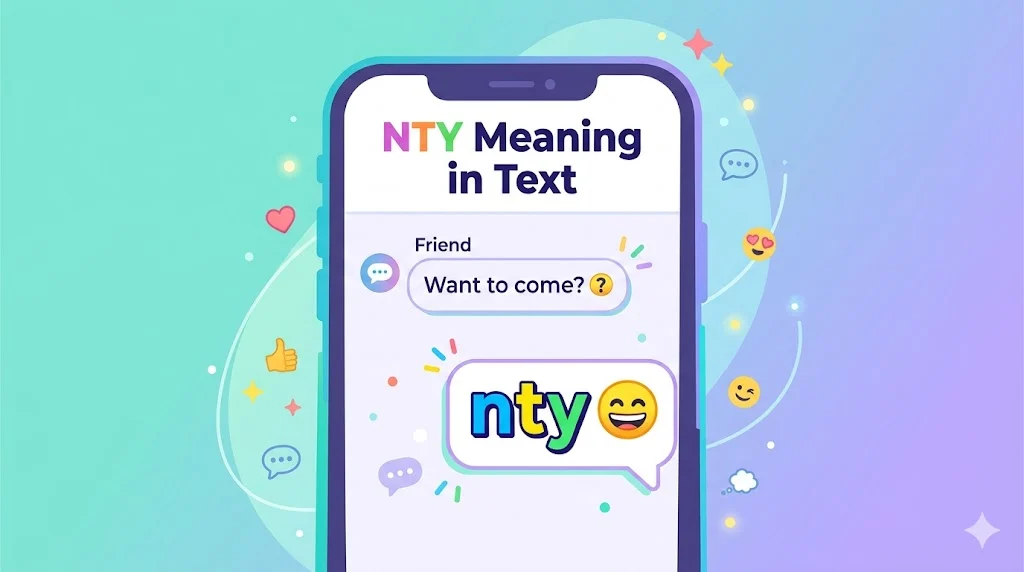
You’re scrolling through your messages and someone drops a quick “nty.” You pause. You read it again. What does that even mean? Is it a typo? A name? Some kind of new slang you missed?
Don’t worry you’re not alone. Texting slang moves fast, and new abbreviations pop up constantly. NTY is one of those shorthand phrases that feels cryptic at first but becomes second nature once you know it. By the time you finish reading this, you’ll know exactly what NTY means in text, where it came from, how to use it without sounding rude, and when to leave it out entirely.
Let’s get into it.
What Does NTY Mean in Text?
NTY stands for “No Thank You.”
That’s it. Clean, simple, and surprisingly versatile. It’s the digital shorthand people use when they want to decline something an offer, an invite, a request without sounding harsh or writing out the full phrase.
Think about it: typing “no thank you” in a fast-moving group chat feels weirdly formal. It’s like showing up to a house party in a tuxedo. NTY, on the other hand, fits right in. It’s polite enough to avoid being rude, casual enough to fit any conversation.
“nty” two letters, one word, zero awkwardness.
The abbreviation follows the same pattern as other texting staples you already know:
- TY = Thank You
- BRB = Be Right Back
- IMO = In My Opinion
- NTY = No Thank You
Each letter represents one word. Simple acronym logic. Once you see it, you can’t unsee it.
The Full Form of NTY: Breaking It Down
Here’s the breakdown, letter by letter:
| Letter | Word |
|---|---|
| N | No |
| T | Thank |
| Y | You |
NTY = No Thank You
It’s an acronym not an initialism though in practice most people use those terms interchangeably. What matters is this: NTY compresses a three-word phrase into three characters. That efficiency is exactly why texting slang exists in the first place.
Quick fact: The phrase “no thank you” itself dates back centuries as a polite refusal in English. NTY is just its 21st-century, smartphone-era descendant.
NTY Meaning in Chat: The Bigger Picture
When someone sends you NTY in a chat, they’re doing something socially clever. They’re saying no but they’re doing it nicely. There’s an implied warmth in “thank you” that plain “no” or “nah” doesn’t carry.
Compare these responses to “Want to come to the gym with me?”:
- “no” blunt, almost cold
- “nah” casual, slightly dismissive
- “nope” firm, playful depending on tone
- “nty” polite, warm, still friendly
That small difference matters more than you’d think. In digital communication, where facial expressions and vocal tone are invisible, word choice carries everything. NTY signals: I’m declining, but I’m not dismissing you.
That’s why it’s stuck around and spread across every major platform.
NTY Meaning in Texting: Real Conversation Examples
Seeing it in action makes everything clearer. Here are some real-life scenarios where NTY shows up naturally:
Declining an Invitation
Friend: “We’re going bowling tonight, you coming?” You: “nty, I’ve got an early morning tomorrow 😅”
Refusing an Offer
Coworker (on WhatsApp): “I’ve got an extra sandwich, want it?” You: “nty I already ate, thanks though!”
Turning Down a Sales Pitch (Online)
Seller: “Hey want to buy this course for $200?” You: “nty”
Politely Rejecting a Hangout
Acquaintance: “We should link up this weekend” You: “nty but maybe another time”
Humorous Use
Someone: “Want to sit through a four-hour Zoom call?” You: “NTY 😂😂”
Notice how the last one uses all caps. That’s intentional capitalization shifts the energy of NTY dramatically. Lowercase feels relaxed and warm. All caps can feel emphatic, dramatic, or sarcastic. More on that in a minute.
NTY Meaning in WhatsApp Specifically
WhatsApp is where NTY probably gets used most often. It’s the go-to messaging platform for friends, family, and group chats exactly the informal spaces where slang thrives.
In WhatsApp specifically, NTY appears in:
- Group chat invites “Beach trip this Saturday?” / “nty y’all have fun tho”
- Family groups declining dinner plans or catch-up calls
- One-on-one chats turning down offers without a lengthy explanation
- Business chats (informal) though risky here, more on that below
One thing to keep in mind with WhatsApp: your audience matters. If you’re in a chat with your grandmother or a new professional contact, “nty” might read as gibberish or come off as dismissive. Know your crowd.
NTY Meaning in Social Media
Across platforms, NTY shows up in slightly different flavors:
Twitter / X
On Twitter, NTY pops up in quote tweets, replies, and threads often with a sarcastic or humorous edge.
Someone posts: “Would you take a $50k pay cut to work at your dream company?” Reply: “NTY lmaooo”
The short character nature of Twitter makes abbreviations like NTY perfect. No fluff, straight to the point.
In DMs and comments, NTY stays casual. You’ll see it when someone’s declining a collab offer, a date proposal, or an event invite slid into their comments.
TikTok
TikTok’s comment culture loves shorthand. NTY appears in response to dares, challenges, or trending questions. “Would you eat this?” / “nty 🤢”
Discord
Gaming communities and Discord servers use NTY constantly. It’s perfect for declining game invites, trade offers, or joining a new server.
“Wanna 1v1 me?” / “nty I just lost three in a row 💀”
Snapchat
In Snap streaks and quick replies, NTY fits naturally. It’s low-effort and keeps the convo moving without a full explanation.
NTY Meaning in Messages: Platform Comparison Table
| Platform | How NTY Is Used | Typical Tone |
|---|---|---|
| SMS/iMessage | Declining invites, offers | Casual, warm |
| Group chats, family, friends | Friendly, casual | |
| Discord | Gaming invites, trades | Blunt, humorous |
| Twitter/X | Replies, quote tweets | Sarcastic, sharp |
| Instagram DMs | Declining collabs, hangouts | Casual, polite |
| TikTok Comments | Reacting to dares, trends | Playful, humorous |
| Snapchat | Quick replies in streaks | Low-effort, breezy |
Does Capitalization Change NTY’s Meaning?
Yes more than you might expect.
In digital communication, how you write something carries as much weight as what you write. Here’s what different versions of NTY signal:
| Version | Implied Tone |
|---|---|
| nty | Casual, relaxed, warm |
| Nty | Neutral, slightly formal |
| NTY | Emphatic, firm, or sarcastic |
| NTY. | Cold, final, possibly irritated |
| ntyy | Softened, almost playful |
| nty 😊 | Warm, friendly decline |
| NTY 😂 | Dramatic, humorous refusal |
The period after NTY is a big one. In texting culture, ending a short message with a period often signals displeasure or finality. “NTY.” feels more like a door slamming than a gentle decline.
NTY vs. Similar Texting Slang: What’s the Difference?
It isn’t the only way to say no in text. Here’s how it stacks up against its closest cousins:
| Slang Term | Full Meaning | Tone | Best Used When |
|---|---|---|---|
| NTY | No Thank You | Polite, casual | You want to be warm but brief |
| NT | No Thanks | Slightly blunt | Quick, low-context refusals |
| Nah | No | Very casual | Close friends, informal chats |
| Nope | No | Firm, sometimes playful | Emphasizing refusal with lightness |
| Hard pass | Definitely no | Emphatic, often funny | Making a strong, humorous point |
| No thx | No thanks | Same as NTY, slightly less formal | Direct but not rude |
| Ntyy | No thank you (elongated) | Softer, more expressive | Adding emotion or exaggerated warmth |
| Not interested | No | Firm, direct | When you want zero ambiguity |
The key takeaway: NTY sits in a sweet spot. It’s more polite than “nah,” less dramatic than “hard pass,” and carries more warmth than a flat “no.”
Is NTY Rude? Let’s Settle This
Here’s the honest answer: NTY is not inherently rude. But context shapes everything.
Think of it like a facial expression. A smile means one thing in a friendly photo and something else entirely when it follows a snarky comment. NTY works the same way.
When NTY feels perfectly fine:
- Declining a casual invite from a close friend
- Turning down an offer in a group chat you’re comfortable in
- Reacting humorously to an outrageous suggestion
- Quick, low-stakes refusals between people who text casually
When NTY can come across wrong:
- Sent with no follow-up context to someone sensitive
- Used in all caps with a period: “NTY.” reads as cold
- Sent to someone who doesn’t know the abbreviation (they’ll just be confused)
- Used in professional or semi-formal conversations
A simple fix? Pair NTY with a softener. Something like:
- “nty but thank you for thinking of me!”
- “nty, maybe next time though 😊”
- “nty lol I’m way too tired”
That little addition transforms NTY from a two-second brush-off into a genuinely warm decline.
When to Use NTY: and When to Leave It Out
Not every situation calls for slang. Here’s a clear guide:
✅ Use NTY When:
- Texting close friends or family
- In group chats with people your own age or communication style
- On social media in casual comment threads
- In gaming or Discord communities
- When declining something genuinely low-stakes
❌ Avoid NTY When:
- Emailing or messaging a manager, client, or employer
- Declining something emotionally significant (a date, a serious invitation, a heartfelt offer)
- Talking to someone older who may not know the term
- In any professional or semi-professional digital space
- When the other person deserves a fuller, more thoughtful response
The rule of thumb: If you’d feel comfortable saying “no thank you” out loud in that context, NTY works. If the situation calls for more care, write it out.
How to Reply When Someone Sends You NTY
Getting an NTY doesn’t have to be awkward. Here’s how to respond gracefully:
Low-pressure, no-fuss responses:
- “No worries at all!”
- “All good! LMK if you change your mind”
- “Fair enough 😄”
- “Totally get it, maybe next time”
- “No stress!”
What to avoid: Don’t push. Don’t ask “why?” repeatedly. Don’t make it weird. NTY is a clear if gentle answer. Respect it and move on. That’s the whole point of the phrase: it lets someone decline without a big explanation, and a good reply honors that.
NTY Full Form in Text: Why Abbreviations Matter
To understand why NTY caught on, you have to understand where texting slang comes from.
It started with SMS character limits in the 1990s and early 2000s. Early mobile plans charged by the message, and each text held only 160 characters. Writing full sentences cost money and effort. Shortcuts weren’t laziness they were necessity.
LOL, BRB, OMG, IMO, TBH these all exploded during that era. NTY followed the same logic. And even after unlimited texting became the norm, the habit stuck. Why? Because brevity feels right in casual conversation. Nobody wants a five-paragraph response to “want to grab lunch?”
Today, texting abbreviations aren’t just about saving characters. They’re about tone and belonging. Using the right slang signals that you’re part of a social group, that you communicate the same way, that you get it.
The Linguistics Behind NTY: Made Simple
You don’t need a linguistics degree to appreciate what’s happening here. NTY is a perfect example of several natural language processes:
Acronym formation: Three words compress into three initials. The meaning carries over entirely because context makes it obvious.
Informal register: NTY lives in what linguists call “informal digital register” the way people communicate in casual online spaces, distinct from how they’d write a formal email or speak at a presentation.
Text normalization: When you type “nty,” your brain (and increasingly, AI systems) automatically expands it to “no thank you.” That’s abbreviation expansion in action.
Tone compression: NTY packs politeness, refusal, and brevity into three characters. That’s a lot of social information for very little effort.
Semantic evolution: Language always adapts to its medium. Just as telephone culture created “hello” as a greeting (it wasn’t commonly used before phones), digital culture creates NTY, LOL, and thousands of other micro-expressions.
NTY in Pop Culture and Everyday Use
NTY hasn’t hit mainstream pop culture the way LOL or OMG has it hasn’t shown up in song lyrics or major TV show dialogue yet. But it’s deeply embedded in the everyday texting habits of millennials and Gen Z.
You’ll find it in:
- Reddit threads especially in r/teenagers, r/gaming, and relationship advice subreddits
- Twitter/X exchanges quick-fire replies and quote tweets
- Discord communities gaming servers especially
- TikTok comment sections responding to challenges or wild questions
It’s one of those quietly ubiquitous phrases. Not flashy enough to headline a meme, but common enough that millions of people use it daily without thinking twice.
Other Texting Abbreviations You Should Know
While you’re here, here’s a solid reference table for the most common texting slang:
| Abbreviation | Full Meaning | Typical Context |
|---|---|---|
| TY | Thank You | Universal |
| YW | You’re Welcome | Universal |
| NTY | No Thank You | Polite refusals |
| IKR | I Know, Right? | Agreement, validation |
| NGL | Not Gonna Lie | Honesty emphasis |
| IMO / IMHO | In My Opinion / In My Humble Opinion | Sharing perspectives |
| BRB | Be Right Back | Leaving briefly |
| TTYL | Talk To You Later | Signing off |
| LMK | Let Me Know | Requesting follow-up |
| HMU | Hit Me Up | Inviting contact |
| IYKYK | If You Know, You Know | Inside references |
| TBH | To Be Honest | Candid statements |
| SMH | Shaking My Head | Disappointment or disbelief |
| IDK | I Don’t Know | Uncertainty |
| OFC | Of Course | Affirmation |
| FR | For Real | Emphasis or agreement |
Knowing these puts you ahead of most casual texters. You’ll never squint at an abbreviation again.
NTY Variations and Spelling Differences
Language isn’t rigid especially online. You’ll see NTY written a few different ways depending on who’s sending it and what they want to express:
- nty standard lowercase, the most common form
- NTY all caps, emphatic or sarcastic
- ntyy elongated, softened or playful (“noooo thank youuu” energy)
- nty! with an exclamation, lighter and friendlier
- n ty rare spacing variation, sometimes seen but less common
- no ty hybrid form mixing the word “no” with the abbreviation “ty”
None of these versions change the core meaning. They just fine-tune the emotional delivery which, in text, is everything.
Polite Refusal in Digital Communication: The Bigger Skill
NTY is more than just slang. It’s part of a broader, genuinely useful skill: declining gracefully in digital spaces.
A lot of people struggle with this. They either say yes to things they don’t want to do (people-pleasing) or they decline so bluntly it creates unnecessary friction. NTY sits right in the middle. It’s the text equivalent of a smile and a “I’m good, thanks.”
Here are some other polite refusal phrases that work well in texting:
- “I’ll pass, but thank you!”
- “Not for me, but appreciate it”
- “Maybe another time?”
- “I’m gonna sit this one out”
- “All good, you go ahead”
- “I’m out this time, enjoy though!”
These all carry the same spirit as NTY warmth without commitment, clarity without coldness. Building this vocabulary makes you easier to communicate with, and people appreciate someone who can decline without drama.
NTY and Digital Etiquette: Setting Boundaries Kindly
One thing NTY does really well is normalize saying no without guilt. In digital communication, there’s often pressure to respond fully, justify yourself, or over-explain every decision. NTY cuts through that.
Healthy digital communication includes:
- Responding, not ignoring NTY is infinitely better than leaving someone on read
- Being clear without being harsh NTY achieves this in three characters
- Not over-explaining you don’t owe anyone a paragraph every time you decline
- Respecting your own time and energy NTY is a soft but real boundary
In that sense, NTY is a tiny but real example of digital maturity. It says: I see your message, I respect you enough to respond, and my answer is no but warmly.
NTY in the Context of AI and Messaging Systems
Here’s something interesting for the tech-curious: AI systems and chat platforms now actively process slang like NTY.
When you send “nty” in a conversation, natural language processing (NLP) systems work behind the scenes to interpret it. This involves:
- Tokenization breaking “nty” into a processable unit
- Abbreviation expansion mapping “nty” to “no thank you”
- Intent classification understanding the message intent as a refusal
- Sentiment analysis reading the emotional tone (polite, neutral, dismissive?)
- Context understanding considering what “nty” responds to
This is why AI assistants and smart reply features on phones can now suggest “No worries!” as a follow-up response when they detect NTY. They’ve learned to read texting slang as fluently as many humans do.
As conversational AI gets smarter, abbreviations like NTY become training data tiny pieces of real human communication that teach machines how people actually talk. That’s kind of fascinating, honestly.
FAQs
What does NTY mean in text messages?
NTY stands for “No Thank You.” It’s a casual, polite abbreviation used to decline an offer, invitation, or request in text messages and online chats.
Is NTY rude to send? Not usually. When paired with a friendly tone or a follow-up like “maybe next time,” NTY reads as warm and casual. Sending “NTY.” with a period or in all caps can feel cold, so context and punctuation matter.
What’s the difference between NTY and NT?
NT means “No Thanks” and is slightly more blunt than NTY. The added “you” in NTY carries a softer, more courteous tone a small difference that matters in casual texting.
Can I use NTY in professional settings?
Best to avoid it. In emails, Slack messages to clients, or professional chats, write out “No, thank you” in full. NTY can come across as too informal or even confusing to someone who doesn’t know the abbreviation.
What does ntyy mean in text?
Ntyy is an elongated version of NTY. The extra letters add emphasis or soften the refusal similar to saying “noooo thank youuu” out loud. It’s playful and expressive rather than firm.
Where is NTY most commonly used?
NTY is most common in SMS, WhatsApp, Discord, and social media DMs. Gaming communities and group chats use it heavily. It’s especially popular among millennials and Gen Z.
Conclusion:
NTY is one of those abbreviations that seems tiny but carries real social weight. It means No Thank You and it does that job brilliantly. Three characters. One clear message. Just enough warmth to keep things friendly.
Whether you’re declining a group hangout, turning down an offer on Discord, or brushing off an unsolicited pitch in your Instagram DMs, NTY gives you a quick, clean, polite out. It’s been quietly part of texting culture for years, and it’s not going anywhere.
The next time you see “nty” in a chat, you’ll know exactly what it means. And the next time you want to say no without the awkwardness? Well now you’ve got your phrase.
Read More Related Articles:
- What Does “No Mames Wey” Mean in English? Cultural Significance (2026)
- What Does the Arrow Mean in a Food Chain? How They Show Energy Flow (2026)
- What Does -3.5 Mean in a Point Spread? Betting Guide (2026)

Ivy Madison is a content creator at TextSprout.com, specializing in word definitions, internet slang, acronyms, and text abbreviations. She delivers clear and engaging explanations, helping readers quickly understand modern digital language and trending terms.