
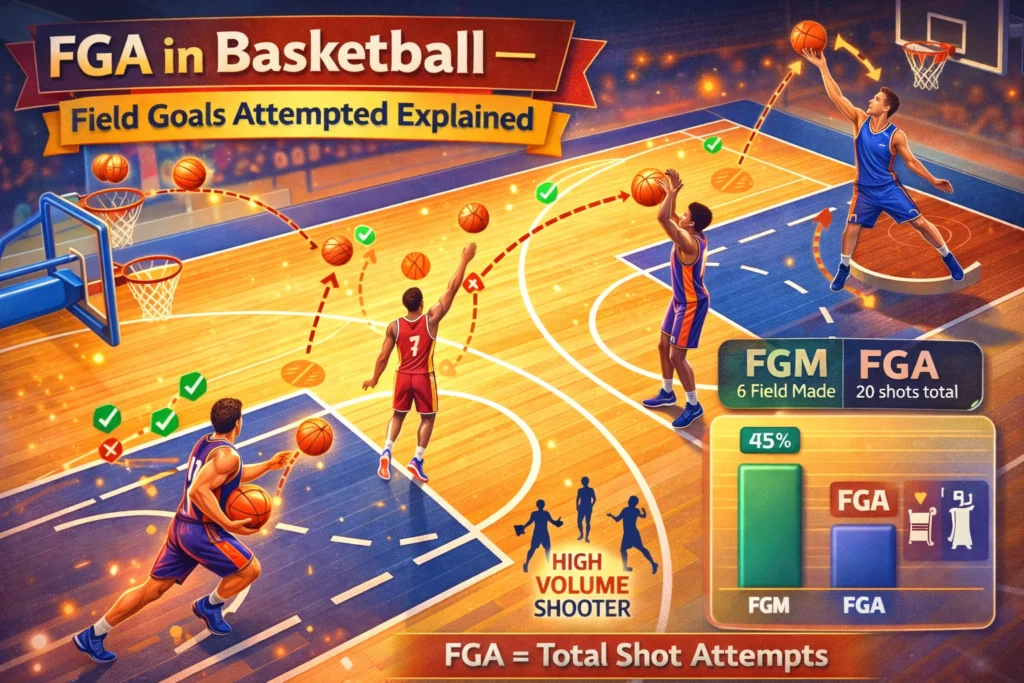
In basketball, FGA stands for Field Goals Attempted. It represents the total number of shots a player or team tries during a game, including both successful and missed attempts, excluding free throws. FGA is a core statistic used to evaluate offensive involvement and scoring opportunities.
Basketball is a numbers game. From points, assists, rebounds to more advanced stats like PER and TS%, understanding these figures helps you appreciate the sport on a whole new level. Among these, FGA is one of the simplest yet most revealing metrics.
Knowing what FGA means can help fans, analysts, and coaches understand who’s taking responsibility on the court, how efficient players are, and how teams strategize their offense.
Origin of FGA
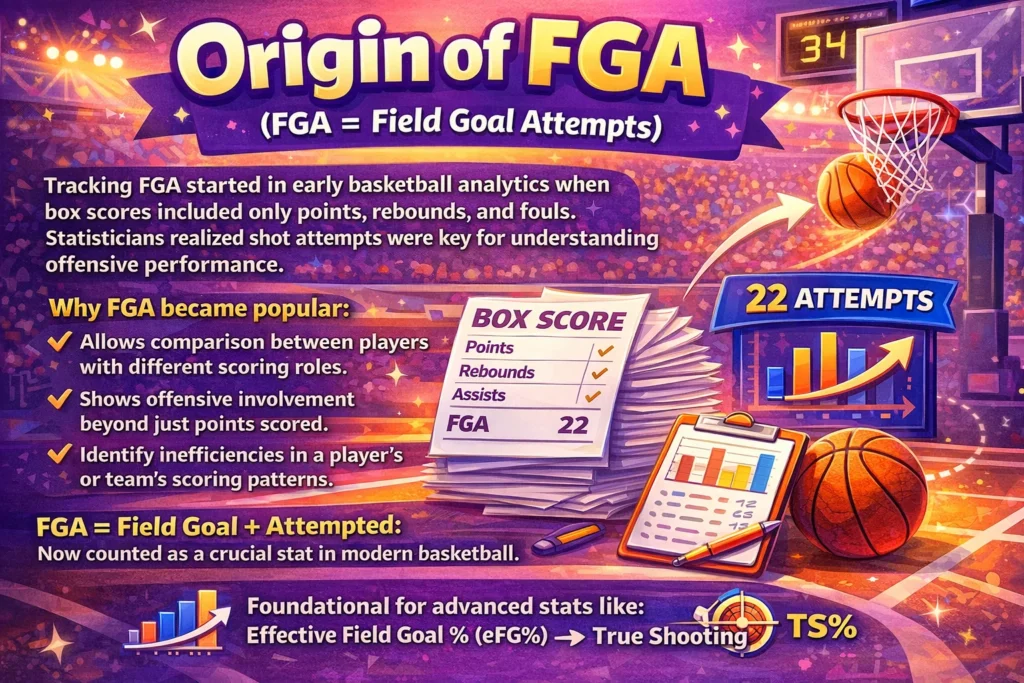
The use of FGA (fga meaning basketball) as a statistic comes from the early days of basketball analytics. While box scores originally recorded only points, rebounds, and fouls, statisticians realized that tracking shot attempts could tell much more about offensive performance.
- Why FGA became popular:
- Allows comparison between players with different scoring roles.
- Shows offensive involvement beyond just points scored.
- Helps identify inefficiencies in a player’s or team’s scoring patterns.
The term combines Field Goal (any basket made during live play, excluding free throws) with Attempted, emphasizing that every shot, successful or missed, is counted.
📊 In modern basketball, FGA is a fundamental building block for advanced metrics like Effective Field Goal Percentage (eFG%) and True Shooting Percentage (TS%), which give a deeper understanding of scoring efficiency.
Understanding FGA in Practice
FGA tells you how often a player or team is taking shots. It’s important for both casual fans and professional analysts.
- Player Perspective:
A player with high FGA is likely the offensive focal point, often tasked with creating scoring opportunities. For example, in the NBA, stars like Kevin Durant or Giannis Antetokounmpo frequently post high FGA numbers because their teams rely on them to generate points. - Team Perspective:
Teams with higher total FGA usually play at a faster pace. A team averaging 100+ FGA per game might be pushing the ball in transition, taking advantage of fast-break opportunities. - Efficiency:
High FGA doesn’t guarantee success. Pairing FGA with FG% or eFG% provides a complete picture.
Example:
A player attempting 25 shots and making 12 has an FG% of 48%, while another taking 18 shots and making 10 has 55%. The second player is more efficient despite fewer attempts.
How FGA Is Calculated
FGA is straightforward: every field goal attempt counts, regardless of whether the shot goes in. Free throws are not included.
Formula:
FGA=Field Goals Made (FGM)+Field Goals Missed
Example:
- Player shoots 7/15 in a game.
- FGM = 7, Missed = 8
- FGA = 15
📌 This clarity makes FGA an accessible stat for beginners and advanced fans alike.
Real-World Examples
Understanding FGA in context is easier when we see it in real-life scenarios:
| Situation | Example | Tone |
|---|---|---|
| Friendly conversation | “Steph Curry had 20 FGA tonight! 🔥 He was unstoppable from deep.” | Positive/Friendly |
| Analytical discussion | “The Lakers averaged 95 FGA per game last season, reflecting a high-tempo offense.” | Neutral/Professional |
| Critical analysis | “He had 18 FGA but only scored 6 points… inefficient shooting tonight.” | Negative/Critical |
📌 Insight: FGA alone doesn’t tell the whole story. Always combine it with points, FG%, and context like game tempo or defensive pressure.
Historical Trends in FGA
Over the decades, FGA trends have shifted as basketball evolved:
- 1980s: Lower FGA on average per team (~80 per game). The game emphasized mid-range shooting and structured offenses.
- 1990s: Slight increase in FGA as pace accelerated. Stars like Michael Jordan averaged 20+ FGA in games.
- 2000s: High-tempo offenses became more common; NBA teams averaged ~85–90 FGA per game.
- Modern Era (2020s): FGA has increased further with 3-point shooting. Teams prioritize volume shooters and pace. The average team now attempts ~100+ FGA per game.
Comparison With Related Basketball Stats
FGA is often confused with other stats. Understanding these distinctions is key.
| Stat | Meaning | How It Differs from FGA |
|---|---|---|
| FGM | Field Goals Made | Counts only successful shots. |
| 3PA | Three-Point Attempts | Only tracks 3-point shot attempts. |
| PTS | Points Scored | Total points include FGA but also free throws and 3-pointers. |
| FTA | Free Throw Attempts | Counts only free throw attempts. |
| eFG% | Effective Field Goal Percentage | Adjusts FG% to account for 3-point shots. |
🔹 Key takeaway: FGA is a raw number of attempts, not efficiency. Always look at FG% or eFG% for performance context.
Advanced Metrics Involving FGA
Modern basketball analytics often use FGA as a foundation for advanced stats:
- Usage Rate (USG%): Percentage of team plays a player is involved in while on court.
- True Shooting Attempts (TSA): Combines FGA with free throws and 3-pointers for scoring attempts.
- Effective Field Goal Percentage (eFG%): Adjusts FG% for 3-pointers, giving a more accurate efficiency metric.
Example:
A player with 20 FGA, 5 3-pointers made, and 10 free throws attempted would have a higher impact than just FGA shows.
NBA Player FGA Comparisons
Let’s look at some top scorers’ FGA in a recent NBA season:
| Player | Games Played | FGA/Game | FG% | Points/Game |
|---|---|---|---|---|
| LeBron James | 55 | 21.5 | 50% | 27 |
| Kevin Durant | 60 | 20.8 | 52% | 28 |
| Stephen Curry | 63 | 22.0 | 48% | 29 |
| Giannis Antetokounmpo | 61 | 23.5 | 55% | 30 |
💡 Insight: Giannis has the highest FGA and FG%—he’s both aggressive and efficient. Curry has a high FGA but slightly lower FG%, reflecting high-volume 3-point shooting.
Practical Tips for Evaluating FGA
- Look Beyond Numbers: High FGA with low FG% can indicate poor shot selection.
- Consider Context: Player roles, defensive pressure, and game pace matter.
- Combine Metrics: Use FGA with FG%, TS%, and usage rate for comprehensive evaluation.
- Historical Comparison: Track changes in FGA trends to understand team strategy evolution.
- Fantasy Basketball: FGA is critical for projecting points in fantasy leagues. High FGA often correlates with higher scoring potential.
Examples of FGA in Game Situations
| Player | Situation | FGA Impact |
|---|---|---|
| Luka Doncic | Late-game isolation | 10 FGA, 5 made, 50% FG – kept team in game |
| Joel Embiid | High post touches | 18 FGA, 12 made, 66% FG – efficient scoring inside |
| Damian Lillard | Fast break | 8 FGA, 3 made, 37.5% FG – high-risk, high-reward attempts |
These examples show how FGA can reflect offensive responsibility, efficiency, and context simultaneously.
Alternate Meanings of FGA
Outside basketball, FGA has a few other interpretations:
- Federal Government Agency – Government context
- Fiber Glass Association – Manufacturing or construction context
- Functional Group Analysis – Chemistry
⚠️ In basketball circles, FGA nearly always means Field Goals Attempted.
Polite or Professional Alternatives
- “Total field goal attempts”
- “Number of shots attempted”
- “Offensive shot volume”
These alternatives sound more formal and are useful in professional analysis or media commentary.
FAQs
1. What does FGA stand for in basketball?
FGA stands for Field Goals Attempted. It tracks the number of shots a player or team attempts during a game, excluding free throws.
2. How is FGA calculated?
FGA is simply the sum of field goals made and missed. Every attempted shot counts.
3. Is FGA the same as FG%?
No. FGA is the raw number of attempts, while FG% measures the percentage of shots made from those attempts.
4. Does FGA include free throws?
No. Free throws are counted separately as Free Throw Attempts (FTA).
5. Can a player have high FGA but low impact?
Yes. A player might take many shots but miss most of them, resulting in low efficiency.
6. Why is FGA important in basketball?
It helps measure offensive involvement, potential scoring opportunities, and team pace.
7. How does FGA relate to team strategy?
Teams with high FGA typically play fast, rely on key scorers, or emphasize volume shooting.
8. Are there professional alternatives to saying FGA?
Yes. You can use “total field goal attempts” or “number of shots attempted” in reports or articles.
Conclusion
FGA basketball meaning is FGA (Field Goals Attempted) is more than just a number. It’s a window into player aggressiveness, team strategy, and offensive flow.
Key takeaways:
- Counts all field goal attempts, excluding free throws.
- High FGA alone doesn’t mean good performance; efficiency matters.
- Combine FGA with FG%, TS%, or eFG% for a full picture.
- Historical trends show FGA increasing with the rise of 3-point shooting and faster-paced games.
💡 Pro Tip: Track FGA alongside other metrics to understand who’s taking responsibility, how efficiently they score, and how the team moves the ball.
Read More Related Articles:
- 12:12 Love Meaning: Signs from the Universe You Can’t Ignore (2026)
- OP Meaning in Gaming – The Term Every Gamer Uses (2026)
- POG Mean in Gaming: From Epic Wins to Gaming Chat Reactions (2026)

Luna Hartley is a content creator at TextSprout.com, where she specializes in explaining word meanings, modern phrases, and everyday language used in texts and online conversations. Her writing focuses on clarity and context, helping readers understand how words are actually used in real communication.