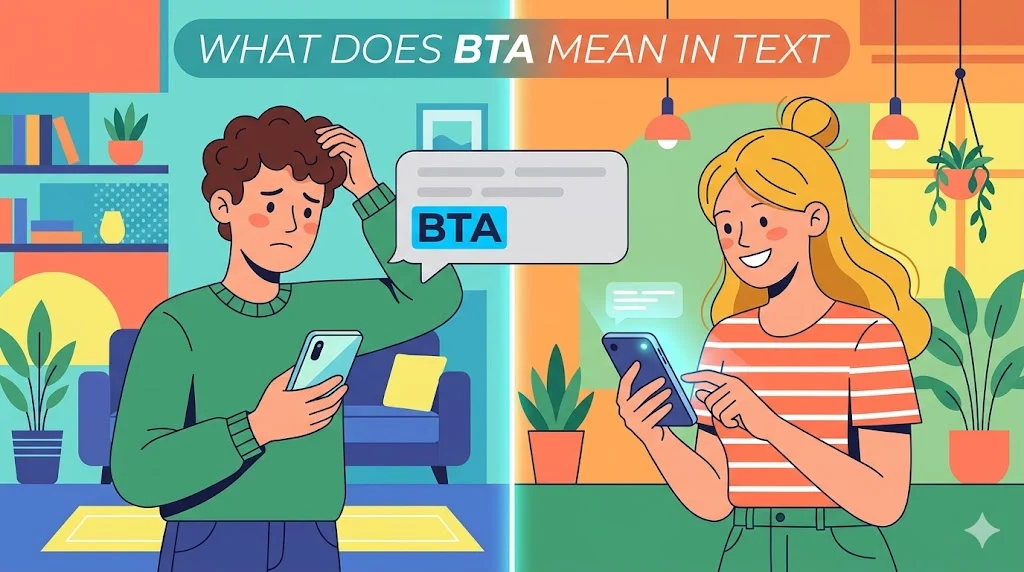
You’re texting someone. Everything’s fine. Then you see it: BTA.
Three little letters. And suddenly you’re staring at your phone like it’s written in ancient Greek.
Does that mean “Better Than Average”? Did they make a typo? Are they mad at you?
Let me save you the Google rabbit hole. BTA meaning in text is almost always “But Then Again.” People use it to add a second thought, express doubt, or balance their own opinion. Think of it as a shortcut for saying, “Well, on the other hand…”
But here’s the catch. Context changes everything. The same three letters on WhatsApp versus a dating app versus a gaming forum? Totally different vibes.
This guide covers every possible bta meaning in text, including how to spot the difference, when to use it yourself, and exactly how to respond when someone sends it to you.
No fluff. No filler. Just real answers.
The Most Common BTA Meaning in Text
Let’s cut straight to it. BTA stands for “But Then Again.”
That’s it. That’s the main bta full form in text that actually matters for daily conversation.
Here’s how it works. You make a statement. Then you follow it with BTA. Then you add a second statement that contradicts or complicates the first one.
Real example: “I think I’ll skip the party tonight. BTA, I might regret missing it.”
See what happened there? The person isn’t sure. They’re weighing two sides of the same coin.
Another example: “This restaurant looks expensive. BTA, we don’t eat out often anyway.”
The speaker acknowledges a potential problem (high prices) but then talks themselves back into the idea (we rarely do this).
What BTA is NOT: It’s not agreement. It’s not disagreement. It’s hesitation in written form. A verbal shrug. A digital “eh, maybe I’m wrong.”
Most people using bta meaning in chat don’t even think about it. It just flows naturally. Like saying “though” at the end of a sentence but faster.
Why Do People Use BTA Instead of Saying “But Then Again”?
Three reasons.
First, speed. Texting rewards shortcuts. Typing “BTA” takes less than a second. Typing “but then again” takes three times longer.
Second, tone. BTA sounds softer than “but.” Compare these two:
- “I like him. But he’s flaky.”
- “I like him. BTA, he’s flaky.”
The first one feels like a contradiction. The second one feels like an observation. BTA lowers the emotional temperature.
Third, habit. Once you start using texting abbreviations, they stick. BTA joins the same mental folder as BTW, IMO, and TBH.
A Quick Table: BTA vs. Full Phrase
| Situation | Full Phrase | BTA Version |
|---|---|---|
| Texting a friend | “I could drive. But then again, traffic is awful.” | “I could drive. BTA, traffic is awful.” |
| WhatsApp group chat | “The movie was good. But then again, the ending dragged.” | “The movie was good. BTA, the ending dragged.” |
| Social media comment | “That’s a hot take. But then again, you make a fair point.” | “That’s a hot take. BTA, you make a fair point.” |
Same meaning. Fewer keystrokes.
When BTA Means Something Else
Okay, honesty time. “But Then Again” covers about 90% of bta meaning in text situations. But those other 10% exist. Let’s hunt them down.
Alternative Meaning 1: Better Than Average
You’ll see this one mostly on dating apps and gaming profiles.
Someone writes “BTA” in their bio. They’re not hesitating. They’re bragging.
Example: “Rank Platinum 3. BTA player. HMU for duos.”
Translation: “I’m better than the typical player. Message me for a two-person team.”
Red flag warning: When someone calls themselves “Better Than Average,” they’re usually average. Truly skilled people let their results speak.
Alternative Meaning 2: Bureau of Transportation Analysis
Ignore this completely unless you work in US government logistics.
Seriously. If someone texts you “BTA,” they’re not discussing federal transportation data. That would be unbelievable.
But for completeness: The Bureau of Transportation Analysis tracks airline performance, freight movement, and infrastructure stats. Zero relevance to casual chat.
Alternative Meaning 3: Typo for BTW
This happens more often than you’d think.
The letters B and T are neighbors on a QWERTY keyboard. A and W are also close. So “BTA” instead of “BTW” is a common fat-finger mistake.
How to spot a typo: Does the sentence make zero sense with “But Then Again”? Try replacing BTA with “By The Way.” If that fits perfectly, someone just has clumsy thumbs.
Typo example: “BTA I’m grabbing coffee later. Want one?”
That’s not hesitation. That’s an offer. “By The Way” works. “But Then Again” doesn’t. So it’s a typo.
Alternative Meaning 4: Before the Attack (Gaming Slang)
In certain MMOs and strategy games, “BTA” means “Before the Attack.” Teams use it to coordinate timing.
Example: “Heal up BTA. Then go in on my mark.”
This is niche. Unless you’re raiding in World of Warcraft or coordinating in Counter-Strike, you’ll never see it.
Quick Reference: Which BTA Meaning Is It?
| Context | Most Likely Meaning | Confidence Level |
|---|---|---|
| Casual text from friend | But Then Again | 95% |
| Dating app bio | Better Than Average | 70% |
| Gaming chat | Before the Attack or But Then Again | 50/50 |
| Work email | Bureau of Transportation Analysis | 1% |
| Sentence makes no sense | Typo for BTW | 80% |
BTA Meaning from a Girl vs. from a Guy
Let’s address this because people search it constantly.
Does bta meaning from a girl differ from bta meaning from a guy?
Short answer: No. The abbreviation itself doesn’t change based on who types it.
Long answer: The tone might shift. But that’s true for every word ever spoken.
When a Girl Uses BTA
Usually signals polite hesitation. Girls often use softer language in text to avoid sounding aggressive or dismissive.
Example from a girl: “He seems sweet. BTA, he canceled on me twice.”
She’s not attacking the guy. She’s presenting both sides. The BTA does the heavy lifting of showing uncertainty.
Another example: “I want to go. BTA, I’m pretty tired.”
Same structure. Honest feeling followed by a conflicting honest feeling.
When a Guy Uses BTA
Men tend to use BTA more logically. Less emotional hedging. More practical second thoughts.
Example from a guy: “The plan works. BTA, we’ll hit rush hour traffic.”
He’s not unsure about the people involved. He’s unsure about logistics.
Another example: “I could buy it now. BTA, next week might have a sale.”
Practical. Calculated. Still hesitant, but hesitant about facts not feelings.
The Real Takeaway
Don’t overanalyze bta meaning texting based on someone’s gender. Look at what comes before and after the BTA. That’s where the real meaning lives.
A girl using BTA to show emotional doubt. A guy using BTA to show practical doubt. Same word. Slightly different flavors. But you’ll know the difference from context.
What you should NOT do: Assume romantic interest. BTA isn’t flirting. It’s not a secret code for “I like you.” It’s just a person thinking out loud.
BTA Meaning on Different Platforms
Not all text is created equal. The platform changes the rules.
BTA Meaning in WhatsApp
WhatsApp is personal. Private chats. Group messages with friends. Family threads.
BTA meaning in WhatsApp is almost always “But Then Again.” People use it constantly in back-and-forth conversation.
WhatsApp example: “We could order pizza. BTA, we had that yesterday.”
Why it works on WhatsApp: WhatsApp messages feel like speech. Short. Casual. Unpolished. BTA fits perfectly.
BTA Meaning in Social Media
Social media is public. Twitter. Reddit. Instagram comments. Facebook groups.
Here, BTA serves a different purpose. It lets you add a counterpoint without starting a fight.
Twitter example: “This take is wild. BTA, I see where you’re coming from.”
Translation: “I disagree but I’m not going to argue with you.”
Reddit example: “OP makes a solid point. BTA, the data doesn’t fully support it.”
BTA softens criticism. On a platform where everyone screams at each other, it’s a quiet way to disagree respectfully.
BTA Meaning in Texting (Standard SMS)
Good old-fashioned text messages. iMessage. Android Messages. The blue bubble / green bubble world.
Same as WhatsApp. Personal and casual. “But Then Again” rules here too.
SMS example: “Running late. BTA, you haven’t left yet either.”
Playful. Accusatory but not mean. BTA makes the jab feel like a joke.
Where You Should NEVER Use BTA
Some places are BTA-free zones.
Work emails. Don’t. Just don’t. Your boss doesn’t want to decode slang.
Client messages. Looks unprofessional. Type the full phrase.
Academic discussions. No professor wants to see “BTA” in a discussion post.
First messages on dating apps. You have one chance to make an impression. Don’t blow it with lazy abbreviations.
Formal complaints. Customer service? Official letter? Spell it out.
Platform Rules (Simple List)
- WhatsApp: ✅ Yes, freely
- iMessage / SMS: ✅ Yes, with friends
- Twitter / Reddit: ✅ Yes, for polite disagreement
- Instagram comments: ✅ Yes, but rarely needed
- Work email: ❌ Never
- Dating app first message: ❌ Avoid
- Academic writing: ❌ Absolutely not
BTA vs. Other Texting Abbreviations
You know BTA now. But how does it stack up against the other slang crowding your phone?
The Full Comparison Table
| Abbreviation | Meaning | When to Use It | Emotional Tone |
|---|---|---|---|
| BTA | But Then Again | Showing doubt or second thoughts | Neutral, hesitant |
| BTW | By The Way | Adding side information | Neutral, casual |
| TBH | To Be Honest | Giving raw opinion | Honest, sometimes blunt |
| IMO | In My Opinion | Softening a statement | Polite, respectful |
| IMHO | In My Humble Opinion | Extra politeness | Very soft, humble |
| FWIW | For What It’s Worth | Dismissing your own input | Self-deprecating |
| IDK | I Don’t Know | Expressing uncertainty | Genuinely unsure |
| NGL | Not Gonna Lie | Admitting something slightly embarrassing | Vulnerable, honest |
Side-by-Side Examples
See how each abbreviation changes the same basic sentence.
Original sentence: “I think that movie was too long.”
- With BTA: “That movie was too long. BTA, the ending needed that setup.”
- With TBH: “TBH, that movie was way too long.”
- With IMO: “IMO, the movie dragged in the middle.”
- With FWIW: “FWIW, I thought the movie was too long.”
- With NGL: “NGL, I almost fell asleep during that movie.”
Same topic. Different flavors. BTA is the only one that directly acknowledges an opposing viewpoint.
Why BTA Is Unique
Most abbreviations add information. BTW adds a side note. TBH adds honesty. IMO adds politeness.
BTA does something different. It contradicts the speaker’s own previous point.
Think about that. When you say “BTA,” you’re arguing with yourself. That’s rare in text shorthand. Most abbreviations help you say something more. BTA helps you say something different.
That’s also why bta meaning slang confuses people. No other common abbreviation does what BTA does.
Real Conversation Examples (BTA in Action)
Let’s see BTA living its best life in actual text conversations.
Example 1: Making Plans
Friend 1: “Dinner at 7?”
Friend 2: “Sure. BTA, I might be 10 minutes late.”
Friend 1: “All good. I’ll grab a table.”
BTA here shows a small uncertainty without canceling the plan.
Example 2: Giving Advice
Person A: “Should I text him back?”
Person B: “I’d wait. BTA, you know your situation better than I do.”
BTA softens the advice. Person B isn’t demanding obedience. They’re offering guidance while admitting limits.
Example 3: Debating
Person 1: “That new policy is terrible.”
Person 2: “It has problems. BTA, it fixes the old loopholes.”
Person 1: “Fair point. I didn’t think about that.”
BTA keeps the debate civil. Person 2 disagrees without attacking.
Example 4: Self-Talk (Yes, People Text Themselves)
Note to self: “Apply for that job. BTA, update your resume first.”
Priorities in text form. The person knows what needs to happen but acknowledges the order matters.
Example 5: Romantic Context (What People Actually Worry About)
Crush: “You’re fun to talk to.”
You: “Thanks. BTA, I’m better in person.”
Flirty. Confident but humble. BTA shows self-awareness without self-criticism.
How to Respond When Someone Texts You BTA
You received a message with BTA. Now what?
The right response depends on what the person actually means.
Scenario 1: They’re Genuinely Unsure
Their text: “I’ll come to the party. BTA, I have an early meeting tomorrow.”
What they need: Permission to change their mind later.
Good responses:
- “No pressure. Just show up if you can.”
- “Totally get it. Play it by ear.”
- “Meeting sounds rough. Want to meet for coffee instead?”
Bad response: “So are you coming or not?” (This adds pressure. Don’t do this.)
Scenario 2: They’re Being Playful
Their text: “Best cook ever. BTA, I burn water sometimes.”
What they need: Acknowledge the joke. Keep it light.
Good responses:
- “Haha humble brag much?”
- “So which is it? Genius or disaster?”
- “Water boiling is advanced. Respect.”
Bad response: No response. Letting the joke hang kills the fun.
Scenario 3: You Have No Idea What BTA Means
Their text: “I like the idea. BTA, let’s check the budget first.”
What you do: Just ask. Seriously. It’s fine.
Good responses:
- “Wait, what does BTA mean? I’m old.”
- “Had to Google that one. But Then Again, right?”
- “Took me a second. Got it now.”
Bad response: Pretending you understand. Then responding wrong. Then looking confused forever.
Scenario 4: They Used BTA Incorrectly
Their text: “BTA I’m hungry. Let’s eat.”
Problem: That doesn’t work. “But Then Again I’m hungry” makes no sense. This is either a typo or misuse.
Your move: Clarify gently.
Good response: “Did you mean BTW? Or is BTA something different now?”
Better response: Ignore it. Understand the intent (they’re hungry). Respond to that.
Common Mistakes People Make with BTA
Even frequent texters mess this up. Here’s what to avoid.
Mistake 1: Using BTA in Formal Writing
Wrong: “We should extend the deadline. BTA, the client might push back.” (In an email to your boss)
Right: “We should extend the deadline. However, the client might push back.”
Why it matters: Formal settings expect full words. Abbreviations look lazy. BTA in a work email says “I didn’t try.”
Mistake 2: Assuming Everyone Knows BTA
They don’t.
BTA isn’t as universal as LOL or BTW. Millennials use it more than Gen Z. Gen Z uses it rarely. Boomers almost never.
Better approach: Use BTA only with people you text regularly. Test it once. If they respond normally, keep it. If they ask “what does BTA mean?” drop it.
Mistake 3: Overusing BTA
Once per conversation. Twice at most. Three times looks like a speech impediment.
Bad example: “I like coffee. BTA, tea is good too, BTA, I drink both and BTA, mornings are hard.”
Stop. Please stop.
Good example: “Coffee first. Tea in the afternoon. BTA, I’ll drink anything with caffeine.”
One BTA. Perfect.
Mistake 4: Confusing BTA with BTW
This happens constantly. Here’s the test.
Replace BTA with “But Then Again.” Does the sentence still make sense?
- “But Then Again I’m going to the store” → No. Wrong.
- “But Then Again, maybe I’ll go to the store” → Yes. Correct.
If the first version is what you meant, you wanted BTW.
Mistake 5: Using BTA When You Actually Agree
BTA expresses doubt. If you fully agree with someone, don’t use BTA. You’ll sound wishy-washy.
Wrong: “You’re right. BTA, you’re totally right.”
Right: “You’re right. No question.”
Save BTA for when you actually have a second thought.
The History of BTA: How This Slang Started
No one knows exactly who typed BTA first. But we can trace the pattern.
Texting abbreviations exploded in the 1990s with SMS character limits. Early classics include LOL (laughing out loud), BRB (be right back), and TTYL (talk to you later).
BTA came later. Early 2000s internet forums. Message boards. AOL Instant Messenger.
The first documented uses of bta abbreviation meaning “But Then Again” appear on tech forums around 2003. People used it to debate product specs. “This phone has good battery life. BTA, the screen is small.”
From forums, BTA spread to email. Then to SMS. Then to WhatsApp and social media.
Today, BTA sits in the second tier of texting abbreviations. Not as famous as LOL. Not as trendy as IJBOL. But respected. Useful. Still kicking.
Why BTA survived: It fills a real gap. No other abbreviation expresses internal contradiction as cleanly. That’s rare staying power for slang.
BTA Meaning in Other Languages: Urdu, Hindi, Spanish
English speakers aren’t the only ones texting. Here’s how BTA translates conceptually.
BTA Meaning in Urdu
Direct translation doesn’t exist. But the closest Urdu phrase is:
“لیکن پھر بھی” (lekin phir bhi)
Pronunciation: leh-kin feer bee
Meaning: “But even then” or “but still”
Example in Urdu: “میں فلم دیکھنا چاہتا ہوں۔ لیکن پھر بھی، مجھے کام کرنا ہے۔”
Translation: “I want to watch the movie. BTA, I have to work.”
Same hesitation. Same second thought. Different script.
BTA Meaning in Hindi
Similar to Urdu. Closest phrase:
“लेकिन फिर भी” (lekin phir bhi)
Same meaning. Same usage.
Example in Hindi: “यह रेस्तरां अच्छा है। लेकिन फिर भी, कीमतें बहुत ज़्यादा हैं।”
Translation: “This restaurant is good. BTA, the prices are very high.”
BTA Meaning in Spanish
Spanish doesn’t have a direct abbreviation either. But the phrase is:
“Pero entonces otra vez”
Too long for texting. Most Spanish speakers just type the full phrase or use “pero bueno” (but well) as a similar hesitation marker.
Key takeaway: BTA is an English-language abbreviation. Other languages have the concept but not the shortcut.
When NOT to Use BTA
Just because you can use BTA doesn’t mean you should.
Situation 1: Serious Conversations
Bad: “I’m really sorry I hurt you. BTA, you also said some mean things.”
Problem: BTA minimizes your apology. It sounds like an excuse.
Better: “I’m really sorry. I was wrong. Can we talk about what happened?”
Save BTA for low-stakes chats. Not fights, not apologies and not breakups.
Situation 2: Giving Bad News
Bad: “You didn’t get the job. BTA, another position might open up.”
Problem: BTA sounds dismissive. Like you don’t care about their disappointment.
Better: “You didn’t get the job this time. I know that’s frustrating. Would you like me to share feedback from the interview?”
Direct. Kind. No abbreviations needed.
Situation 3: First Impressions
Bad: “BTA, I’m usually shy. But you seem cool.”
Problem: You introduced yourself with an abbreviation. The other person is still processing your name.
Better: “I’m usually shy. But you seem cool.”
Full sentence. Human connection. No decoding required.
Situation 4: Any Message Longer Than Three Sentences
If you’re writing a paragraph, don’t use BTA. The abbreviation works for quick exchanges. For longer messages, type “but then again.” It reads better.
How BTA Fits Into Modern Internet Slang
Slang changes fast. Here’s where BTA stands right now.
Current Status: Active but Niche
- Usage rate: Moderate. You’ll see BTA weekly if you text frequently.
- Trend direction: Stable. Not growing. Not dying.
- Primary age group: 25-40 years old.
- Gen Z adoption: Low. Gen Z prefers “but also” or just stating both sides without a marker.
Comparison to Other Slang (Popularity Ranking)
| Slang | Popularity (1-10) | Trend |
|---|---|---|
| LOL | 9 | Flat |
| BTW | 8 | Flat |
| TBH | 7 | Flat |
| IMO | 6 | Slight decline |
| BTA | 4 | Stable |
| IJBOL | 3 | Rising (Gen Z) |
| SMH | 5 | Slow decline |
BTA isn’t winning any popularity contests. But it’s not disappearing either. It occupies a small, stable space in the slang ecosystem.
Will BTA Die Out?
Probably not completely. Here’s why.
Slang dies when something better replaces it. Nothing replaces BTA’s specific function.
You can say “but also” instead. That’s close. But “but also” adds a point. BTA questions a point. Different jobs.
You can just use two sentences. “I want to go. But I’m tired.” That works fine. BTA just makes it faster.
So BTA will stick around for people who want speed and precision. Everyone else will ignore it. And that’s fine.
FAQs
What does BTA mean in texting from a guy?
BTA from a guy means “But Then Again” just like from anyone else. Guys often use it for practical second thoughts. Example: “I can drive. BTA, my gas light is on.” Don’t read romance into it. It’s just hesitation.
What does BTA mean on Snapchat?
Same meaning as everywhere else. “But Then Again.” Snapchat’s disappearing messages make BTA even more useful. You don’t need perfect grammar when the message vanishes in 24 hours. Use it freely in Snapchat chats.
Is BTA rude or polite?
BTA is neutral. Neither rude nor polite. The tone comes from what you say around it. “You’re wrong. BTA, I’m no expert” sounds humble. “You’re wrong. BTA, whatever” sounds dismissive. Watch your surrounding words, not the abbreviation itself.
Can I use BTA in a work Slack channel?
Depends on your workplace culture. Tech startups? Probably fine. Law firm? Absolutely not. When in doubt, don’t. Type “but then again” instead. You lose nothing and avoid looking unprofessional.
What’s the difference between BTA and TBH?
TBH means “To Be Honest.” It introduces a direct opinion. BTA means “But Then Again.” It introduces a contradictory opinion. Use TBH when you have one strong feeling. Use BTA when you have two conflicting feelings.
Does BTA mean anything in business?
In rare cases, BTA means “Business Transfer Agreement” or “Bureau of Transportation Analysis.” But if someone texts you “BTA” at work, they’re using slang 99% of the time. Business acronyms appear in documents and emails, not casual messages.
Conclusion:
You made it through the full guide. Now you know more about bta meaning in text than 99% of people who actually use the abbreviation.
Here’s what to remember.
The core truth: BTA means “But Then Again.” Always start there.
The exception: Sometimes it’s a typo for BTW. Sometimes it’s “Better Than Average” on dating apps. Rarely, it’s gaming slang. But mostly? But Then Again.
The practical advice: Use BTA with friends who text often. Avoid it at work. Never use it in formal writing. Don’t overthink when someone sends it to you. Just nod mentally and keep the conversation going.
The big picture: Slang comes and goes. BTA has lasted 20+ years because it solves a real problem. We all have second thoughts. We all argue with ourselves. Now we have a four-character shortcut for that universal human experience.
Next time you see BTA in a message, you won’t freeze. You’ll smile. You’ll understand. And maybe you’ll even use it yourself.
BTA, you might already be using it by tomorrow.
Read More Related Articles:
- Transitioning Mean in Hospice: A Gentle Guide for Families In 2026
- “Más” Means in Spanish: Why This One Word Changes Everything In 2026
- PF Meaning in Basketball: More Than Just a Position In 2026

Luna Hartley is a content creator at TextSprout.com, where she specializes in explaining word meanings, modern phrases, and everyday language used in texts and online conversations. Her writing focuses on clarity and context, helping readers understand how words are actually used in real communication.