
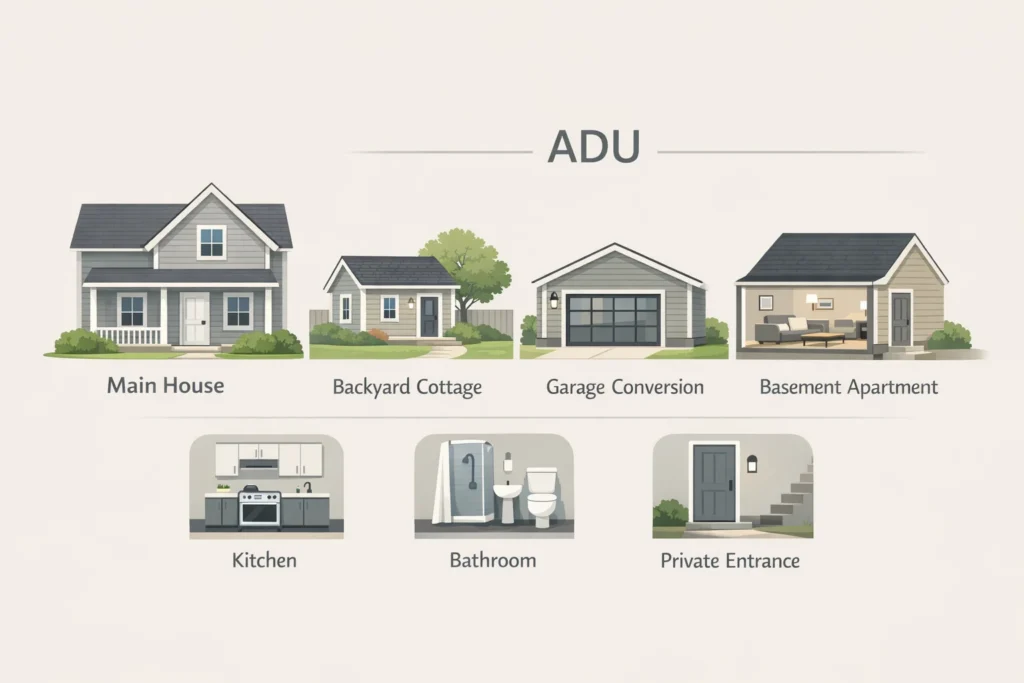
ADU stands for “Accessory Dwelling Unit.” It refers to a secondary housing unit built on the same property as a main home. It has its own living space, which usually includes a kitchen, bathroom, and sleeping area.
In simple terms, an ADU is like a smaller, independent home located on the same lot as a primary house.
If you’ve been looking into real estate, watching home renovation videos, or even just scrolling through property listings, you may have come across the term ADU. At first glance, it might feel like just another confusing piece of housing jargon. But once you understand it, you realize it’s actually a pretty practical and increasingly popular concept.
An ADU is not some complicated technical structure. In fact, it’s something many people already recognize, just by a different name. Whether it’s a small guest house in the backyard, a converted garage, or a basement apartment, ADUs are quietly reshaping how people think about living spaces.
Let’s walk through what ADU really means, how it works, and why it has become such a big deal in modern housing.
What an ADU Actually Looks Like in Real Life
Instead of thinking about it as a technical term, it helps to picture real examples.
An ADU can take many forms:
- A small house built in the backyard
- A garage that has been turned into a living space
- A basement converted into a separate apartment
- A unit above a garage
- A detached tiny home on the same property
What makes something an ADU is not how it looks, but how it functions. It has to be a self-contained living space, meaning someone could live there independently from the main house.
So if it has its own entrance, kitchen, bathroom, and sleeping area, it likely qualifies as an ADU.
Why ADUs Are Becoming So Popular
Over the past few years, ADUs have gone from being a niche idea to something people actively plan for. There are a few very real reasons behind that shift.
First, housing has become more expensive in many places. People are looking for ways to make better use of the space they already own. Adding an ADU is one way to do that.
Second, families are changing. More people are living with extended family members, whether it’s aging parents, adult children, or relatives who need a place to stay. An ADU creates a balance between closeness and privacy.
Third, homeowners are realizing that an ADU can generate income. Renting out a small unit on your property can help cover mortgage payments or provide extra financial stability.
It’s not just about space anymore. It’s about flexibility.
The Different Types of ADUs
Not all ADUs are built the same way. There are a few common types, each with its own feel and purpose.
Detached ADU
This is a completely separate structure from the main house. It might sit in the backyard and look like a small standalone home.
People often choose this option when they want maximum privacy between the main home and the ADU.
Attached ADU
This type is connected to the main house but still functions as a separate living space. It might share a wall but have its own entrance and facilities.
It feels like an extension of the home, but with independence built in.
Garage Conversion
This is one of the most common and cost-effective options. An existing garage is transformed into a living space.
Instead of building something new, you’re reusing what’s already there.
Basement or Interior ADU
Sometimes, part of the existing house is converted into a separate unit. A basement apartment is a classic example.
This type is often the easiest to create because the structure already exists.
ADU vs Guest House vs Tiny Home
People often mix up ADUs with similar housing concepts, so it helps to clear that up.
A guest house might look like an ADU, but it doesn’t always have full living facilities. It might not include a kitchen or be intended for long-term living.
A tiny home is more about size and lifestyle. It can exist anywhere, not necessarily on the same property as another home.
An ADU, on the other hand, is defined by its relationship to a primary residence. It must be on the same property and function as a complete, independent living unit.
What Makes an ADU Legal
This is where things get a little more practical. Just because you can build something doesn’t always mean it qualifies as a legal ADU.
For a unit to be recognized as an ADU, it usually needs to meet certain requirements:
- It must be on the same lot as the main house
- It must have its own entrance
- It must include a kitchen and bathroom
- It must comply with local building codes
- It must meet size and zoning regulations
These rules can vary depending on where you live. Some areas encourage ADUs, while others have stricter guidelines.
The Benefits of Having an ADU
Once you understand what an ADU is, the appeal becomes pretty clear.
Extra Income
One of the biggest advantages is the ability to rent it out. Even a small unit can bring in consistent monthly income.
Family Flexibility
An ADU can be perfect for:
- Aging parents who want to live close but independently
- Adult children who are saving money
- Guests who need a longer stay
Increased Property Value
Homes with ADUs are often more attractive to buyers because they offer more options.
Privacy With Connection
You get the best of both worlds. People can live close to each other without sharing the same space.
The Challenges to Keep in Mind
Of course, ADUs are not perfect for everyone. There are a few challenges to consider.
Cost
Building an ADU can be expensive, especially if you’re starting from scratch.
Permits and Regulations
Navigating local rules can take time and effort.
Space Limitations
Not every property has enough room for an ADU.
Privacy Concerns
Even though ADUs offer independence, sharing a property still requires boundaries.
How Much Does It Cost to Build an ADU
Costs can vary widely depending on the type of ADU and location.
A simple garage conversion might be relatively affordable, while a fully detached unit can cost significantly more.
Factors that affect cost include:
- Size of the unit
- Construction materials
- Labor costs
- Utility connections
- Permits and fees
For many homeowners, the long-term benefits can outweigh the upfront investment, especially if the unit is rented out.
ADUs as Rental Opportunities
One of the main reasons people build ADUs today is to create rental income.
You can rent an ADU in different ways:
- Long-term rental to a tenant
- Short-term rental for travelers
- Temporary housing for students or workers
This flexibility allows homeowners to adapt based on their needs and local market conditions.
The Lifestyle Side of ADUs
Beyond money and property value, ADUs also reflect a shift in how people think about living.
Instead of large single-family homes being the only option, people are exploring smaller, smarter spaces.
ADUs encourage:
- Minimalist living
- Efficient use of land
- Multi-generational households
- Sustainable housing solutions
They’re not just practical. They represent a different way of thinking about home.
Tips for Planning an ADU
If you’re considering an ADU, here are a few things to keep in mind.
Start with your purpose
Do you want rental income, family space, or both
Check local rules early
Understanding regulations can save time later
Think about privacy
Consider layout, entrances, and distance from the main house
Plan utilities carefully
Water, electricity, and plumbing need to be properly set up
Focus on comfort
Even a small space should feel like a real home
FAQs
What does ADU mean in housing?
It stands for Accessory Dwelling Unit, which is a secondary housing unit on the same property as a main home.
Is an ADU the same as a tiny house?
Not exactly. A tiny house can be anywhere, while an ADU must be on the same property as another home.
Can you rent out an ADU?
Yes, many people use ADUs as rental units, depending on local laws.
Do ADUs increase property value?
In many cases, yes, because they add usable living space and flexibility.
Is it expensive to build an ADU?
Costs vary, but it can be a significant investment depending on size and type.
Can family members live in an ADU?
Yes, they are often used for relatives who want independence while staying close.
Do ADUs need permits?
Yes, most areas require permits and compliance with building regulations.
Are ADUs a good investment?
They can be, especially if used for rental income or long-term property value.
Conclusion
So, what does ADU mean in housing? At its simplest, it’s a second, smaller home on the same property as your main house. But in reality, it’s much more than that.
An ADU represents flexibility, opportunity, and a smarter way to use space. It can bring families closer while still respecting independence. It can create income while increasing property value. And it can turn an ordinary property into something much more dynamic.
As housing needs continue to evolve, ADUs are becoming a practical solution for modern living. Whether you’re thinking about building one, renting one, or just trying to understand the term, you now have a clear picture of what it means and why it matters.
Read More Related Articles:
- MVC Mean in Medical Terms: Causes and Prevention In 2026
- Penia Mean in Medical Terms: Definition, Causes & Examples In 2026
- Decile Mean in Class Rank: Explanation & Academic Insights In 2026

Ivy Madison is a content creator at TextSprout.com, specializing in word definitions, internet slang, acronyms, and text abbreviations. She delivers clear and engaging explanations, helping readers quickly understand modern digital language and trending terms.