
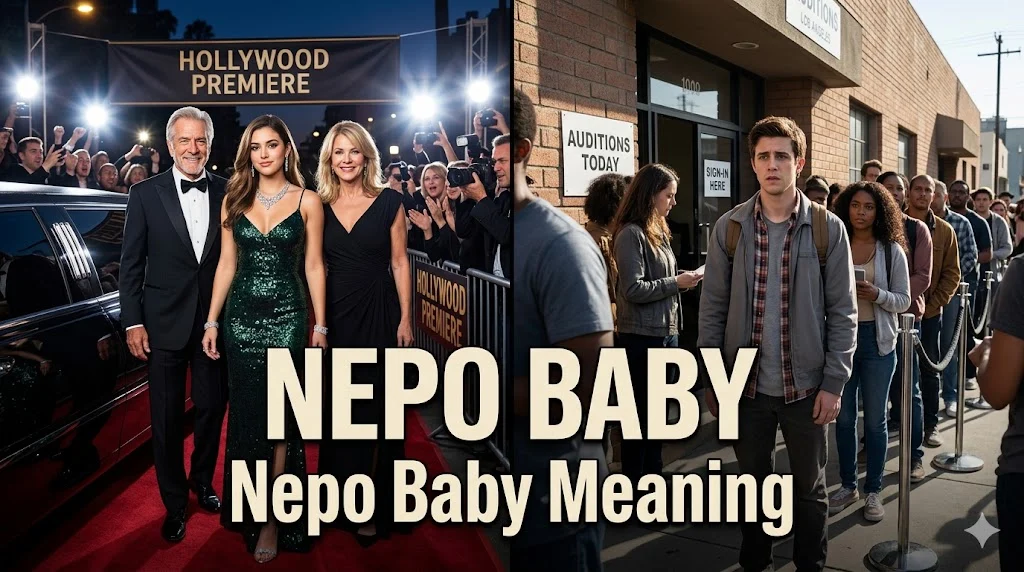
You’ve seen it everywhere. On TikTok. In celebrity gossip headlines. Scattered across Twitter threads and Instagram comment sections. Someone gets cast in a major film and instantly the replies fill up with the same two words: nepo baby. Learn Nepo Baby Meaning here.
But what does it actually mean? Where did it come from? And why does it spark such fierce debate every single time it comes up?
This guide covers all of it. The definition, the origin, the real mechanics behind how nepotism works in Hollywood, the famous names people can’t stop citing, and the bigger cultural question sitting underneath all of it. By the end, you’ll know exactly what a nepo baby is and why the conversation matters far beyond celebrity gossip.
Nepo Baby Meaning: What Does the Term Actually Mean?
Let’s start with the basics.
A nepo baby is a person, most commonly in the entertainment industry, who has benefited professionally from having a famous, powerful, or well-connected parent or relative. The term is a portmanteau of two words: nepotism and baby.
Break it down and it makes perfect sense.
Nepo comes from nepotism, which is the practice of giving career advantages, job opportunities, or preferential treatment to family members regardless of their qualifications or merit. The word nepotism itself has roots in the Italian nipote, meaning nephew, and traces back to the Catholic Church where popes and bishops would appoint their nephews to positions of power.
Baby is the metaphorical half of the phrase. It refers to the offspring of someone powerful. Not a literal infant but the child, the product, the next generation of someone who already has influence.
Put them together and you get a blunt, catchy label for something people have observed for decades but never had a clean way to say out loud.
“Nepo baby” doesn’t just describe having famous parents. It specifically implies that those connections created career opportunities that likely wouldn’t have existed otherwise.
That distinction matters. Plenty of children of celebrities go on to do remarkable things in completely unrelated fields. A nepo baby, in the cultural sense, is someone whose professional career — particularly in entertainment, media, or public life — appears to have been accelerated or enabled by family connections rather than a level playing field.
Nepo Baby vs. Similar Terms
The slang landscape around this topic can get a little tangled. Here’s how nepo baby compares to related terms you might encounter:
| Term | Meaning | Tone |
|---|---|---|
| Nepo baby | Child of a famous or powerful person who benefits professionally from those connections | Critical or neutral depending on context |
| Star kid | Child of a celebrity, most commonly used in Bollywood culture | Neutral, descriptive |
| Legacy hire | The corporate world’s version of the same concept, a hire made based on family ties | Formal, often critical |
| Industry plant | An artist allegedly manufactured or heavily backed by labels or studios rather than discovered organically | Accusatory, conspiracy-adjacent |
| Silver spoon | Anyone born into wealth or privilege, not necessarily industry-specific | General, slightly old-fashioned |
The nepo baby term carries a specific cultural charge that the others don’t quite capture. It’s pointed. It’s modern. And it lands hardest in the entertainment industry because that world sells itself on the idea that talent alone determines who makes it.
The Origin of the Nepo Baby Term: How a Piece of Slang Went Mainstream
The phrase didn’t emerge from a sociology textbook or an academic paper on labor inequality. It was born on the internet, shaped by frustration, and detonated into mainstream culture by a single piece of journalism.
The Social Media Roots
Nepo baby as a phrase started circulating on Twitter and Reddit years before most people heard it. Film and pop culture communities had long used variations of the concept to discuss celebrities who seemed to leapfrog the usual career ladder. The frustration wasn’t new. The label was.
Social media gave people a shorthand. Instead of writing a paragraph about how a particular actor’s debut seemed suspiciously well-positioned for someone with zero prior credits, users could just say nepo baby and everyone understood exactly what they meant.
The phrase spread slowly at first, mostly in entertainment forums, stan communities, and celebrity gossip circles. Then December 2022 happened.
The Vulture Moment That Changed Everything
In December 2022, New York Magazine’s entertainment vertical Vulture published a sprawling, heavily researched piece mapping the family trees of Hollywood’s most prominent young stars. The article visualized just how many recognizable names in film and television had at least one famous parent, grandparent, or powerful industry relative.
The piece went viral almost immediately. It wasn’t just the information, though the information was striking. It was the visual impact. Seeing the connections laid out like a family tree made something that people had vaguely sensed feel suddenly undeniable.
Within days, “nepo baby” was trending globally. Celebrities responded. Fans debated. Opinion pieces multiplied. The conversation jumped from entertainment media to mainstream news outlets, think pieces, and late-night television segments.
What the Vulture article did so effectively was give the cultural frustration a focus. The term already existed but now it had a face, or rather, dozens of faces, and a visual framework that made the argument concrete.
Why That Moment Resonated So Deeply
Timing matters with cultural flashpoints. The nepo baby debate exploded in late 2022 for reasons that go beyond one article.
The post-pandemic moment had sharpened public awareness of inequality across every sector of society. People were watching housing costs surge, wages stagnate, and job markets tighten while simultaneously watching the children of billionaires and A-listers land magazine covers and film roles seemingly without breaking a sweat.
Gen Z, the generation most active on the platforms where this debate raged hardest, had grown up watching aspirational content and been sold on the idea that success was about hustle, authenticity, and talent. The nepo baby conversation challenged that narrative directly.
It named the thing that the meritocracy myth had been hiding.
Is Nepo Baby an Insult? The Answer Is More Complicated Than You Think
This is where people disagree most sharply.
Some argue that calling someone a nepo baby is a straightforward observation, neutral and factual, like noting someone went to an Ivy League school on a legacy admission. Others use it as a direct challenge to a person’s legitimacy and talent. And the targets of the label? They’ve had some very different reactions.
The Case for Neutral Descriptor
If your parent is a famous actor and you become a famous actor, that’s a verifiable fact. Calling you a nepo baby, in this reading, simply acknowledges a structural reality about how you entered the industry.
- It doesn’t mean you’re talentless.
- It doesn’t mean your work has no value.
- It just means you had a significant advantage that most aspiring actors don’t have.
Framed this way, the term is less an insult and more a piece of social analysis. It asks us to think about access, opportunity, and the systems that determine who gets to try.
The Case for Critical Label
On the other side, many people use nepo baby specifically to question someone’s merit. The implication being: would this person have a career at all without their family connections? That’s a much sharper question. And it cuts at something most performers care about deeply, which is whether their success is genuinely earned.
When the term gets used this way, it’s not really about nepotism as a system. It’s about the individual person and whether they deserve their platform.
How Celebrities Have Responded
Several high-profile figures have addressed the label directly, with varying degrees of grace.
Lily-Rose Depp, daughter of Johnny Depp and Vanessa Paradis, pushed back firmly in a 2023 interview, arguing that her success required real work and that people wouldn’t keep hiring someone just because of their last name.
Jamie Lee Curtis, daughter of Tony Curtis and Janet Leigh, took a more reflective approach, acknowledging her privilege while also defending her career as something she built.
Gwyneth Paltrow, daughter of producer Bruce Paltrow and actress Blythe Danner, has spoken openly about the advantages she received while also noting that the entertainment industry is far more brutal than outsiders assume.
Dakota Johnson, daughter of Melanie Griffith and Don Johnson, offered perhaps the most self-aware take, essentially acknowledging the head start while pointing out that maintaining a career still requires skill.
The honest answer to whether nepo baby is an insult is this: it depends entirely on how you use it and what you mean by it. As a structural observation, it’s fair. As a wholesale dismissal of someone’s talent, it oversimplifies a complicated reality.
Famous Nepo Babies: The Names That Dominate the Conversation
No discussion of the nepo baby meaning is complete without looking at the actual people the term gets applied to most often. Here are some of the most widely cited examples, along with the relevant context.
Hollywood’s Most Talked-About Nepo Babies
| Name | Parents / Family Background | Career Highlights | Notes on “Nepo Baby” Context |
|---|---|---|---|
| Zoë Kravitz | Lenny Kravitz (rock musician), Lisa Bonet (actress), stepdaughter of Jason Momoa | Big Little Lies, The Batman (Catwoman), multiple major films | Widely regarded as talented; strong industry access from birth |
| Maya Hawke | Uma Thurman & Ethan Hawke (acclaimed actors) | Stranger Things, various film roles | Industry network and access shaped early opportunities |
| Lily-Rose Depp | Johnny Depp & Vanessa Paradis | Film roles with major directors, luxury fashion campaigns | One of the most discussed “nepo baby” figures |
| Jack Quaid | Meg Ryan & Dennis Quaid | The Boys (Amazon Prime) | Often cited as a successful, well-received example |
| Maude Apatow | Judd Apatow (director) & Leslie Mann (actress) | Euphoria, early roles in family films | Career path closely tied to family productions |
| Jaden Smith | Will Smith & Jada Pinkett Smith | The Pursuit of Happyness, music career | Early breakthrough via father’s film role |
| Brooklyn Beckham | David Beckham & Victoria Beckham | Photography, cooking, brand partnerships | Fame and opportunities tied to Beckham brand |
| Anais Gallagher | Noel Gallagher (Oasis guitarist) | Modeling, presenting | Media attention linked to Gallagher legacy |
| Kate Hudson | Goldie Hawn & Kurt Russell | Almost Famous, major 2000s film star | Early industry access via mother’s connections |
A Broader View: Nepo Babies Across Generations
| Name | Famous Parent(s) | Industry | Notable Work |
|---|---|---|---|
| Zoë Kravitz | Lenny Kravitz, Lisa Bonet | Film/TV | The Batman, Big Little Lies |
| Maya Hawke | Uma Thurman, Ethan Hawke | Film/TV | Stranger Things |
| Lily-Rose Depp | Johnny Depp, Vanessa Paradis | Film/Fashion | Idol, Chanel campaigns |
| Jack Quaid | Meg Ryan, Dennis Quaid | Film/TV | The Boys |
| Maude Apatow | Judd Apatow, Leslie Mann | TV | Euphoria |
| Jaden Smith | Will Smith, Jada Pinkett Smith | Film/Music | The Pursuit of Happyness |
| Kate Hudson | Goldie Hawn, Kurt Russell | Film | Almost Famous |
| Brooklyn Beckham | David & Victoria Beckham | Photography/Media | Brand partnerships |
How Nepotism Actually Works in Hollywood: The Real Pipeline
Here’s where most coverage of the nepo baby topic gets shallow. People talk about famous parents as if the advantage is a single phone call. It’s much more structural than that.
Access Is the Foundation
The most powerful advantage a nepo baby has isn’t a specific favor. It’s access.
Growing up in an industry household means being surrounded by agents, managers, casting directors, producers, and directors from childhood.
- You meet these people at dinner parties.
- You visit film sets.
- You understand how auditions work, how deals get made, and what the industry actually looks like from the inside.
Most aspiring actors spend years just trying to understand the landscape that nepo babies navigate instinctively by their teenage years.
The Financial Safety Net Changes Everything
This one doesn’t get nearly enough attention in the nepo baby debate.
Building an acting career typically involves years of unpaid or very low-paid work. Short films. Student productions. Off-off-Broadway theater. Fringe festival appearances. Most talented, driven people who pursue entertainment careers have to hold second jobs, take on debt, and make enormous financial sacrifices during those early years.
A nepo baby, in almost every case, doesn’t face that constraint.
- They can take the unpaid role in the interesting indie film.
- They can spend three months doing a workshop production.
- They can say no to the commercial that would pay rent but damage their artistic credibility.
That financial freedom is an enormous structural advantage that has nothing to do with talent and everything to do with family wealth.
Osmosis: The Invisible Advantage
There’s a less discussed form of advantage that researchers who study inequality in creative industries call cultural capital by osmosis. Growing up in an industry household, you absorb things unconsciously.
- You develop taste.
- You learn what good performances look like by watching them up close.
- You pick up industry vocabulary, unwritten rules, and professional norms that other aspiring performers spend years learning through painful experience.
You also develop confidence. Not arrogance necessarily but the kind of baseline self-assurance that comes from growing up in spaces where people who look like you and share your family name are treated as important.
Media Visibility Before Earning It
Many nepo babies have public profiles before they’ve done a single professional project. Paparazzi photos. Red carpet appearances as children. Social media followings inherited from their parents’ fanbases.
This creates a feedback loop. Media visibility leads to brand interest. Brand interest leads to fashion partnerships and campaign work. Campaign work creates cultural credibility. Cultural credibility opens casting doors.
The career machine can start running before the nepo baby has done anything to merit it.
The Audition Room Isn’t Equal
Casting directors are human beings with professional relationships. When a well-connected agent submits a client whose parent is a trusted industry figure, that submission carries implicit weight. It doesn’t mean the audition is rigged. But it does mean the tape gets watched, the callback gets made, and the name gets remembered.
For someone with no connections submitting a cold reel through a general casting call, the path to the same room is exponentially harder.
Can a Nepo Baby Actually Earn Their Spot? The Honest Answer
This is the most important question the nepo baby debate raises and also the most frequently dodged.
The honest answer is yes, with a significant caveat.
Getting into a room because of your parents is one thing. Delivering once you’re in it is another. The entertainment industry is unforgiving about sustained mediocrity. Films are expensive. Television pilots are expensive. No production company will keep hiring someone who doesn’t perform just because their parent is famous. The stakes are too high.
So talent does eventually play a role. But the caveat is critical: most people with equivalent talent never get the chance to prove it.
The nepo baby isn’t necessarily less talented than the person who didn’t make it. They may well be equally talented, more talented, or yes, sometimes less talented. The point isn’t about individual ability. It’s about the fact that the system creates dramatically unequal starting lines.
Soft Nepotism: The Most Common Form
Most nepo baby cases aren’t as simple as a famous parent making a direct phone call to get their child cast. The more common mechanism is what sociologists call soft nepotism: the accumulation of indirect advantages that add up to a tilted playing field.
This includes:
- Industry knowledge absorbed from childhood
- Social access to gatekeepers
- Financial cushioning during the early career years
- Media attention before any professional output
- Name recognition that gives a first project a built-in audience
None of these individually looks like nepotism in the classic sense. Together they create a structural advantage that’s real, measurable, and very difficult to overcome for those on the outside.
Second-Generation Success Stories
Some nepo babies have built careers so strong that the nepotism conversation has largely faded into the background. Their work speaks loudly enough.
Angelina Jolie, daughter of Jon Voight, won an Academy Award and became one of the highest-grossing action stars in film history. Nicolas Cage, also from the Coppola family, built a wildly eclectic body of work that includes Leaving Las Vegas, for which he won the Oscar, and decades of genre films that have made him a cult figure.
These cases don’t disprove the structural argument. They show that some nepo babies go on to genuinely transcend their starting point. But they don’t erase the fact that the starting point was still different from everyone else’s.
Nepo Babies Beyond Hollywood: This Problem Is Everywhere
Hollywood takes the heat because it’s the most visible industry and because it loudly markets itself as a place where dreams and talent triumph. But nepotism operates across virtually every high-status professional field.
Politics: The Original Nepo Industry
Political dynasties have shaped democracies for centuries.
The Kennedy family. The Bushes. The Clintons. The Gandhis in India. The Bhuttos in Pakistan. Political nepotism predates the word nepotism itself, which as noted earlier, actually originated from the practice of powerful Catholic figures appointing family members to influential positions.
Modern political nepo babies don’t usually get as much social media heat as their Hollywood counterparts, possibly because political dynasties have been normalized for so long that people have stopped seeing them as unusual.
Business: Inherited Boardrooms
Family businesses make up a significant portion of the global economy. According to the Family Business Institute, family businesses account for roughly 64% of GDP in the United States and employ 62% of the workforce.
In many cases, leadership passes from parent to child not through a merit-based selection process but through inheritance of ownership. The nepo baby dynamic in business is arguably more consequential than in entertainment because the decisions these leaders make affect far more people.
Media and Journalism
Legacy hires in major media organizations follow the same pattern. Children of prominent journalists, editors, and media executives often find doors open in ways that talented outsiders don’t experience.
The media industry, like entertainment, is one that styles itself as meritocratic while operating systems that quietly favor those with the right connections and family backgrounds.
The Music Industry
The music industry has its own version of the nepo baby phenomenon. Children of successful musicians often benefit from:
- Direct introductions to label executives
- Access to studios and professional equipment from a young age
- Exposure to the business side of the industry
- A built-in fanbase through their parent’s following
Miley Cyrus is one of the most frequently cited music industry examples, having gotten her Disney Channel break in part through her father Billy Ray Cyrus’s industry connections, though she has since built an enormous independent career.
Why does Hollywood get the most criticism? Because it sells the dream most aggressively. The entire mythology of Hollywood is built on the idea of discovery, of a kid from nowhere getting spotted and becoming a star. The nepo baby conversation exposes how selective and structurally supported that discovery process actually is.
The Cultural and Sociological Context: Why This Debate Matters Now
The nepo baby conversation isn’t happening in a vacuum. It reflects broader anxieties about inequality, meritocracy, and how power reproduces itself across generations.
Gen Z and the Meritocracy Myth
Gen Z grew up with social media. They watched peers build audiences on YouTube and TikTok from nothing. They were sold heavily on the idea that hustle, authenticity, and talent were the keys to success. Platforms like Instagram and TikTok created an apparent leveling effect. Anyone could go viral. Anyone could build a following.
The nepo baby debate hit this generation particularly hard because it revealed that even in the digital age, the old structural advantages still operate powerfully. Family connections don’t just matter in old-money industries. They matter in casting rooms, in brand deals, in who gets the first big platform to showcase their talent.
Gen Z didn’t invent skepticism about inherited advantage. But they gave it a new vocabulary and a new urgency.
The Relatability Economy and Its Contradictions
Social media built what cultural critics now call the relatability economy: the idea that celebrities succeed by seeming like regular people, by being authentic, by sharing their real lives and struggles.
Nepo babies participate in this economy. They post casual selfies, talk about their anxieties, share their creative processes. They perform relatability. But the nepo baby label punctures that performance by pointing out that the underlying circumstances are fundamentally different from those of the people watching.
When an actor talks about how hard the journey was and the audience knows their parent is a legendary filmmaker who funded their first short film and made their first introduction to a major agent, the relatability narrative collapses.
Inequality Made Visible
Post-pandemic, economic inequality became impossible to ignore. Housing. Healthcare. Student debt. Wage stagnation. The gulf between people with inherited wealth and connections and those without it had never felt more concrete.
The nepo baby conversation entered this environment and gave people a specific, human-scale example of how structural advantage works. It’s easier to feel the injustice of a famous person’s child getting a film role than to fully grasp macroeconomic inequality statistics.
The nepo baby debate is, at its core, a conversation about who gets access to opportunity and why.
The Data Behind the Debate: What Research Actually Shows
The frustration driving the nepo baby conversation isn’t just vibes. Research on social mobility, career inequality, and the entertainment industry backs up the structural argument.
Social Mobility in Creative Industries Is Declining
Studies on the UK and US entertainment industries have consistently found that people from working-class backgrounds are significantly underrepresented in creative professions compared to their share of the general population.
The Sutton Trust, a UK-based social mobility organization, has found that actors, directors, and musicians in the UK are dramatically more likely to have attended private schools than the general population, indicating that financial privilege is strongly correlated with breaking into creative fields.
The Unpaid Work Problem
A 2019 study by the Creative Industries Policy and Evidence Centre found that unpaid internships and low-paid early career work are endemic in creative industries. Only those with independent financial support can sustain these career-building phases. This structurally filters out candidates from working-class and middle-class backgrounds regardless of their talent.
This is the financial reality that underpins the nepo baby advantage. It’s not just about connections. It’s about who can afford to play the long game.
Name Recognition Has Measurable Commercial Value
Marketing research consistently shows that brand recognition and pre-existing audience familiarity reduce risk in entertainment projects. A new film starring a recognizable name, even an untested one with a famous parent, is demonstrably easier to finance and market than one starring an unknown with no prior media presence.
This is why studios and production companies are more likely to take a chance on a nepo baby for a debut project. The famous name carries commercial insurance. This isn’t a conspiracy. It’s just rational risk management within an industry where the financial stakes are enormous.
Nepotism in the Digital Age: Does Social Media Level the Playing Field?
One of the most interesting questions the nepo baby debate raises is whether the internet changes anything.
The argument goes like this: social media has democratized discovery. Someone in a small town with no connections can post a video, go viral, and land a management deal. TikTok has produced genuine success stories of people who came from nothing and built massive platforms through talent and consistency alone.
Does this mean the nepo baby advantage is shrinking?
Not really. And here’s why.
Viral fame and industry insertion are different things. Going viral on TikTok can create an audience. But converting that audience into a sustainable entertainment career still requires industry infrastructure: agents, lawyers, managers, publicists, casting relationships, and production access. Nepo babies often enter at the level where that infrastructure already exists in their family network.
The digital space has created new entry points. But the traditional entertainment industry still operates heavily on relationships, and those relationships still reproduce themselves through family and social connections.
Additionally, even in the digital creator economy, advantages compound. A nepo baby who also pursues social media arrives with a built-in audience from their parent’s fanbase, access to professional photographers and videographers, and the ability to collaborate with other high-profile figures from day one.
The playing field is more complex now. It isn’t level.
What the Nepo Baby Debate Gets Wrong and Right
Every cultural conversation has its blindspots. The nepo baby debate is no different.
What It Gets Right
The conversation correctly identifies that access and opportunity in entertainment are not equally distributed. Family connections create real, measurable advantages that compound over time. The structural argument is sound.
It also correctly challenges the meritocracy myth that the entertainment industry has long used to justify its outcomes. Talent alone does not determine who succeeds. Who you know, what resources you have, and what doors open for you before you’ve proven anything all play enormous roles.
What It Gets Wrong
The debate sometimes collapses into individual judgments about specific people’s talent, which is both unfair and beside the point. Whether Lily-Rose Depp is a good actress is a separate question from whether she had structural advantages most aspiring actresses don’t have. Both things can be true simultaneously.
There’s also a tendency in the nepo baby conversation to treat entertainment industry success as a zero-sum game: the nepo baby got the role, therefore a more deserving person didn’t. Reality is more complicated. Many factors determine casting beyond the famous-parent variable.
And the conversation sometimes focuses so heavily on individual celebrities that it loses sight of the systemic issue. The problem isn’t any specific nepo baby. The problem is a system that reproduces privilege across generations while claiming to be open and meritocratic.
FAQs
What is the nepo baby meaning in simple terms?
A nepo baby is someone, usually in entertainment or another high-profile industry, whose career has been significantly helped by having a famous or powerful parent or family member. The word nepo is short for nepotism, and baby refers to the offspring of someone influential.
Where did the nepo baby term come from?
The term originated on social media, particularly Twitter and Reddit, and exploded into mainstream culture in December 2022 following a widely shared Vulture article that mapped Hollywood’s celebrity family trees and visualized just how many prominent young stars had famous parents.
Can nepo babies be genuinely talented?
Absolutely. Having famous parents doesn’t guarantee talent, but it doesn’t prevent it either. Many nepo babies have gone on to build genuinely impressive careers on the strength of their work. The issue isn’t individual talent. It’s that equally talented people without the right connections often never get the chance to show what they can do.
Is nepotism in Hollywood illegal?
No. In private industries like entertainment, nepotism is a social and ethical issue rather than a legal one. There are no laws in most countries that prevent entertainment companies from hiring or casting the children of powerful figures.
Why did the nepo baby conversation explode when it did?
Several factors converged in late 2022: the viral Vulture article, post-pandemic awareness of economic inequality, Gen Z’s skepticism of inherited advantage, and social media’s ability to turn a cultural observation into a global trending topic almost overnight.
Conclusion:
Here’s the thing about the nepo baby debate that often gets lost in the noise of celebrity gossip. It isn’t really about hating famous people’s kids. Most reasonable people understand that you don’t choose your parents and that being born into a privileged family isn’t a moral failing.
The conversation matters because it names a structural reality that affects far more people than just Hollywood actors.
- Every time a film set prioritizes the director’s nephew over an equally skilled candidate from outside the network, that’s the nepo baby dynamic.
- Every time a brand chooses a celebrity’s child for a campaign because the name is recognizable rather than because the person is the best creative fit, that’s it.
- Every time an industry insider’s kid gets the audition that never happened for someone equally talented who grew up without the right connections, that’s it.
The term gives us language for something that was happening long before TikTok, long before Hollywood, long before social media gave everyone a platform to notice it and say something about it.
What changes when we name it clearly?
Naming it doesn’t fix the system automatically. But it creates accountability. It makes producers, casting directors, brand managers, and industry gatekeepers more aware of when they’re choosing the safe, connected option over the genuinely meritocratic one. It encourages audiences to think critically about the media they consume and the narratives they’re sold.
Read More Related Articles:
- What Does GG Mean in Text? Discover the Hidden Meaning (2026)
- KK Mean in Texting: Why It Can Sound Passive-Aggressive (2026)
- What Does the Liver Do | Complete Guide to Liver Functions In 2026

Ivy Madison is a content creator at TextSprout.com, specializing in word definitions, internet slang, acronyms, and text abbreviations. She delivers clear and engaging explanations, helping readers quickly understand modern digital language and trending terms.