
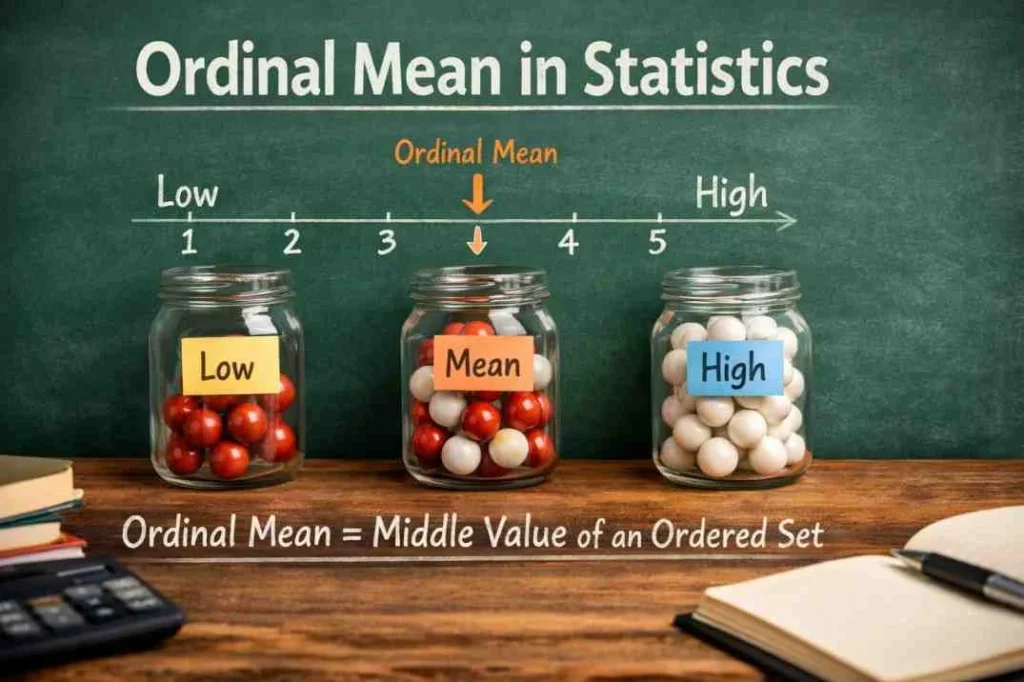
In statistics, ordinal refers to a type of data that represents categories with a clear order or ranking, but where the exact differences between those categories are not measured or consistent.
Understanding statistics can sometimes feel overwhelming, especially when you come across terms like “ordinal.” It sounds technical, maybe even intimidating at first. Yet once you break it down, the concept is actually quite simple and extremely useful in everyday data analysis. Whether you are a student, a researcher, or just someone trying to understand data better, knowing what ordinal means in statistics can make a big difference.
In simpler terms, ordinal data tells you the position of something in a sequence, like first, second, or third, without explaining how much difference exists between each position.
Understanding Ordinal Data in Simple Terms
Imagine you are asked to rate your satisfaction with a service. You might choose from options like:
- Very satisfied
- Satisfied
- Neutral
- Unsatisfied
- Very unsatisfied
These categories clearly follow a logical order from best to worst. However, the difference between “very satisfied” and “satisfied” is not something you can measure precisely. This is what makes the data ordinal.
Ordinal data focuses on order rather than exact value. It answers questions like who is higher or lower, better or worse, earlier or later. It does not tell you by how much.
Key Characteristics of Ordinal Data
Ordinal data has a few defining features that make it different from other types of data in statistics. Understanding these will help you quickly recognize it in real life.
- Ordered categories
The values follow a meaningful sequence or ranking. - No fixed intervals
The gaps between categories are not equal or measurable. - Qualitative nature
Ordinal data often describes qualities or opinions rather than numbers. - Limited mathematical use
You can rank and compare values, but you cannot perform precise calculations like addition or subtraction.
These characteristics make ordinal data ideal for surveys, rankings, and preference-based information.
Examples of Ordinal Data in Everyday Life
Ordinal data is everywhere once you start noticing it. It appears in education, business, healthcare, and even daily conversations.
Common Real World Examples
- Class rankings such as first place, second place, third place
- Customer satisfaction levels
- Education levels such as high school, bachelor’s, master’s, PhD
- Pain levels described as mild, moderate, severe
- Movie ratings like one star to five stars
Each example shows a clear order but lacks precise numerical differences between categories.
Example Table of Ordinal Data
| Scenario | Ordinal Categories | Explanation |
|---|---|---|
| Customer Feedback | Poor, Fair, Good, Excellent | Ordered from lowest to highest satisfaction |
| Education Level | High School, Bachelor’s, Master’s, PhD | Shows progression in academic achievement |
| Race Results | 1st, 2nd, 3rd | Ranking without indicating time differences |
| Pain Scale | Mild, Moderate, Severe | Indicates intensity but not exact measurement |
This table highlights how ordinal data organizes information in a meaningful sequence without relying on exact numbers.
Ordinal vs Other Types of Data
To fully understand ordinal data, it helps to compare it with other common types of data used in statistics.
Main Types of Data in Statistics
- Nominal
- Ordinal
- Interval
- Ratio
Each type serves a different purpose and has unique characteristics.
Comparison Table
| Data Type | Description | Example | Key Difference |
|---|---|---|---|
| Nominal | Categories with no order | Colors, gender | No ranking involved |
| Ordinal | Categories with order | Rankings, satisfaction levels | Order exists but no equal gaps |
| Interval | Numeric data with equal intervals | Temperature in Celsius | No true zero point |
| Ratio | Numeric data with equal intervals and true zero | Height, weight | Allows full mathematical operations |
This comparison makes it clear that ordinal data sits between nominal and numerical data. It has structure, but not precision.
Why Ordinal Data Matters
Ordinal data plays a crucial role in many fields because it captures human experiences and preferences in a structured way.
Key Uses
- Surveys and questionnaires
Businesses rely on ordinal scales to measure customer satisfaction and feedback. - Education systems
Grades and rankings often follow an ordinal structure. - Healthcare assessments
Pain levels and symptom severity are commonly recorded as ordinal data. - Market research
Understanding consumer preferences often involves ranking products or services.
Ordinal data allows organizations to make decisions based on patterns and trends, even when exact measurements are not available.
How Ordinal Data Is Analyzed
Even though ordinal data does not allow full mathematical operations, it can still be analyzed in meaningful ways.
Common Methods
- Median
The middle value in an ordered dataset - Mode
The most frequently occurring category - Ranking comparisons
Comparing positions such as higher or lower - Non parametric tests
Statistical tests designed for ordinal data
What You Cannot Do
- Calculate precise averages in the traditional sense
- Assume equal differences between categories
- Use advanced calculations that require exact numerical values
Understanding these limitations helps prevent incorrect conclusions.
Example of Ordinal Data Analysis
Imagine a survey where people rate a restaurant:
| Rating | Number of Responses |
|---|---|
| Excellent | 20 |
| Good | 35 |
| Average | 25 |
| Poor | 10 |
| Very Poor | 5 |
From this data, you can determine:
- The most common rating is “Good”
- The general trend leans toward positive feedback
- The median rating falls around “Good” or “Average”
However, you cannot say exactly how much better “Excellent” is compared to “Good.”
Ordinal Scales Explained
An ordinal scale is the system used to collect ordinal data. It provides a set of categories arranged in a meaningful order.
Common Ordinal Scales
- Likert scale
Strongly agree to strongly disagree - Ranking scale
First to last position - Rating scale
Poor to excellent
These scales are widely used because they are easy to understand and simple to analyze.
Tone and Context in Ordinal Data
Interestingly, ordinal data often reflects human emotions and perceptions. The tone behind responses can vary depending on context.
Friendly or Positive Tone
“Excellent service” or “Very satisfied 😊”
Neutral Tone
“Average experience” or “Neutral”
Negative or Critical Tone
“Poor service” or “Very dissatisfied 😕”
Even though these are categories, they carry emotional meaning that helps researchers understand user experiences more deeply.
Ordinal Data in Research and Surveys
Ordinal data is one of the most commonly used data types in research because it balances simplicity and usefulness.
Why Researchers Prefer It
- Easy for participants to understand
- Quick to collect large amounts of data
- Useful for identifying trends and patterns
- Flexible for different industries
However, researchers must be careful not to treat ordinal data as precise numerical data.
Advantages of Ordinal Data
Ordinal data offers several benefits that make it valuable in statistics:
- Simple and intuitive
- Captures subjective experiences
- Useful for ranking and comparison
- Works well in surveys and feedback systems
Limitations of Ordinal Data
Despite its usefulness, ordinal data has some limitations:
- No precise measurement of differences
- Limited statistical analysis options
- Potential for subjective interpretation
- Cannot support complex calculations
Understanding both strengths and weaknesses ensures accurate data interpretation.
Ordinal Data vs Ranking Systems
While ordinal data often involves ranking, not all rankings are purely ordinal in practice.
For example, in a race, positions like first and second are ordinal. However, if you also record the time taken, you move into numerical data.
This distinction is important when analyzing results.
Alternate Meanings of Ordinal
While ordinal is primarily used in statistics, it can also appear in other contexts:
- In mathematics, ordinal numbers describe position such as first, second, third
- In everyday language, it refers to order or sequence
In all cases, the core idea remains the same. It is about placement within a sequence.
Practical Tips for Using Ordinal Data
If you are working with ordinal data, these tips can help you use it effectively:
- Always respect the order of categories
- Avoid treating it as precise numerical data
- Use median and mode instead of mean
- Be careful when interpreting differences between categories
- Combine with qualitative insights for deeper understanding
These practices will improve the accuracy of your analysis.
FAQs
What does ordinal mean in statistics?
Ordinal refers to data that can be ordered or ranked, but where the exact differences between values are not measurable.
What is an example of ordinal data?
Customer satisfaction ratings like poor, good, and excellent are common examples.
How is ordinal data different from nominal data?
Ordinal data has a clear order, while nominal data does not.
Can you calculate averages with ordinal data?
Not accurately, because the intervals between categories are not equal.
What is an ordinal scale?
It is a scale that ranks data in a meaningful order, such as strongly agree to strongly disagree.
Where is ordinal data used?
It is widely used in surveys, education, healthcare, and market research.
Is ranking data always ordinal?
Yes, as long as it only shows order without exact numerical differences.
Why is ordinal data important?
It helps capture opinions, preferences, and rankings in a structured way.
Conclusion
Ordinal data is a fundamental concept in statistics that helps us organize and understand information based on order rather than exact measurement. It plays a key role in surveys, research, and everyday decision making.
By recognizing its characteristics, strengths, and limitations, you can use ordinal data effectively without misinterpreting results. Whether you are analyzing customer feedback, ranking performance, or studying human behavior, ordinal data provides valuable insights that numbers alone cannot fully capture.
In the end, ordinal data reminds us that not everything needs to be measured precisely to be meaningful. Sometimes, simply knowing what comes before or after is enough to tell a powerful story.
Read More Related Articles:
- What Does Sanction Mean in Court: Courtroom Guide In 2026
- What Does Playa Mean in Spanish: Beach or Player In 2026
- Suka Meaning in Russian: From Slang to Viral Internet Term In 2026

Luna Hartley is a content creator at TextSprout.com, where she specializes in explaining word meanings, modern phrases, and everyday language used in texts and online conversations. Her writing focuses on clarity and context, helping readers understand how words are actually used in real communication.