
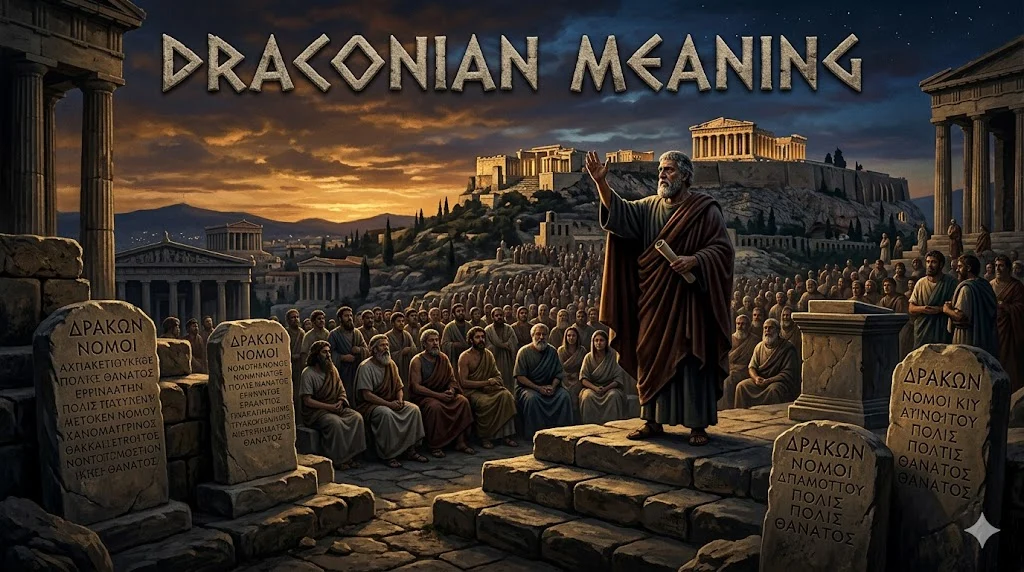
Have you ever heard someone call a new government policy “draconian” and wondered what that actually means? Or maybe you’ve used the word yourself without knowing the full story behind it. Here’s the thing draconian isn’t just a fancy synonym for “strict.” It carries centuries of history, one man’s brutal legal legacy, and a moral weight that most words simply don’t have. See here Draconian Meaning in detail.
This guide breaks it all down. You’ll get the full definition, the origin story, real-world examples across history and modern life, translations into Urdu and Hindi, and everything you need to use the word correctly and confidently. Let’s get into it.
What Does Draconian Mean? The Core Definition
At its most basic, draconian is an adjective. It describes laws, rules, punishments, or measures that are excessively harsh, severe, or disproportionately cruel relative to what the situation actually calls for.
Think of it this way. If a school gives a student detention for chewing gum, that’s strict. But if that same school expels a student permanently for the same offense, strips them of all academic records, and bans them from every school in the district that’s draconian. The punishment has no reasonable relationship to the offense. It’s wildly out of proportion.
Here’s a clean, simple definition:
Draconian (adjective): Describing a law, rule, policy, or measure so excessively severe or harsh that it appears cruel, unjust, or disproportionate to its stated purpose.
The word almost always appears before a noun or after a linking verb. You’ll see it written as:
- Draconian law
- Draconian measures
- Draconian punishment
- Draconian rules
- Draconian policy
- “The sentence was draconian.”
- “Critics called the legislation draconian.”
It’s never used as a noun or a verb. You wouldn’t say “he draconianed the employees” or “that was a real draconian.” It only ever works as an adjective, and that precision is part of what gives it its force.
Draconian Meaning in Simple Words
If someone asks you to explain draconian without using complicated terms, here’s the short version: it means a rule or law so harsh it’s almost cruel. Not just tough. Not just firm. But so far over the line that most reasonable people would find it unjust or excessive.
That’s the core of it. Everything else the history, the examples, the nuances builds on that foundation.
Draconian vs. Strict vs. Harsh: What’s the Real Difference?
People often use “strict,” “harsh,” and “draconian” interchangeably. They shouldn’t. Each word sits at a different point on the spectrum of severity and carries a different emotional weight.
Here’s a table that lays it out clearly:
| Word | Intensity Level | Emotional Connotation | Typical Context |
|---|---|---|---|
| Strict | Moderate | Neutral or firm | Parenting, school rules, workplace policies |
| Firm | Low to moderate | Neutral, professional | Leadership, negotiation |
| Harsh | High | Negative | Punishments, criticisms, weather |
| Severe | High | Clinical or formal | Medical conditions, legal sentencing |
| Rigid | High | Cold, inflexible | Bureaucracy, rules without exceptions |
| Draconian | Extreme | Historically charged, morally negative | Laws, government policies, legal systems |
| Tyrannical | Extreme | Deeply oppressive, political | Authoritarian regimes, abusive power |
| Oppressive | Extreme | Systemic injustice | Social structures, marginalized groups |
The key distinction is proportionality. Strict rules can be fair. Harsh penalties can sometimes be justified. But draconian measures, by definition, go beyond what’s reasonable. They’re punishments or rules that reasonable people look at and say: “That’s too far.”
That’s also what makes the word so powerful in political debate. When someone calls a policy “draconian,” they’re not just saying it’s tough. They’re making a moral claim that whoever created it has crossed a line.
The Origin of Draconian: Meet the Man Behind the Word
This is where it gets genuinely fascinating. Draconian isn’t a metaphor invented by a poet or a philosopher. It comes directly from a real historical figure whose name and work were so extreme that his identity fused permanently with the concept of excessive legal punishment.
Who Was Draco of Athens?
Draco was an Athenian statesman and lawmaker who lived in the 7th century BCE, around 650 to 600 BCE. He served as the chief magistrate of Athens around 621 BCE, during a period of significant social unrest. Before his laws, Athens had no unified written legal code. Disputes were settled through blood feuds, personal vengeance, and the arbitrary decisions of aristocratic judges. The system was chaotic, inconsistent, and deeply unjust, especially for the people with low-income.
Draco stepped in to fix this. His mission was genuinely noble: create Athens’ first written legal code and replace private vengeance with public justice. On paper, that’s an admirable goal. In practice, the code he created was so brutal it became infamous across the ancient world.
What Did Draco’s Laws Actually Say?
The short version: almost everything was punishable by death.
Theft? Death. Idleness (being unemployed without a good reason)? Death. Stealing vegetables or fruit? Death. Disobeying a magistrate? Death. Most minor civil offenses that modern societies would handle with fines or community service carried capital punishment under Draco’s code.
The 4th-century BCE orator Demades famously observed that Draco wrote his laws not in ink but in blood. That line has echoed through history for over 2,000 years because it captures perfectly what was wrong with the code.
When asked to justify the death penalty for so many minor crimes, Draco reportedly replied that small offenses deserved it, and he couldn’t think of anything harsher for greater crimes. That’s the logic of draconian law in its purest form: maximum punishment, minimum nuance.
One area where Draco’s code was actually progressive for its time: he distinguished between intentional and unintentional homicide. That distinction recognizing that intent matters in determining guilt was legally sophisticated and ahead of its era. But it stood as a lonely island of reason in an ocean of extreme penalties.
Solon, the great Athenian reformer who came after Draco around 594 BCE, repealed almost the entire legal code. He kept only the laws regarding homicide. Everything else was too harsh to maintain. Even the ancient Greeks thought Draco went too far.
How Did the Word Enter the English Language?
Draco died around 600 BCE. The word “draconian” didn’t appear in English until the 19th century roughly 1,400 years later. The earliest recorded use in English dates to approximately 1876, when historians and political writers began using it to describe any legal code or punishment that mirrored Draco’s approach in its severity.
It traveled a long road: from ancient Greek historical texts, through Latin scholarship during the Renaissance, into French political writing, and finally into English as a formal adjective. Today it’s fully naturalized you’ll find it in every major English dictionary and hear it on any given day in political commentary, journalism, and everyday speech.
The word is what linguists call an eponym a word derived directly from a person’s name. Other examples include sandwich (from the Earl of Sandwich), boycott (from Captain Charles Boycott), and maverick (from Samuel Maverick). Draco joins that list as one of history’s more sobering contributions to the English language.
A Quick Note on Other “Dracos”
Some readers might associate the name Draco with the constellation Draco, which snakes between the Big and Little Dippers in the northern sky. Or with Draco Malfoy, the antagonist in J.K. Rowling’s Harry Potter series. These are separate references, though Rowling almost certainly named her character deliberately “Draco” and “Malfoy” both carry dark, predatory connotations in their respective linguistic roots. The constellation has no connection to the Athenian lawmaker; it predates him in mythology as a dragon or serpent figure. But the lawgiver is the source of the adjective.
Draconian Laws Meaning: Real Examples Through History
Understanding the draconian definition is one thing. Seeing it in action across different eras of history brings the word to life in a completely different way. Here are some of the clearest real-world examples of draconian laws and measures throughout history.
Ancient and Classical Examples
Draco’s Athenian Code (621 BCE) remains the original reference point. As described above, nearly every offense carried the death penalty. It was the world’s first written legal code for Athens and also one of its most reviled.
Roman proscription lists under Sulla (82 to 79 BCE) represent another stark example. The Roman dictator Lucius Cornelius Sulla published lists of political enemies who could be legally killed by anyone, with rewards offered for their heads. Their property was confiscated and their descendants barred from public office. Thousands were killed. It was judicial murder on a mass scale.
The Athenian practice of ostracism, while less bloody, was still severe. Citizens could vote to exile any person for 10 years simply by scratching a name on a pottery shard. No trial. No formal accusation. A popular vote and you were gone.
Medieval and Early Modern Examples
The Inquisition operated across Catholic Europe from the 12th through the 17th centuries. Accusations of heresy often vague, impossible to disprove, and based on gossip could result in torture, imprisonment, or burning at the stake. The accused frequently had no meaningful right to defense.
England’s Black Acts of 1723 made over 50 offenses punishable by death, including poaching deer, cutting down young trees, damaging fishponds, and appearing armed in a forest with a blackened face. This law was specifically designed to protect aristocratic property and hunting privileges at the cost of working-class lives.
The Enclosure Acts in Britain (16th to 19th centuries) dispossessed millions of rural people with low-income by converting common land into private property. Peasants who had farmed common land for generations suddenly found themselves landless and legally barred from resources they had always depended on. Violations carried severe criminal penalties.
Colonial-Era Examples
The British Corn Laws (1815 to 1846) protected wealthy landowners by imposing high tariffs on imported grain. The result: bread prices stayed artificially high while working-class and people with low-income families couldn’t afford to eat. Repealing them took decades of political struggle. The laws weren’t designed to starve people but the effect was draconian for those at the bottom.
Apartheid Laws in South Africa (1948 to 1994) form one of the most comprehensive draconian legal systems of the modern era. The Population Registration Act, the Group Areas Act, the Pass Laws, the Immorality Act together these laws dictated where Black South Africans could live, work, travel, love, and go to school. Violations carried criminal penalties. The entire system was backed by state violence.
Colonial vagrancy laws across British-controlled territories in Africa, Asia, and the Caribbean effectively criminalized poverty and landlessness conditions created by colonial economic policies. Indigenous people who didn’t work for colonial employers could be arrested, fined, or subjected to forced labor.
Modern Examples of Draconian Measures
Draconian isn’t just a historical curiosity. It’s very much alive in contemporary political discourse.
Singapore’s drug laws are among the world’s most stringent. Trafficking more than 15 grams of heroin, 30 grams of cocaine, or 500 grams of cannabis carries a mandatory death penalty. The laws are applied strictly and without exception, regardless of the defendant’s personal circumstances. Human rights organizations routinely describe them as draconian.
China’s social credit system, as reported by international observers and journalists, assigns citizens scores based on financial behavior, social conduct, and compliance with state directives. Low scores can result in being banned from flights, trains, certain schools, hotels, and government positions. Critics worldwide consistently describe the system as draconian in both design and execution.
Post-9/11 surveillance laws in the United States particularly the USA PATRIOT Act of 2001 expanded government surveillance powers dramatically. Civil liberties organizations including the ACLU described multiple provisions as draconian, arguing they allowed mass surveillance without adequate judicial oversight or individual rights protections.
COVID-19 lockdown policies across various countries sparked heated debate about draconian governance. Countries like Australia, New Zealand, and China implemented strict movement restrictions, border closures, and mandatory quarantine policies. Supporters argued they were necessary. Critics called them draconian and the debate illustrated perfectly how the word functions in modern political argument.
Zero-tolerance school policies in the United States, introduced widely in the 1990s, mandated automatic suspension or expulsion for specific offenses regardless of context or intent. A child who accidentally brought a butter knife to school in a lunchbox faced the same consequences as one who brought a weapon intentionally. Many education researchers now consider such policies a textbook example of draconian rule-making.
Draconian Measures Meaning in Modern Political Discourse
The word “draconian” carries particularly heavy freight in political and journalistic writing. Understanding how it functions in these contexts helps you read and write more critically.
How Politicians Use the Word
Politicians use “draconian” strategically. When opposition parties call a new law draconian, they’re making a rhetorical claim that goes beyond mere criticism. They’re invoking a historical tradition of disproportionate authority and state overreach. It’s a word designed to trigger a moral response in listeners, not just an intellectual one.
Here’s an important distinction worth keeping in mind:
- A policy can be strict without being draconian (firm immigration enforcement with due process)
- A policy can be harsh without being draconian (lengthy sentencing for violent crimes)
- A policy becomes draconian when the severity is grossly disproportionate to the offense or when it strips away fundamental rights with minimal justification
The line isn’t always obvious. That’s precisely why the word shows up in so many political arguments because reasonable people can disagree about where “necessary severity” ends and “draconian overreach” begins.
How Journalists Deploy the Word
News media use “draconian” as a signal to readers that a law or policy has crossed a threshold most people would find troubling. It’s one of the stronger judgment words in a journalist’s vocabulary. When a reporter writes that a new regulation is “draconian,” they’re editorializing which is why it tends to appear more in opinion writing and analysis than in straight news reporting.
Major international outlets including the BBC, The Guardian, The New York Times, and Reuters use the term regularly when covering authoritarian crackdowns, extreme sentencing guidelines, and sweeping surveillance or censorship laws.
When “Draconian” Gets Overused
Here’s a fair warning. Like any powerful word, draconian gets diluted when people use it too loosely. When every inconvenient rule gets called draconian a parking fine, a social media ban, a curfew that’s genuinely reasonable the word loses its bite.
Precision matters. Save draconian for situations where:
- The punishment is wildly out of proportion to the offense
- The rule eliminates meaningful rights or freedoms without adequate justification
- The policy causes significant harm to a population it claims to protect
- No reasonable alternative was considered
Used that way, the word hits hard every time. Used carelessly, it’s just noise.
Draconian Punishment Meaning: What Makes a Punishment Draconian?
Not every severe punishment qualifies as draconian. The distinction lies in proportionality, intent, and systemic effect.
A punishment is draconian when it meets one or more of these criteria:
Disproportionate severity the penalty is far greater than what the offense warrants by any reasonable standard. Life imprisonment for jaywalking. The death penalty for stealing bread. Permanent exile for a single minor infraction.
No room for context or mercy draconian systems typically operate without discretion. The judge can’t consider circumstances. The law applies identically regardless of intent, background, age, or any other mitigating factor.
Designed to intimidate rather than reform Draco himself admitted his goal was fear-based deterrence. Draconian punishment isn’t about rehabilitation or proportional justice. It’s about making an example so terrifying that others won’t dare to disobey.
Applied unevenly across social classes historically, many so-called draconian laws fell hardest on the people with low-income, marginalized communities, or political enemies of those in power, while the wealthy faced little consequence for the same or worse offenses.
These characteristics help explain why the word carries such a negative charge. It’s not just about toughness. It’s about a fundamental failure of justice.
Draconian Synonyms: Choosing the Right Word
Knowing synonyms makes you a better writer and a sharper thinker. Here’s a breakdown of the closest synonyms to draconian, with guidance on when each one fits best.
| Synonym | Best Used When | Example |
|---|---|---|
| Harsh | Describing intensity of tone or punishment | “The judge handed down a harsh sentence.” |
| Severe | Formal or clinical writing | “The regulations impose severe penalties.” |
| Oppressive | Systemic injustice affecting a group | “Oppressive policies kept Indigenous peoples from voting.” |
| Rigid | Rules with absolutely no flexibility | “Rigid bureaucracy made exceptions impossible.” |
| Authoritarian | Government or leadership structures | “The authoritarian regime silenced dissent.” |
| Tyrannical | Leaders who abuse power over others | “His tyrannical management style drove staff away.” |
| Punitive | Focus is on punishment as the primary aim | “The punitive tax was designed to hurt, not fix.” |
| Unforgiving | Situations with zero margin for error | “The unforgiving schedule left no room for delays.” |
| Ruthless | Total disregard for human cost | “The ruthless crackdown left hundreds injured.” |
| Despotic | Absolute, unchecked authority | “The despotic ruler answered to no one.” |
Antonyms of Draconian Worth Knowing
- Lenient allowing more than usual, forgiving
- Merciful showing compassion and willingness to forgive
- Proportionate appropriate in size or degree to the offense
- Flexible able to adapt to circumstances
- Humane showing compassion and respect for human dignity
- Moderate reasonable, not extreme
Draconian Meaning in Urdu
For Urdu-speaking readers, here’s how draconian translates and how it’s understood in South Asian linguistic and cultural contexts.
Primary Translation: ظالمانہ (Zalimanah) Meaning: Cruel, oppressive, unjust in its severity
Secondary Translation: سخت (Sakht) Meaning: Strict, severe, rigid
Extended Translation: انتہائی سخت (Intihai Sakht) Meaning: Extremely strict or excessively harsh
Example sentence in Urdu: حکومت نے احتجاج کو روکنے کے لیے ظالمانہ قوانین نافذ کیے۔ (The government enforced draconian laws to suppress the protest.)
In Urdu political and media discourse particularly in Pakistani and Indian journalism “draconian laws” often appears in discussions around sedition laws, blasphemy statutes, and anti-terrorism legislation. Pakistan’s maintenance of Public Order ordinances and India’s Armed Forces Special Powers Act have both been described using this framing in English-language South Asian media.
The concept of excessive legal harshness maps naturally onto the Urdu terms “zulm” (oppression) and “zyadati” (excess or injustice), which carry deep cultural resonance in Islamic legal and ethical traditions around fair and proportionate justice.
Draconian Meaning in Hindi
For Hindi-speaking readers, here’s the full breakdown of how draconian is understood and translated.
Primary Translation: कठोर (Kathor) Meaning: Severe, rigid, tough
Extended Translation: अत्यंत कठोर (Atyant Kathor) Meaning: Extremely harsh or excessively strict
Alternative: निर्मम (Nirmam) Meaning: Merciless, ruthless captures the cruelty dimension specifically
Example sentence in Hindi: सरकार ने कठोर नियम लागू किए जो नागरिकों के मूल अधिकारों का उल्लंघन करते थे। (The government enforced draconian rules that violated the fundamental rights of citizens.)
In Indian media and political commentary, draconian appears frequently in discussions of:
- The Armed Forces Special Powers Act (AFSPA), which grants military personnel broad immunity in designated conflict zones
- Sedition laws inherited from British colonial rule, used against journalists, activists, and political opponents
- Internet shutdown orders, which India leads the world in implementing
- Anti-conversion laws in certain states that critics argue disproportionately target Indigenous peoples religious communities
The Hindi concept of “anyay” (injustice) and “atyachar” (tyranny or atrocity) closely capture the moral dimension of draconian that goes beyond mere severity into active injustice.
How to Use Draconian Correctly: A Practical Grammar Guide
Grammar rules first. Then the nuances.
Basic Grammar Rules
Draconian is always an adjective. It modifies nouns. It never works as a noun, verb, or adverb.
Correct uses:
- “The draconian policy sparked protests nationwide.”
- “Critics described the sentence as draconian.”
- “She argued against the draconian measures.”
Incorrect uses:
- “The law was a draconian.” (no it’s not a noun)
- “They draconianed the employees.” (no it’s not a verb)
- “The sentence was draconianly harsh.” (no it doesn’t form an adverb)
Common Mistakes to Avoid
Don’t use it for individual behavior. Draconian describes systems, laws, and policies not personal attitudes. Saying “my boss is draconian” is technically unusual; saying “my boss enforces draconian attendance rules” is correct usage.
Don’t confuse it with “draconic.” Draconic means relating to or resembling a dragon. It occasionally gets confused with draconian, especially in fantasy or gaming contexts. They’re completely different words.
Don’t use it for personal preference. “That restaurant has draconian portion sizes” this is hyperbole. The word loses power when stretched to cover trivial inconveniences.
10 Natural Example Sentences
Here are 10 sentences that demonstrate proper, varied, natural usage across different contexts:
- The military junta imposed draconian curfews that kept civilians indoors from sunset to sunrise.
- Human rights groups condemned the legislation as draconian and incompatible with international law.
- Employees filed complaints against the company’s draconian zero-tolerance policy on tardiness.
- The judge acknowledged the sentencing guidelines were draconian but said he had no discretion to deviate from them.
- What began as a temporary emergency measure quickly became a draconian permanent fixture of daily life.
- Parents protested the school board’s draconian approach to disciplining students with disabilities.
- Investors feared the new regulatory framework was so draconian it would drive businesses out of the country entirely.
- The draconian drug laws drew international criticism but remained unchanged for decades.
- Activists argued that draconian border policies punished asylum seekers for crimes they hadn’t committed.
- Even supporters of the crackdown admitted some of the measures were draconian in their scope.
Draconian in Pop Culture and Literature
The concept of draconian law shows up throughout literature and popular culture sometimes explicitly, sometimes as an unnamed force shaping the story’s world.
George Orwell’s 1984
Orwell’s dystopian masterpiece features the most thoroughly imagined draconian system in literary history. Thoughtcrime merely thinking in opposition to the Party carries the death penalty or lifelong torture in the Ministry of Love. The legal code doesn’t even need to be written down because enforcement is absolute and arbitrary. It’s Draco’s code taken to its logical extreme: maximum punishment for the smallest possible offense, applied with perfect consistency and zero mercy.
Harry Potter’s Draco Malfoy
J.K. Rowling named her primary antagonist “Draco” deliberately. The name comes from the Latin word for dragon and the Greek word for serpent, but its association with the Athenian lawmaker almost certainly informed the choice. Draco Malfoy embodies rigidity, cruelty, inherited privilege, and the belief that certain people are simply above ordinary standards of decency all themes connected to the historical Draco’s worldview.
Kafka’s The Trial
Franz Kafka’s Josef K. faces a legal system that never explains its charges, never reveals its rules, and punishes the accused simply for existing within its reach. It’s not called draconian within the novel, but it captures the essence of the word better than almost any explicit reference: punishment without proportion, law without justice, authority without accountability.
Political Speeches
The word appears constantly in political oratory. Nelson Mandela used it to describe apartheid legislation. Civil rights leaders used it against Jim Crow laws. Contemporary politicians invoke it against surveillance laws, immigration detention policies, and austerity measures. Its rhetorical power lies in that historical link to Draco when you call something draconian, you’re placing it in a 2,600-year tradition of excessive, unjust governance.
FAQs
What does draconian mean in simple terms?
It means a law, rule, or punishment so extremely harsh that it feels cruel or unjust. Not just strict excessively strict, in a way that most people would find disproportionate. The simplest possible version: “way too harsh.”
Why are harsh laws called draconian?
Because of Draco, Athens’ first lawmaker around 621 BCE. His written legal code made almost every offense punishable by death including minor ones like theft and idleness. His name became permanently associated with excessive legal severity, and “draconian” entered English in the 1800s as a direct reference to his approach.
Is draconian a negative word?
Yes, almost always. It’s not neutral. Calling a law or policy draconian is a moral judgment, not just a descriptive one. It implies the law goes beyond what’s reasonable or just. Very few people use it approvingly. When they do, it’s usually to argue that extreme measures are necessary in extreme circumstances, but even then, they’re acknowledging the severity.
How do you pronounce draconian?
The correct pronunciation is: druh-KOH-nee-uhn. The stress falls on the second syllable. Break it down: dra (as in “drama”) + KO (as in “co-worker”) + nee + un. Put it together: druh-KOH-nee-un.
What is the opposite of draconian?
The clearest antonyms are lenient (allowing more than usual or expected), merciful (showing compassion and willingness to forgive), proportionate (appropriate in scale to the offense), humane (showing respect for human dignity), and equitable (fair and impartial). Each captures a different dimension of what draconian lacks.
Conclusion
One man’s legal code written in the 7th century BCE in a city-state on the Aegean coast gave us a word that’s still in daily use more than 2,600 years later. That’s a remarkable testament to how deeply the idea of excessive, disproportionate punishment resonates across cultures and centuries. Draco is gone. His laws were repealed within a generation. But his name survived, baked permanently into the English language as a shorthand for everything a just legal system should not be.
Draconian isn’t just a vocabulary word. It’s a reminder. Every time you hear it in a news broadcast, a political debate, a courtroom argument it’s pulling on a thread that goes all the way back to ancient Athens and a stone tablet covered in laws written, as Demades said, not in ink but in blood.
Now you know exactly what it means, where it came from, how to use it correctly, and why it still matters. Use it precisely. Use it when the situation genuinely calls for it. And when you do, you’re participating in a tradition of calling out injustice that’s older than most nations on Earth.
Read More Related Articles:
- Abide Mean in the Bible | Deeper Look at Its Spiritual Meaning In 2026
- What Does NIL Stand For? The New Era of College Football In 2026
- DTD Mean in Fantasy Basketball: Impact and Strategy Tips In 2026

Ivy Madison is a content creator at TextSprout.com, specializing in word definitions, internet slang, acronyms, and text abbreviations. She delivers clear and engaging explanations, helping readers quickly understand modern digital language and trending terms.