
Definition
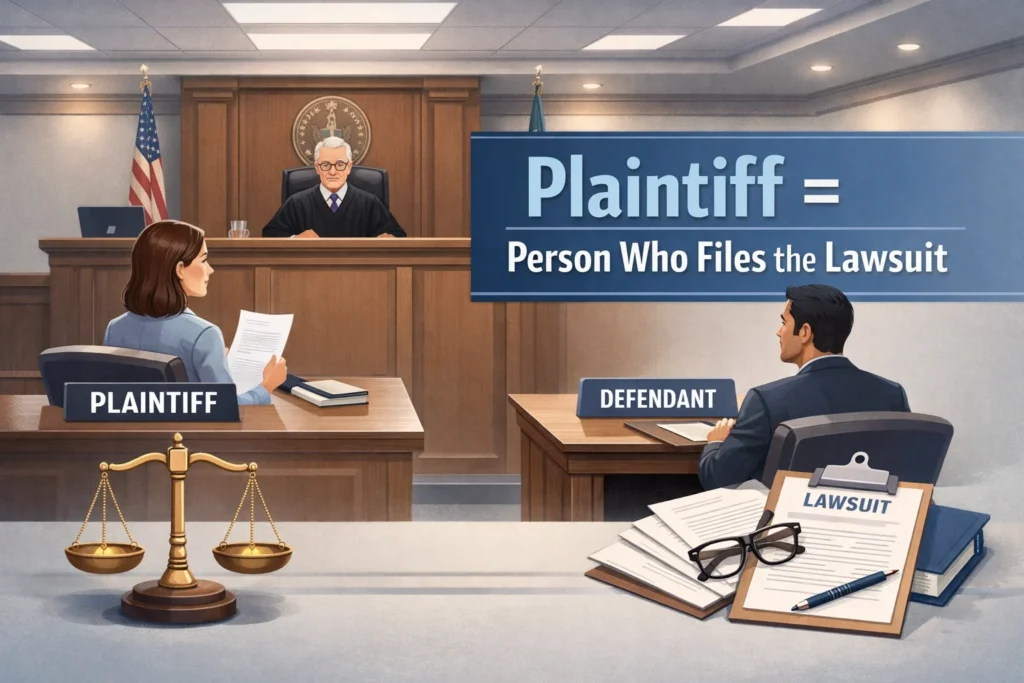
A plaintiff is the person or party who starts a lawsuit in court by filing a complaint against another person or organization, known as the defendant, seeking a legal remedy such as compensation or enforcement of rights.
Understanding legal terms can feel overwhelming, especially when you come across words like plaintiff in court documents, TV shows, or news reports. The legal system uses specific language to describe the people involved in a case, and knowing what these terms mean can help you follow what is happening more clearly. One of the most important terms in civil law is plaintiff.
Whether you are learning about lawsuits, reading a legal notice, or simply curious about how court cases work, understanding the role of a plaintiff is essential. This guide breaks down everything in a simple, conversational way so you can fully understand what the term means and how it is used in real legal situations.
In simple terms, the plaintiff is the one who claims they have been wronged and asks the court to provide justice.
What Does Plaintiff Mean in Court
In court, the plaintiff is the individual, group, or organization that brings a legal case against someone else. This type of case usually falls under civil law, which deals with disputes between private parties rather than criminal charges brought by the government.
The plaintiff believes they have suffered harm, loss, or violation of rights and seeks legal help to resolve the issue. This could involve money compensation, property disputes, contract disagreements, or personal injury claims.
The other party in the case is called the defendant, who responds to the allegations made by the plaintiff.
Simple Explanation of Plaintiff
Think of a court case like a disagreement being settled in a formal setting.
The plaintiff is the person who says:
“I believe I have been wronged and I am asking the court to fix it.”
The defendant responds with:
“I do not agree with the claim.”
The judge or jury then listens to both sides and makes a decision based on evidence and law.
Origin of the Term Plaintiff
The word plaintiff comes from the Old French word pleintif, which means “complaining” or “one who complains.” It entered English legal language centuries ago and has remained a standard term in court systems that follow common law traditions.
The idea behind the word reflects the role of the plaintiff as the person who brings a complaint before the court. Even though legal systems have evolved, the term has stayed the same because it clearly defines the initiating party in a lawsuit.
Role of a Plaintiff in a Lawsuit
The plaintiff plays a central role in starting and moving a legal case forward. Without a plaintiff, most civil cases would not exist because courts do not usually begin these cases on their own.
Key responsibilities of a plaintiff include:
- Filing a formal complaint or petition in court
- Stating the legal issue or harm suffered
- Providing evidence to support their claims
- Attending court hearings or mediation sessions
- Working with a lawyer to present the case
- Seeking a legal remedy such as compensation or injunction
The plaintiff essentially sets the legal process in motion.
Who Can Be a Plaintiff
A plaintiff is not limited to a single type of person. Many different entities can act as plaintiffs in court cases.
Types of plaintiffs include:
| Type | Example |
|---|---|
| Individual person | Someone injured in a car accident |
| Company | A business suing for breach of contract |
| Government agency | A public authority filing a civil enforcement case |
| Group of people | Multiple employees filing a workplace lawsuit |
| Organization | A nonprofit suing for environmental protection |
This shows that the role of plaintiff is flexible and can apply to many legal situations.
Real-Life Examples of a Plaintiff
Understanding legal terms becomes easier with examples.
Example 1 Personal Injury Case
A person is injured in a car accident caused by another driver. The injured person files a lawsuit seeking compensation for medical bills and becomes the plaintiff.
Example 2 Contract Dispute
A business hires a contractor who fails to complete a project. The business files a case for breach of contract and acts as the plaintiff.
Example 3 Property Dispute
Two neighbors disagree over land boundaries. One neighbor files a legal case to resolve the issue and becomes the plaintiff.
Example 4 Employment Case
An employee claims unfair dismissal from a job and files a lawsuit against the employer. The employee is the plaintiff.
These examples show that plaintiffs are always the party initiating legal action.
Plaintiff vs Defendant
One of the most important legal distinctions is between plaintiff and defendant.
Comparison Table
| Role | Plaintiff | Defendant |
|---|---|---|
| Meaning | The one who files the case | The one being accused or sued |
| Action | Starts the lawsuit | Responds to the lawsuit |
| Goal | Seeks legal remedy | Defends against claims |
| Burden | Must prove the case | Must respond and defend |
The plaintiff always begins the legal process, while the defendant reacts to it.
Plaintiff in Civil vs Criminal Cases
The term plaintiff is mainly used in civil law cases. However, it is important to understand how it differs from criminal law.
Civil Case
- Involves disputes between individuals or organizations
- The plaintiff files the lawsuit
- Example: property disputes, contract issues
Criminal Case
- Involves crimes against the state
- The government prosecutes the case
- The accused is called the defendant, not plaintiff
In criminal cases, there is no plaintiff. Instead, there is a prosecutor representing the government.
What a Plaintiff Wants From Court
A plaintiff usually seeks a legal remedy, which can take different forms depending on the situation.
Common outcomes requested by plaintiffs:
- Monetary compensation for damages
- Return of property or assets
- Enforcement of a contract
- Legal order to stop certain actions
- Declaration of legal rights
The goal is to restore fairness or compensate for harm caused.
How a Plaintiff Starts a Case
The legal process begins when the plaintiff files a document called a complaint or petition in court. This document includes:
- Details of the issue
- Description of harm or dispute
- Legal reasons for the claim
- What the plaintiff is asking the court to do
Once filed, the court notifies the defendant, and the legal process officially begins.
Life of a Plaintiff During a Case
Being a plaintiff involves several stages:
1 Filing the case
The plaintiff submits the complaint to the court.
2 Serving notice
The defendant is informed about the lawsuit.
3 Evidence collection
Both sides gather documents, witnesses, and proof.
4 Hearings and arguments
The plaintiff presents their case in court.
5 Judgment
The judge or jury decides the outcome.
6 Enforcement
If the plaintiff wins, the court ensures the judgment is carried out.
Emotional Side of Being a Plaintiff
While legal language can sound formal, being a plaintiff often comes with emotional experiences. Many plaintiffs are dealing with stress, financial loss, or personal conflict.
For example, someone injured in an accident may be dealing with pain and medical recovery while also participating in legal proceedings. Similarly, a business owner may feel pressure when involved in a contract dispute that affects their livelihood.
Understanding this human side helps explain why legal systems aim to provide structured and fair resolution processes.
Common Misunderstandings About Plaintiffs
There are a few common misconceptions about plaintiffs:
- A plaintiff is not always a victim in a moral sense
- Being a plaintiff does not guarantee winning the case
- Plaintiffs must prove their claims with evidence
- Plaintiffs can also lose and sometimes pay legal costs
The role simply means starting the lawsuit, not automatically being correct or wrong.
Importance of Plaintiffs in the Legal System
Plaintiffs play a vital role in ensuring justice is accessible. Without plaintiffs, many disputes would remain unresolved. They help the legal system function by bringing issues before the court for evaluation.
This process ensures that:
- Rights are protected
- Disputes are resolved fairly
- Laws are properly enforced
- Harmed parties have a way to seek justice
The plaintiff is therefore a key part of civil justice systems worldwide.
FAQs
What does plaintiff mean in court
A plaintiff is the person or party who files a lawsuit seeking legal action or compensation.
Is plaintiff the same as victim
Not always. A plaintiff is the person who starts the case, but not every plaintiff is legally proven to be a victim.
Who is the opposite of plaintiff
The opposite is the defendant, who responds to the lawsuit.
Can a company be a plaintiff
Yes, businesses and organizations can file lawsuits and act as plaintiffs.
Is plaintiff used in criminal cases
No, criminal cases use the term prosecutor instead of plaintiff.
Does the plaintiff always win
No, the court decides based on evidence and law.
What is a plaintiff seeking in court
Usually compensation, legal rights, or enforcement of an agreement.
Who hires a lawyer, plaintiff or defendant
Both sides can hire lawyers to represent them in court.
Conclusion
In court terminology, a plaintiff is the person or party who starts a legal case by filing a complaint against another party. They play a central role in civil law by bringing disputes to court and seeking justice or compensation.
Understanding the meaning of plaintiff helps you better follow legal news, court cases, and real-life disputes. Whether it is an individual, a business, or an organization, the plaintiff is always the one who initiates the legal process and asks the court to intervene.
While the legal system may seem complex, breaking down terms like plaintiff makes it easier to understand how justice works in everyday life.
Discover More Related Articles:
- MMCHT in Texts: Meaning, Tone, and How to Use It in 2026
- What Does Te Amo Mean in English? Here’s the Truth (2026)
- SG in Text: The Meaning Changes More Than You Think (2026)

Luna Hartley is a content creator at TextSprout.com, where she specializes in explaining word meanings, modern phrases, and everyday language used in texts and online conversations. Her writing focuses on clarity and context, helping readers understand how words are actually used in real communication.