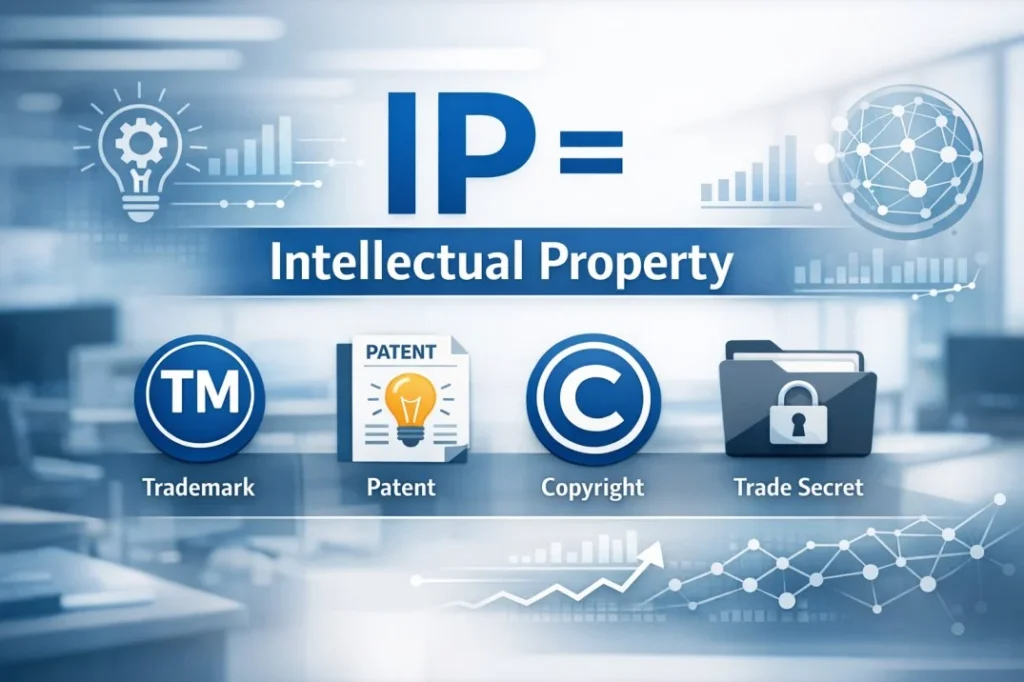
IP in business stands for “Intellectual Property,” which refers to creations of the mind such as inventions, brand names, logos, designs, and artistic works that are legally protected and owned by a person or company.
These assets give businesses exclusive rights to use, sell, or license their ideas and creations.
In business conversations, legal documents, branding discussions, or startup planning, you will often hear the term IP. It is one of the most important concepts in modern commerce, especially in industries like technology, entertainment, fashion, pharmaceuticals, and digital media. Yet many people still ask a simple question: what does IP actually mean in business?
Understanding IP is essential because it often represents the most valuable assets a company owns. In many cases, a business’s success is not just about physical products or office spaces but about ideas, creativity, branding, and innovation. All of these fall under the concept of IP.
Understanding IP in Simple Business Terms
At its core, intellectual property means ownership of ideas and creativity. Unlike physical property such as buildings or machines, IP refers to intangible assets that come from human intelligence and creativity.
For example, a company’s logo, a mobile app design, a song, a product invention, or even a slogan can all be considered intellectual property.
In business, IP is extremely valuable because it helps companies:
• Protect their unique ideas
• Prevent competitors from copying their work
• Build strong brand identity
• Generate revenue through licensing or sales
• Maintain competitive advantage in the market
Without IP protection, businesses could easily lose control over their innovations.
Types of Intellectual Property in Business
Intellectual property is not a single concept. It includes several categories, each protecting different types of creations.
1. Trademarks
A trademark protects brand identity elements such as:
• Company names
• Logos
• Slogans
• Product names
For example, when you see a specific logo or brand name, you immediately recognize the company behind it. That recognition is protected by trademark law.
Trademarks help businesses stand out in crowded markets and prevent others from using similar branding.
2. Copyright
Copyright protects creative works such as:
• Books
• Music
• Movies
• Software code
• Photography
• Marketing content
Once something is created and fixed in a tangible form, copyright automatically applies in many countries. It gives the creator exclusive rights to use and distribute the work.
In business, copyright is especially important for media companies, software developers, and content creators.
3. Patents
A patent protects inventions and new technologies. It gives the inventor exclusive rights to make, use, or sell their invention for a certain period of time.
Examples include:
• A new smartphone technology
• A pharmaceutical drug formula
• A mechanical device
• A manufacturing process
Patents are crucial in industries that rely heavily on innovation because they protect research and development investments.
4. Trade Secrets
Trade secrets refer to confidential business information that gives a company a competitive advantage. Unlike patents or trademarks, trade secrets are not publicly registered.
Examples include:
• Secret recipes
• Algorithms
• Manufacturing processes
• Customer databases
• Marketing strategies
A famous example is the formula used in soft drinks, which is kept confidential to maintain uniqueness.
Why IP Is Important in Business
Intellectual property plays a major role in business success. It is often the foundation of brand value, market position, and long term profitability.
Key reasons IP matters:
- It protects innovation and creativity
- It prevents competitors from copying products or ideas
- It increases brand value and recognition
- It allows businesses to earn money through licensing
- It attracts investors and partners
- It builds long term competitive advantage
In fact, many modern companies are valued more for their intellectual property than their physical assets.
Real World Examples of IP in Business
To understand IP better, it helps to look at real world examples.
Example 1 Technology Company
A smartphone company develops a new camera technology. They file a patent to protect it. This prevents other companies from using the same technology without permission.
Example 2 Fashion Brand
A clothing company creates a unique logo and brand name. They register it as a trademark. This ensures no other brand can copy their identity.
Example 3 Software Company
A tech startup builds an app with original code. That code is protected by copyright, meaning others cannot legally copy it.
Example 4 Food Business
A restaurant keeps its signature sauce recipe secret. This recipe becomes a trade secret that gives the restaurant a competitive edge.
Table of IP Types in Business
| Type of IP | What It Protects | Example | Business Use |
|---|---|---|---|
| Trademark | Brand identity | Logo, name, slogan | Branding and marketing |
| Copyright | Creative works | Books, music, software | Media and content protection |
| Patent | Inventions | New machine or formula | Innovation and technology |
| Trade Secret | Confidential information | Recipe, algorithm | Competitive advantage |
How Businesses Use IP Strategically
Intellectual property is not just about protection. It is also a business strategy.
Companies use IP in several ways:
1. Branding Strategy
Strong trademarks help companies build recognizable brands that customers trust.
2. Revenue Generation
Businesses can license their IP to others. For example, a technology company might allow another company to use its patented system in exchange for royalties.
3. Market Protection
IP prevents competitors from copying products, giving businesses time to dominate the market.
4. Business Expansion
Companies often expand globally by registering IP rights in different countries.
5. Investor Attraction
Startups with strong IP portfolios are more attractive to investors because their ideas are legally protected.
IP in the Digital Economy
In today’s digital world, intellectual property is more important than ever. Online businesses, apps, and content creators rely heavily on IP protection.
Examples include:
• Mobile applications
• Streaming platforms
• Online courses
• Digital artwork
• Social media branding
Even a simple logo or Instagram content can become valuable intellectual property.
With the rise of AI, digital content creation, and global e commerce, protecting IP has become a top priority for businesses of all sizes.
Common Misunderstandings About IP
Many people misunderstand intellectual property. Here are a few common misconceptions:
Misconception 1 IP is only for big companies
Small businesses and startups also rely heavily on IP protection.
Misconception 2 If I create it, I automatically own it everywhere
IP rights often depend on registration and country laws.
Misconception 3 Ideas alone are protected
In most cases, ideas must be expressed in a tangible form to qualify for protection.
How Businesses Protect Their IP
Companies use several methods to protect their intellectual property:
• Registering trademarks and patents
• Using legal agreements like NDAs
• Monitoring for infringement
• Taking legal action when necessary
• Keeping trade secrets confidential
Proper IP protection ensures long term business security.
Importance of IP for Startups
For startups, IP can be one of the most valuable assets. Even if a startup does not have large revenue, its idea, technology, or branding can be worth millions if protected properly.
Investors often evaluate startups based on:
• Strength of their patents
• Uniqueness of their technology
• Brand identity strength
• Scalability of their intellectual property
IP vs Physical Assets in Business
Unlike physical assets such as machines or buildings, intellectual property can grow in value over time.
| Physical Assets | Intellectual Property |
|---|---|
| Can depreciate | Can appreciate |
| Limited use | Can scale globally |
| Requires maintenance | Requires legal protection |
| Tangible | Intangible |
In many modern companies, IP is the most valuable asset.
FAQs
What does IP mean in business
IP stands for Intellectual Property, which includes creations like brand names, inventions, designs, and creative works owned by a business or individual.
Why is IP important in business
It protects ideas, prevents copying, builds brand value, and helps companies earn money through licensing or exclusive rights.
What are the four types of IP
The main types are trademarks, copyrights, patents, and trade secrets.
Is IP only for big companies
No, small businesses and startups also rely on IP to protect their ideas and compete in the market.
Can IP be sold or licensed
Yes, businesses can sell or license intellectual property to generate revenue.
What happens if IP is not protected
Without protection, competitors may copy ideas, products, or branding without legal consequences.
Is a logo considered IP
Yes, a logo is protected under trademark law as intellectual property.
How do companies protect IP
They use legal registration, contracts, confidentiality agreements, and enforcement actions when necessary.
Conclusion
In business, IP stands for Intellectual Property, and it represents one of the most valuable assets a company can own. It includes inventions, branding, creative works, and confidential information that give businesses a competitive edge in the market.
From trademarks and copyrights to patents and trade secrets, intellectual property shapes how companies innovate, compete, and grow. In today’s digital and global economy, protecting IP is not optional but essential for long term success.
Whether you are a startup founder, business owner, or simply learning about business concepts, understanding IP helps you appreciate how ideas become powerful assets that drive modern industries.
Read More Related Articles:
- 333 Meaning in the Bible: What This Powerful Number Reveals In 2026
- Akari Mean in Japanese: Name That Means Light In 2026
- 7 Means in Numerology: Symbolism and Spiritual Significance In 2026

Neon Samuel is a digital content creator at TextSprout.com, dedicated to decoding modern words, slang, and expressions. His writing helps readers quickly grasp meanings and understand how terms are used in real conversations across text and social platforms.