
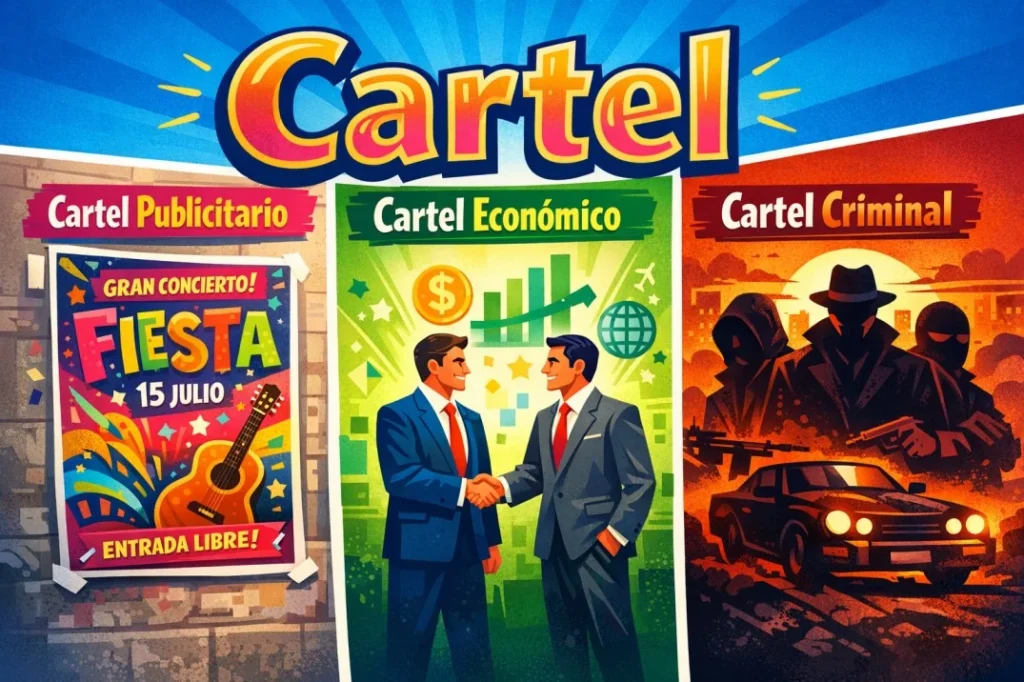
In Spanish, “cartel” can mean a poster or sign used for advertising, or a group of businesses or individuals who collaborate to control prices or markets. In some contexts, it is also used to describe organized crime groups.
Example:
- Vi un cartel en la calle” → I saw a poster on the street.
- “Ese grupo es un cartel” → That group operates like a cartel controlling a market.
If you’ve ever watched movies, read news headlines, or heard conversations about Latin America, you’ve probably come across the word “cartel.” For many people, the word immediately brings to mind crime, drugs, and powerful organizations. But in Spanish, the meaning of cartel is actually broader and more nuanced than that.
Depending on the context, cartel can mean something as simple as a poster or sign, or something as serious as an organized group controlling a market. This dual meaning often causes confusion, especially for people learning Spanish or trying to understand how the word is used in different situations.
In this guide, we’ll break down exactly what cartel means in Spanish, how it is used in everyday language, how its meaning changes by context, and how to use it naturally without sounding awkward or misunderstood.
The Basic Meaning of “Cartel” in Spanish
At its simplest level, cartel in Spanish refers to a poster, sign, or notice. This is the original and most neutral meaning of the word.
You will often hear it used in everyday situations, especially when talking about advertisements, announcements, or public notices.
For example:
- “Hay un cartel en la puerta” → There is a sign on the door
- “El cartel del concierto está por toda la ciudad” → The concert poster is all over the city
- “Leí el cartel en la tienda” → I read the sign in the shop
In these examples, cartel has nothing to do with crime or anything negative. It simply refers to something visual that communicates information.
Cartel as a Poster or Advertisement
In many Spanish-speaking countries, cartel is commonly used in marketing and daily life. If you walk through a city, you will see “carteles” everywhere.
These can include:
- Movie posters
- Concert announcements
- Store signs
- Public warnings
- Event promotions
It is a very normal, everyday word.
For example:
- “El cartel de la película es increíble” → The movie poster is amazing
- “Pusieron carteles para el evento” → They put up posters for the event
In this sense, the word is completely harmless and widely used in both casual and formal contexts.
The Economic Meaning of “Cartel”
The meaning of cartel becomes more complex when used in economics or business. In this context, a cartel refers to a group of companies or organizations that work together to control prices, supply, or competition.
Instead of competing with each other, these groups cooperate to increase profits or dominate a market.
For example:
- “Las empresas formaron un cartel para subir los precios”
→ The companies formed a cartel to raise prices
This use of the word exists in both Spanish and English. It is often discussed in business, law, and economics.
Cartel in Crime and Media
The meaning that most people recognize today comes from news and media. In this context, cartel refers to organized crime groups, especially those involved in illegal activities like drug trafficking.
This is where the word gained global attention.
For example:
- “Ese cartel controla la región” → That cartel controls the region
- “Los carteles son muy poderosos” → Cartels are very powerful
In this sense, the word carries a serious and often negative tone. It is associated with:
- Organized crime
- Control of illegal markets
- Violence and power struggles
However, it is important to remember that this is just one meaning of the word, not the only one.
Why “Cartel” Has Different Meanings
The reason cartel has multiple meanings comes from its origin. The word originally referred to something posted or displayed publicly, like a notice or announcement.
Over time, the meaning expanded. When groups of businesses began working together secretly or strategically, the word was used to describe their agreements. Eventually, the term was also applied to organized crime groups that controlled markets in a similar way.
So even though the meanings seem very different, they are connected by the idea of public display or organized control.
Examples of “Cartel” in Different Contexts
Here are some examples to help you clearly see how the meaning changes depending on context:
| Context | Spanish Sentence | Meaning in English |
|---|---|---|
| Everyday | “Vi un cartel en la pared” | I saw a poster on the wall |
| Advertising | “El cartel del evento es bonito” | The event poster is nice |
| Business | “Formaron un cartel económico” | They formed an economic cartel |
| Crime | “El cartel domina la ciudad” | The cartel controls the city |
These examples show how the same word can shift meaning based on the situation.
Tone and Context Matter
One of the most important things to understand about cartel is that its meaning depends heavily on context.
If you are talking about:
- A shop or street → It likely means a sign or poster
- Business or economics → It means a group controlling a market
- News or crime → It refers to an organized crime group
This is why context is everything. Without it, the word can easily be misunderstood.
Cartel vs Similar Spanish Words
There are other Spanish words that can be confused with cartel, especially when referring to signs or posters.
| Word | Meaning | Difference |
|---|---|---|
| Cartel | Poster or sign | General use |
| Anuncio | Advertisement | More focused on marketing |
| Aviso | Notice or warning | Often informational |
| Póster | Poster | Borrowed from English |
While these words overlap, cartel is often the most flexible and widely used.
When to Use “Cartel”
You can use cartel in several everyday situations:
- Talking about signs or posters
- Describing advertisements
- Referring to economic groups
- Discussing news topics
Examples:
- “Hay un cartel afuera” → There is a sign outside
- “El cartel del concierto es genial” → The concert poster is great
When to Be Careful Using “Cartel”
Even though the word is common, there are situations where you should be careful.
If you say “cartel” without context, people might assume you mean a crime organization, especially in international conversations.
So it is helpful to clarify your meaning when needed.
For example:
- “Cartel publicitario” → Advertising poster
- “Cartel económico” → Economic cartel
This makes your meaning clear and avoids confusion.
Cultural Influence of the Word
The global perception of the word cartel has been strongly shaped by movies, television, and news. Many people outside Spanish-speaking countries first hear the word in crime-related contexts.
Because of this, the criminal meaning has become the most recognized internationally, even though it is not the original meaning.
In everyday Spanish, however, people still use cartel normally to refer to posters and signs without any negative association.
FAQs
What does cartel mean in Spanish?
Cartel can mean a poster or sign, a group controlling a market, or an organized crime group depending on context.
Is cartel always related to crime?
No, it often simply means a poster or sign in everyday Spanish.
What is the original meaning of cartel?
The original meaning refers to a posted notice, sign, or advertisement.
How do you know which meaning is correct?
You need to look at the context of the conversation, such as whether it is about advertising, business, or crime.
Is cartel used in daily conversation?
Yes, especially when talking about posters or signs.
What is a cartel in business terms?
It is a group of companies that work together to control prices or competition.
Why is cartel associated with crime?
Because media and news often use the term to describe organized crime groups.
Can cartel have a neutral meaning?
Yes, when referring to signs, posters, or advertisements, it is completely neutral.
Conclusion
The Spanish word cartel is a perfect example of how language can carry multiple meanings depending on context. At its most basic level, it simply refers to a poster or sign, something you might see every day on a wall or in a shop.
However, in more complex contexts, it can describe groups that control markets or even organized crime networks. This range of meanings can feel confusing at first, but once you understand the context, it becomes much easier to interpret.
The key takeaway is simple. Cartel always involves either communication or control, whether it is a message displayed publicly or a group working together behind the scenes.
So the next time you hear the word cartel, don’t jump to conclusions. Pay attention to the situation, and you will quickly understand what it really means.
Read More Related Articles:
- Snake Mean in Dreams: Spiritual and Psychological Meaning In 2026
- Hermosa Mean in English: Beautiful Spanish Word Explained In 2026
- “MK” Mean in Texting: Understanding the Tone Behind It In 2026

Neon Samuel is a digital content creator at TextSprout.com, dedicated to decoding modern words, slang, and expressions. His writing helps readers quickly grasp meanings and understand how terms are used in real conversations across text and social platforms.