
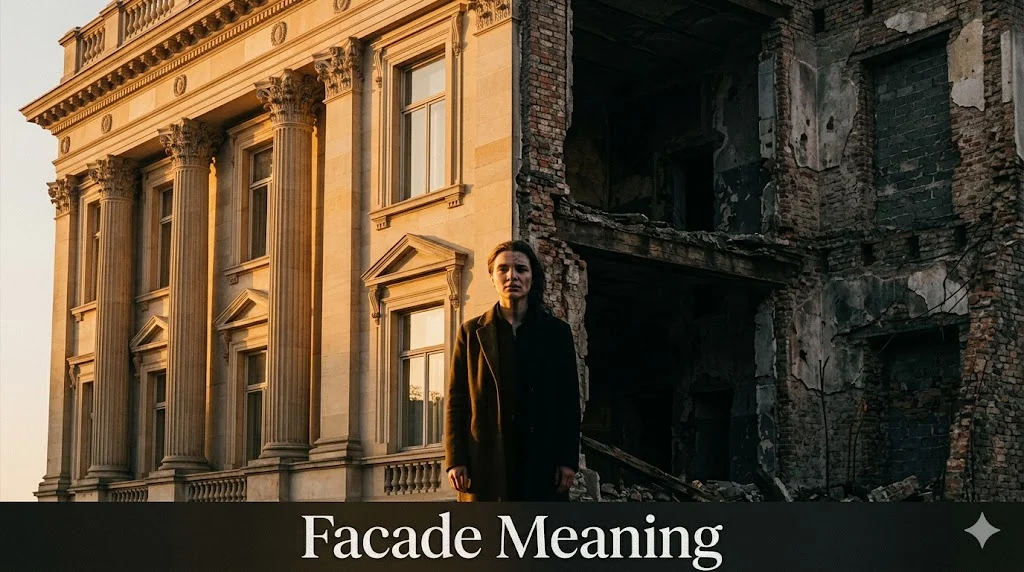
You know that person at work the one who greets everyone with a radiant smile, cracks jokes in meetings, and seems almost unnervingly upbeat? Then one day, out of nowhere, you learn they’ve been quietly falling apart for months. Nobody saw it coming. Why? Because what everyone saw wasn’t the real picture. It was a facade. Understanding facade meaning completely means understanding architecture, language, psychology, and human behavior all at once.
That one word carries more weight than most people realize. It explains a character in a novel, the front wall of a historic building, and the mask your neighbor wears every morning when they wave goodbye to their family.
This guide breaks it all down. Pronunciation, etymology, psychology, synonyms, real-life examples, cultural significance everything you need. Let’s get into it.
What Does Facade Mean? The Core Definition
At its most basic level, a facade is an outward appearance that hides what’s really going on underneath. The word carries two distinct but deeply connected meanings one architectural, one behavioral and both rest on the same central idea: what you see on the surface isn’t the whole truth.
Facade Meaning in Simple Words
Think of a movie set. From the front, you see a convincing street of shops, brick walls, and painted signs. Walk around the back and it’s just hollow wooden frames propped up by nothing. That front-facing illusion? That’s a facade.
In everyday language, when someone describes a person, a relationship, or even an institution as a facade, they mean the exterior presentation is polished and deliberate while something entirely different exists beneath it.
The denotation (literal dictionary meaning) of facade: the front face of a building, or any false, superficial, or artificial appearance.
The connotation (implied meaning) of facade: deception, performance, emotional concealment, and the gap between who someone appears to be and who they actually are.
Facade Definition Across Major Dictionaries
| Dictionary | Definition |
|---|---|
| Merriam-Webster | The front of a building; also: any face of a building given special architectural treatment / a false, superficial, or artificial appearance or effect |
| Oxford English Dictionary | The face of a building, especially the principal front; an outward appearance that is maintained to conceal a less pleasant reality |
| Cambridge Dictionary | The front of a large building; a way of behaving that hides your real feelings |
| Collins English Dictionary | The facade of a building is its front wall; a facade is an outward appearance which is deliberately false |
Every definition circles back to the same core idea a front that conceals. Whether stone and mortar or smiles and rehearsed answers, the logic is identical.
Facade Pronunciation: Say It Right
Here’s where a lot of people stumble. The word looks like it should rhyme with “arcade” but it doesn’t.
Correct pronunciation: /fəˈsɑːd/
Break it down: fuh-SAHD
The stress lands on the second syllable. The first syllable is a soft, unstressed “fuh.” The second syllable sounds like “sahd” rhymes with “odd” or “god” in a British accent, and closer to “sawd” in American English.
Common mispronunciations to avoid:
- FAY-sahd (wrong stress placement)
- fuh-KAYD (confusing it with “arcade”)
- fuh-SAYD (wrong vowel in the second syllable)
What about the spelling “façade” with the cedilla (ç)?
The cedilla under the “c” is the original French spelling. It signals that the “c” makes a soft /s/ sound rather than a hard /k/ sound. In English, both spellings facade and façade are accepted. The pronunciation stays exactly the same either way. Most modern publications drop the cedilla for simplicity, but both versions are correct.
The Etymology of Facade: Where Did This Word Come From?
Words don’t just appear. They travel, evolve, and collect meaning along the way. Facade has one of the cleanest etymological trails in English.
| Stage | Language | Word | Meaning |
|---|---|---|---|
| Origin | Latin | facies | Face, form, appearance |
| Evolution | Italian | facciata | Front of a building (from faccia, “face”) |
| Borrowing | French | façade | Front wall of a building |
| Adoption | English | facade / façade | Building front; false outward appearance |
The word entered English from French in the mid-17th century, initially used strictly in architectural contexts. By the 19th century, writers began using it figuratively to describe people who presented a carefully constructed outward image that didn’t match their inner reality. The metaphor was almost too perfect to resist.
A building’s facade is the part that gets all the attention cleaned, decorated, and designed to impress. The plumbing, the structural supports, the unglamorous machinery of the building stays hidden behind it. People work the same way. The parts they show the world get groomed and managed. Everything messy stays tucked away.
Facade in Architecture: The Original Meaning
Before it described human behavior, facade described stone. In architecture, the facade of a building is its principal front-facing exterior wall the side most visible to the public, typically facing a street or square.
Architects treat facades as primary design statements. The facade communicates a building’s purpose, its era, its cultural values, and the ambitions of whoever commissioned it. A Gothic cathedral’s facade speaks of faith, awe, and vertical aspiration. A modernist glass tower’s facade speaks of transparency, efficiency, and corporate power.
Key architectural elements found on facades:
- Columns and pilasters (vertical structural or decorative elements)
- Cornices (horizontal molded projections)
- Pediments (triangular forms above entrances)
- Fenestration (the arrangement of windows)
- Rustication (deliberately rough stonework at the base)
- Ornamental carvings, reliefs, and inscriptions
Why architectural facades matter:
They control first impressions, define street character, reflect historical periods, carry cultural symbolism, and in many cases are legally protected as heritage features even when the building’s interior gets completely renovated.
This is where the figurative meaning gets its power. A heritage building can gut its entire interior and replace it with something modern and unrecognizable but as long as the facade stays intact, it looks like nothing changed. People do this constantly.
Facade Meaning in Psychology: The Deep Dive
This is where the word gets genuinely fascinating. In psychology, a facade refers to a socially constructed outward presentation that conceals a person’s genuine emotional state, identity, or vulnerabilities.
The Psychology Behind Why Facades Form
Psychologist Erving Goffman introduced the concept of impression management in his landmark 1959 work The Presentation of Self in Everyday Life. His central argument: social life is essentially a theatrical performance. People constantly manage how they appear to others, adjusting their behavior depending on the “audience” present.
Goffman called this front stage behavior (the performance others see) versus back stage behavior (the private self, unguarded and authentic). A facade is the front stage taken to an extreme when the performance becomes so dominant it crowds out the authentic self almost entirely.
Psychologists identify several core reasons people build facades:
Fear of judgment. When someone grows up in an environment where vulnerability was met with ridicule or punishment, they learn to hide anything that might invite criticism. The facade becomes armor.
Childhood conditioning. Children raised in households where emotions were dismissed, minimized, or treated as inconvenient learn to suppress authentic expression early. “Don’t cry,” “toughen up,” “stop being so sensitive” repeated enough, these messages build thick walls.
Social and workplace pressure. Certain environments punish emotional honesty. Corporate culture, competitive social circles, and high-stakes professional environments often reward the performance of confidence, happiness, and competence over their genuine expression.
Trauma responses. After significant psychological trauma, some people erect elaborate facades as a survival mechanism. Looking fine on the outside becomes a way of maintaining some sense of control when the inside feels chaotic and unsafe.
Cultural expectations. Many cultures have deeply ingrained norms around emotional expression. Showing sadness, fear, or uncertainty in certain cultural contexts carries real social consequences. The facade becomes a cultural necessity, not just a personal choice.
Social Facade Examples in Real Life
Understanding this concept in the abstract is one thing. Recognizing it in real situations is another. Here are concrete examples:
The high-achieving professional. Outwardly successful, confident in every meeting, projects certainty in every decision. Privately struggles with chronic anxiety, imposter syndrome, and the constant fear of being “found out.”
The happy marriage performance. A couple that attends social events together, posts warm family photos, and presents a united front. Behind closed doors, the relationship has been disconnected or volatile for years.
The social media persona. Curated images of travel, fitness, and apparent contentment while the person behind the account deals with loneliness, financial stress, or mental health struggles they’d never post about.
The “I’m fine” reflexive response. Perhaps the most universal facade of all. Asked how they’re doing, a person answers “fine” or “great” out of habit, regardless of what’s actually happening internally.
The life of the party. Someone who performs extroverted, entertaining behavior in social settings while privately experiencing depression or social anxiety. Robin Williams is one of the most famous and heartbreaking real-world examples.
Facade Personality Traits: How to Recognize One
Spotting a facade isn’t about judgment it’s about perception. People who rely heavily on facades tend to display recognizable patterns:
- Excessive positivity that feels slightly too rehearsed or consistent, regardless of circumstances
- Deflection when conversations turn personal or emotionally honest
- Discomfort with vulnerability their own or other people’s
- Inconsistency between how they behave in public settings versus private ones
- Over-investment in image what others think matters disproportionately to them
- Difficulty receiving genuine care or concern it threatens the performance
- Exhaustion maintaining a facade is genuinely tiring, and it often shows
- Resistance to being truly known by anyone, even close friends or partners
It’s worth noting that many people displaying these traits aren’t consciously performing. The facade has often become so habitual it feels natural. They may not recognize they’re doing it at all.
Facade vs. Mask: Is There Actually a Difference?
People use these two words interchangeably, but there’s a meaningful distinction worth understanding.
| Concept | Nature | Level of Awareness | Typical Function | Example |
|---|---|---|---|---|
| Facade | Sustained outward presentation | Often unconscious or semi-conscious | Ongoing social performance | Appearing confident and together at all times |
| Mask | Deliberate, targeted concealment | Usually conscious | Hiding a specific feeling in a specific moment | Hiding grief at a celebratory event |
Think of it this way: a mask is something you put on for a specific occasion and know you’re wearing. A facade is a full set design the backdrop, the costume, the lighting that you’ve built so carefully over time that you sometimes forget it isn’t your actual life.
A mask is tactical. A facade is architectural and that metaphor circles right back to where we started.
Facade in Literature: When Writers Use It Best
Great writers have always understood that the gap between appearance and reality is where the most interesting human stories live. The facade is one of literature’s most enduring themes.
The Great Gatsby by F. Scott Fitzgerald
Jay Gatsby’s entire existence is a masterwork of facade construction. Born James Gatz into modest circumstances, he reinvents himself completely the mansion, the parties, the shirts, the carefully rehearsed “old sport” affectation. Every detail is designed to project wealth, sophistication, and belonging to a world that never actually accepted him. His facade is so elaborate and so earnest that it becomes genuinely tragic. Fitzgerald uses Gatsby to argue that the American Dream itself might be the grandest facade of all.
The Picture of Dorian Gray by Oscar Wilde
Wilde’s novel is essentially a meditation on facade made physical. Dorian Gray’s beautiful face remains permanently youthful while a portrait hidden away records the true toll of his moral corruption. His appearance is a living, breathing facade. The horror of the ending comes precisely from the facade collapsing reality finally catching up with appearance.
Hamlet by William Shakespeare
“One may smile, and smile, and be a villain.” Shakespeare understood facades intimately. Claudius wears the facade of a grieving brother and devoted king while concealing the fact that he murdered his own brother to steal the throne. The entire dramatic tension of Hamlet hinges on the gap between what characters present and what they truly are.
Facade in Contemporary Literature
Modern literary fiction is saturated with facade themes. From the unreliable narrators of Gillian Flynn’s Gone Girl to the carefully maintained domestic surfaces of Richard Yates’ Revolutionary Road, contemporary writers return again and again to the question: what are people hiding, and what does hiding it cost them?
How to Use Facade in a Sentence: Real Examples
Seeing a word used correctly in context is the fastest way to understand it fully. Here are varied, authentic example sentences grouped by context:
In architecture:
- “The building’s restored facade concealed a completely modernized interior.”
- “The architect spent months designing the limestone facade to complement the historic streetscape.”
Describing people and behavior:
- “She kept up a cheerful facade even as her personal life fell apart around her.”
- “Behind his charming facade was a man deeply frightened of being ordinary.”
- “Their marriage had been little more than a facade for years before anyone noticed.”
- “He dropped the tough facade the moment he was alone with his closest friend.”
In formal or literary writing:
- “The corporation’s philanthropic facade masked a culture of systematic exploitation.”
- “The novel’s genius lies in stripping away each character’s carefully maintained facade.”
In casual, everyday conversation:
- “Drop the facade nobody here cares if you’re not okay right now.”
- “The whole neighborhood had a friendly facade that tourists loved, but locals knew the reality.”
Facade Synonyms: Words That Share Its Meaning
The English language offers several strong alternatives to facade, each with its own shade of meaning.
| Synonym | Core Nuance | Best Used When… |
|---|---|---|
| Pretense | A false claim actively maintained | Someone is knowingly performing something false |
| Veneer | A thin, surface-level layer | The covering is fragile and easily scratched |
| Guise | A disguise adopted to mislead | The deception is intentional and deliberate |
| Front | A false outward show (informal) | Speaking casually about someone putting on an act |
| Charade | A performance everyone can see through | The facade is obvious but maintained anyway |
| Illusion | A false perception | The distortion isn’t necessarily intentional |
| Disguise | Deliberate concealment | Physical or behavioral camouflage |
| Affectation | Artificial manner adopted to impress | Behavior designed to seem impressive or sophisticated |
| Masquerade | Living under a false identity | Long-term or elaborate deception |
| Show | A display not reflecting reality | Informal; “it was all just a show” |
Facade Antonyms: The Opposite of Pretense
Understanding what a facade is NOT helps sharpen the definition:
- Authenticity genuine, unperformed self-expression
- Transparency openness about true thoughts and feelings
- Candor frank, honest communication
- Sincerity genuine feeling behind expressed sentiment
- Genuineness being exactly what you appear to be
Facade Meaning in Urdu
In Urdu, the concept of facade translates most naturally through several related words:
دکھاوا (Dikhawa) This is the closest equivalent in everyday Urdu usage. It directly means “show” or “display” and carries the connotation of performing something for appearances rather than genuine feeling. “Yeh sab dikhawa hai” (یہ سب دکھاوا ہے) translates roughly as “This is all just a facade / It’s all just for show.”
بناوٹ (Banaawat) Means artificiality or constructed behavior. Carries a sense of something deliberately made up or manufactured rather than organic.
ظاہرداری (Zaahirdaari) Refers to the maintenance of outward appearances, particularly in social and family contexts. This word is deeply resonant in South Asian cultural contexts where social image and family honor carry significant weight.
Example sentence in Urdu: “اس کی مسکراہٹ صرف ایک دکھاوا تھی، اندر سے وہ بالکل ٹوٹا ہوا تھا۔” (Translation: His smile was nothing but a facade inside, he was completely broken.)
Facade Meaning in Hindi
In Hindi, facade meaning aligns closely with the Urdu equivalents, given the shared linguistic roots:
दिखावा (Dikhawa) The most common and direct translation. Means outward show or display, with the clear implication that the display doesn’t reflect reality.
बाहरी रूप (Baahri Roop) Literally “outer form” or “outward appearance.” Used to describe surface-level presentation as distinct from inner reality.
आडंबर (Aadambar) Carries a slightly stronger negative connotation, suggesting pomposity or ostentatious display. Used when a facade is particularly elaborate or performative.
Example sentence in Hindi: “उसकी खुशी का दिखावा सबको दिखता था, लेकिन असल में वह अंदर से बहुत दुखी था।” (Translation: His facade of happiness was visible to everyone, but in reality he was deeply unhappy inside.)
Quick Multilingual Comparison
| Language | Primary Word | Literal Meaning | Cultural Weight |
|---|---|---|---|
| Urdu | دکھاوا Dikhawa | Show / Display | Very high social image is culturally central |
| Hindi | दिखावा Dikhawa | Outward show | High performance and appearances carry social significance |
| French | Façade | Front face | Moderate origin language, primarily architectural |
| Spanish | Fachada | Building front | Moderate mostly architectural, some figurative use |
| Italian | Facciata | Face / Front | Moderate architectural origin retained strongly |
| Arabic | واجهة (Wajiha) | Front / Face | High used extensively for both buildings and behavior |
The Real Cost of Living Behind a Facade
Maintaining a facade isn’t a neutral activity. It takes real energy, creates real distance, and carries real psychological costs. Research in personality psychology and clinical settings consistently shows that people who rely heavily on facade behaviors tend to experience:
Chronic emotional exhaustion. Performing a version of yourself that isn’t authentic is genuinely draining. The mental overhead of tracking what you’ve presented, to whom, and maintaining consistency across contexts is enormous.
Shallow relationships. When people only know your facade, they like your facade not you. That means even when you’re surrounded by people, genuine connection is absent. The loneliness that creates is particularly painful because it’s invisible.
Identity confusion. Over time, people who have maintained facades for years sometimes report losing clarity about who they actually are outside the performance. The line between the real self and the constructed self blurs.
Physical health consequences. Studies on emotional suppression which underlies most facade behavior link it to elevated cortisol levels, weakened immune function, increased cardiovascular risk, and higher rates of anxiety and depression.
The collapse problem. Facades are structurally fragile. They hold up under ordinary conditions but fail dramatically under pressure. A health crisis, a relationship breakdown, a sudden loss these strip away the performance and leave the person without practiced tools for being genuine.
How to Stop Living a Facade: Practical Steps Toward Authenticity
Recognizing the facade is the first step. What comes after that?
Check the Gap
Ask yourself honestly: is there a significant difference between how I present myself in public and who I actually am when alone? Some variation is healthy and normal we all modulate behavior based on context. The question is whether the gap has become large enough to cause suffering or prevent real connection.
Useful journaling prompts:
- What am I afraid would happen if people saw me as I actually am?
- Who, if anyone, knows the real me? What allowed that closeness to happen?
- What emotions do I habitually hide? Why?
Start With Safe Relationships
You don’t need to suddenly bare your soul to everyone. Real authenticity is built incrementally. Identify one or two trusted people in your life and practice being genuinely honest with them. Let yourself need something. Admit when you’re struggling. Notice that the relationship doesn’t end it deepens.
Separate Professionalism From Suppression
There’s a meaningful difference between professional context-appropriate behavior (not sobbing at a board meeting) and chronic emotional suppression (never letting anyone see you’re human). The former is social competence. The latter is a facade. One is healthy adaptation; the other is corrosive over time.
Therapy and Self-Awareness Practices
Cognitive-behavioral therapy (CBT) and acceptance and commitment therapy (ACT) both offer structured approaches to identifying and dismantling long-held behavioral patterns including facade behaviors. Mindfulness practices help by increasing moment-to-moment awareness of the gap between what you’re feeling and what you’re projecting.
Understand That Authenticity Doesn’t Mean Oversharing
This is a common misconception. Dropping the facade doesn’t mean turning every interaction into a therapy session. It means letting your actual values, actual emotions, and actual self be present in your life not performing a character.
Facade in Psychology: Polysemy and the Word’s Many Layers
The concept of polysemy one word carrying multiple meanings applies perfectly to facade. The same word describes:
- A stone wall (architectural, literal)
- A behavioral performance (psychological, figurative)
- A social strategy (sociological)
- A narrative device (literary)
- A cultural phenomenon (anthropological)
What ties all these meanings together is the consistent underlying structure: a designed, visible exterior that controls perception while concealing a different interior reality. Whether it’s a cathedral, a person, an institution, or a character in a novel if the front doesn’t match the interior, you’re dealing with a facade.
This is why the word has such staying power. It captures something fundamental about how surfaces and depths relate in buildings, in people, in societies.
FAQs
What does facade mean in simple words?
A facade is when something or someone shows a carefully managed outward appearance that hides a different reality underneath. In architecture, it’s the front wall of a building. In everyday life, it’s the polished image a person projects to the world that doesn’t match who they actually are inside.
What is a facade in psychology?
In psychology, a facade refers to a sustained pattern of outward behavior designed to manage how others perceive you, typically by concealing genuine emotions, vulnerabilities, or aspects of your true personality. It’s closely linked to Erving Goffman’s theory of impression management and concepts like emotional suppression and social performance.
How do you pronounce facade correctly?
Facade is pronounced /fəˈsɑːd/ “fuh-SAHD.” The stress is on the second syllable. Both spellings “facade” and “façade” are acceptable in English and share the same pronunciation.
What are some real-life examples of a facade?
Real-life facade examples include: a high-achiever who projects confidence while privately battling anxiety; a marriage that appears happy in public while being disconnected privately; social media profiles that present curated joy while the person behind them struggles; and the person who reflexively answers “I’m fine” regardless of how they actually feel.
What does facade mean in Urdu and Hindi?
In Urdu, the closest equivalent is دکھاوا (Dikhawa), meaning a show or display that doesn’t reflect genuine reality. In Hindi, the same word दिखावा (Dikhawa) is used, along with बाहरी रूप (Baahri Roop) meaning “outward appearance.” Both languages use these terms to describe social performances that conceal true feelings or intentions.
Conclusion: The Word That Sees Through Surfaces
There’s a reason “facade” has endured so long in the English language and spread so naturally from architecture into psychology, literature, and everyday conversation. It names something deeply human the gap between the front we show and the reality we live.
Every building has a facade. So does every person, to some degree. The question isn’t whether you have one. The question is whether yours serves you or costs you whether it’s a healthy professional presentation or a wall so thick that genuine connection can’t get through.
Understanding facade meaning completely means recognizing the word’s architectural precision, its psychological weight, and its cultural resonance across languages and centuries. It means seeing the word in Fitzgerald’s Gatsby, in Goffman’s sociology, in the colleague who laughs loudest and stays latest at every office event. It means, perhaps, recognizing something in the mirror too.
The most powerful thing about this word is what it implies by contrast: that behind every facade, there’s something real. And real is always more interesting than the designed front.
Read More Related Articles:
- What Does Patent Mean in Medical Terms? Clinical Significance In 2026
- What Does Pick 6 Mean in Football? From Interception to Touchdown In 2026
- What Does SRS Mean in a Car: Why This Safety Feature Matters In 2026

Luna Hartley is a content creator at TextSprout.com, where she specializes in explaining word meanings, modern phrases, and everyday language used in texts and online conversations. Her writing focuses on clarity and context, helping readers understand how words are actually used in real communication.