
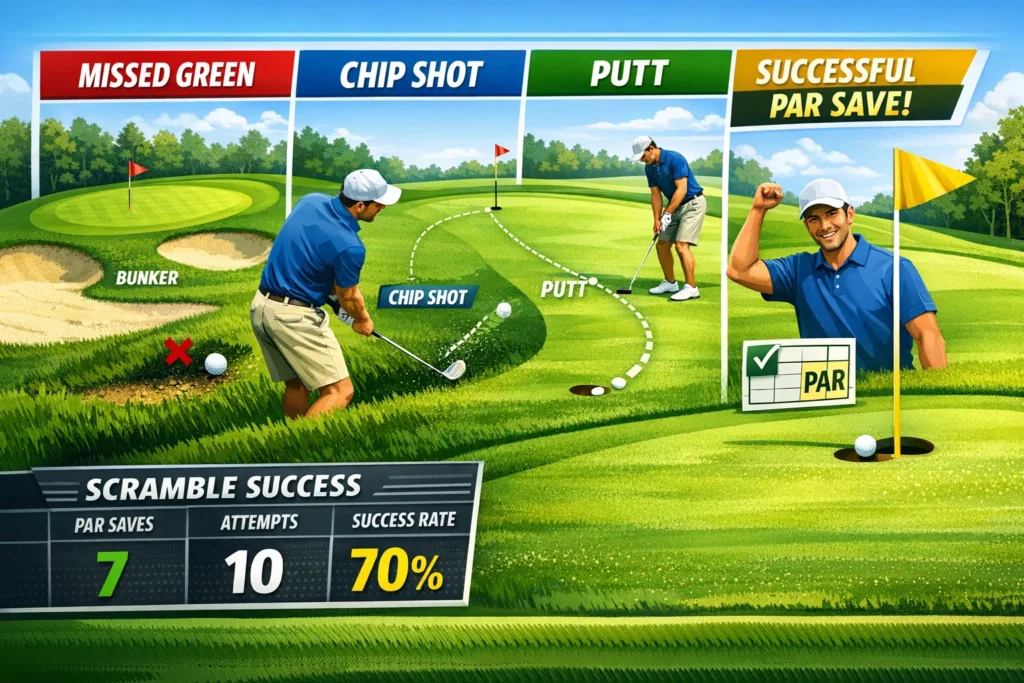
Scrambling in golf means saving par after missing the green in regulation.
It refers to a situation where a golfer fails to reach the green in the expected number of strokes but still manages to score par or better by getting up and down using chips, pitches, or putts.
Golf is a game filled with precision, patience, and strategy. While most people focus on long drives or perfect iron shots, there is another skill that quietly separates good golfers from great ones. That skill is scrambling.
Scrambling is what happens when things do not go as planned. Even professional golfers miss greens, hit poor approach shots, or find themselves in difficult positions. What matters next is how they recover. Scrambling is the art of turning a potential bogey into a par or even a birdie.
It is one of the most important short game skills in golf because it measures creativity, control, and mental toughness. Players who are strong at scrambling can stay competitive even when their long game is not at its best.
In this guide, you will learn what scrambling means in golf, how it is calculated, why it matters, examples of real situations, techniques to improve it, and how professionals use it to win tournaments.
What Scrambling Means in Golf
Scrambling in golf refers to the ability to save par after missing the green in regulation.
To understand it better, let’s break it down:
- A golfer is expected to reach the green in a certain number of strokes based on the hole difficulty
- If they miss the green in that expected number of shots, they are “off the green in regulation”
- If they still manage to finish the hole in par or better, that is a successful scramble
In simple terms, scrambling is about recovery after a missed shot.
What Does “Up and Down” Mean
Scrambling is closely connected to another important golf term called “up and down.”
An “up and down” happens when:
- You hit the ball onto the green from off the green (the “up”)
- Then you take only one putt to finish the hole (the “down”)
So if a golfer chips onto the green and then sinks the putt, they have completed an up and down, which counts as a successful scramble.
How Scrambling Is Calculated
Scrambling is measured as a percentage. It shows how often a golfer successfully saves par after missing the green.
Formula for Scrambling Percentage
Scrambling percentage is calculated like this:
Successful scrambles divided by total missed greens in regulation multiplied by 100
For example:
- A golfer misses 10 greens in a round
- They save par on 6 of those holes
- Their scrambling percentage is 60 percent
This number helps evaluate how good a player is around the greens.
Example of Scrambling in Real Golf Situations
To understand scrambling better, let’s look at real game situations.
Example 1
A golfer is playing a par 4 hole.
- Tee shot is good
- Approach shot misses the green
- Ball lands in rough near the green
- Golfer chips onto the green
- One putt is made
Result is par. That is a successful scramble.
Example 2
On a par 3 hole:
- Tee shot misses the green
- Ball lands in bunker
- Golfer plays a sand shot onto the green
- Two putts are made
Result is bogey. That is not a successful scramble.
Example 3
On a par 5:
- Second shot misses green
- Ball is near fringe
- Chip shot lands close
- Putt is made for birdie
Result is better than par. That is also considered a successful scramble.
Why Scrambling Is Important in Golf
Scrambling is one of the most important skills in golf because no player hits every green. Even professionals miss shots, especially under pressure.
1. It Saves Strokes
Good scrambling helps prevent bogeys. Instead of dropping shots, players maintain their score.
2. It Builds Confidence
Knowing you can recover from mistakes reduces pressure and improves mental focus.
3. It Separates Good Players From Great Ones
Top golfers often have excellent scrambling ability. It keeps their scores low even on bad ball striking days.
4. It Improves Short Game Skills
Scrambling forces players to improve chipping, pitching, bunker shots, and putting.
Key Skills Needed for Good Scrambling
Scrambling is not just one skill. It involves several short game abilities working together.
Chipping
Short shots near the green that require touch and accuracy.
Pitching
Higher shots that land softly on the green.
Putting
Finishing the hole with minimal strokes.
Course Management
Choosing the safest and smartest recovery option.
Mental Strength
Staying calm after a bad shot and focusing on recovery.
Scrambling vs Greens in Regulation
These two stats are often used together in golf analysis.
| Term | Meaning |
|---|---|
| Greens in Regulation | Hitting the green in expected number of strokes |
| Scrambling | Saving par after missing the green |
A player may have low greens in regulation but still score well if their scrambling is strong.
Professional Golf and Scrambling
In professional golf, scrambling is tracked closely because it reflects consistency under pressure.
Top players often have scrambling percentages above 60 percent, meaning they recover successfully more than half the time when they miss a green.
Professional golfers rely heavily on scrambling during tournaments because even the best ball strikers miss greens occasionally. What matters is how well they recover.
Types of Scrambling Situations
Scrambling can happen from different areas around the green.
From the Rough
Most common situation where golfers miss the green slightly.
From Bunkers
Requires technique and precision to escape sand and get close to the hole.
From Fringe
Short chips or putts from just off the green.
From Difficult Lies
Uneven ground or thick grass requiring creative shots.
Techniques to Improve Scrambling
Improving scrambling requires practice and patience.
1. Practice Short Game Daily
Spend more time on chipping and putting than driving.
2. Learn Different Shot Types
Practice bump and run, flop shots, and controlled pitches.
3. Improve Distance Control
Focus on landing the ball close to the hole rather than just getting it on the green.
4. Read Greens Carefully
Understanding slopes helps improve putting success.
5. Practice Bunker Shots
Many scrambling situations involve sand shots.
6. Stay Mentally Calm
Do not panic after a missed green. Focus on recovery.
Common Mistakes in Scrambling
Many golfers struggle with scrambling because of simple mistakes.
- Trying overly difficult shots instead of safe ones
- Poor distance control on chips
- Rushing putts under pressure
- Lack of practice in short game
- Negative thinking after a bad shot
Avoiding these mistakes can significantly improve performance.
Scrambling Strategy on the Course
Good golfers do not just react. They plan their recovery.
Smart Scrambling Strategy
- Aim for safest landing area near the green
- Avoid risky shots unless necessary
- Focus on getting the ball close, not perfect
- Prioritize putting opportunities
Sometimes the smartest scramble is a simple chip and safe two putts rather than an aggressive risky shot.
Scrambling and Mental Game
Scrambling is not only physical. It is also mental.
Golfers who scramble well often share these traits:
- Calm under pressure
- Positive attitude after mistakes
- Strong focus on next shot only
- Confidence in short game ability
A good mindset can turn a bad situation into a good score.
Scrambling Percentage Guide
Here is a simple interpretation of scrambling percentages:
| Scrambling Percentage | Skill Level |
|---|---|
| Below 40 percent | Needs improvement |
| 40 to 50 percent | Average golfer |
| 50 to 60 percent | Good player |
| Above 60 percent | Very strong short game |
Professional players often aim for the higher range.
FAQs
What does scrambling mean in golf
Scrambling means saving par after missing the green in regulation using short game shots and putting.
Is scrambling good in golf
Yes. A higher scrambling percentage shows strong short game skills and good recovery ability.
What is an up and down in golf
An up and down means getting the ball onto the green and finishing the hole in one putt.
Does scrambling include birdies
Yes. If you miss the green but still score birdie, it counts as a successful scramble.
What is a good scrambling percentage for amateurs
Around 50 percent is considered good for most amateur golfers.
Why is scrambling important
It helps reduce scores, saves strokes, and improves overall consistency.
Do professional golfers focus on scrambling
Yes. Professionals spend a lot of time practicing short game and recovery shots.
Can scrambling improve my handicap
Yes. Better scrambling often leads to lower scores and improved handicap.
Conclusion
Scrambling in golf is one of the most important skills for any player who wants to improve their game. It represents the ability to recover after missing the green and still save par or better. While driving and iron shots often get attention, scrambling is what keeps scores low when mistakes happen.
A strong scrambling game shows confidence, creativity, and control in the short game. It involves chipping, pitching, putting, and smart decision making under pressure. Players who master scrambling often perform better even on bad ball striking days.
In simple terms, scrambling is the art of turning problems into opportunities. It is what keeps golfers competitive, consistent, and confident on the course.
Read More Related Articles:

Neon Samuel is a digital content creator at TextSprout.com, dedicated to decoding modern words, slang, and expressions. His writing helps readers quickly grasp meanings and understand how terms are used in real conversations across text and social platforms.