
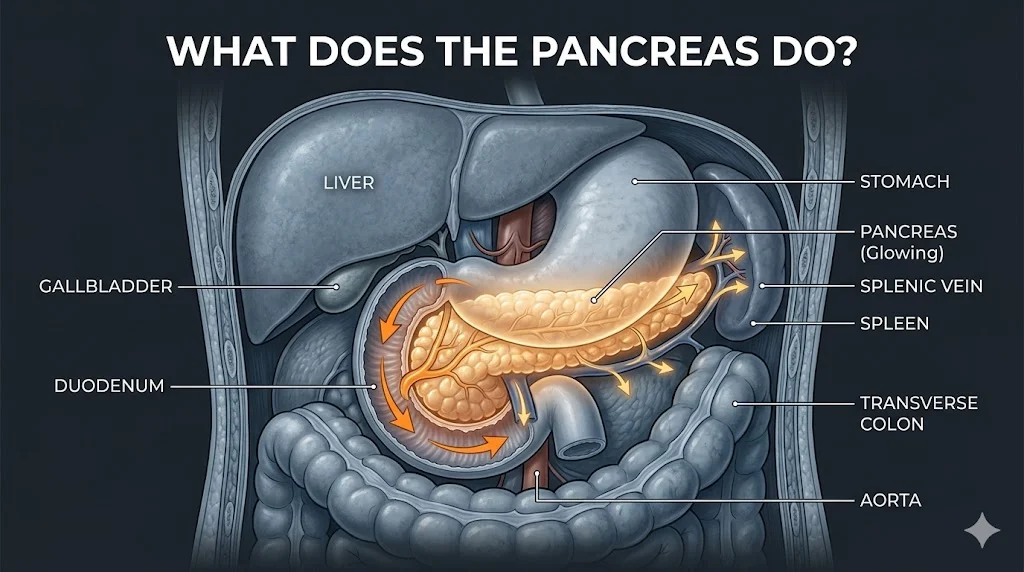
Most people go their entire lives without thinking about their pancreas right up until something goes wrong with it. Then it demands every ounce of attention. Tucked quietly behind your stomach, this unassuming, 6-inch organ is silently running two of your body’s most critical systems at the same time, every single day.
So what does the pancreas do, exactly? The short answer: a lot. The full answer is what this guide is for.
Whether you’re trying to understand a diagnosis, prep for a health conversation, or just satisfy genuine curiosity you’re in the right place. Let’s break it all down.
What Is the Pancreas?
Before getting into function, let’s get the anatomy straight. The pancreas is a soft, elongated gland nestled deep in the upper left abdomen, tucked snugly behind the stomach and in front of the spine. It sits in the curve of the duodenum the first section of the small intestine which is no accident. That positioning is essential to how it does its job.
It measures roughly 6 to 10 inches long and weighs about 70 to 100 grams in a healthy adult. Shape-wise, think of a flattened tadpole wider at one end, tapering to a narrow tail.
The Three Structural Parts
| Part | Location | Key Role |
|---|---|---|
| Head | Nestled in the curve of the duodenum | Connects pancreatic duct to small intestine |
| Body | Central section behind the stomach | Bulk of enzyme and hormone production |
| Tail | Extends toward the spleen | Dense with insulin-producing beta cells |
Each section contains both types of functional tissue exocrine and endocrine though the tail is especially rich in the hormone-producing clusters called islets of Langerhans.
Neighboring the liver, gallbladder, spleen, and stomach, the pancreas sits at a literal crossroads of the digestive and circulatory systems. That central location isn’t just anatomical trivia it’s the reason one organ can serve two completely different masters.
The Two Jobs the Pancreas Does Simultaneously
Here’s what makes the pancreas genuinely remarkable: it’s two organs in one.
Most organs specialize. The heart pumps. The lungs breathe. The kidneys filter. But the pancreas pulls double duty, operating two entirely separate functional systems within the same physical structure the exocrine system and the endocrine system.
“The pancreas is like a factory with two completely independent production lines running side by side, 24 hours a day, without ever mixing up their shipments.”
Here’s how they compare:
| Feature | Exocrine Function | Endocrine Function |
|---|---|---|
| What it produces | Digestive enzymes + bicarbonate | Hormones (insulin, glucagon, others) |
| Where it delivers | Into the small intestine via ducts | Directly into the bloodstream |
| Primary purpose | Break down food | Regulate blood sugar |
| Tissue involved | Acinar cells (~98–99% of pancreas) | Islets of Langerhans (~1–2%) |
That 1–2% of endocrine tissue? Don’t let the small percentage fool you. It’s responsible for keeping every cell in your body fueled and when it malfunctions, the consequences are life-altering.
Pancreas Function in Digestion: The Exocrine System Explained
Let’s start with the digestive role, since it accounts for the vast majority of pancreatic activity.
What Is Pancreatic Juice?
Every time you eat, your pancreas gets to work producing pancreatic juice a clear, alkaline fluid that does the heavy lifting in your small intestine. Your pancreas produces roughly 1.5 liters of this fluid every single day.
Pancreatic juice contains two critical components:
- Digestive enzymes the molecular scissors that cut food into absorbable pieces
- Sodium bicarbonate an alkaline buffer that neutralizes the stomach acid your food is soaked in before it hits the duodenum
That second point is easy to overlook, but it’s vital. Stomach acid has a pH of around 2 corrosive enough to damage the intestinal lining. The bicarbonate in pancreatic juice raises that pH to a safe level before the enzymes can even begin their work.
The Three Enzymes the Pancreas Produces
The pancreas manufactures three categories of digestive enzymes, each targeting a different macronutrient:
1. Amylase: The Carbohydrate Cutter
- Breaks down complex carbohydrates and starches into simple sugars like maltose and glucose
- Works on the pasta, bread, rice, and potatoes in your meal
- Salivary glands also produce a form of amylase, but pancreatic amylase does most of the heavy work
2. Lipase: The Fat Splitter
- Breaks down dietary fats (triglycerides) into fatty acids and glycerol
- Works in partnership with bile from the gallbladder, which emulsifies fat droplets first
- Without sufficient lipase, fat passes through undigested a condition called steatorrhea (fatty, foul-smelling stools)
3. Proteases: The Protein Processors
- Includes trypsin, chymotrypsin, and elastase
- Breaks down proteins into smaller peptides and amino acids
- These are the enzymes that allow your body to actually use the protein you eat
Why Enzymes Are Released Inactive: And Why It Matters
Here’s a fascinating detail that most people never learn: the pancreas releases its proteases in an inactive form, called zymogens. Trypsinogen, for example, only becomes active trypsin once it reaches the small intestine.
Why? Because active proteases would digest the pancreas itself. The organ essentially ships a loaded weapon with the safety on and the small intestine’s environment flips the switch.
When this protective mechanism breaks down due to gallstones, alcohol, or genetic factors the enzymes activate inside the pancreas. That’s acute pancreatitis, and it’s as painful as it sounds.
Step-by-Step: How Pancreatic Digestion Actually Works
- You eat a meal containing carbohydrates, fats, and proteins
- The stomach partially digests food and releases it into the duodenum
- The duodenum releases two hormones secretin and cholecystokinin (CCK) into the bloodstream
- Secretin signals the pancreas to release bicarbonate; CCK triggers enzyme release
- Pancreatic juice flows through the pancreatic duct into the duodenum
- Enzymes activate and begin systematically breaking down every macronutrient
- The intestinal lining absorbs the resulting nutrients into the bloodstream
The whole process is tightly choreographed. Disrupt any step block the duct, damage the acinar cells, or interfere with hormone signaling and digestion falls apart.
Pancreas Function in Blood Sugar Regulation: The Endocrine System Explained
Now for the second job the one that connects the pancreas to diabetes, metabolism, and nearly every cell in your body.
The Islets of Langerhans: Small Clusters, Enormous Power
Scattered throughout the pancreas are roughly 1 million tiny clusters of hormone-producing cells called the islets of Langerhans (named after German pathologist Paul Langerhans, who discovered them in 1869). Each islet is a self-contained endocrine unit containing four main cell types:
| Cell Type | Hormone Produced | Function |
|---|---|---|
| Beta cells (~65–80%) | Insulin | Lowers blood glucose; promotes storage |
| Alpha cells (~15–20%) | Glucagon | Raises blood glucose; promotes release |
| Delta cells (~3–10%) | Somatostatin | Regulates insulin and glucagon release |
| PP cells (~1%) | Pancreatic polypeptide | Modulates enzyme secretion and appetite |
Beta and alpha cells are the stars of the show. They operate as a perfectly balanced push-pull system one raises blood sugar, the other lowers it keeping glucose levels within a remarkably narrow range.
Insulin: The “Storage” Hormone
Insulin is the pancreas’s most famous product, and for good reason. After a meal, blood glucose rises. Beta cells detect this rise and release insulin into the bloodstream. Insulin then:
- Signals muscle, fat, and liver cells to absorb glucose from the blood
- Promotes glycogen synthesis in the liver converting excess glucose into stored form
- Encourages fat storage when glycogen tanks are full
- Suppresses glucose production in the liver
Think of insulin as a master key. Every cell in your body has insulin receptors essentially locks. When insulin binds to those receptors, the cell opens up and lets glucose in. Without the key, glucose piles up in the blood but can’t enter the cells that need it. That’s the central tragedy of diabetes.
Normal insulin response timeline:
- Blood glucose rises within 15–30 minutes of eating
- Beta cells respond within 2–5 minutes
- Peak insulin release occurs around 30–60 minutes post-meal
- Blood glucose returns to baseline within 2–3 hours
Glucagon: The “Release” Hormone
While insulin gets most of the attention, glucagon is equally critical. When blood glucose drops during fasting, exercise, or between meals alpha cells release glucagon, which:
- Signals the liver to break down glycogen back into glucose (glycogenolysis)
- Triggers gluconeogenesis the creation of new glucose from amino acids and fats
- Mobilizes fat stores for energy
Glucagon is essentially your body’s emergency fuel line. Without it, blood sugar would crash dangerously during any period of fasting. People with Type 1 diabetes carry glucagon emergency kits for exactly this reason if they inject too much insulin and blood sugar plummets, glucagon can reverse the crash rapidly.
The Blood Sugar Feedback Loop
Your body maintains fasting blood glucose between 70–99 mg/dL through a continuous feedback system:
Blood glucose rises (after eating)
        ↓
Beta cells release insulin
        ↓
Cells absorb glucose; liver stores excess
        ↓
Blood glucose falls
        ↓
Alpha cells release glucagon
        ↓
Liver releases stored glucose
        ↓
Blood glucose rises back to normal
This loop runs constantly, 24/7. The precision is extraordinary a healthy pancreas keeps blood sugar within a tight range even during prolonged fasting or high-carbohydrate meals.
Why the Pancreas Is Critical to Metabolism
Metabolism is often reduced to “how fast you burn calories.” It’s actually far more nuanced it’s the entire system by which your body manages, converts, and distributes energy. The pancreas sits at the control center.
Here’s what people miss: the pancreas doesn’t just regulate carbohydrate metabolism. It governs all three macronutrients:
- Carbohydrates insulin and glucagon control glucose storage and release
- Fats insulin suppresses fat breakdown; low insulin triggers fat mobilization
- Proteins insulin promotes amino acid uptake for muscle repair and growth
When the pancreas fails to produce sufficient insulin, it doesn’t just cause high blood sugar. It triggers a cascade where fat breaks down uncontrollably, proteins get burned for energy instead of building tissue, and the body essentially enters a starvation state even when plenty of food is available.
That’s why untreated Type 1 diabetes is fatal without insulin replacement. It’s not just a “sugar problem.” It’s total metabolic collapse.
The Pancreas and Diabetes: A Connection You Need to Understand
No conversation about pancreas function is complete without addressing diabetes. It’s the most common consequence of pancreatic endocrine dysfunction and one of the most prevalent chronic diseases on the planet.
Type 1 Diabetes: When the Immune System Attacks
In Type 1 diabetes, the immune system mistakenly identifies beta cells as threats and destroys them. The result: the pancreas produces little to no insulin.
Key facts about Type 1 diabetes:
- Affects approximately 8–9 million people worldwide
- Usually diagnosed in children, teens, and young adults (though it can appear at any age)
- Not caused by diet or lifestyle it’s an autoimmune condition
- Requires insulin therapy for survival no insulin means no glucose uptake, no life
- Cannot be reversed with lifestyle changes (unlike Type 2)
Type 2 Diabetes: When the System Gets Overwhelmed
Type 2 diabetes is a different beast. Beta cells still function at least initially but the body’s cells become insulin resistant. The pancreas compensates by producing more and more insulin. Over years, the beta cells exhaust themselves from overproduction and start to fail.
Key facts about Type 2 diabetes:
- Affects over 500 million adults globally as of 2021 (IDF Diabetes Atlas)
- Strongly linked to excess body weight, physical inactivity, and diet
- Can be significantly improved or reversed in early stages through lifestyle intervention
- Eventually may require insulin therapy as beta cell function declines
- Often precedes a period of prediabetes a warning window most people miss
Prediabetes: The Window You Don’t Want to Miss
Prediabetes means blood sugar is elevated but not yet at diabetic levels. Fasting glucose falls between 100–125 mg/dL. At this stage, beta cells are struggling but haven’t failed. Intervention here through diet, exercise, and weight management can fully restore normal glucose regulation and prevent Type 2 diabetes from developing.
Over 88 million Americans have prediabetes. More than 80% don’t know it.
What Happens When the Pancreas Fails or Gets Sick?
When this organ goes wrong, it goes spectacularly, painfully wrong. Here are the most significant conditions affecting pancreatic function.
Pancreatitis: When the Pancreas Attacks Itself
Pancreatitis occurs when digestive enzymes activate inside the pancreas instead of the small intestine. The organ begins digesting itself. It’s one of the most agonizing abdominal conditions known to medicine.
Acute pancreatitis:
- Sudden onset, usually resolves with treatment
- Symptoms: severe upper abdominal pain radiating to the back, nausea, vomiting, fever
- Most common causes: gallstones (40%) and excessive alcohol (30%)
- Hospitalization is usually required
- Most cases resolve fully; severe cases can be life-threatening
Chronic pancreatitis:
- Repeated inflammation that permanently scars pancreatic tissue
- Leads to progressive loss of both exocrine and endocrine function
- Eventually causes both digestive problems AND diabetes
- Chronic pain is often the most debilitating symptom
Exocrine Pancreatic Insufficiency (EPI)
EPI happens when the pancreas can’t produce enough digestive enzymes. Food passes through partially or completely undigested.
Signs of EPI include:
- Chronic diarrhea
- Fatty, greasy, foul-smelling stools (steatorrhea)
- Unintentional weight loss
- Nutritional deficiencies (especially fat-soluble vitamins A, D, E, K)
- Bloating and abdominal discomfort after eating
EPI is commonly caused by chronic pancreatitis, pancreatic cancer, or cystic fibrosis. It’s frequently underdiagnosed because its symptoms overlap with IBS and other digestive conditions. Treatment involves pancreatic enzyme replacement therapy (PERT) oral enzymes taken with every meal.
Pancreatic Cancer: The Silent, Dangerous One
Pancreatic cancer is one of the deadliest forms of cancer, primarily because it produces almost no symptoms until it has spread significantly.
Critical facts:
- 5-year survival rate is approximately 12% among the lowest of any cancer
- The pancreas’s deep location makes tumors nearly undetectable in early stages
- Most cases are diagnosed at Stage III or IV, when surgery is no longer curative
- Risk factors include: smoking (doubles risk), chronic pancreatitis, Type 2 diabetes, obesity, family history, and age over 65
- Pancreatic ductal adenocarcinoma (PDAC) accounts for roughly 90% of cases
Warning signs that warrant immediate investigation:
- Painless jaundice (yellowing of skin and eyes)
- New-onset diabetes in older adults with no family history
- Unexplained weight loss
- Upper abdominal or back pain that doesn’t resolve
Cystic Fibrosis and the Pancreas
In cystic fibrosis, a genetic mutation causes thick, sticky mucus to block the pancreatic ducts. Enzymes can’t reach the small intestine and end up trapped damaging the pancreas from within. Most CF patients develop EPI and require enzyme replacement therapy. Over time, many also develop cystic fibrosis-related diabetes (CFRD) as endocrine tissue is destroyed.
How to Keep Your Pancreas Healthy
Good news: the pancreas is resilient, and most of the choices that protect it are straightforward lifestyle decisions.
Protect your pancreas with these evidence-based habits:
- Limit or avoid alcohol chronic heavy drinking is the second leading cause of pancreatitis and directly damages pancreatic tissue over time
- Don’t smoke smoking is independently linked to both pancreatitis and pancreatic cancer
- Maintain a healthy body weight visceral (abdominal) fat promotes insulin resistance and puts chronic stress on beta cells
- Eat a balanced diet emphasize whole foods, fiber, and healthy fats; minimize ultra-processed foods and added sugars
- Stay hydrated adequate hydration supports enzyme production and keeps pancreatic ducts flowing freely
- Manage blood sugar proactively even prediabetes causes cumulative beta cell stress; don’t wait for a diagnosis to act
- Treat gallstones promptly gallstones are the leading cause of acute pancreatitis; don’t ignore symptoms
- Get regular checkups if you have a family history of pancreatic disease or cancer, discuss screening options with your doctor
FAQs
What does the pancreas do in simple terms?
The pancreas does two things: it produces digestive enzymes that break down food in the small intestine, and it produces hormones mainly insulin and glucagon that keep your blood sugar in a healthy range. It’s the only organ in the body that serves both the digestive and endocrine systems simultaneously.
Is the pancreas part of the digestive system or the endocrine system?
Both. About 98–99% of pancreatic tissue is exocrine and serves digestion. The remaining 1–2% the islets of Langerhans is endocrine tissue that releases hormones into the bloodstream. This dual role makes the pancreas anatomically unique.
Can you live without a pancreas?
Yes but it requires lifelong medical management. A total pancreatectomy (surgical removal) leaves the patient with no insulin, no glucagon, and no digestive enzymes. This is called brittle diabetes or Type 3c diabetes and is extremely difficult to control. Patients must take insulin injections, enzyme replacement pills with every meal, and other hormone supplements indefinitely.
What’s the difference between Type 1 and Type 2 diabetes in relation to the pancreas?
In Type 1, the immune system destroys the beta cells entirely so the pancreas produces no insulin at all. In Type 2, the beta cells still function but the body becomes resistant to insulin’s effects; over time, the beta cells burn out from overwork. Both result in high blood sugar, but the underlying pancreatic mechanism is completely different.
What are early warning signs that something is wrong with your pancreas?
Warning signs include: persistent upper abdominal pain (especially if it radiates to the back), unexplained weight loss, oily or floating stools, new-onset diabetes without family history, jaundice, or nausea after eating fatty meals. None of these are diagnostic on their own, but any of them warrant a conversation with a doctor.
Conclusion
The pancreas is one of those organs that only gets noticed when something goes wrong and by then, it’s often been quietly struggling for years. It doesn’t beat visibly like the heart or expand with every breath like the lungs. It just works, relentlessly, behind the scenes.
But now you know what it’s actually doing. It’s breaking down every meal you eat. It’s keeping your blood sugar stable through every fast and every feast. And it’s balancing two complex biological systems simultaneously, with precision that no medical device has yet been able to fully replicate.
Understanding what your pancreas does is the first step toward protecting it. Make the lifestyle choices that support it before you have a reason not to. If you have symptoms that concern you or a family history of pancreatic disease, don’t wait. Speak to your doctor. Early awareness saves lives.
Read More Related Articles:
- MMCHT in Texts: Meaning, Tone, and How to Use It in 2026
- SG in Text: The Meaning Changes More Than You Think (2026)
- STG Meaning in Texting: Promise or Just Slang? (2026)

Neon Samuel is a digital content creator at TextSprout.com, dedicated to decoding modern words, slang, and expressions. His writing helps readers quickly grasp meanings and understand how terms are used in real conversations across text and social platforms.