
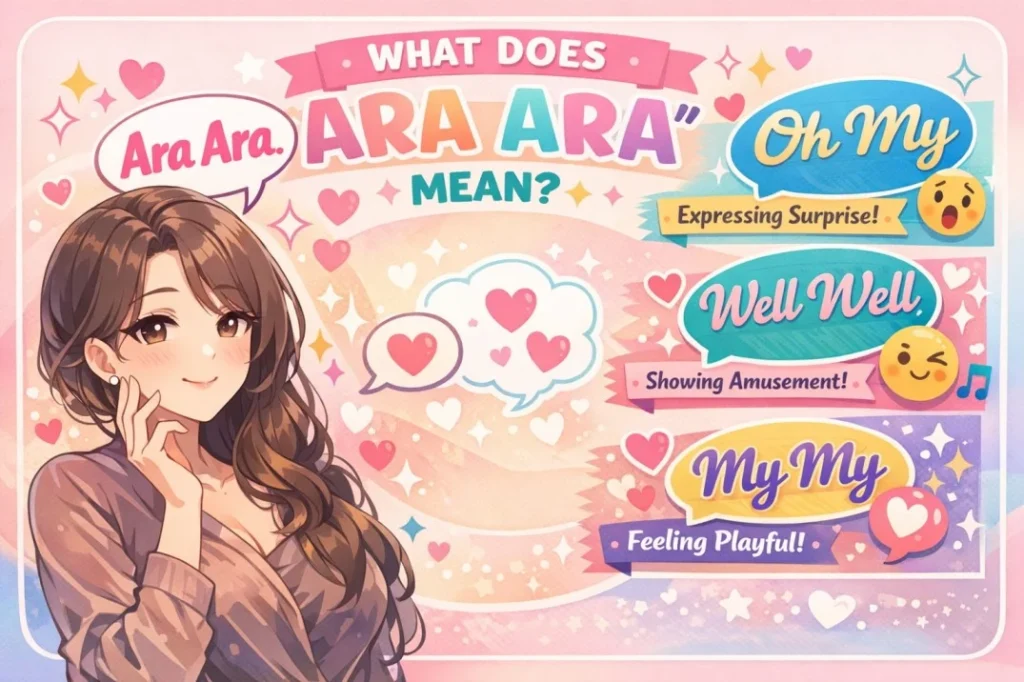
“Ara ara” is a Japanese expression used to show mild surprise, amusement, or playful curiosity.
In English, it loosely translates to phrases like “oh my,” “well well,” or “my, my.” The exact meaning depends heavily on tone, context, and the speaker’s personality.
If you’ve spent time watching anime, browsing memes, or scrolling through social media, you’ve probably heard the phrase “ara ara.” It often appears in playful, mysterious, or slightly teasing situations, usually spoken by a calm or confident character. For many English speakers, the phrase can feel confusing because it does not have a direct one word translation.
So what does it actually mean, and why is it used so often in Japanese media and online culture?
Understanding “ara ara” is not just about translation. It is about tone, context, and subtle emotional expression. Once you grasp how it is used, you will start recognizing it everywhere and understand exactly what the speaker is trying to convey.
Origin and Cultural Background
The phrase “ara ara” comes from everyday Japanese language, where short expressions are often used to convey emotion rather than literal meaning.
The word “ara” by itself is already an expression of surprise, similar to saying “oh” or “ah” in English. When repeated as “ara ara,” it adds emphasis and a softer, more expressive tone.
In traditional Japanese settings, it is often associated with:
- Polite or refined speech
- Older women or mature female characters
- Gentle reactions rather than strong emotions
Over time, anime and internet culture have amplified its use, giving it new layers of meaning that go beyond its original everyday usage.
What “Ara Ara” Means in English
Since “ara ara” does not have a direct translation, its meaning changes depending on how it is used. Here are some common English equivalents.
| Japanese Phrase | Closest English Meaning | Tone |
|---|---|---|
| Ara ara | Oh my | Mild surprise |
| Ara ara | Well well | Curious or amused |
| Ara ara | My my | Playful or teasing |
| Ara ara | Oh dear | Gentle concern |
The key thing to remember is that “ara ara” is more about feeling and tone than literal translation.
Common Uses of “Ara Ara”
1. Mild Surprise
One of the most common uses is to express light surprise in a calm and gentle way.
Example:
Someone does something unexpected
Response:
“Ara ara… I didn’t expect that.”
This is softer than saying “What?” or “Wow” and feels more composed.
2. Playful Teasing
In anime and online culture, “ara ara” is often used in a teasing or flirtatious way.
Example:
“Ara ara… looks like someone is in trouble.”
Here, the tone is slightly playful and sometimes mischievous.
3. Gentle Curiosity
It can also express curiosity without sounding harsh or direct.
Example:
“Ara ara… what’s going on here?”
This feels softer than asking directly and adds a layer of politeness.
4. Mock Concern
Sometimes it is used to show light concern, often in a dramatic or humorous way.
Example:
“Ara ara… are you okay?”
This can sound caring or slightly exaggerated depending on tone.
Tone and Emotional Context
The meaning of “ara ara” changes significantly depending on how it is said. Tone plays a huge role.
Friendly Tone 😊
Used in a warm and kind way
Example:
“Ara ara, you did your best.”
Feels encouraging and supportive.
Playful or Flirty Tone 😉
Often used in anime by confident characters
Example:
“Ara ara… you’re blushing.”
Feels teasing and slightly mischievous.
Neutral Tone
Used casually without strong emotion
Example:
“Ara ara, that’s interesting.”
Feels observational and calm.
Slightly Dismissive Tone
Rare, but possible depending on context
Example:
“Ara ara… is that all?”
Can feel subtly condescending if used this way.
Popularity in Anime and Internet Culture
The phrase became globally popular through anime. It is often associated with a specific character type.
The “Ara Ara” Character
Usually a mature, confident, and calm woman who speaks gently but carries authority.
These characters often use “ara ara” to:
- Tease younger characters
- Show amusement
- Maintain a composed personality
This has led to the phrase becoming a meme online, especially in gaming and anime communities.
Examples in Real Context
Here are some realistic examples showing how “ara ara” might be used.
| Situation | Example | Meaning |
|---|---|---|
| Someone makes a mistake | Ara ara, be careful next time | Gentle correction |
| Someone is embarrassed | Ara ara… how cute | Playful teasing |
| Unexpected event | Ara ara, that was surprising | Mild surprise |
| Friendly conversation | Ara ara, tell me more | Curious interest |
These examples show how flexible the phrase can be.
Comparison With Similar Expressions
“Ara ara” is not the only Japanese expression like this. Here are some similar ones.
| Phrase | Meaning | Difference |
|---|---|---|
| Ara | Oh | Shorter and less expressive |
| Maa maa | Well well or calm down | More soothing tone |
| Eto | Um | Used for hesitation, not surprise |
| Hee | Oh really | Shows interest or surprise |
Compared to these, “ara ara” feels more elegant and expressive.
Alternate Meanings Outside Japanese
While “ara ara” is primarily a Japanese phrase, it can have different meanings in other contexts.
| Context | Meaning |
|---|---|
| Japanese language | Expression of surprise or amusement |
| Internet slang | Meme associated with anime characters |
| Other languages | May have unrelated meanings depending on region |
In most cases online, it is safe to assume the Japanese meaning is intended.
Professional or Polite Alternatives in English
If you want to express a similar feeling in English without sounding informal or anime inspired, you can use:
- Oh my, that is interesting
- Well, that is unexpected
- I see, tell me more
- That is quite surprising
- Oh dear, are you alright
These alternatives are more appropriate in formal or professional settings.
Real World Scenario
Imagine a teacher noticing a student struggling but trying their best.
They might say:
“Oh my, you are working hard. Let me help you.”
In an anime style, this might become:
“Ara ara, you are trying so hard.”
Both convey kindness, but the tone and cultural style are different.
Why “Ara Ara” Feels Unique
What makes “ara ara” special is its emotional flexibility. It can express surprise, curiosity, affection, or teasing all at once, depending on delivery.
English often requires multiple words or tone changes to achieve the same effect, while “ara ara” does it with just a simple phrase.
FAQs
What does ara ara mean in English?
It loosely means “oh my,” “well well,” or “my my,” depending on context and tone.
Is ara ara a real Japanese phrase?
Yes, it is a genuine expression used in Japanese to show mild surprise or curiosity.
Why do anime characters say ara ara?
It is often used by calm or mature characters to express gentle amusement or teasing.
Is ara ara flirtatious?
It can be, depending on tone. In many anime scenes, it is used in a playful or teasing way.
Can men say ara ara?
Yes, but it is more commonly associated with female speech in media.
Is ara ara formal or informal?
It is generally informal but polite in tone. It is not typically used in formal business settings.
Does ara ara always mean the same thing?
No, its meaning changes depending on context, tone, and situation.
Is ara ara used in real life or just anime?
It is used in real life, but less dramatically than in anime. In everyday conversation, it is usually softer and more natural.
Conclusion
“Ara ara” is a simple yet expressive Japanese phrase that carries a range of meanings depending on context and tone. While it loosely translates to expressions like “oh my” or “well well,” its true meaning lies in how it is delivered.
From gentle surprise to playful teasing, “ara ara” adds emotional depth to conversations in a way that is uniquely Japanese. Its popularity in anime and online culture has made it recognizable worldwide, but understanding its subtle nuances allows you to appreciate it more fully.
Whether you encounter it in a show, a meme, or a conversation, you now know that “ara ara” is not just a phrase. It is a reflection of tone, personality, and cultural expression.
Read More Related Articles:
- What Does Patent Mean in Medical Terms? Clinical Significance In 2026
- What Does Pick 6 Mean in Football? From Interception to Touchdown In 2026
- What Does SRS Mean in a Car: Why This Safety Feature Matters In 2026

Neon Samuel is a digital content creator at TextSprout.com, dedicated to decoding modern words, slang, and expressions. His writing helps readers quickly grasp meanings and understand how terms are used in real conversations across text and social platforms.