
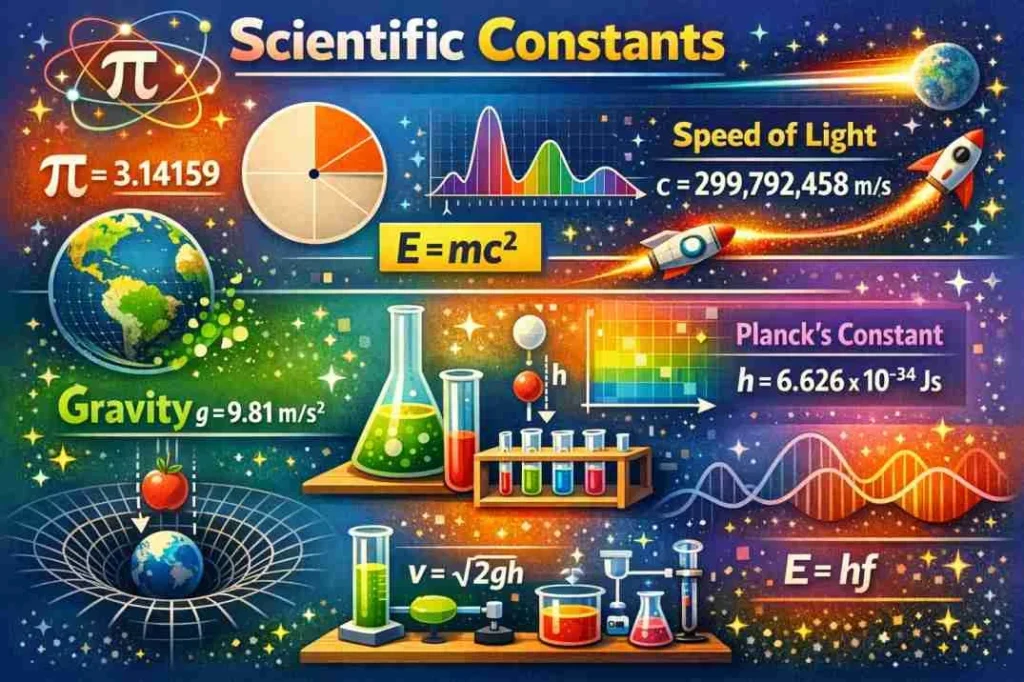
In science, a constant is a value that does not change under specific conditions and remains the same throughout an experiment, equation, or natural law.
Constants can be fixed numbers like π in mathematics or universal values like the speed of light in physics.
Have you ever wondered why some values in science never seem to change, no matter the situation? Whether you are studying physics, chemistry, or mathematics, you will often encounter the word constant. It might sound simple at first, but this concept plays a powerful role in how we understand the universe.
From the speed of light to fixed numbers in equations, constants help scientists describe patterns, make predictions, and ensure accuracy in experiments. Without constants, scientific formulas would become unreliable, and comparing results would be much more difficult.
Understanding what a constant means in science is not just helpful for students. It also builds a deeper appreciation for how nature behaves in a consistent and predictable way.
What Is a Constant in Simple Terms
A constant is something that stays the same. It does not vary, shift, or depend on other variables within a given context.
For example, imagine you are measuring how fast an object falls. The acceleration due to gravity on Earth remains constant at approximately 9.8 meters per second squared. This means every object falls at the same rate regardless of its size, assuming air resistance is ignored.
Constants bring stability to scientific calculations. They act as reliable reference points that allow scientists to compare results and build accurate models.
Types of Constants in Science
Not all constants are the same. Different scientific fields use different types of constants depending on what they are studying.
Mathematical Constants
These are fixed numbers that always remain the same.
Examples include
- π which represents the ratio of a circle’s circumference to its diameter
- e which is used in exponential growth and decay
Physical Constants
These are universal values found in nature.
Examples include
- Speed of light
- Gravitational constant
- Planck’s constant
Experimental Constants
These are values kept unchanged during an experiment to ensure fairness.
For example, if you are testing plant growth, you might keep sunlight, water, and soil type constant while changing only the fertilizer.
Table: Types of Constants with Examples
| Type of Constant | Example | Description |
|---|---|---|
| Mathematical | π | Fixed numerical value used in geometry |
| Physical | Speed of light | Universal value in physics |
| Experimental | Temperature in a lab | Controlled variable kept unchanged |
Why Constants Are Important in Science
Constants play a critical role in making science reliable and predictable.
They Ensure Accuracy
Without constants, calculations would vary every time. Scientists rely on constants to get consistent results.
They Help in Formulas
Most scientific formulas include constants. For example, the equation for energy includes constants that make calculations precise.
They Allow Comparisons
When constants are used, experiments can be repeated and compared across different locations and times.
They Support Scientific Laws
Many laws of nature depend on constants. These laws would not hold true without stable values.
Real World Examples of Constants
Constants are not just theoretical. They appear in everyday science and practical applications.
Example 1: Speed of Light
The speed of light is always the same in a vacuum. Scientists use this constant in calculations related to space and energy.
Example 2: Gravity on Earth
Gravity remains constant in most everyday situations. It determines how objects fall and how we stay grounded.
Example 3: Boiling Point of Water
At standard pressure, water boils at 100 degrees Celsius. This is a constant used in chemistry experiments.
Table: Common Scientific Constants
| Constant Name | Value | Field | Use Case |
|---|---|---|---|
| Speed of light | 299,792,458 m/s | Physics | Relativity and energy equations |
| Gravitational force | 9.8 m/s² | Physics | Motion and falling objects |
| π | 3.14159 | Mathematics | Circles and geometry |
| Avogadro’s number | 6.022 × 10²³ | Chemistry | Counting particles |
Constants vs Variables
Understanding the difference between constants and variables is essential.
A constant stays the same. A variable can change depending on conditions.
Simple Comparison Table
| Feature | Constant | Variable |
|---|---|---|
| Change | Does not change | Can change |
| Role | Fixed value | Measured or adjusted |
| Example | π | Temperature |
For example, in an experiment measuring plant growth, sunlight might be kept constant, while plant height is the variable being measured.
How Constants Are Used in Experiments
Constants ensure that experiments are fair and reliable.
Imagine you are testing how different fertilizers affect plant growth. You would keep several factors constant:
- Same amount of water
- Same type of soil
- Same exposure to sunlight
By controlling these constants, you can clearly see the effect of the fertilizer alone.
Table: Example of Constants in an Experiment
| Factor | Type | Role in Experiment |
|---|---|---|
| Water amount | Constant | Same for all plants |
| Soil type | Constant | Prevents variation |
| Fertilizer type | Variable | Factor being tested |
| Plant growth | Result | Outcome measured |
Tone and Usage in Different Contexts
The word constant can be used in different tones depending on context.
Friendly Tone
“The temperature stayed constant, so the experiment worked perfectly 😊”
Neutral Tone
“The variable was measured while other conditions remained constant.”
Slightly Negative Tone
“The noise was constant and made it hard to focus.”
In science, the tone is usually neutral and precise.
Origin and History of the Term
The word constant comes from Latin, meaning “standing firm” or “unchanging.” Over time, it became widely used in mathematics and science to describe fixed values.
As scientific knowledge expanded, constants became essential for defining laws and formulas. Today, they are a core part of scientific language across all disciplines.
Comparison with Related Terms
Understanding related terms helps avoid confusion.
Constant vs Coefficient
A constant is a fixed value. A coefficient is a number multiplied by a variable.
Constant vs Control Variable
A constant is any fixed value. A control variable is specifically kept constant during an experiment.
Constant vs Parameter
A parameter may be constant in one situation but change in another context.
Table: Related Terms Comparison
| Term | Meaning | Example |
|---|---|---|
| Constant | Fixed value | π |
| Coefficient | Multiplier of a variable | 3 in 3x |
| Control Variable | Factor kept unchanged in experiment | Temperature |
| Parameter | Value that may change in different cases | Population size |
Alternate Meanings of Constant
While constant is mainly used in science, it can have other meanings.
- In everyday language, it can describe something continuous or frequent
- In programming, it refers to a fixed value that cannot be changed
These meanings are slightly different but share the idea of stability and consistency.
Professional and Practical Alternatives
Depending on context, you might use alternative terms:
- Fixed value
- Unchanging factor
- Stable condition
- Controlled variable
These alternatives can make explanations clearer, especially for beginners.
FAQs
What does constant mean in science in simple words
A constant is something that does not change. It stays the same in an equation, experiment, or natural law.
What is an example of a constant in science
The speed of light is a well known constant. It always has the same value in a vacuum.
What is the difference between a constant and a variable
A constant does not change, while a variable can change depending on conditions or inputs.
Why are constants important in experiments
Constants ensure that experiments are fair and accurate by keeping certain factors the same.
Is temperature always a constant
No, temperature can be a constant only if it is controlled and kept the same during an experiment.
Are constants used in all branches of science
Yes, constants are used in physics, chemistry, biology, and mathematics to maintain consistency.
Can constants ever change
Most scientific constants do not change under normal conditions, but some values may vary in extreme environments.
What is a control variable in relation to a constant
A control variable is a type of constant that is deliberately kept unchanged during an experiment.
Is gravity a constant everywhere
Gravity is nearly constant on Earth but can vary slightly depending on location and altitude.
How do scientists determine constants
Scientists use experiments and precise measurements to determine constants and confirm their accuracy over time.
Can a constant become a variable
In some contexts, a value may be treated as constant, but in a different situation, it could act as a variable.
Why is π considered a constant
π is always the same value when calculating relationships in circles, making it a mathematical constant.
Conclusion
Constants are one of the most important concepts in science. They provide stability, accuracy, and consistency in equations, experiments, and natural laws. Without constants, scientific understanding would become unreliable and unpredictable.
Whether it is the speed of light, gravity, or a controlled variable in a lab experiment, constants help us make sense of the world in a structured way. They allow scientists to test ideas, compare results, and build knowledge that stands the test of time.
By understanding constants, you gain a stronger foundation in science and a clearer view of how the universe operates in a consistent and logical manner.
Read More Related Articles:
- MS Meaning in Coins: How It Affects Price and Rarity In 2026
- Volatile Mean in Stocks: Examples and Investing Insights
- Quesadilla Mean in English: History, Variations and Tips In 2026

Ivy Madison is a content creator at TextSprout.com, specializing in word definitions, internet slang, acronyms, and text abbreviations. She delivers clear and engaging explanations, helping readers quickly understand modern digital language and trending terms.