
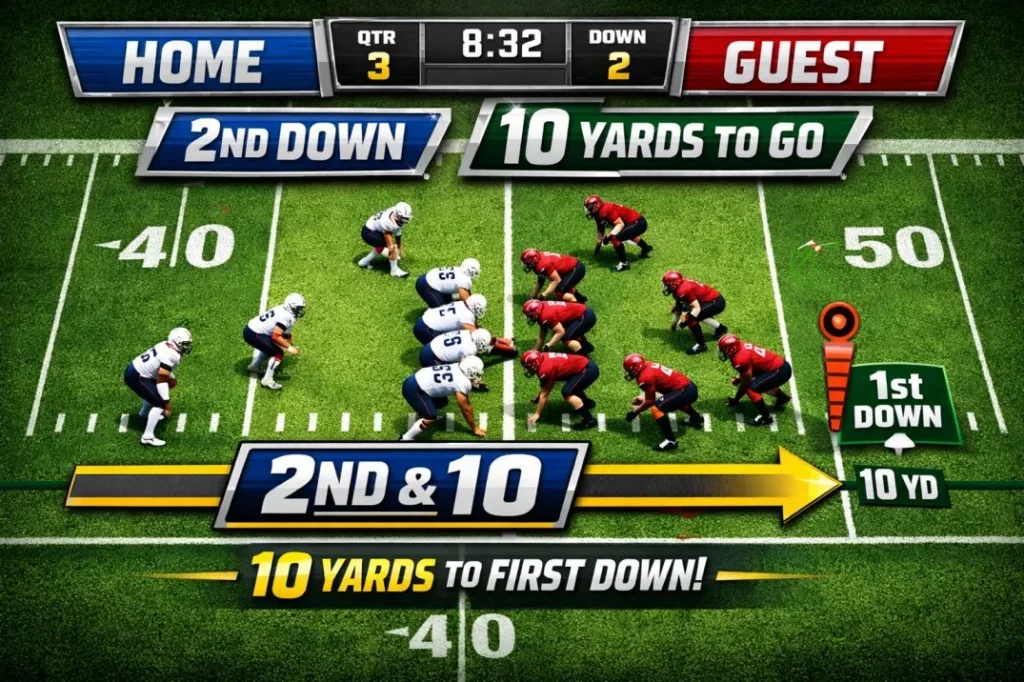
“2nd and 10” in football means it is the second down of a team’s possession, and they still need 10 yards to get a first down.
In simple terms, the offense has already played one down, gained no yards or very few yards, and now has four downs total to try to move the ball at least 10 yards forward.
American football has a unique system of rules that can feel confusing at first, especially if you are new to the game. One of the most important concepts is called downs and distance, which is where terms like “2nd and 10” come from.
If you have ever watched a football game and heard commentators say something like “It’s 2nd and 10,” they are describing the current situation of the offensive team on the field. This simple phrase tells you a lot about how the game is progressing, what strategy might be used next, and how much pressure the offense is under.
Understanding this concept makes football much easier to follow and more exciting to watch because you can predict what might happen next in a play.
What Does 2nd and 10 Mean?
The phrase “2nd and 10” has two parts:
1. Second Down
This means the team is on their second attempt to move the ball forward.
2. 10 Yards to Go
This means the team still needs to gain 10 more yards to achieve a first down.
So, “2nd and 10” means the team has not yet made progress on their first play, or they may have lost yards, and they still need a full 10 yards to reset the downs.
Understanding Downs in Football
To fully understand “2nd and 10,” you need to understand what downs are.
A team on offense gets four attempts (downs) to move the ball at least 10 yards forward.
If they succeed, they get a new set of four downs. If they fail, the ball goes to the other team.
The Four Downs Are:
- 1st down
- 2nd down
- 3rd down
- 4th down
Each down is a single play or attempt.
How 2nd and 10 Happens
Let’s break it down simply.
A team starts a possession:
First Play
They begin with 1st and 10 (meaning first attempt, 10 yards needed).
Now imagine this happens:
- The quarterback passes the ball
- The receiver is tackled immediately
- No yards are gained
Now the situation becomes:
👉 2nd and 10
Because:
- It is now the second attempt
- They still need the same 10 yards
Example of 2nd and 10 in Action
Imagine this real game situation:
- The offense starts at their own 25-yard line
- First play: a short run for 0 yards
- Next play: announcer says “2nd and 10”
This means:
- Second down
- Still 10 yards needed for a first down
Now the offense might choose a safer play or a more aggressive pass depending on the situation.
Why 2nd and 10 Is Important
“2nd and 10” is considered a neutral or early-down situation, but it often sets the tone for the rest of the drive.
It is important because:
- The offense still has three downs left
- The playbook is still wide open
- Both running and passing plays are possible
However, it also means:
- No progress has been made yet
- The offense needs to start gaining yards quickly
Common Situations Leading to 2nd and 10
Here are typical reasons a team ends up in 2nd and 10:
Incomplete Pass
The quarterback throws the ball but no one catches it.
No Gain Run
The running back is tackled at the line of scrimmage.
Short Loss
The offense loses yards due to a tackle behind the line.
Penalties (sometimes)
Certain penalties can also create similar situations depending on enforcement.
Strategy on 2nd and 10
Coaches treat 2nd and 10 very carefully because it shapes the next plays.
Common Offensive Strategies:
- Short passing plays to gain 5 to 8 yards
- Running plays to stay balanced
- Play-action passes to surprise defense
- Screen passes to avoid pressure
The goal is usually to avoid a difficult 3rd and long situation.
Example Strategy Breakdown Table
| Situation | Likely Strategy | Goal |
|---|---|---|
| 2nd and 10 | Short pass or run | Gain 4 to 6 yards |
| 2nd and 10 (deep field) | Safer play | Avoid turnover |
| 2nd and 10 in red zone | More aggressive pass | Score touchdown |
| 2nd and 10 late game | Clock management play | Control time |
2nd and 10 vs Other Down Situations
To understand it better, compare it with other common football situations:
| Down & Distance | Meaning | Difficulty |
|---|---|---|
| 1st and 10 | First attempt, full distance | Normal start |
| 2nd and 10 | Second attempt, no gain | Slight pressure |
| 3rd and 10 | Final chance before punt | High pressure |
| 2nd and 5 | Good progress made | Advantage offense |
| 2nd and 15 | Loss of yards | Very difficult |
What Happens After 2nd and 10?
The result of the next play changes everything:
If they gain 10+ yards
- They get a first down
- The count resets to 1st and 10
If they gain some yards
- It becomes something like 3rd and 5
If they lose yards
- It could become 3rd and 12 or worse
Real Game Example
Let’s imagine a real NFL style sequence:
- 1st and 10: short run, 0 yards
- 2nd and 10: quarterback throws incomplete pass
- 3rd and 10: pressure situation
- 3rd down pass completes for 12 yards
- First down achieved
This shows how 2nd and 10 is part of a larger drive strategy.
Why Fans Hear “2nd and 10” So Often
It is one of the most common football situations because:
- Many first downs result in no gain or small gain
- Defensive teams are strong on early plays
- Offensive teams often test the defense on first down
So naturally, 2nd and 10 happens frequently in games.
Simple Explanation for Beginners
If football still feels confusing, here is the simplest way to understand it:
👉 “2nd and 10 means the team tried once, didn’t move forward, and still needs a full 10 yards to continue their drive.”
That’s it. No complexity needed.
Importance in Game Commentary
Commentators use “2nd and 10” to quickly explain:
- Game pressure
- Offensive difficulty
- Possible play choices
- Momentum of the drive
It helps viewers instantly understand the situation without watching every detail.
Key Takeaways
- 2nd and 10 means second attempt and 10 yards needed
- It happens after little or no gain on first down
- It is a very common football situation
- Teams still have flexibility in play calling
- It is part of the larger system of downs and distance
FAQs
What does 2nd and 10 mean in football?
It means the offense is on its second down and still needs 10 yards to get a first down.
Is 2nd and 10 good or bad?
It is neutral. It is not great, but the offense still has three downs left to succeed.
Why is it always 10 yards?
Because a first down requires 10 yards of advancement from the starting line of scrimmage.
What happens after 2nd and 10?
The next play can lead to a first down, a shorter 3rd down, or a loss of yards.
Can you score on 2nd and 10?
Yes. A touchdown can happen on any down if the play reaches the end zone.
What is worse than 2nd and 10?
Situations like 2nd and 15 or 3rd and long are more difficult.
What is better than 2nd and 10?
2nd and 5 or 1st and 10 after a big gain are better situations.
Why do announcers say down and distance?
Because it quickly explains how far the offense needs to go and what attempt they are on.
Conclusion
“2nd and 10” is one of the most common and important terms in football. It simply describes a situation where the offense is on its second attempt and still needs 10 yards to continue their drive.
While it may sound technical at first, it actually gives a clear snapshot of the game situation. It tells you how successful the previous play was and what the team needs to do next.
Once you understand this concept, football becomes much easier to follow and far more exciting because you can anticipate strategy, pressure, and possible outcomes on every play.
Read More Related Articles:
- “Bicho” Mean in Spanish: Definition and Cultural Insights In 2026
- RTS Mean in Gaming: Understanding Real-Time Strategy Games In 2026
- What Do Blood Clots Mean in Period: Complete Guide In 2026

Ivy Madison is a content creator at TextSprout.com, specializing in word definitions, internet slang, acronyms, and text abbreviations. She delivers clear and engaging explanations, helping readers quickly understand modern digital language and trending terms.