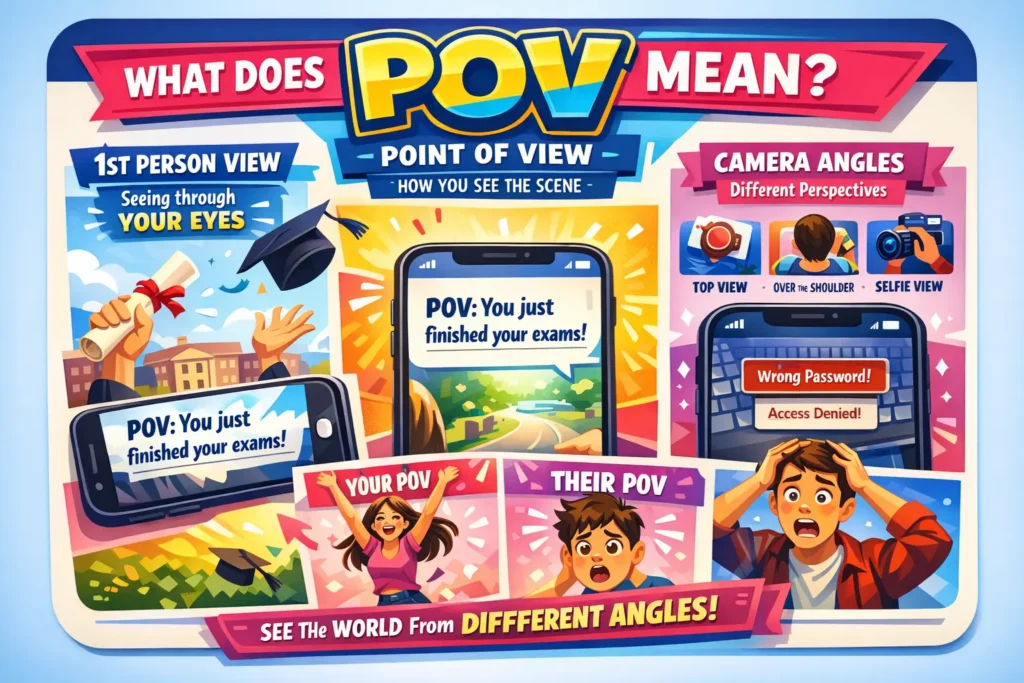
POV stands for “Point of View.” It refers to the perspective from which a story, scene, or situation is presented or experienced.
In modern usage, especially online, POV often describes a scenario where the viewer is placed in a specific role or perspective.
If you spend time on social media, watch videos online, or read stories, you have probably come across the term POV. It appears in captions, comments, memes, and even everyday conversations. Sometimes it seems obvious, but other times it can feel confusing depending on how it is used.
Understanding what POV means can help you follow trends, interpret messages correctly, and even create content that connects better with others. The meaning is simple at its core, but its usage has evolved across storytelling, media, and digital culture.
What POV Means in Simple Terms
At its most basic level, POV is about perspective. It answers the question: Who is seeing or experiencing this situation?
When someone uses POV, they are inviting you to imagine yourself in a particular role or position. It can be used in storytelling, videos, writing, or even jokes.
For example, if someone posts a video captioned:
“POV you just finished your exams and feel free”
They are asking you to imagine that you are the person in that situation.
Origin of POV
The term “point of view” has long been used in literature, film, and art. Writers and filmmakers use POV to describe the angle from which a story is told.
In literature, POV determines how much the reader knows and how they experience the story. Over time, the abbreviation POV became common in film discussions and later spread to online culture.
With the rise of platforms like TikTok, Instagram, and YouTube, POV evolved into a popular content style. Creators began using it to make videos that feel personal and immersive.
POV in Literature and Storytelling
POV plays a major role in storytelling. It shapes how readers or viewers understand events and characters.
Types of POV in Writing
| Type | Description | Example |
|---|---|---|
| First person | The narrator is part of the story | I walked into the room and felt nervous |
| Second person | The reader is addressed directly | You walk into the room and feel nervous |
| Third person | An outside narrator tells the story | She walked into the room and felt nervous |
Each type creates a different experience. First person feels personal, second person feels immersive, and third person offers a broader view.
POV in Social Media
In today’s digital world, POV has taken on a slightly different meaning. It is often used in captions to describe a scenario where the viewer is placed inside the situation.
Common Social Media Usage
| Example Caption | Meaning |
|---|---|
| POV you just got your dream job | Imagine yourself in that moment |
| POV your friend cancels plans again | Relatable situation |
| POV you forgot your password again | Humorous everyday scenario |
This usage makes content more engaging because it invites the viewer to relate personally.
Examples of POV in Different Tones
Understanding tone helps you interpret POV correctly.
Friendly tone
“POV you are hanging out with your best friends on a perfect day”
This creates a warm and positive feeling.
Neutral tone
“POV you are attending your first meeting at work”
This simply describes a situation without strong emotion.
Humorous tone
“POV you open the fridge and forget why you came”
This adds humor by describing a relatable moment.
Dramatic tone
“POV you realize everything has changed overnight”
This creates intensity and emotional depth.
POV Compared With Similar Terms
It is often confused with other abbreviations or concepts. Understanding the differences can help avoid misunderstandings.
| Term | Meaning | Difference |
|---|---|---|
| POV | Point of View | Focuses on perspective |
| IMO | In My Opinion | Expresses personal opinion |
| FYI | For Your Information | Shares information |
| IRL | In Real Life | Refers to real-world situations |
While POV focuses on perspective, terms like IMO focus on opinion.
Alternate Meanings of POV
Although POV usually means “point of view,” it can have other meanings depending on context.
| Meaning | Context |
|---|---|
| Point of View | Literature, film, social media |
| Persistence of Vision | Film and animation science |
| Privately Owned Vehicle | Transportation or military context |
However, in everyday conversations and online platforms, POV almost always refers to “point of view.”
Why POV Became So Popular
POV has become widely used because it makes communication more engaging.
Some reasons for its popularity include:
- It encourages people to imagine themselves in a situation
- It creates relatable and shareable content
- It makes storytelling more immersive
- It works well in short-form content like videos and memes
People enjoy content that feels personal, and POV achieves exactly that.
How to Use POV Correctly
Using POV effectively requires understanding context.
Tips for Using POV
- Clearly define the scenario you want to present
- Keep it relatable so others can connect
- Match the tone with the message
- Use it naturally in captions or conversations
For example:
“POV you finally finish a long project and feel relieved”
This works because it is relatable and easy to imagine.
Common Mistakes When Using POV
Some people misunderstand how POV works, especially online.
Mistakes to Avoid
- Using POV without a clear perspective
- Confusing POV with personal opinion
- Creating overly complicated scenarios
- Mislabeling content that is not actually from a specific perspective
For instance, a video labeled POV should make the viewer feel like they are part of the scene.
POV in Everyday Conversations
While POV is popular online, it also appears in daily communication.
People might say:
“My POV is that we should wait before making a decision”
In this case, POV means personal perspective or viewpoint.
This usage is closer to traditional meaning rather than social media style.
Real-Life Scenarios Using POV
- Scenario 1 Casual conversation
Friend A: “What do you think about this idea?”
Friend B: “From my POV, it could work if we plan properly.” - Scenario 2 Social media post
“POV you wake up early and the world is completely quiet” - Scenario 3 Workplace discussion
“From a manager’s POV, communication is the most important skill.”
These examples show how POV can be used in different contexts naturally.
FAQs
What does POV mean in texting?
POV means point of view and is used to describe a perspective or situation you want someone to imagine.
What does POV mean on TikTok?
On TikTok, POV is used to create videos where the viewer is placed inside a scenario as if they are part of it.
Is POV the same as opinion?
Not exactly. POV refers to perspective, while opinion is a personal belief or judgment.
How do you use POV in a sentence?
You can say, “From my POV, this is the best option,” or use it in captions like “POV you just finished your exams.”
Why is POV popular online?
It makes content more relatable, engaging, and immersive for viewers.
Can POV be used in formal writing?
Yes, but usually in its full form “point of view” rather than the abbreviation.
What are the types of POV in writing?
First person, second person, and third person are the main types.
Does POV always mean point of view?
Most of the time yes, especially in social media and everyday conversation.
Conclusion
POV stands for point of view, a term that describes perspective in storytelling, communication, and digital content. While its roots lie in literature and film, it has evolved into a powerful tool in social media, allowing creators to connect with audiences in a more personal way.
From casual conversations to viral videos, POV helps people express ideas, emotions, and experiences in a relatable format. Understanding how it works not only improves your communication but also helps you engage more effectively with modern content.
Whether you are reading a story, watching a video, or chatting with friends, recognizing POV gives you a clearer understanding of the perspective behind the message.
Read More Related Articles:
- PP Meaning in Text: Everything You Need to Know (2026)
- WYF Meaning in Texting and Slang: Full Guide with Examples and Tips (2026)
- SG in Text: The Meaning Changes More Than You Think In 2026

Neon Samuel is a digital content creator at TextSprout.com, dedicated to decoding modern words, slang, and expressions. His writing helps readers quickly grasp meanings and understand how terms are used in real conversations across text and social platforms.