
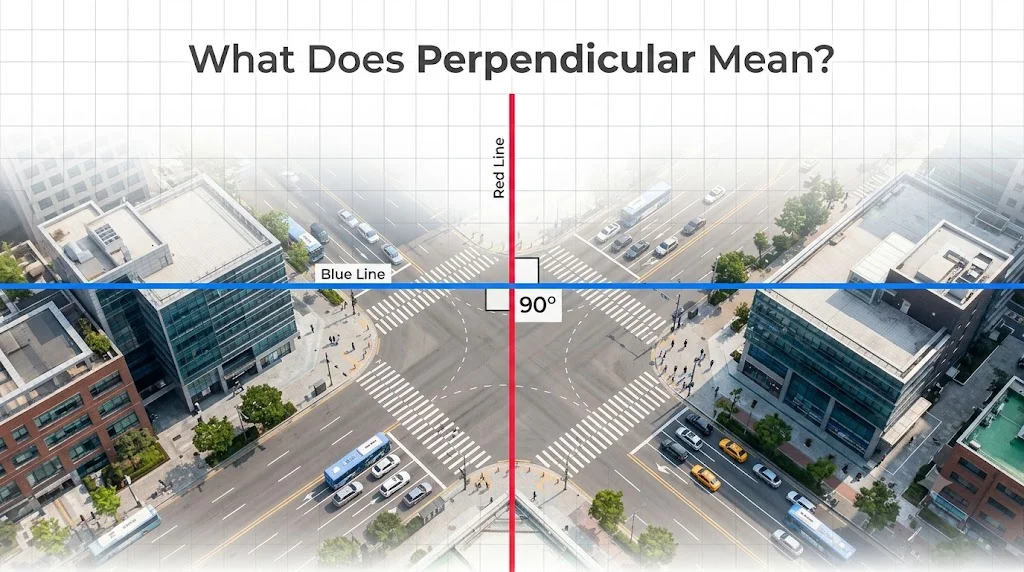
You’ve seen it a thousand times without thinking about it. The corner where your wall meets your floor. The “T” shape at a road junction. The plus sign on a first-aid kit. Every single one of those is a real-world example of perpendicular lines doing their job quietly and precisely.
But what does perpendicular actually mean mathematically, geometrically, and in the world around you? Whether you’re a student brushing up for an exam, a curious adult, or someone helping their kid with homework, this guide breaks it all down. No jargon overload. No unnecessary complexity. Just clear, accurate explanations from the ground up.
What Does Perpendicular Mean? The Core Definition
Let’s start with the simplest possible answer.
Two lines are perpendicular when they intersect at exactly a 90-degree angle also called a right angle. That’s it. That’s the whole idea.
Think about the letter “T.” The horizontal bar sits at a perfect right angle to the vertical stem. Or picture a plus sign “+” all four corners formed at that center point are exactly 90 degrees. Those are perpendicular lines in their most recognizable form.
One thing worth knowing right away: perpendicular lines must intersect. Lines that never meet can’t be perpendicular. That distinction matters a lot once you start comparing perpendicular with parallel lines but we’ll get there.
“Perpendicularity is one of geometry’s most elegant ideas: the perfect right angle, reliable and exact, showing up everywhere from ancient Roman architecture to modern circuit boards.”
Where the Word Comes From
The word perpendicular traces back to Latin perpendicularis, which came from perpendiculum, meaning a plumb line. Roman builders used a weighted string (the plumb bob) hanging straight down from a point to determine a perfectly vertical line relative to flat ground. That relationship vertical against horizontal, forming a perfect right angle is exactly what perpendicular describes.
So the concept isn’t modern at all. It’s thousands of years old and has been keeping buildings upright ever since.
The Formal Mathematical Definition
In geometry, two lines are perpendicular if and only if they form four right angles at their point of intersection. Not one right angle four. When two lines cross at 90°, all four corners created at that intersection are automatically 90° each (since a full rotation is 360°, and 360 ÷ 4 = 90).
This applies to:
- Full lines (extending infinitely in both directions)
- Line segments (lines with two fixed endpoints)
- Rays (lines with one fixed starting point, extending infinitely in one direction)
All three can be perpendicular to each other. The key requirement is always the same a 90-degree meeting point.
The Perpendicular Symbol (⊥)
Every mathematical concept worth knowing has its own notation. Perpendicular lines use the symbol ⊥, which looks like an upside-down capital T. It’s officially called the “up tack” symbol.
Here’s how it works in practice:
- If Line AB is perpendicular to Line CD, you write it as: AB ⊥ CD
- On a diagram, a small square drawn at the corner of the intersection marks the right angle
You’ll encounter this symbol in geometry textbooks, engineering blueprints, architectural drawings, and mathematical proofs. Once you know it, you’ll start noticing it everywhere.
Compare it to the parallel symbol:
| RelationshipSymbolWhat It Means | ||
|---|---|---|
| Perpendicular | ⊥ | Lines meet at exactly 90° |
| Parallel | ∥ | Lines never meet; equal distance apart forever |
Those two symbols are the bedrock of line relationship notation in geometry. Know both and you’re ahead of most people.
Perpendicular Lines in Geometry: Properties and Rules
Now let’s dig into the geometric properties that make perpendicular lines unique.
Key Properties of Perpendicular Lines
- They always intersect. No exceptions. If two lines don’t cross, they’re not perpendicular.
- The intersection angle is always exactly 90°. Not 89°. Not 91°. Exactly 90.
- Four right angles form at the intersection even if only one is visually marked.
- The relationship is symmetric. If Line A ⊥ Line B, then Line B ⊥ Line A. It works both ways.
- Perpendicular lines are never parallel and parallel lines can never become perpendicular.
Perpendicular vs. Parallel Lines
This is one of the most commonly tested comparisons in geometry. Here’s a clean breakdown:
| Feature | Perpendicular Lines | Parallel Lines |
|---|---|---|
| Do they intersect? | Yes at exactly 90° | No never meet |
| Angle formed | 90 degrees (right angle) | No angle (no meeting point) |
| Symbol | ⊥ | ∥ |
| Real-life example | Corner of a room | Railway tracks |
| Slope relationship | Negative reciprocal slopes | Equal slopes |
| Can they exist on the same plane? | Yes | Yes |
The easiest mental image: parallel lines are like railroad tracks always the same distance apart, never crossing. Perpendicular lines are like a road crossing those tracks cutting straight across at a right angle.
Perpendicular vs. Oblique Intersecting Lines
Here’s a misconception worth clearing up immediately: not all intersecting lines are perpendicular.
Any two lines that cross each other are called intersecting lines. But unless that crossing happens at exactly 90°, they’re called oblique lines they meet at an acute or obtuse angle instead.
Picture a clock face. At 10:10, the minute hand and hour hand cross each other but they form an angle of roughly 115 degrees, not 90. Intersecting? Yes. Perpendicular? Definitely not.
The 90-degree requirement is non-negotiable. It’s what separates perpendicular from every other kind of intersection.
Perpendicular Lines in Coordinate Geometry
This is where things get more mathematical and genuinely useful for solving problems. In coordinate geometry, you can identify perpendicular lines using their slopes.
The Negative Reciprocal Slope Rule
Here’s the rule: if two lines are perpendicular, their slopes are negative reciprocals of each other.
What does negative reciprocal mean? Flip the fraction and change the sign.
- If one line has slope 2, the perpendicular line has slope −½
- If one line has slope ⅓, the perpendicular line has slope −3
- If one line has slope −4, the perpendicular line has slope ¼
The formula looks like this:
If Line 1 has slope m, then Line 2 (perpendicular to it) has slope −1/m
And here’s the test: multiply the two slopes together. If the product equals −1, the lines are perpendicular.
Example:
- Line 1 slope: 3
- Line 2 slope: −⅓
- 3 × (−⅓) = −1 ✅ Perpendicular confirmed.
Step-by-Step Worked Example
Let’s say you’re given two lines:
- Line 1: y = 2x + 5
- Line 2: y = −½x + 3
1: Identify the slopes.
- Line 1 slope (m₁) = 2
- Line 2 slope (m₂) = −½
2: Multiply them.
- 2 × (−½) = −1
3: Since the product is −1, the lines are perpendicular. ✅
That’s the whole process. Once you’re comfortable identifying slope from an equation, checking perpendicularity takes about ten seconds.
The Special Cases You Can’t Forget
Most explanations skip these. Don’t let them catch you off guard:
- Vertical lines have an undefined slope (you’d be dividing by zero). A vertical line is always perpendicular to a horizontal line but the negative reciprocal formula doesn’t technically apply here.
- Horizontal lines have a slope of 0. They’re always perpendicular to vertical lines.
- The x-axis and y-axis are the most fundamental perpendicular pair in all of mathematics one horizontal, one vertical, meeting at the origin (0, 0) at exactly 90°.
How to Check if Two Lines Are Perpendicular: Quick Checklist
- Write both equations in slope-intercept form: y = mx + b
- Identify the slope (m) of each line
- Multiply the two slopes: m₁ × m₂
- If the result is −1, the lines are perpendicular
- Special rule: A vertical line and a horizontal line are always perpendicular, regardless of the formula
What Does Perpendicular Mean in Math for Kids?
Sometimes you just need to hear something explained without the math vocabulary. Here’s the stripped-down version.
Imagine the letter “T.” The top bar goes sideways. The stem goes straight down. Right where they meet, they make a perfect corner like the corner of a square. That perfect corner is called a right angle, and when two lines make that kind of corner, they’re called perpendicular.
You’ve already seen perpendicular lines today without knowing it:
- The edge of your notebook meeting the bottom of the page
- A flagpole standing straight up from flat ground
- The lines on a sheet of graph paper every vertical line is perpendicular to every horizontal one
Here’s another way to think about it: stand up straight with your arms stretched out to the sides.
- Your body goes up-down.
- Your arms go left-right.
- Your arms and your body form a right angle at your shoulders.
That’s perpendicular.
It’s not complicated once you see it. It’s just two lines making a perfect corner every single time.
Real-Life Examples of Perpendicular Lines
Perpendicular lines aren’t just a textbook concept. They’re holding up buildings, organizing cities, and making technology work right now.
In Architecture and Construction
Every structurally sound building depends on perpendicular angles. When walls meet floors at 90°, weight distributes evenly and the structure stays stable. Deviate from that even slightly and you get stress fractures, leaning walls, and eventually collapse.
- Wall meets floor: The most basic perpendicular relationship in construction
- Door frames and window frames: Designed to right-angle standards so doors open and close properly
- Tile grids: Every grid line runs perpendicular to the ones crossing it that’s what creates the neat square pattern
- Plumb bob and spirit level: Two ancient tools that exist specifically to establish perpendicular relationships on a job site. The plumb bob confirms vertical. The spirit level confirms horizontal. Together, they verify perpendicularity.
Builders have been using these principles since the ancient Egyptians who relied on perpendicular geometry to build the pyramids with remarkable precision.
In Navigation and Geography
- City street grids: Manhattan is the iconic example. Numbered streets run east–west; numbered avenues run north–south. They’re perpendicular to each other, making navigation straightforward.
- Latitude and longitude: Lines of latitude run east–west (horizontal). Lines of longitude run north–south (vertical). They intersect perpendicularly which is why you can pinpoint any location on Earth using just two coordinates.
- Compass directions: North–South is perpendicular to East–West. Every compass bearing system is built on this.
In Everyday Objects
You’re surrounded by perpendicular lines right now. Here are some you might not have noticed:
- The plus sign (+) on a first-aid kit or medicine label
- A bookshelf against a wall the shelf surface is perpendicular to the wall behind it
- Graph paper every single grid line is perpendicular to those it crosses
- Scissors when the blades cross at a right angle during a cut, they’re momentarily perpendicular
- A light switch plate on a wall its edges run perpendicular to the wall’s baseboard
In Technology and Design
- Computer screens: The width and height axes of any display are perpendicular. Every pixel is addressed using this perpendicular coordinate system.
- Circuit boards: Perpendicular trace layouts minimize electromagnetic interference between pathways.
- Road intersections: Four-way intersections designed at 90° are proven safer and easier to navigate than oblique crossings. That’s why urban planners default to grid systems.
- QR codes: The tiny squares in a QR code are arranged in a perpendicular grid that’s how scanners read them reliably from any angle.
The Perpendicular Axes: X and Y
The entire Cartesian coordinate system the grid you’ve been using since middle school to plot points, draw graphs, and solve equations is built on one foundational perpendicular relationship: the x-axis and y-axis.
The x-axis runs horizontally. The y-axis runs vertically. They meet at the origin (0, 0) at exactly 90 degrees. Every point on every graph you’ve ever drawn is located by measuring its distance from these two perpendicular reference lines.
French mathematician René Descartes formalized this system in 1637. Before that, algebra and geometry were largely separate disciplines. By introducing perpendicular axes as a coordinate framework, Descartes united them letting you describe geometric shapes with algebraic equations and vice versa. It’s one of the most consequential ideas in the history of mathematics.
Think about what that means practically: every graph, every map, every data visualization, every video game environment uses perpendicular axes as its foundation. GPS coordinates. Weather maps. Stock charts. 3D modeling software. All of it traces back to two lines meeting at a right angle.
Perpendicular Lines Beyond Mathematics
Perpendicularity isn’t confined to geometry class. It shows up in surprisingly diverse fields.
Physics
When physicists analyze forces, they routinely break them into perpendicular components one horizontal, one vertical. This technique (called vector decomposition) makes complex motion problems solvable. A ball thrown at an angle? Its motion is analyzed as two perpendicular movements happening simultaneously: forward (horizontal) and up-then-down (vertical). Without perpendicular thinking, classical mechanics would be far messier.
Engineering
Structural engineers design for perpendicular load paths. When a bridge carries weight, that load travels downward through perpendicular columns into the foundation. Trusses the triangular frameworks used in bridges and roofs work because perpendicular and diagonal members distribute stress efficiently. Deviate from perpendicular design principles and you compromise the structure.
Art and Design
Perspective drawing relies on perpendicular vanishing lines to create the illusion of depth. The rule of thirds the compositional guideline photographers and designers use divides an image with two horizontal and two vertical lines, all perpendicular. Even abstract art uses perpendicular tension (think Mondrian’s famous grid paintings) as a compositional strategy.
Music (Surprisingly)
When sound engineers and physicists visualize audio, they use oscilloscope displays where time runs along the horizontal axis and amplitude (volume) runs along the vertical axis. Two perpendicular axes, rendering sound visible. The entire field of audio visualization rests on this geometric relationship.
Common Misconceptions About Perpendicular Lines
Let’s clear up the errors that trip people up most often.
❌ “Any two lines that cross are perpendicular.” False. Lines that cross at any angle other than 90° are oblique intersecting lines not perpendicular. The right angle is the requirement.
❌ “Perpendicular lines have to be perfectly vertical and horizontal.” False. A diagonal line running at 45° can absolutely be perpendicular to another diagonal line as long as they meet at 90°. Vertical and horizontal are just the most recognizable example.
❌ “Parallel lines can eventually become perpendicular.” False. Parallel lines never intersect, by definition. A line that eventually crosses another line was never parallel to begin with.
❌ “The right angle needs to look like a right angle on the page to count.” False. On a distorted diagram or a skewed drawing, two perpendicular lines might not visually look like a right angle. The relationship is defined mathematically by the 90-degree measurement not by how it appears in a rough sketch.
❌ “Perpendicular only applies to straight lines.” Mostly true in basic geometry but in higher mathematics, the concept extends to curves, vectors, and even functions. Two curves are perpendicular at a point if their tangent lines at that point are perpendicular. The core idea scales upward.
Quick-Reference Summary
| Concept | Key Fact |
|---|---|
| Definition | Two lines meeting at exactly 90° |
| Symbol | ⊥ |
| Right angle marker | Small square drawn at the intersection point |
| Slope relationship | Slopes are negative reciprocals (m₁ × m₂ = −1) |
| Differs from parallel | Parallel lines never meet; perpendicular always do |
| Differs from oblique | Oblique lines intersect at angles other than 90° |
| Real-life example | Corner of a room, city street grid, T-intersection |
| In coordinate geometry | x-axis ⊥ y-axis at origin (0,0) |
| How to verify | Multiply slopes product must equal −1 |
| Special case | Vertical line ⊥ horizontal line (slope rule doesn’t apply) |
FAQs
What does perpendicular mean in simple words?
Two lines are perpendicular when they cross each other at a perfect right angle exactly 90 degrees. Think of the letter “T” or a plus sign. Where those lines meet, they form a square corner. That’s perpendicular.
What is the symbol for perpendicular lines?
The symbol is ⊥ it looks like an upside-down capital T. If Line AB is perpendicular to Line CD, you write AB ⊥ CD. On diagrams, a small square at the corner of the intersection marks the right angle.
What’s the difference between perpendicular and parallel lines?
Perpendicular lines intersect at exactly 90°. Parallel lines never intersect they run side by side at the same distance apart forever. Railway tracks are parallel. The corner of a room is perpendicular.
How do you find the perpendicular slope of a line?
Flip the original slope upside down (take the reciprocal) and change its sign. A line with slope 4 has a perpendicular slope of −¼. A line with slope −⅔ has a perpendicular slope of 3/2. Multiply the two slopes together if you get −1, you’ve confirmed perpendicularity.
What does perpendicular mean in math for kids?
It means two lines that make a perfect corner where they meet exactly like the corner of a square. The edge of your notebook, the corner of a door frame, the letter “T” all of these show perpendicular lines in action.
Are the x-axis and y-axis perpendicular to each other?
Yes always. The x-axis runs horizontally and the y-axis runs vertically. They meet at the origin (0, 0) at exactly 90 degrees. This perpendicular relationship is the foundation of the entire Cartesian coordinate system, which underpins virtually all of modern mathematics, mapping, and data visualization.
Conclusion
Perpendicular lines are one of geometry’s most fundamental ideas and once you truly understand them, you start seeing them everywhere. The 90-degree angle isn’t just an abstract math concept. It’s the reason buildings stand, cities are navigable, graphs are readable, and bridges carry weight.
The definition is simple: two lines that meet at exactly 90 degrees. The symbol is ⊥. The slope rule is clean: negative reciprocals multiply to −1. And the real-world applications stretch from Roman plumb bobs to modern circuit boards.
Next time you turn a corner, look at a grid, or glance at a map you’ll know exactly what geometric relationship is working silently in the background.
Read More Related Articles:
- OP Meaning in Gaming – The Term Every Gamer Uses (2026)
- HU Meaning in Text: Simple Guide with Examples You Can’t Miss (2026)
- PH Means in Texting: Meaning Most People Get Wrong (2026)

Neon Samuel is a digital content creator at TextSprout.com, dedicated to decoding modern words, slang, and expressions. His writing helps readers quickly grasp meanings and understand how terms are used in real conversations across text and social platforms.