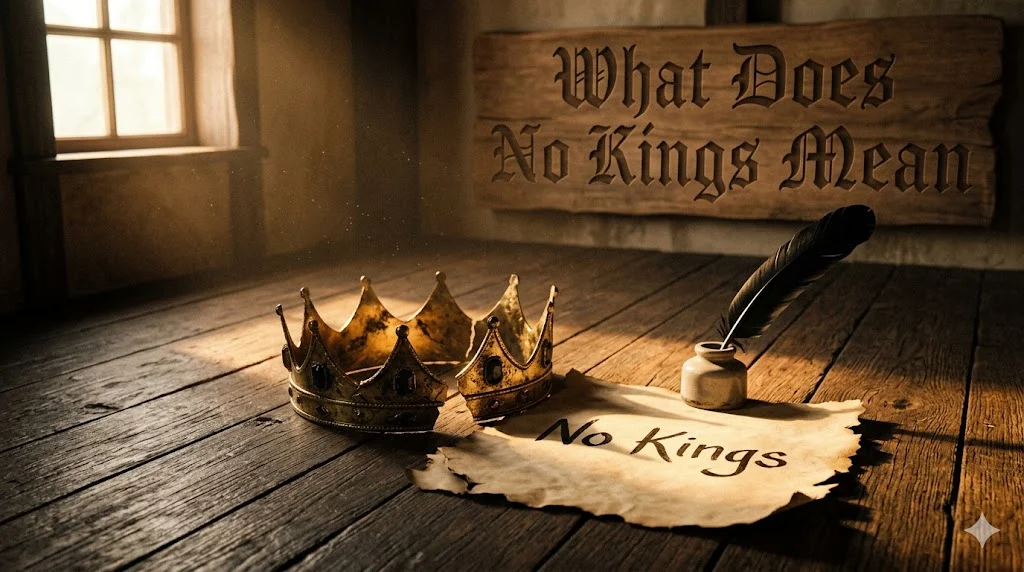
You’ve seen the phrase on a protest sign. Maybe on Twitter. Possibly in a meme. Someone yells “no kings” and you nod along but do you actually know what it means?
Let’s get one thing straight right now.
“No kings” isn’t just about royalty. It’s not some dusty history book term. And it sure isn’t only for Americans celebrating July 4th.
No kings means rejecting any single person’s absolute rule. Whether that person wears a crown, sits in a presidential palace, or runs a company like a dictatorship.
This article walks you through the literal definition, the historical fire that forged the phrase, how people use it in modern politics, and why it keeps popping up on social media. No lectures. Just real answers.
The Literal Definition of No Kings
Let’s start simple.
No kings meaning: opposition to monarchy and unchecked single-person rule.
A king inherits power. You don’t vote for them. You can’t fire them. They often rule for life. And in traditional monarchies, they answer to no one except maybe a god or a parliament they control.
The phrase “no kings” strips that away. It says: Nobody gets that kind of power by birth. Nobody gets to rule alone forever.
Here’s a quick table to lock it in:
| Term | What It Means |
|---|---|
| Monarchy | One person rules by bloodline. Usually for life. |
| No kings | No hereditary rulers. No unchecked authority. |
| Republic | Leaders elected by people. Limited terms. Accountable to laws. |
| Dictatorship | One person rules by force. No elections. No term limits. |
Notice the difference? “No kings” doesn’t mean no leaders. It means no unremovable leaders.
Think of it this way. A president serves four or five years. You can vote them out. A king? You wait for them to die or start a revolution. That’s a massive difference in power.
So when someone says “no kings,” they’re drawing a hard line. Power must come from below, not from a bloodline. And it must have limits.
Historical Roots: Where “No Kings” Really Comes From
You can’t understand “what does no kings mean” without knowing its roots. But let’s skip the boring timeline and hit the real moments that shaped the phrase.
The American Revolution Didn’t Start with Tea
Most people think the American Revolution began over taxes. That’s only half true.
Colonists got furious about “taxation without representation.” But the deeper rage? They hated being treated like subjects.
British kings, especially George III, acted like America existed for England’s benefit.
- The Crown appointed governors.
- The Crown vetoed colonial laws.
- The Crown quartered soldiers in people’s homes.
That’s why you find the phrase “no king but King Jesus” on old revolutionary flags. It sounds religious. And sure, some meant it that way. But the political translation is clear: No earthly monarch gets final say over us.
Here’s a fact that sticks. After the Declaration of Independence in 1776, colonies dropped the word “royal” from everything. Royal courts became common pleas courts. Royal governors fled. Statues of King George III came crashing down in Manhattan and Savannah.
One patriot wrote in his diary: “We pulled down the king. Then we danced on his face.”
That’s not a metaphor. They literally toppled a lead statue and melted it into musket balls.
The Enlightenment Spark
Before the revolution came the ideas. Philosophers like John Locke and Thomas Paine poured gasoline on the anti-king fire.
Locke argued that governments exist by consent of the governed. Not God’s permission, not birthright and not conquest. Consent. And if a king breaks that trust? You have the right to replace him.
Paine went further. In Common Sense (1776), he called monarchy absurd. He wrote: “Of more worth is one honest man to society than all the crowned ruffians that ever lived.”
Bold words for a time when kings ruled most of the world.
Paine also mocked the idea of royal bloodlines. He asked why any family deserves to rule just because they won a battle 300 years ago. Good question. Still unanswered.
The British Anti-Monarchy Tradition
America didn’t invent “no kings.” The English did against their own kings.
In 1649, England executed King Charles I. A whole country killed its monarch. Then they abolished the monarchy entirely. For 11 years, England had no king.
That period, called the Commonwealth, eventually failed. But the idea survived. By the 1689 Bill of Rights, England had a constitutional monarchy. The king could no longer suspend laws, raise taxes, or keep an army without Parliament’s approval.
That’s a “no kings” compromise. Not abolition. But serious limits.
So when Americans later shouted “no kings,” they borrowed from English rebels who had already spilled blood over the same idea.
Modern Political Meaning: No Kings in Today’s World
Now let’s jump to the present. The world has far fewer kings than in 1776. But the phrase “no kings” hasn’t retired. It just changed targets.
Who Do People Mean by “King” Today?
Nobody thinks the President of the United States is a literal monarch. But people use “king” to describe any leader who acts like one.
Here’s what triggers the “no kings” warning today:
- Executives who bypass legislatures using executive orders, decrees, or emergencies that never expire.
- Leaders who refuse to leave office after their term ends or after losing elections.
- Political dynasties where power passes from parent to child like a family heirloom.
- Unelected judges or officials who serve for life and answer to nobody.
- CEOs or billionaires who control public policy without any democratic check.
See the pattern? “No kings” isn’t just about thrones. It’s about unaccountable power in any form.
Real-World Examples (No Names Needed)
Consider a president who declares a national emergency and rules by decree for years. The emergency was real. But after the crisis ends, the powers remain. That’s kingship by another name.
Or imagine a prime minister whose father, mother, and sibling all held the same office. Critics start shouting “no kings” because it looks like a family business, not a democracy.
Even within political parties, you see it. A party boss who picks all the candidates. Controls all the money. Stays in power for 30 years. Nobody elected them to be boss. Yet they rule.
The phrase adapts to whoever wears the invisible crown.
Protests and Movements
Walk into any anti-authoritarian protest today. You’ll see “No Kings” on signs. Sometimes alongside “No Gods, No Masters” an old anarchist slogan.
But “no kings” isn’t strictly anarchist. Anarchists want zero hierarchy. “No kings” accepts leaders. It just demands they face election, term limits, and the rule of law.
You see the slogan in:
- Pro-democracy protests in countries with long-reigning presidents.
- Anti-monarchy rallies in the UK, Canada, Australia, and Thailand.
- Grassroots campaigns against political family dynasties.
- Online debates about lifetime judicial appointments.
One recent example: In 2022, protests erupted in multiple Commonwealth nations ahead of a major royal tour. Signs read “No Kings” and “Abolish the Crown.” Not fringe groups. Ordinary citizens.
So when you ask “what does no kings mean in politics,” the answer is simple: It’s a tripwire. It warns when someone is grabbing too much power.
No Kings on Social Media: Memes, Hashtags, and Slang
You can’t talk about modern “no kings meaning” without opening Twitter, TikTok, or Reddit. The phrase exploded online.
What Does No Kings Mean on Twitter?
On social media, “no kings” usually pops up during political fights about:
- Lifetime appointments (judges, senators, officials)
- Political families (dynasties that span decades)
- Leaders who overstay their welcome
- Emergency powers that never get turned off
The hashtag #NoKings spikes during debates about term limits, executive overreach, or when a president’s relative runs for office.
Here’s a typical tweet format:
“They want us to accept another decade of the same family in power? No kings. Not now. Not ever.”
Short. Punchy. No explanation needed. The audience knows exactly what “no kings” means in that context.
Meme Culture and the Phrase
Memes give “no kings” new life. You’ll see images of someone placing a Burger King crown on a politician’s head. Or a photo of a throne with “reserved for nobody” written underneath.
One popular meme format shows a historical painting of a crowned figure. The caption: “We didn’t fight a revolution for this.”
It’s humor with teeth. The joke works because everyone knows the historical weight behind “no kings.”
Slang Usage Among Younger Generations
Gen Z and younger millennials use “no kings” more loosely. Sometimes it means rejecting any authority figure even reasonable ones.
For example:
- “My boss wants me to come in on Saturday. No kings.”
- “Mom says I can’t date them. No kings.”
That’s a diluted meaning. But it shows how powerful the phrase is. Even when joking, people reach for “no kings” to say: You don’t rule me.
However, the serious political use remains strong. During election seasons or constitutional crises, “no kings” trends with news articles and op-eds, not just memes.
Common Misconceptions About No Kings
Let’s clear up confusion. People get “no kings” wrong all the time.
Misconception 1: No Kings Means No Leaders
Wrong. “No kings” rejects unelected, unremovable, unaccountable leaders. It does not reject leadership itself.
A fire chief who runs toward danger? Fine. A president who serves four years and faces voters? Fine. A CEO who answers to a board? Fine.
A king who rules by birth until death? Not fine.
Think of it this way. You can support your local mayor and still chant “no kings” at a dictator. Those aren’t contradictions.
Misconception 2: Only Americans Use It
False. Anti-monarchy movements exist worldwide. Here’s proof:
- United Kingdom: Republic campaign wants to abolish the monarchy. They use “No Kings” rhetoric constantly.
- Canada: Citizens for a Canadian Republic pushes for an elected head of state.
- Australia: Australian Republic Movement gained steam after multiple referendums.
- Thailand: Young pro-democracy activists use “no kings” references despite severe legal risks.
So no, it’s not just July 4th barbecue talk.
Misconception 3: No Kings Is Ancient History
Not even close. In 2022, anti-monarchy protests erupted across the Caribbean. Leaders in Barbados removed the British monarch as head of state in 2021. Jamaica plans to do the same.
And in non-monarchy countries, “no kings” appears whenever a president ignores courts, suspends parliaments, or stays past term limits.
The phrase lives wherever power threatens to become permanent.
Misconception 4: No Kings = Anarchism
This one needs a firm no.
Anarchists want zero hierarchy. No state, no bosses and no rulers of any kind.
“No kings” tolerates hierarchy as long as it’s elected, temporary, and accountable. That’s a democracy or a republic. Not anarchy.
The two overlap in their distrust of authority. But they are not the same.
Why No Kings Still Matters Today
You might think: “We don’t have kings anymore. Why does this matter?”
Because kings don’t need crowns. They need power without checks.
Every democracy faces the same risk. A leader wins an election. Then they refuse to leave. Or they pack the courts with loyalists. Either they rule by decree. Or they pass power to their child.
When that happens, citizens start muttering “no kings.” It’s not nostalgia. It’s a warning.
The Test for Any Leader
Here’s a simple test. Ask three questions about any leader:
- Can you vote them out?
- Do they face the same laws as everyone else?
- Does their power have an expiration date?
If the answer to any question is no, you’re looking at a king in disguise.
“No kings” keeps that test front of mind. It’s a shortcut phrase that carries centuries of fight against unchecked power.
A Personal Connection for You
Let me bring this home.
You don’t need to study political science to feel the “no kings” instinct. You feel it when your boss acts like a tyrant. When a politician ignores your vote. When someone in power says “because I said so” with no appeal.
That gut reaction? That’s the same fire that melted King George’s statue.
So the next time you hear “no kings,” don’t just think about history books. Think about who holds power over you.
- Ask if they earned it.
- Ask if they answer to anyone.
- Ask if you can ever say “enough.”
If the answer makes you uncomfortable, you understand exactly what “no kings” means.
Real-World Facts and Figures
Let’s ground this in numbers. No fluff. Just data.
Current monarchies worldwide: 43 countries still have a monarch as head of state. That includes the UK, Canada, Australia, Japan, Thailand, Saudi Arabia, and many smaller nations.
Public support for monarchy (UK): As of 2023, about 60% of Brits still support the monarchy. But support drops below 40% for young adults aged 18-24. The anti-monarchy movement grows every year.
Countries that abolished monarchy since 1900: More than 50. Recent examples include Greece (1973), Nepal (2008), and Barbados (2021).
Term limits for heads of state: 54% of countries now have presidential term limits. That’s up from almost none in 1950. Every time a country adds term limits, it’s a “no kings” victory.
Lifetime appointments worldwide: Only a handful of countries still give judges or officials lifetime terms. The U.S. Supreme Court is a major holdout. Critics increasingly use “no kings” to argue against life tenure.
These numbers prove one thing. The battle against permanent, unaccountable power isn’t over. And the slogan “no kings” stays relevant because the problem keeps showing up.
Summary Table: No Kings at a Glance
| Aspect | What You Need to Know |
|---|---|
| Literal meaning | No hereditary absolute rulers |
| Political meaning | No unaccountable, unelected, or permanent leaders |
| Historical origin | American Revolution + English Civil War + Enlightenment |
| Modern use | Anti-dynasty, anti-lifetime appointment, anti-executive overreach |
| Social media use | Hashtag #NoKings for protests against permanent power |
| Common misconception | It’s not anarchism. It’s democracy without kings. |
| Why it matters | Tests whether any leader answers to the people |
FAQs
What does no kings mean in simple terms?
It means no single person should have unlimited, lifelong, inherited power. Leaders must face elections, term limits, and the same laws as everyone else.
Is no kings the same as anti monarchy?
Yes and no. It opposes monarchy. But it also opposes any leader president, prime minister, or dictator who acts like a king.
What does no kings mean on social media?
People use it to protest lifetime political appointments, family dynasties, or leaders who refuse to leave office. It’s a quick way to say “you don’t rule me.”
Does no kings mean no government at all?
No. That’s anarchism. “No kings” accepts government as long as leaders are elected, temporary, and accountable.
Where did the no kings slogan originate?
The American Revolution popularized it. But the idea goes back to English rebels who executed King Charles I in 1649 and Enlightenment philosophers like John Locke and Thomas Paine.
Can you say no kings in a democracy?
Absolutely. People say it when democratic leaders act like monarchs ignoring courts, bypassing legislatures, or refusing to leave office.
What’s the difference between no kings and no gods no masters?
“No gods, no masters” is an anarchist slogan rejecting all hierarchy. “No kings” accepts elected leaders. It just rejects hereditary or absolute rule.
Is no kings still relevant today?
Yes. Any time a leader grabs too much power, dodges term limits, or creates a political dynasty, “no kings” comes back. It’s a timeless check on authority.
Conclusion:
You asked what “no kings” means. Now you know.
It’s not a relic. Not a joke. Not just for history buffs.
No kings is a line in the sand. It says power should come from below. It should have limits. And nobody no matter how fancy their title gets to rule forever.
Keep the phrase in your back pocket. You’ll need it next time someone acts like they’re wearing an invisible crown.
And when you hear it? You’ll know exactly what’s at stake.
Read More Related Articles:
- SG in Text: The Meaning Changes More Than You Think (2026)
- What Does ISTG Mean? Used When People Are Fed Up (2026)
- Fasting Meaning in the Bible: More Than Skipping Food (2026)

Ivy Madison is a content creator at TextSprout.com, specializing in word definitions, internet slang, acronyms, and text abbreviations. She delivers clear and engaging explanations, helping readers quickly understand modern digital language and trending terms.