DNA stands for Deoxyribonucleic Acid. It is a molecule found in nearly all living organisms that carries genetic instructions used for growth, development, functioning, and reproduction.
In simple terms, DNA is the biological code that tells your body how to build and maintain itself.
DNA is one of those scientific terms that appears everywhere, from school biology lessons to crime shows and medical documentaries. Even though most people have heard of it, many still wonder what it actually means and why it is so important. Understanding DNA helps explain how living things grow, function, and pass traits from one generation to the next.
At its core, DNA is not just a scientific abbreviation. It is the instruction manual of life itself.
What DNA Really Means in Simple Language
To understand DNA without heavy science terms, think of it as a set of instructions written in a special biological language. Every living organism, including humans, animals, plants, and even some microorganisms, has DNA inside their cells.
DNA is like a blueprint. Just as an architect uses a blueprint to build a house, your body uses DNA to build you.
It determines:
- Your eye color
- Your height potential
- Your hair texture
- How your body functions internally
- How cells grow and repair
Without DNA, life as we know it would not exist.
What DNA Stands For and How the Name Came About
The full form of DNA is Deoxyribonucleic Acid, which may sound complicated, but each part has meaning.
- Deoxy refers to a type of sugar in the molecule
- Ribo relates to ribose sugar, which is chemically similar
- Nucleic refers to the nucleus of the cell where DNA is found
- Acid refers to its chemical nature
Scientists named it based on its chemical structure when it was discovered in the 19th and 20th centuries. Even though the name sounds complex, the idea behind it is simple. DNA is a chemical compound that stores life’s instructions.
Where DNA Is Found in the Body
DNA is found in almost every cell of your body. Most of it is stored in a part of the cell called the nucleus. This is why DNA is often referred to as the control center of life.
There is also a small amount of DNA found in another part of the cell called mitochondria. This is sometimes called mitochondrial DNA and is inherited differently from nuclear DNA.
Every cell in your body, from skin cells to brain cells, contains the same DNA, but different parts of it are active depending on the function of the cell.
The Structure of DNA Explained Simply
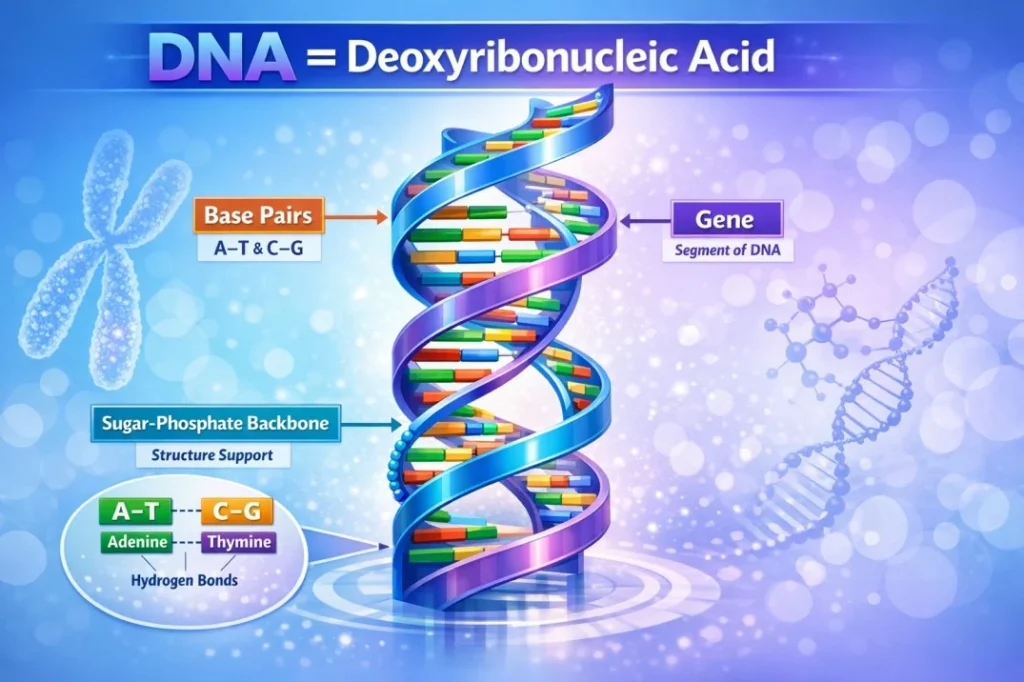
DNA has a unique shape that looks like a twisted ladder. This structure is called a double helix.
Imagine a spiral staircase. The two sides of the staircase are made of sugar and phosphate molecules. The steps between them are made of chemical pairs called bases.
There are four main bases in DNA:
- Adenine
- Thymine
- Cytosine
- Guanine
These bases always pair in a specific way:
- Adenine pairs with Thymine
- Cytosine pairs with Guanine
This pairing system is what allows DNA to copy itself accurately when cells divide.
A Simple Table of DNA Components
| Component | Role |
|---|---|
| Sugar | Forms the backbone of DNA |
| Phosphate | Connects the structure together |
| Adenine | Pairs with Thymine |
| Thymine | Pairs with Adenine |
| Cytosine | Pairs with Guanine |
| Guanine | Pairs with Cytosine |
These components work together like a coded language that the body reads.
What DNA Does in the Body
DNA has one major job: to store and transmit genetic information. But within that job, it performs several important functions.
It helps:
- Build proteins in the body
- Control how cells function
- Guide growth and development
- Repair damaged tissues
- Pass traits from parents to children
Every time your body needs to create something, like a new cell or a protein, it follows instructions from DNA.
DNA and Genetics
DNA is the foundation of genetics. Genetics is the study of how traits are passed from parents to children.
This is why you might have your mother’s eye shape or your father’s height. These traits are coded in your DNA.
Genes are small sections of DNA that control specific traits. You can think of DNA as a full book, and genes as individual chapters in that book.
Each human has around 20,000 to 25,000 genes in their DNA.
How DNA Is Passed From Parents to Children
When a child is conceived, they receive half of their DNA from the mother and half from the father. This combination creates a unique genetic identity.
This is why no two humans (except identical twins) are exactly the same.
The process of inheritance explains:
- Family resemblances
- Genetic disorders
- Blood types
- Physical traits
DNA mixing is also why siblings can look different even with the same parents.
DNA and Human Identity
It is what makes each person biologically unique. Even if two people look similar, their DNA is different.
This uniqueness is used in many real-world applications such as:
- Paternity testing
- Forensic investigations
- Medical diagnosis
- Genetic research
Because DNA is so specific, it is often called a biological fingerprint.
DNA in Everyday Life
Even though DNA sounds like something only scientists deal with, it affects everyday life in many ways.
Here are some examples:
- Doctors use DNA to understand diseases
- Scientists use DNA to develop medicines
- Police use DNA to solve crimes
- Farmers use DNA to improve crops
- Researchers use DNA to study human evolution
DNA plays a silent but powerful role in modern life.
DNA vs RNA Explained Simply
People often confuse DNA with RNA. While they are related, they are not the same.
| Feature | DNA | RNA |
|---|---|---|
| Full form | Deoxyribonucleic Acid | Ribonucleic Acid |
| Function | Stores genetic information | Helps create proteins |
| Structure | Double strand | Single strand |
| Stability | Very stable | Less stable |
DNA is like the master instruction manual, while RNA is like a working copy used to carry out tasks.
Interesting Facts About DNA
Here are some fascinating facts that make DNA even more amazing:
- If all DNA in one human cell were stretched out, it would be about two meters long
- All human DNA is about 99.9 percent identical, with only small differences making each person unique
- DNA can store huge amounts of information in a tiny space
- Some DNA sequences are shared between humans and other living organisms
- DNA can survive for thousands of years under the right conditions
These facts show how powerful and efficient DNA really is.
Why DNA Is Important
DNA is essential for life. Without it, cells would not know how to function, grow, or reproduce.
Its importance includes:
- Maintaining biological order in the body
- Ensuring accurate reproduction of cells
- Passing genetic traits to future generations
- Helping scientists understand diseases
- Supporting medical advancements
DNA is essentially the foundation of all living things.
Real Life Example of DNA in Action
Imagine a recipe book. Each recipe tells you how to make a dish. Now imagine that book contains all the instructions needed to build a human body.
That is what DNA is like.
When a cell needs to perform a task, it looks at the DNA instructions and follows them step by step. Without DNA, there would be no guidance for how life works.
FAQs
What does DNA stand for?
DNA stands for Deoxyribonucleic Acid, a molecule that carries genetic instructions in living organisms.
Where is DNA found?
DNA is found in almost every cell of the body, mainly in the nucleus and also in mitochondria.
What is the main function of DNA?
Its main function is to store genetic information and guide the development and functioning of living organisms.
Is DNA the same in every person?
All humans share about 99.9 percent of the same DNA, but small differences make each person unique.
Can DNA change?
Yes, DNA can change through mutations, which may happen naturally or due to environmental factors.
Why is DNA important in medicine?
DNA helps doctors understand genetic diseases and develop targeted treatments.
Do animals and humans share DNA?
Yes, many animals share parts of DNA with humans due to common evolutionary ancestry.
Can DNA be used to identify people?
Yes, DNA is often used in forensic science because it is unique to each individual.
Conclusion
DNA, or Deoxyribonucleic Acid, is the fundamental building block of life. It carries the instructions that control how living organisms grow, function, and reproduce. Found in nearly every cell, DNA acts as a biological blueprint that makes each individual unique while also connecting all life on Earth through shared genetic structures.
From determining physical traits to helping scientists cure diseases, DNA plays a central role in both biology and modern science. Understanding DNA not only helps explain how life works but also shows how interconnected all living beings truly are.
Read More Related Articles:
- What Does Patent Mean in Medical Terms? Clinical Significance In 2026
- What Does Pick 6 Mean in Football? From Interception to Touchdown In 2026
- What Does SRS Mean in a Car: Why This Safety Feature Matters In 2026

Luna Hartley is a content creator at TextSprout.com, where she specializes in explaining word meanings, modern phrases, and everyday language used in texts and online conversations. Her writing focuses on clarity and context, helping readers understand how words are actually used in real communication.