
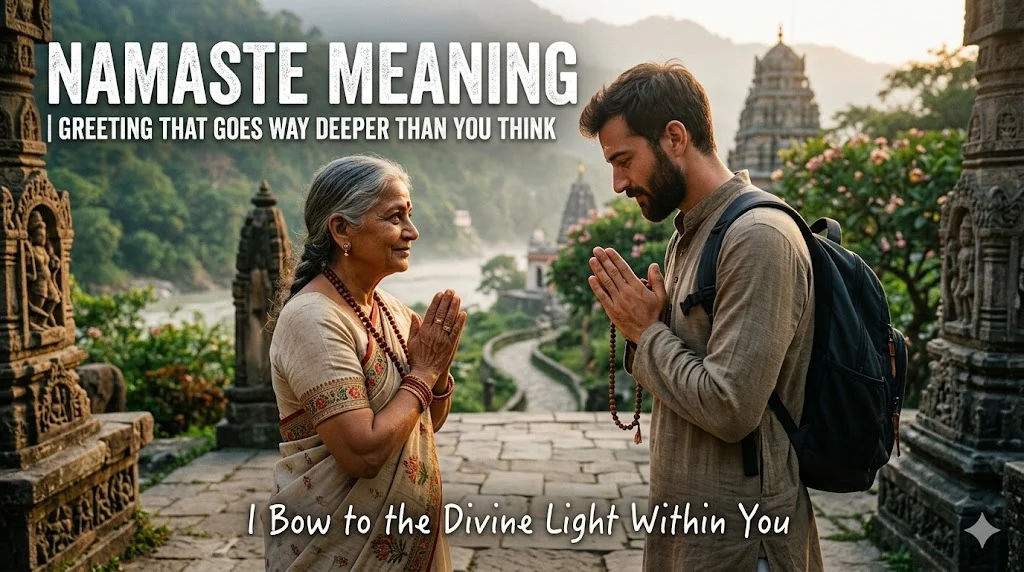
You’ve heard it at the end of every yoga class. You’ve seen it printed on tote bags, coffee mugs, and retreat brochures. But most people who say it have no idea what they’re actually expressing. See here Namaste Meaning.
Namaste is one of the most mispronounced, misunderstood, and misused words in modern wellness culture. And yet, its real meaning is so much more powerful than “hello” or “goodbye” could ever be.
This guide breaks it all the way down. The Sanskrit roots. The spiritual depth. The cultural weight it carries in India and Nepal. The proper way to use it. And why, once you understand what namaste truly means, you’ll never hear it the same way again.
What Does Namaste Mean? The Exact Definition
Let’s start at the very foundation.
Namaste (pronounced nah-MAH-stay) is a Sanskrit word composed of two parts:
| Sanskrit Component | Transliteration | English Meaning |
|---|---|---|
| नमस् | Namas | Bow, reverence, adoration |
| ते | Te | To you |
| नमस्ते | Namaste | I bow to you |
So the literal namaste definition is simple: I bow to you.
But here’s the thing. That translation only scratches the surface. The word namas carries connotations of deep humility, selfless respect, and reverence. It isn’t a casual bow like you’d give a stranger in an elevator. It’s the kind of bow that says, “I see something in you that deserves my full respect.”
That nuance is what makes the namaste meaning so extraordinary.
Think about the word saudade in Portuguese, which describes a deep emotional longing that no single English word can capture. Or the Danish hygge, which describes cozy contentment. Namaste works the same way. You can translate it, but you can’t fully replicate it in English.
The namaste meaning in English that comes closest to capturing its spirit is: “I honor the divine within you.” That’s the phrase most yoga teachers and Sanskrit scholars land on. And as you’ll see, it points to something far more profound than any standard greeting.
Namaste Origin: Born in One of the World’s Oldest Languages
To understand where namaste comes from, you need to understand Sanskrit.
Sanskrit is one of the oldest documented languages on Earth. It belongs to the Indo-European language family and dates back to approximately 1500 BCE, though some scholars push the oral tradition even further. The Vedas, which are humanity’s oldest surviving scriptures, were composed in Vedic Sanskrit. Namaste appears in this ancient tradition not as small talk but as a philosophical declaration.
Here’s a simplified timeline of how the word traveled through history:
~1500 BCE    Vedic Sanskrit emerges in the Indian subcontinent
~1200 BCE    Namaste appears in ancient Hindu ritual and greeting traditions
~500 BCE     Spread deepens through Buddhist and Jain philosophical texts
1893         Swami Vivekananda addresses the Parliament of the World's Religions
              in Chicago, introducing Indian philosophy to Western audiences
1970s        The global yoga boom carries namaste into Western fitness culture
2000s+       Social media and celebrity wellness culture turn namaste into a
              global brand word
2020         During COVID-19, world leaders including Emmanuel Macron and
              Narendra Modi promote the gesture as a hygienic, no-contact greeting
The namaste origin sits squarely in Hindu Vedic culture. Its geography spans the Indian subcontinent, where it’s been used continuously in India, Nepal, and parts of Southeast Asia for thousands of years.
What makes its etymology so interesting is that the word never lost its meaning over that entire span of time. Most ancient words get diluted or transformed as they travel through cultures. Namaste kept its philosophical integrity right up until it hit the Western wellness market and started appearing on yoga pants.
The Spiritual Meaning of Namaste: This Is Where It Gets Profound
Embedded in the namaste spiritual meaning is a concept from Hindu philosophy called Atman, which refers to the individual soul or divine spark that exists within every living being. The Upanishads, a collection of ancient philosophical texts, describe Atman as identical to Brahman, the universal consciousness that underlies all of existence.
The spiritual namaste meaning becomes: “The divine in me bows to the divine in you.”
That’s a radically different thing from “hey.”
“Namaste isn’t a greeting you say. It’s a truth you acknowledge.”
The what does namaste mean spiritually question connects to several layers of Hindu and Buddhist philosophy:
- In Hinduism:
- Tat tvam asi (Sanskrit: “Thou art that”) is one of the Mahavakyas, the great sayings of the Upanishads. It means you and I share the same divine essence.
- The concept of Namaskara extends this greeting into a formal ritual act of devotion, used when approaching a deity or a revered teacher.
- Namaste honors the Jyoti, the inner light, that Hindu philosophy says burns in every human heart.
2. In Buddhism:
- Buddhist philosophy teaches Buddha-nature, the belief that every sentient being carries the innate capacity for enlightenment.
- Greeting someone with namaste, in a Buddhist context, is acknowledging that potential in them.
- In Tibet and parts of Southeast Asia, a similar gesture called Wai (in Thailand) carries comparable spiritual weight.
3. In Jainism:
- Jains use the greeting Jai Jinendra, which means “Victory to the conquerors of the self,” but the gesture of the Anjali Mudra appears across Jain practice as well.
- The shared thread: all three traditions use the gesture to honor something eternal within the person being greeted.
The deeper you go, the more you realize that namaste isn’t really about the person saying it or even the person receiving it. It’s about the belief that something sacred connects all living beings. And that’s worth pausing for.
Namaste in Indian Culture: How It Actually Lives Day to Day
Here’s something Western pop culture tends to get wrong. In India, namaste isn’t reserved for yoga classes or spiritual retreats. It’s Tuesday morning.
Kids greet their grandparents with namaste before school. Shopkeepers greet customers with it. Politicians use it on the campaign trail. It functions as a general-purpose salutation across generations, regions, and religions in India.
A few key facts about how namaste operates in everyday Indian culture:
- It works as both a hello and a goodbye, similar to how aloha functions in Hawaiian
- It’s considered more respectful than a handshake in formal or elder-greeting contexts
- Children are taught to offer namaste to elders as a fundamental expression of respect and humility
- It’s used across Hindu, Sikh, Jain, and even some Muslim communities in India, making it less about religion and more about cultural identity
- In Nepal, the word carries the same meaning and cultural weight as in India
Regional variations matter too. In South India, Namaskaram is the more common form. In parts of Maharashtra, you’ll hear Namaskar. These are all variations of the same Sanskrit root with the same fundamental meaning.
The COVID-19 moment was revealing. When the pandemic began in early 2020 and handshakes became a health risk, French President Emmanuel Macron demonstrated the namaste gesture during a press conference. Israeli Prime Minister Benjamin Netanyahu did the same. It made headlines globally, and for the first time, millions of people outside South Asia started Googling the namaste gesture meaning.
That moment showed something important: namaste is inherently practical as well as philosophical. No physical contact. Immediate signal of respect. Universally readable. It had been ahead of its time for 3,500 years.
The Namaste Gesture: What the Hands Are Actually Saying
You can say the word. But the gesture carries its own complete vocabulary.
The physical form of namaste is called the Anjali Mudra in Sanskrit. Anjali means “offering” or “divine offering.” Mudra means “seal” or “gesture.” So the Anjali Mudra is literally the gesture of offering.
Here’s how to do it correctly:
- Press both palms together, flat and firm
- Fingers point upward
- Hold the hands at the heart center, also called the Anahata chakra in yogic anatomy
- Bow the head slightly forward
- The eyes may close briefly or remain open with soft, direct gaze
Why the heart center? In yogic philosophy, the heart chakra is the seat of compassion, love, and emotional truth. Placing your hands there while bowing communicates that your greeting comes from a genuine, emotionally honest place. It isn’t a performance. It’s an offering.
| Gesture Element | Symbolic Meaning |
|---|---|
| Pressed palms | Unity of self; bringing left and right, logic and intuition together |
| Heart placement | Emotional sincerity; the greeting comes from the heart, not the mind |
| Upward fingers | Aspiration; reaching toward something higher |
| Bowed head | Humility; temporarily releasing the ego to meet another as an equal |
| Closed eyes (optional) | Inward reflection; turning attention toward the inner divine |
One important note: in traditional Indian and yogic contexts, the gesture often stands alone without the word. The Anjali Mudra is so universally understood across South and Southeast Asia that speaking the word becomes optional. The hands say everything.
There’s also a higher variation of the gesture used in devotional contexts. When offering namaste to a deity or a highly revered spiritual teacher, the hands are raised to the forehead or even to the crown of the head. The higher the placement, the deeper the reverence.
Namaste in Yoga: Why Every Class Ends With It
Yoga, in its traditional form, isn’t just a physical practice. It’s a philosophical system rooted in ancient Indian texts including the Yoga Sutras of Patanjali, the Bhagavad Gita, and the Upanishads. The physical postures you do in class (asanas) are just one of eight limbs of yoga described by Patanjali. The whole system is oriented toward moksha, liberation from the cycles of suffering and the realization of one’s true divine nature.
In that context, namaste at the end of class means something specific:
- Gratitude for the shared practice
- Acknowledgment of the teacher-student relationship, called coach-shishya in Sanskrit
- Recognition that both teacher and student hold the same inner light
- Closure of a sacred container of time and intention
The significance of namaste in yoga is also deeply egalitarian. When a teacher bows and says namaste to their students, they’re saying, “The divine in me is no greater than the divine in you. We met here as equals.” That’s a powerful thing for a teacher to say.
Namaste entered Western yoga primarily through Indian teachers who traveled to Europe and North America in the 20th century. Teachers like Krishnamacharya, B.K.S. Iyengar, Pattabhi Jois, and Indra Devi carried the word and the practice with them. Their Western students adopted the greeting, and as yoga exploded globally, namaste came with it.
Some current facts about yoga’s global reach:
- Approximately 300 million people practice yoga worldwide as of 2024
- The yoga industry generates over $88 billion annually worldwide
- The United States alone has an estimated 36 million yoga practitioners
- June 21 is recognized as International Yoga Day by the United Nations, a designation proposed by Prime Minister Narendra Modi in 2014
With those numbers, you begin to understand how one Sanskrit word reached every corner of the globe.
Namaste vs. Hello: Two Words, Two Completely Different Worldviews
On the surface, both words are greetings. That’s where the similarity ends.
“Hello” entered the English language in the early 1800s, popularized partly through its use with telephone communication. Before that, “hallo,” “hullo,” and “hail” served similar functions. The word carries no deeper meaning beyond acknowledging someone’s presence. It’s a social function, not a philosophical statement.
Namaste, by contrast, is 3,500 years old and carries an entire cosmology.
| Feature | Hello | Namaste |
|---|---|---|
| Language origin | Old English / Germanic | Sanskrit |
| Approximate age | ~200 years in modern form | ~3,500 years |
| Literal meaning | No agreed etymology; a call of attention | I bow to you |
| Deeper meaning | None beyond acknowledgment | Recognition of the divine in another |
| Physical component | Handshake, wave, or nothing | Anjali Mudra with a bow |
| Cultural weight | Culturally neutral | Philosophically significant |
| Directionality | One-way acknowledgment | Mutual recognition |
| Usage context | Universal, casual, unrestricted | Context-sensitive, intentional |
The gap between these two words reflects a fundamental difference in how Eastern and Western traditions think about human connection. Western greetings tend to be transactional. You greet someone to signal you’ve noticed them. Eastern philosophical greetings like namaste are relational. You greet someone to honor something essential and shared between you.
Neither approach is wrong. But once you understand the difference, you start to see why namaste traveled so far so fast. People across cultures are hungry for the kind of connection it implies.
Namaste Pronunciation: Getting It Right
This one matters more than most people think.
Correct pronunciation: nah-MAH-stay
Here’s the breakdown:
- Na as in “nah” (rhymes with “spa”)
- mas as in “mahs” (not “mass”)
- te as in “tay” (not “tee”)
The emphasis falls on the second syllable: nah-MAH-stay.
Common mispronunciations to avoid:
- “NAH-muh-stay” (wrong stress, vowels flattened)
- “nah-mah-STEE” (stress on the wrong syllable, short final vowel)
- “nah-MAY-stee” (incorrect vowel in the second syllable)
In Sanskrit, vowel length and stress are precise and meaningful. The language was designed to be spoken with specific tonal accuracy because it was an oral tradition for centuries before it was written down. Getting the pronunciation right is a small but real form of respect for the culture that gave us the word.
In Hindi, the pronunciation is essentially the same as the Sanskrit original, which is why namaste has maintained phonetic consistency across thousands of years and dozens of regional languages.
How to Use Namaste Correctly (And What to Avoid)
Let’s get practical. You want to use this word and gesture with genuine understanding. Here’s how.
Appropriate contexts for namaste:
- Greeting or departing from someone in a South Asian cultural setting
- Opening or closing a yoga or meditation session
- Expressing deep gratitude or respect to a teacher, elder, or mentor
- As a no-contact greeting in professional or multicultural settings
- Moments of genuine spiritual connection or acknowledgment
How to do it properly:
- Bring your palms together firmly at your heart center
- Bow your head slightly and hold briefly
- If you speak the word, say it with intention, not as a reflex
- Make eye contact before or after the bow to signal genuine presence
- Don’t rush it. The gesture loses meaning when it’s performed at sprint pace
What to avoid:
- Saying namaste sarcastically or ironically
- Using it as a punchline in a joke at the expense of Indian or Hindu culture
- Placing it on merchandise purely as an aesthetic without any understanding of its meaning
- Performing the gesture mechanically, without any awareness of what you’re doing
- Assuming it’s interchangeable with any generic goodbye
The big question: Is namaste religious?
This one comes up constantly and deserves a direct answer. Namaste has philosophical and cultural roots in Hindu tradition but it isn’t an inherently religious act in everyday use. In India, millions of people who aren’t practicing Hindus use it daily. The gesture predates organized religion as we know it.
That said, in a devotional context (greeting a deity’s statue, bowing to a coach), it carries explicit religious meaning. Context determines everything.
Is Using Namaste Cultural Appropriation?
This is the uncomfortable question that nobody in the yoga world wants to sit with. So let’s address it directly.
Cultural appropriation occurs when elements of a minority or historically marginalized culture are adopted by a dominant culture in ways that strip the original context, often for profit or aesthetic novelty, without acknowledgment or respect.
Using namaste falls into a spectrum:
Appreciation (generally acceptable):
- Using the word and gesture with genuine understanding of its meaning
- Studying the philosophical tradition it comes from
- Teaching it to yoga students with proper cultural context
- Acknowledging its South Asian origins
Appropriation (worth reconsidering):
- Slapping “Namaste” on a wine glass or beer koozie for ironic laughs
- Using it as a trendy aesthetic without any engagement with its meaning
- Deliberately mispronouncing it while claiming to teach yoga
- Profiting from the word while showing no interest in its cultural origins
The distinction isn’t about policing language. It’s about honesty. When you use a word with 3,500 years of philosophical history behind it, you’re borrowing something precious. The minimum courtesy is knowing what you’ve borrowed.
Most Indian and South Asian voices on this topic aren’t asking Westerners to stop using namaste. They’re asking for respect and awareness. That’s a reasonable request.
Namaste Across Cultures: A Word That Resonates Everywhere
One of the most fascinating things about namaste is how many cultures have independently arrived at something similar. This suggests the idea embedded in the word, honoring something divine or essential within another person, is a deeply human impulse.
Similar greetings across the world:
| Culture | Greeting | Meaning |
|---|---|---|
| Japan | Rei (bow) | Respect and acknowledgment |
| Thailand | Wai (palms together, bow) | Respect; similar gesture to Anjali Mudra |
| Hawaii | Aloha | Love, peace, compassion, and presence |
| Zulu (South Africa) | Sawubona | “I see you” — remarkably close to namaste’s spirit |
| Tibet | Tashi Delek | Auspiciousness; blessings upon you |
| Cambodia | Sampeah | Palms together, bow; identical gesture to namaste |
The Zulu Sawubona deserves special attention. Its literal translation is “I see you,” and the traditional response is Sikhona, meaning “I am here.” Together they create a mutual acknowledgment: I see you, therefore you exist. I exist because you see me. That’s strikingly close to what namaste is doing philosophically.
The fact that human beings across wildly different cultures, separated by oceans and centuries, arrived at such similar ideas about greeting suggests something important. Maybe honoring the dignity of the person in front of you isn’t a cultural preference. Maybe it’s a human necessity.
Namaste Meaning in Urdu and Across South Asian Languages
The namaste meaning in Urdu is essentially identical to its Hindi and Sanskrit meaning. Namaste or Namaskar are used among Hindu communities in Pakistan, while the parallel Muslim greeting As-salamu alaykum (“Peace be upon you”) carries a similarly philosophical weight about honoring another person.
In multilingual, multireligious South Asia, greetings carry enormous social information. Saying namaste signals cultural identity. Saying Adaab (a traditional Urdu/Muslim greeting) or As-salamu alaykum signals another. Neither is superior. Both reflect the same underlying impulse: human beings reaching across the space between themselves to acknowledge another’s presence and worth.
Across South Asian languages, you’ll find these variations:
- Hindi/Sanskrit: Namaste, Namaskar
- Urdu: Namaste (used by Hindu communities), Adaab, Salaam
- Bengali: Namaskar
- Gujarati: Jai Shree Krishna, Namaskar
- Marathi: Namaskar
- Tamil: Vanakkam (similar gesture, different etymology)
- Kannada: Namaskara
- Nepali: Namaste (identical to Hindi usage)
The consistency of the gesture across all these variations is remarkable. Even where the spoken word differs, the pressed palms and bowed head tend to appear. The body language of reverence transcends the specific word.
The Deeper Lesson Namaste Teaches Us About Human Connection
Step back from the linguistics, the history, and the gesture for a moment.
What does it actually mean to greet someone by saying, “The divine in me recognizes the divine in you”?
It means you walk into every encounter acknowledging that the person in front of you carries something sacred. Not because of what they’ve achieved or what they own or what they look like. But because they exist. Because something essential and irreducible lives in them the way it lives in you.
That’s a radical posture to take in daily life.
Most modern greetings are transactional. “Hey, how are you?” “Fine, thanks.” The exchange happens and everyone moves on. Nobody’s actually seen. Nobody’s actually honored.
Namaste short-circuits that transaction. It replaces it with recognition.
Imagine applying that spirit, even loosely, to ordinary interactions. The barista who makes your coffee. The colleague you’ve stopped really seeing because you pass them every day. The family member you’ve been taking for granted. What would change if you greeted them with the awareness that something worthy of reverence lives inside them?
This isn’t a fantasy. It’s what the word has always been asking us to do.
FAQs
What is the true meaning of namaste?
The true namaste meaning is “I bow to you,” derived from the Sanskrit namas (bow, reverence) and te (to you). Its deeper spiritual meaning is “The divine in me recognizes and honors the divine in you,” reflecting Hindu philosophy’s belief in the divine spark (Atman) present within every living being.
Can non-Hindus or non-Indians use namaste?
Yes, with awareness and genuine respect for its origins. The word wasn’t designed to be exclusive. However, using it with understanding of its meaning and cultural roots is the responsible way to engage with it.
What is the correct way to perform the namaste gesture?
Press both palms flat together at the heart center (chest level), fingers pointing upward. Bow the head slightly. You may close your eyes briefly. The gesture can be performed with or without speaking the word.
Is it disrespectful to use namaste casually?
Using it casually isn’t inherently disrespectful as long as you’re not using it mockingly or stripping it of all meaning for commercial purposes. In India, namaste is used casually every day by hundreds of millions of people. The problem arises when it’s used with zero awareness of its origins or meaning, or when it’s exploited purely as an peculiar aesthetic.
Conclusion:
Namaste has traveled an extraordinary distance. From ancient Sanskrit texts composed thousands of years ago to yoga studios in London, Los Angeles, and Lahore, it’s crossed every conceivable boundary of geography, religion, and culture.
And it’s still here. Still being spoken. Still carrying meaning.
That’s not an accident. Words that survive thousands of years and cross continents do so because they point at something real. Something that resonates across every human culture, no matter how different.
The namaste meaning, at its most essential, is this: you are not separate from me. Something in you is the same as something in me. And that something is worth honoring.
Next time you bring your palms together and bow your head, whether in a yoga class, in a greeting, or just in a quiet moment of reflection, you’re participating in one of humanity’s oldest and most generous gestures.
Read More Related Articles:
- What Does a Walkover Mean in Tennis? Real Match Impact In 2026
- What Does Pick 6 Mean in Football? From Interception to Touchdown In 2026
- What Does Flex Mean in Fantasy Football? Strategy Explained In 2026

Ivy Madison is a content creator at TextSprout.com, specializing in word definitions, internet slang, acronyms, and text abbreviations. She delivers clear and engaging explanations, helping readers quickly understand modern digital language and trending terms.