
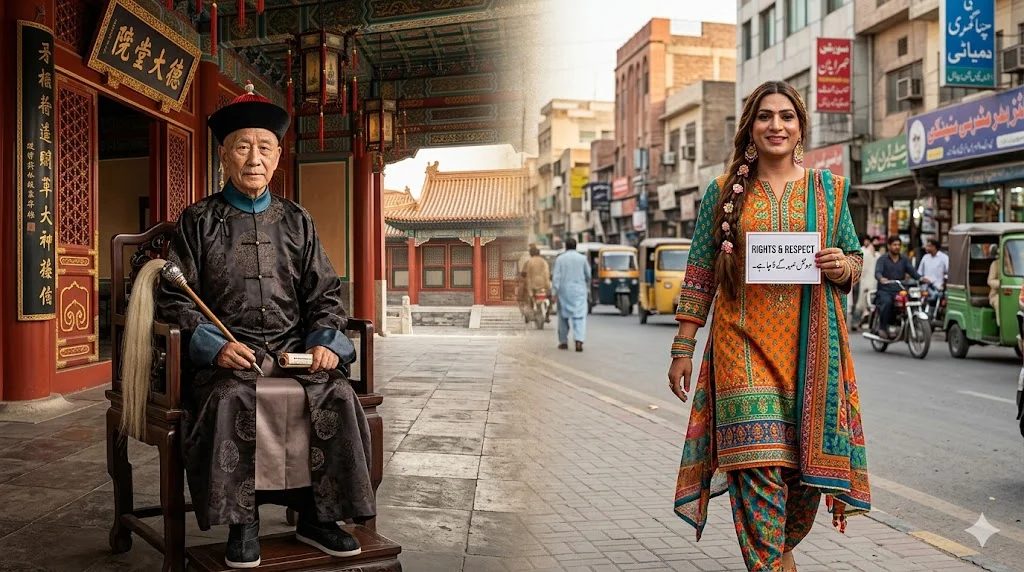
Let’s cut through the confusion right now. Explore Real Meaning of Eunuch here.
A eunuch is a human male who has been castrated. That means surgical or traumatic removal of the testicles. People usually did this before puberty, but not always.
The eunuch definition sounds simple. But the real story? It’s wildly complex.
Some eunuchs became emperors’ closest advisors. Others guarded royal harems. A few commanded massive navies. Many lived as outcasts. And today, the meaning of eunuch has evolved into something entirely different in places like India and Pakistan.
So let’s break this down. No fluff. Just facts, stories, and straight talk.
Where the Word “Eunuch” Comes From
The origin of the word eunuch surprises most people.
Ancient Greek gives us eunoukhos. Break it down:
- Eunē means “bed”
- Ekhein means “to keep” or “to guard”
So a eunuch was literally a “bedroom guard.”
That tells you everything about the job. Rulers needed someone to guard their wives and concubines. But they couldn’t trust an uncastrated man near those women. Solution? Remove the sexual threat entirely.
The eunuch etymology reveals function first, biology second. These weren’t just “castrated men.” They were trusted insiders.
Eunuch synonym options exist but none fit perfectly:
- Chamberlain (too narrow – only some eunuchs held that title)
- Castrato (only for singers)
- Guard-servant (clumsy but accurate)
Stick with “eunuch.” It’s precise.
Pronunciation: Say It Right
Eunuch pronunciation trips people up constantly.
It’s YOO-nik.
- Not “yoo-nutch.”
- Not “ay-ooh-nich.”
- Not “ee-un-uch.”
Say it with me: YOO-nik. Like “unique” without the “que.”
Eunuch in a sentence example:
“The Byzantine emperor’s most trusted general was a eunuch named Narses.”
Another one:
“No, a eunuch isn’t the same as an intersex person – different origins entirely.”
The Biological Reality: What Castration Actually Does
Let’s get medical for a moment. No squeamishness allowed.
Castration removes the testicles. Those are the primary male reproductive organs. They produce sperm and most of the body’s testosterone.
Remove them, and everything changes.
If castration happens BEFORE puberty:
| Effect | Why It Happens |
|---|---|
| High, boyish voice | Larynx doesn’t deepen |
| No facial or body hair | Androgens drive hair growth |
| Long limbs, short torso | Growth plates close later |
| Underdeveloped muscles | No testosterone surge |
| Rounded hips and chest | Fat distribution shifts |
| No balding | DHT never rises |
If castration happens AFTER puberty:
| Effect | Why It Happens |
|---|---|
| Voice stays deep | Larynx already changed |
| Existing hair remains | Won’t grow new facial hair but keeps old |
| Muscle loss over time | Testosterone drops |
| Libido disappears | Sexual drive hormones crash |
| Possible breast growth | Estrogen now dominates |
| Bone density loss | No testosterone support |
Is a eunuch considered male or female?
Biologically? Male. The Y chromosome doesn’t change. Socially? Many cultures created a third category – neither fully man nor woman.
Eunuch vs intersex – huge difference. A intersex (now called intersex) is born with ambiguous genitalia or mixed chromosomes. A eunuch is made through castration. One is congenital. One is surgical.
Why Were Eunuchs Created? The Brutal Logic
No sugarcoating this. The reasons are harsh but real.
Rulers across civilizations discovered the same ugly truth: a castrated man could be incredibly useful.
Why were eunuchs created across so many cultures? Four main reasons:
Reason 1: Guard the Harem
This is the big one. Royal women needed protection. But an uncastrated male guard posed an obvious risk. A eunuch? No threat at all.
Where practiced: Ottoman Empire, Mughal India, Imperial China, Persia
Reason 2: Prevent Dynastic Coups
A eunuch can’t have children. That means no son to overthrow the emperor. No family to build a rival power base.
A ruler could promote a eunuch to the highest ranks without ever fearing a hereditary takeover.
Where practiced: China most famously, but also Byzantium
Reason 3: Create Totally Loyal Servants
Cut a boy off from his family. Remove his ability to start his own. He has nowhere else to go. His loyalty belongs entirely to his master.
That kind of dependence is powerful. Rulers exploited it ruthlessly.
Where practiced: Everywhere eunuchs existed
Reason 4: Preserve a Singing Voice
This one’s different. In Renaissance Italy, some boys were castrated before puberty to keep their high, pure voices forever.
These castrati became opera superstars. Farinelli (1705–1782) earned more than most kings. The Catholic Church officially banned the practice in 1903.
Where practiced: Italy, 16th–19th centuries
Deep Dive: Eunuchs in China: The Most Powerful Examples
Eunuchs in China history spans over 2,000 years. From the Qin dynasty (221 BCE) to the Qing dynasty (1912 CE), eunuchs served every imperial house.
The scale was staggering. By the Ming dynasty (1368–1644), over 100,000 eunuchs worked in the Forbidden City alone. They ran the palace, managed finances and they spied on officials. Sometimes, they ruled.
Zheng He – The Eunuch Admiral
Famous eunuchs in history don’t get more impressive than Zheng He.
Born a Muslim boy named Ma He in 1371. Captured as a child. Castrated. Made a eunuch servant in the Ming court.
But here’s where the story flips. He rose through the ranks. Became a trusted advisor to Emperor Yongle. And then? He commanded the largest wooden ships the world had ever seen.
Between 1405 and 1433, Zheng He led seven massive voyages. His fleet included 300 ships and 28,000 men. They reached Southeast Asia, India, the Persian Gulf, and East Africa. Decades before Columbus even sailed.
Key fact: Zheng He’s biggest ship measured about 400 feet long. Columbus’s Santa Maria? 85 feet. Not even close.
Wei Zhongxian: The Eunuch Who Ruled an Empire
The dark side of eunuch power.
Wei Zhongxian started as a minor palace servant. Through cunning and alliance-building, he became the most powerful man in the Ming Empire. He controlled the emperor, purged hundreds of honest officials and he built a personal fortune that rivaled the national treasury.
He proves that why were eunuchs used in ancient palaces wasn’t just about safety. It was also about control – and sometimes, that control backfired spectacularly.
Deep Dive: Eunuchs in the Ottoman Empire
The Ottomans perfected the eunuch system. They created two distinct tiers:
| Type | Origin | Role | Skin Color (as they classified) |
|---|---|---|---|
| White Eunuchs | Balkans (Christian boys) | Palace administration, education | Fair |
| Black Eunuchs | Africa (Nubia, Ethiopia) | Harem guard, sacred mosque keeper | Dark |
The Black Eunuchs held more real power. They guarded the Sultan’s own harem at Topkapı Palace. The Chief Black Eunuch (Kızlar Ağası) ranked among the empire’s top officials. He controlled access to the Sultan’s mother and wives – and therefore, access to the Sultan himself.
Famous example: Hüseyin Ağa (17th century). Rose from enslaved boy to Chief Black Eunuch. Amassed enormous wealth. Built mosques and fountains across Istanbul. Died one of the richest men in the empire.
Eunuchs in the Ottoman Empire lasted until 1922 – the empire’s final collapse.
Deep Dive: Eunuchs in the Mughal Empire
South Asia had its own powerful eunuch tradition.
Role of eunuchs in Mughal Empire centered on the zenana – the women’s quarters. Eunuchs guarded these spaces. They delivered messages. They managed household staff. And some rose to astonishing power.
The most famous? Malik Kafur. Originally a captured slave. Castrated. Became General and Chief Minister under Sultan Alauddin Khalji (13th–14th century). He led military campaigns, made political decisions and he commanded armies of thousands.
Eunuch meaning in Hindi today connects directly to this history. The word hijra and the more formal napunsak both carry echoes of these Mughal-era roles.
Eunuch meaning in Urdu uses Khawaja Sira – the preferred modern term in Pakistan. This word consciously moves away from older, more derogatory labels.
Eunuchs in Religion: A Complicated Legacy
Eunuchs in religion and culture vary wildly by faith and text.
In Islam
The Quran mentions eunuchs directly. Surah An-Nur (24:31) says:
“And tell the believing women… not to reveal their adornment except to their husbands, their fathers… or male attendants who have no physical desire.”
Those “male attendants” meant eunuchs.
Eunuch meaning in Islam and history is largely practical. Eunuchs served as permitted attendants to women. No religious ban existed. Many Ottoman and Mughal eunuchs lived devout Muslim lives.
In Christianity
The Bible mentions eunuchs multiple times. Most famously in Acts 8:
An Ethiopian eunuch, the queen’s treasurer, meets Philip on the road. He asks to be baptized. Philip agrees. The eunuch becomes one of the first Christian converts from Africa.
Jesus himself references eunuchs in Matthew 19:12:
“For there are eunuchs who were born that way, others were made that way by men, and others choose to live like eunuchs for the kingdom of heaven.”
That third category – “choose to live like eunuchs” – later inspired celibate monks and priests, though they weren’t literally castrated.
In Hinduism
No direct eunuch doctrine. But the hijra community, which includes castrated members, has deep roots in Hindu mythology. The god Rama reportedly blessed hijras. The Mahabharata mentions a eunuch-like character, Shikhandi, who was born female but raised male.
Modern-Day Eunuchs: The Hijra and Khawaja Sira Communities
This is where the eunuch meaning gets updated for 2026.
Modern-day eunuchs exist. But they don’t look like Ottoman palace guards.
The Hijra Community of South Asia
Hijra community meaning in India, Pakistan, and Bangladesh refers to a third-gender group. Some hijras undergo castration (nirvan). Others don’t. Some identify as women. Others as neither male nor female.
Key facts about hijras today:
| Fact | Detail |
|---|---|
| Estimated population (India) | 2–3 million (2023 census data) |
| Legal recognition | Third gender (India 2014, Pakistan 2018, Bangladesh 2013) |
| Traditional work | Blessings at births/weddings, performing, begging |
| Modern activism | Running for office, NGOs, media representation |
| Major challenges | Discrimination, poverty, housing access |
Real life examples of eunuchs in this context:
Laxmi Narayan Tripathi – hijra activist. Fought India’s Supreme Court for third-gender recognition. Won in 2014. Now runs NGOs and speaks at the UN.
Kami Sid – Pakistani Khawaja Sira model and activist. Walked runways. Starred in documentaries. Changed how Pakistan sees its third-gender citizens.
Difference Between Eunuch and Transgender – Critical Distinction
This confuses people constantly. Here’s the breakdown:
| Aspect | Eunuch (Historical) | Eunuch (Modern Hijra) | Transgender Woman |
|---|---|---|---|
| Born male | Yes | Usually | Usually |
| Castrated | Yes | Often, but not always | Sometimes, not required |
| Identifies as | Male (socially different) | Third gender or female | Female |
| Reason | Forced or chosen for role | Cultural/religious choice | Gender identity |
What does eunuch mean in modern context outside South Asia? Most people use it only historically. But within hijra and Khawaja Sira communities, it’s a living identity.
How Were Eunuchs Made Historically?
How eunuchs were made historically varied by time and place. None were pleasant.
Three main methods:
Method 1: Complete removal
Cut off testicles and penis. Highest death rate – over 60% in unsanitary conditions. Practiced in China and the Ottoman Empire.
Method 2: Testicle removal only
Removed just the testicles. Lower death rate (still 20-30%). Penis remained functional for urination. Common in Byzantium and Europe.
Method 3: Crushing
Testicles crushed with a heavy tool. No cutting. Still destroyed hormone production. Rare, but used in some African and Middle Eastern contexts.
Most boys were castrated between ages 6 and 12. Younger meant higher survival rate. The best “eunuch makers” – specialized surgeons in China and India – could achieve 80-90% survival. The worst butchers killed most of their victims.
Eunuch meaning in biology and society can’t ignore this brutal reality. These were children, often enslaved or sold by desperate families, undergoing life-changing surgery without modern anesthesia.
Eunuch Meaning in Simple Words: Quick Reference
Someone asks you what is a eunuch? Here’s your answer:
A eunuch is a male who has been castrated – usually as a child – often to serve in a royal court, guard a harem, or hold a trusted government position. The term comes from Greek for “bedroom guard.” Today, some South Asian communities (hijra and Khawaja Sira) continue modified forms of this tradition.
Eunuch definition simple enough? Good.
Eunuch meaning with examples:
- A Chinese palace eunuch managing imperial finances
- An Ottoman harem guard delivering secret messages
- An Italian castrato singing opera for the Pope
- A modern hijra blessing a newborn baby in Delhi
Famous Eunuchs in History You Should Know
Beyond Zheng He and Wei Zhongxian:
| Name | Time Period | Culture | Claim to Fame |
|---|---|---|---|
| Narses | 478–573 CE | Byzantine | General, crushed the Ostrogoths in Italy |
| Farinelli | 1705–1782 | Italian | World’s most famous castrato singer |
| Sporus | c. 50–69 CE | Roman | Emperor Nero married him in a public ceremony |
| Pothinus | c. 100–48 BCE | Egyptian | Regent for young Pharaoh Ptolemy XIII |
| Zhang Rang | d. 189 CE | Chinese | Led the infamous Ten Eunuchs of the Han dynasty |
Eunuch meaning in a sentence for Narses:
“Narses, a eunuch, defeated the Ostrogoths in 552 CE at the Battle of Taginae – proving that castration didn’t stop military brilliance.”
Why This History Still Matters
You might wonder – why care about eunuchs in 2026?
Three reasons.
First: The hijra and Khawaja Sira communities live this history right now. Over 3 million people in South Asia identify with traditions stretching back to Mughal and Ottoman times. Understanding eunuch history means understanding their present.
Second: Eunuchs reveal how power really works. Rulers didn’t castrate boys for cruelty’s sake (though cruelty was real). They did it because a man without family ties was the only man they could fully trust. That says something ugly about human society – and something we still haven’t fixed.
Third: The eunuch meaning keeps evolving. What started as “bedroom guard” became “court official,” then “opera singer,” then “third-gender identity.” Words change. People change. History doesn’t stop.
FAQs
Q1: What does eunuch mean in simple English?
A: A castrated male, especially one who worked as a royal guard or servant in ancient courts.
Q2: Is a eunuch the same as a transgender person?
No. Eunuch refers to castration status. Transgender refers to gender identity. Some hijras overlap both categories. Most transgender people are not eunuchs.
Q3: Can a eunuch still have sex?
After puberty castration: erection becomes difficult but not impossible. Libido drops sharply. No sperm production. Before puberty castration: genitals remain childlike; sexual function is minimal or absent.
Q4: Are there eunuchs today?
Yes. The hijra community in India (2–3 million people) includes many castrated individuals. Small Western communities of “modern eunuchs” also exist – private, often medical or identity-related.
Q5: What is the difference between eunuch and hijra?
Hijra is a South Asian third-gender identity. Some hijras are eunuchs (castrated). Some are not. The terms overlap but aren’t identical.
Conclusion:
Eunuch meaning isn’t one thing. It’s a dozen things layered over 3,000 years.
It’s the Greek guard. The Chinese admiral. The Ottoman vizier. The Italian castrato. The Indian hijra.
It’s brutal surgery and breathtaking loyalty, crushing oppression and surprising powerand it’s ancient history and modern identity.
What is a eunuch today?
For most of the world, it’s a word from the past, for millions in South Asia, it’s a living identity and for anyone who loves history, it’s a window into how societies bend human bodies to serve human power.
Now you know the real story.
Read More Related Articles:
- Offal Meaning In Text | Why You Should Eat It and How to Cook It Right In 2026
- Virtue Mean in the Bible: Meaning and Spiritual Insights In 2026
- What Does ISTG Mean | Origin and How to Use It Correctly In 2026

Ivy Madison is a content creator at TextSprout.com, specializing in word definitions, internet slang, acronyms, and text abbreviations. She delivers clear and engaging explanations, helping readers quickly understand modern digital language and trending terms.