
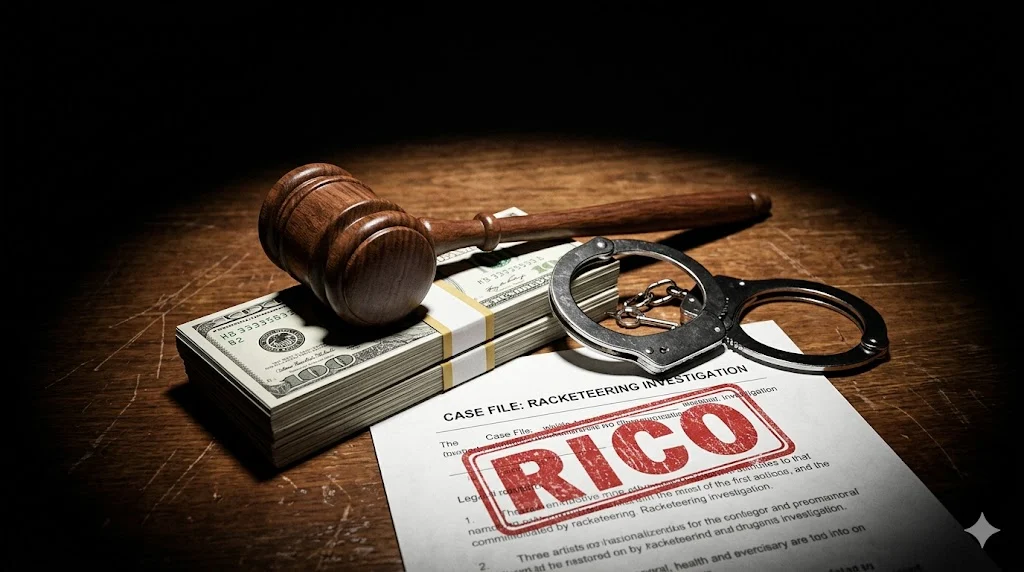
You hear the word in movies and news headlines. But the actual racketeering meaning stays fuzzy for most people. Let’s fix that right now. And get to know Racketeering Meaning Explained in detail
Racketeering means running an illegal business or scheme through a seemingly legitimate enterprise. Think of a recycling company that actually smuggles stolen goods. Or a union that collects “dues” but really takes kickbacks.
The FBI calls it “acquiring control of a legitimate business through illegal acts.” But we can say it simpler: racket = illegal money machine.
This guide gives you the full racketeering definition, how federal law treats it, real examples, punishment, and how it differs from extortion or organized crime. No law degree required.
What Is Racketeering in Simple Terms
Let’s start with a simple definition of racketeering you’d explain over coffee.
Racketeering = committing at least two illegal acts as part of a criminal group or business.
Those illegal acts could be bribery, fraud, money laundering, murder, or drug trafficking. The key is pattern and enterprise.
One stolen car? That’s theft. Running a stolen car ring with fake paperwork, bribed inspectors, and a chop shop? That’s racketeering.
The racketeering law meaning requires two things:
- A criminal enterprise (not necessarily the Mafia)
- A pattern of racketeering activity (two or more related crimes within 10 years)
You don’t need to be a mob boss. A corporate executive who runs a bribery scheme qualifies. So does a gang leader who uses a record label to launder drug money.
Racketeering in simple terms boils down to: crime as a business.
Legal Racketeering Definition Under U.S. Code
The official racketeering definition lives in 18 U.S. Code § 1961. It defines “racketeering activity” as any act or threat involving:
- Murder
- Kidnapping
- Gambling
- Arson
- Bribery
- Extortion
- Drug trafficking
- Money laundering
- Fraud (mail, wire, bank)
- Obstruction of justice
- Human trafficking
- Embezzlement from unions
- Counterfeiting
- Dealing in stolen goods
That list includes over 35 predicate offenses. A predicate offense just means a crime that can trigger a racketeering charge.
The meaning of racketeering in law also requires an enterprise. That enterprise can be:
- A sole proprietorship
- A partnership
- A corporation
- A union
- A gang
- Any group of people associated in fact (even without a formal name)
So a loosely organized crew selling fake IDs across three states? That’s an enterprise.
How Racketeering Works: The Enterprise + Pattern Formula
Prosecutors must prove two things for a racketeering charge to stick.
First: An enterprise exists.
This doesn’t need a charter or business license. The group just needs a common purpose, ongoing organization, and continuity.
Second: A pattern of racketeering activity.
Pattern means at least two predicate acts within 10 years. Those acts must be related (same purpose or victims) and pose a threat of continued criminal activity.
Example: A car dealership owner pays off a DMV clerk (bribery) and then files false loan applications (bank fraud). That’s two acts. If they happen within 10 years, you have a pattern.
The racketeering activities list covers so many crimes that prosecutors often stack charges. One RICO count can include 50 separate predicate acts.
“RICO turns a collection of individual crimes into a conspiracy charge against the entire operation.” – Former federal prosecutor.
That’s the real power. You don’t just charge the guy who pulled the trigger. You charge the boss who ordered it, the accountant who hid the money, and the front business owner who provided cover.
Real Racketeering Examples You Should Know
Racketeering examples help the definition stick. Here are real cases.
The Mafia’s Commission Case (1985)
Nine leaders of New York’s Five Families faced RICO charges. The government proved a pattern of murder, extortion, gambling, and labor racketeering. All convicted. Sentences ranged from 10 years to life.
The Chicago Outfit’s Casino Skimming (1980s–90s)
Mobsters skimmed millions from Las Vegas casinos. They used shell companies to hide profits. RICO charges brought down the entire skimming operation. What does racketeering mean in law here? Using legitimate casinos as an enterprise to commit tax evasion and fraud.
Paul Manafort (2018)
Trump’s former campaign chairman wasn’t just charged with tax fraud. Prosecutors used racketeering-like charges (conspiracy and money laundering) based on his Ukraine lobbying work. He received 7+ years.
Health Management Associates (2018–2022)
A hospital chain paid kickbacks for patient referrals. That’s a federal crime. The government charged multiple executives under federal racketeering laws for running a bribery enterprise.
Genovese Family Loan Sharking (2023 update)
In 2023, the FBI arrested 15 members of the Genovese crime family. Charges included loan sharking, illegal gambling, and extortion – all part of a single racketeering conspiracy. Some defendants faced life sentences.
Racketeering cases aren’t historical relics. New indictments drop every month.
Racketeering vs Extortion: Spot the Difference
People confuse racketeering vs extortion constantly. Here’s the clean breakdown.
| Aspect | Racketeering | Extortion |
|---|---|---|
| Scope | Pattern of multiple crimes | Single threat |
| Legal basis | RICO Act | State or federal extortion law |
| Enterprise needed | Yes | No |
| Example | Loan sharking + murder + fraud | “Pay me or I break your windows” |
| Punishment range | Up to 20 years per count | Typically 1–20 years depending on state |
Extortion is one tool in racketeering. You can commit extortion without racketeering (one threat, no enterprise). But most organized crime racketeering includes extortion as one predicate act.
Think of it this way: Extortion is a single punch. Racketeering is a whole boxing match with multiple rounds.
The RICO Act Explained: The Government’s Secret Weapon
You cannot fully understand racketeering meaning without knowing the RICO Act explained clearly.
RICO stands for Racketeer Influenced and Corrupt Organizations Act. Congress passed it in 1970 specifically to fight organized crime.
Before RICO, prosecutors could only charge individual crimes. The boss gave orders from a clean office. The soldier went to prison. The boss stayed free.
RICO changed that completely.
Under RICO, anyone who:
- Invests racketeering income into an enterprise
- Acquires or controls an enterprise through racketeering
- Conducts an enterprise through a pattern of racketeering
- Conspires to do any of the above
…can face the same charges as the person on the street.
Four Key RICO Provisions
- Criminal penalties – Up to 20 years per RICO count (some predicates carry life)
- Civil RICO – Private citizens can sue for triple damages
- Forfeiture – Government seeps all proceeds and assets from the racketeering
- Conspiracy liability – You don’t need to commit a predicate act yourself. Just agreeing to participate is enough.
Racketeering under RICO Act has convicted mob bosses, Wall Street traders, anti-abortion protesters, and even football coaches (SMU’s pay-for-play scandal in the 1980s).
“RICO is the single most powerful criminal statute in the federal arsenal.” – Notre Dame Law Review.
That’s not hyperbole. One RICO indictment can name 30 defendants, 100 predicate acts, and cover a decade of criminal activity.
Racketeering Charges: What Happens When You’re Indicted
A racketeering charge isn’t like a speeding ticket. It’s a federal felony with life-altering consequences.
The Indictment Process
- Investigation – FBI, IRS, or DEA builds a case. This takes months or years.
- Grand jury – Prosecutors present evidence. No defense attorney present.
- Indictment – Formal charges unsealed. Often includes asset freezes.
- Arraignment – Defendant enters a plea.
- Trial or plea – Most RICO defendants plead guilty. Trials are expensive and risky.
Racketeering Punishment By the Numbers
- Minimum sentence for one RICO count: Usually 5–10 years for serious predicates
- Maximum: 20 years per count. Life if predicate includes murder or drug trafficking.
- Fines: Up to $250,000 per count or twice the illegal gain
- Forfeiture: All assets tied to the racketeering – homes, cars, bank accounts, businesses
Real sentencing examples:
| Defendant | Crime | Sentence |
|---|---|---|
| John Gotti (Gambino family) | Murder, extortion, gambling | Life without parole |
| Michael Franzese (Colombo family) | Gasoline tax fraud racket | 10 years |
| Joaquín “El Chapo” Guzmán | Drug trafficking enterprise | Life plus 30 years |
| Scott Tucker (payday lending) | Illegal lending racket | 16+ years |
Racketeering in the US carries some of the longest federal sentences outside of terrorism.
Common Racketeering Activities List (Full Breakdown)
The official racketeering activities list under 18 U.S.C. § 1961 includes dozens of crimes. Here are the most common ones prosecutors use.
Violence-Based Predicates
- Murder and manslaughter
- Kidnapping
- Robbery
- Arson
- Assault with intent to kill
Fraud and Deception
- Mail fraud
- Wire fraud
- Bank fraud
- Securities fraud
- Health care fraud
- Identity theft
Financial and Business Crimes
- Money laundering
- Bribery
- Embezzlement from labor unions
- Counterfeiting
- Extortionate credit transactions (loan sharking)
Vice and Trafficking
- Drug trafficking (any controlled substance)
- Gambling offenses (illegal casinos, sports betting)
- Human trafficking
- Alien smuggling
Obstruction and Perjury
- Obstruction of justice
- Witness tampering
- Perjury
Prosecutors love mail and wire fraud. Why? Almost any scheme using phones, email, or postal mail can trigger those charges. In the digital age, that’s nearly every racketeering case.
Racketeering in Business: When Companies Become Criminals
Racketeering meaning in business matters because white-collar executives now face RICO charges regularly.
A legitimate business becomes a criminal enterprise when it uses corporate resources to commit crimes. Examples include:
- A construction company that pays off building inspectors (bribery + fraud)
- A medical lab that gives kickbacks for patient referrals
- A bank that launders drug money through dummy accounts
- A tech company that sells user data through illegal channels
Recent Corporate Racketeering Cases
Purdue Pharma (2020)
The government didn’t just charge opioid distribution. They alleged a racketeering conspiracy to mislead doctors and patients about OxyContin’s addiction risks. Purdue paid $8.3 billion in penalties.
Binance (2023)
The crypto exchange pleaded guilty to money laundering and sanctions violations. The DOJ called it a “criminal enterprise” – classic racketeering language. Binance paid $4.3 billion.
Goldman Sachs (1MDB scandal)
The bank helped launder billions from a Malaysian development fund. A former executive received a RICO conviction in 2022. Goldman paid over $5 billion in penalties.
Illegal business operations look different today. They involve shell companies, encrypted messaging apps, and offshore accounts. But the legal principle stays the same: a pattern of crime through an enterprise.
Trending Data: Racketeering Cases Are Rising
Recent trending data shows racketeering charges aren’t fading. They’re evolving.
2023–2024 RICO Statistics
- Over 300 federal RICO indictments filed in 2023 (Transactional Records Access Clearinghouse)
- 43% increase in health care fraud RICO cases since 2020 (DOJ)
- 21% of all federal organized crime cases now involve cyber racketeering (FBI)
- Racketeering conviction rate at trial: over 85% for federal prosecutors
New Racketeering Trends
Cyber racketeering – Ransomware gangs now face RICO charges. The DOJ indicted NetWalker group members in 2021 for a pattern of cyber extortion.
Fentanyl trafficking – Cartels running fentanyl operations face RICO conspiracy charges regularly. 2024 saw multiple cartel leaders extradited on racketeering counts.
Pandemic fraud rings – Over 1,000 defendants faced racketeering-related charges for stealing COVID relief funds. Many used shell companies and fake employee lists.
Racketeering vs organized crime is blurring. Traditional Mafia cases have dropped. But cyber gangs, cartels, and corrupt corporate executives now fill the dockets.
Racketeering vs Organized Crime: Not the Same Thing
Difference between racketeering and organized crime confuses even law students. Let’s separate them cleanly.
| Concept | Definition | Example |
|---|---|---|
| Organized crime | A structured group using illegal methods for profit | The Mafia, cartels, Triads |
| Racketeering | A pattern of specific illegal acts through an enterprise | Running a loan shark operation inside a car wash |
You cannot have organized crime without racketeering. The group needs those predicate acts to function.
But you can have racketeering without an organized crime syndicate. One corrupt corporation qualifies. So does a single police officer running a protection racket.
Criminal organization structure enables racketeering. The organization provides hierarchy, resources, and cover. Racketeering gives the organization its income and power.
Think of it this way: Organized crime is the who. Racketeering is the what.
How to Spot Racketeering in Daily Life
You probably won’t witness a mob hit. But some racketeering patterns appear in everyday settings.
Warning Signs of a Racketeering Enterprise
- A business that deals mostly in cash with no clear product
- Loan offers with interest rates above 25% (potentially loan sharking)
- A contractor who insists on cash payments only
- Repeated “consulting fees” with no actual consulting work
- A charity that shares address and phone with a for-profit business
These signs don’t guarantee racketeering. But prosecutors look for exactly these patterns during investigations.
What does racketeering mean in law for an ordinary person? Mostly, it means you can recognize the signs. If you see them, report to the FBI’s organized crime tip line.
FAQs
What does racketeering mean in law?
In federal law, racketeering means a pattern of illegal activity conducted through a criminal enterprise. The RICO Act defines it. You need at least two predicate acts within 10 years.
Is racketeering a felony?
Yes. Always a federal felony. Some states also have racketeering statutes (RICO state laws). A racketeering conviction usually carries 5–20 years minimum.
How does racketeering work in organized crime?
The crime group uses racketeering acts (extortion, fraud, trafficking) to make money. Then launders that money through legitimate-looking businesses. The enterprise protects the leaders from direct prosecution.
Can a legitimate business commit racketeering?
Yes. If a corporation uses its normal operations to commit fraud, bribery, or money laundering, it becomes a criminal enterprise. Executives can face RICO charges.
What are the most common racketeering activities?
Mail fraud, wire fraud, money laundering, drug trafficking, bribery, extortion, and illegal gambling. The FBI says 80% of RICO cases involve mail or wire fraud.
How many racketeering cases are filed each year?
Over 300 federal RICO indictments annually. Thousands more state-level racketeering cases. Numbers rose 15% between 2020 and 2024.
Does racketeering require violence?
No. Many racketeering cases involve only fraud and money laundering. Violence is just one category of predicate acts. Non-violent financial crimes work too.
Conclusion:
Understanding racketeering meaning helps you see through crime headlines. You realize the guy in the suit can be as guilty as the guy with the gun.
Racketeering isn’t a movie trope. It’s a daily reality in federal courtrooms. New cases drop every week. The RICO Act explained in this guide gives you the legal backbone. The racketeering examples give you real-world proof.
Racketeering definition recap:
- An enterprise + pattern of crime = racketeering
- RICO allows prosecutors to charge entire organizations
- Penalties include decades in prison and total asset forfeiture
- Racketeering happens in boardrooms, not just back alleys
Racketeering in simple terms one more time: Crime as a business. Business as a crime.
Now when you hear “racketeering charges filed,” you know exactly what it means. You understand the machine behind the word. And you won’t confuse it with a one-off crime or simple extortion.
The law treats racketeering seriously because it attacks the entire criminal network. Not just the symptoms. The whole disease.
That’s the real racketeering law meaning – and now it’s yours to keep.
Read More Related Articles:
- MRN Mean in Medical Terms: Medical Record Number Explained In 2026
- ADL Means in Medical Terms: Assessment & Clinical Use In 2026
- HMB Meaning in Text Messages: What It Stands For, When to Use It &Better Alternatives (2026)

Ivy Madison is a content creator at TextSprout.com, specializing in word definitions, internet slang, acronyms, and text abbreviations. She delivers clear and engaging explanations, helping readers quickly understand modern digital language and trending terms.