
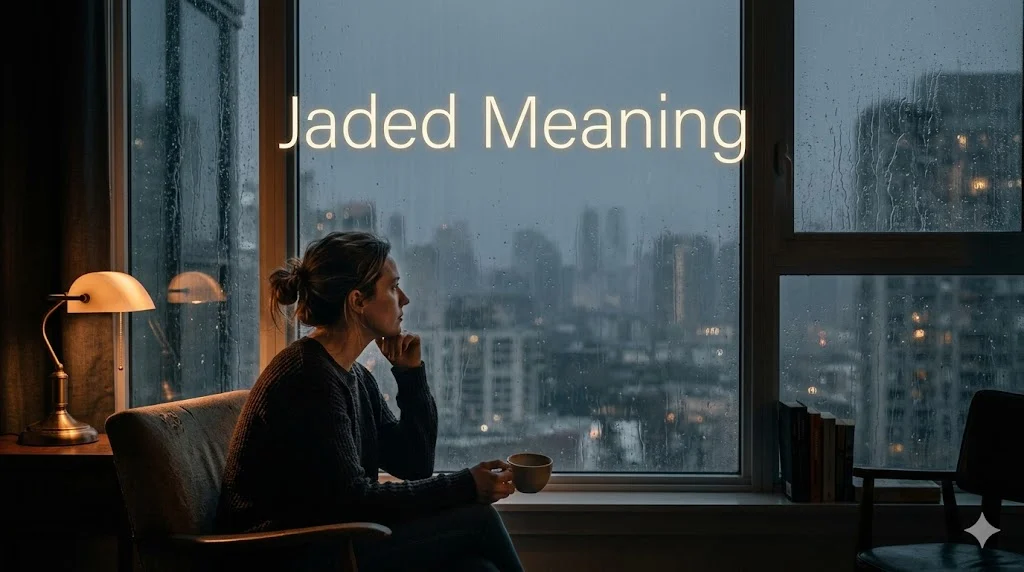
You used to wake up excited. Monday mornings felt full of possibility. New jobs, new relationships, new cities they all carried that electric hum of what if. But somewhere along the way, that feeling packed its bags and left without saying goodbye. Now you scroll through the same feeds, sit through the same meetings, and smile at the same conversations feeling absolutely nothing. Here you can get knowledge about Jaded Meaning.
If that sounds familiar, there’s a word for it. That word is jaded.
It’s one of those words that stops people mid-sentence. “Wait, what does jaded mean, exactly?” Some people use it to mean tired. Others think it means bitter. A few mix it up with being cynical. But jaded is its own thing entirely and understanding it properly might be the first step to actually doing something about it.
This guide covers everything. The real jaded meaning, where the word actually comes from, how it differs from related words like cynical or burned out, what it looks like in relationships and careers, and yes what you can actually do about it.
What Does Jaded Mean? The Core Definition
Let’s start with the plain English version, because dictionary definitions can be surprisingly unhelpful.
Jaded means feeling dull, numb, or unexcited because of too much exposure to something. It’s not sadness, not anger. It’s something quieter and, in some ways, harder to deal with it’s the slow draining of enthusiasm after years of overexposure.
The simplest way to put it: once it thrilled you, now it bores you and you don’t even have the energy to be disappointed about it. That’s jaded.
What the Dictionaries Say
Merriam-Webster defines jaded as “exhausted by overindulgence” and “dulled by surfeit.” Oxford takes a slightly more accessible route, describing it as “tired, bored, or lacking enthusiasm, typically after having had too much of something.”
Both are accurate. But they don’t quite capture the weight of the word in real life. A person who’s jaded isn’t just “a bit tired.” They’ve crossed a threshold. They’ve moved from enthusiastic to hopeful to cautious to resigned and they did it gradually, almost without noticing.
The Grammar of Jaded
Knowing how to use the word correctly matters, especially if you’re writing or speaking in formal contexts.
| Form | Part of Speech | Example Sentence |
|---|---|---|
| Jaded | Adjective | “She felt jaded after a decade in corporate law.” |
| Jadedness | Noun | “His jadedness showed in every meeting.” |
| Jadedly | Adverb | “He smiled jadedly at the familiar pitch.” |
Jaded almost always follows a linking verb like feel, seem, become, or grow or it precedes a noun directly. “A jaded traveler.” “He grew jaded.” These are natural constructions. You’d never say “he jadedly the situation” the adverb form is rare in everyday speech.
The Etymology of Jaded: Where the Word Actually Comes From
Here’s where it gets genuinely interesting. The word jaded didn’t start as an emotional term at all.
It comes from the late 16th century English word “jade” which, at the time, referred to a worn-out, exhausted horse. A jade was a horse that had been worked too hard, pushed past its limits, and left unable to perform. The animal wasn’t broken in spirit exactly it was simply depleted. Too spent to care.
Over time, the word migrated from horses to people. By the 17th century, writers were using “jade” to describe women they considered worn-out or disreputable. And eventually, “jaded” became the adjective form describing anyone or anything dulled through overuse.
What makes the etymology so perfect is how precisely it mirrors the modern meaning. A jaded person hasn’t given up in a dramatic, theatrical way. They’ve simply been worked past their capacity to feel wonder. The depletion happened gradually. And like that old horse, rest alone doesn’t always fix it.
“The word ‘jaded’ carries its history with it a quietly powerful metaphor about what happens when something is pushed far beyond what it was built to sustain.”
Jaded Meaning in Different Languages
The concept of jadedness isn’t uniquely English. People feel it everywhere and different languages have developed their own nuanced ways to express it.
Jaded Meaning in Urdu
In Urdu, the closest equivalents to jaded are:
- اکتایا ہوا (Uktaya hua) literally “fed up” or “weary of repetition”
- بیزار (Bezaar) deeply disenchanted, repelled by something once tolerable
Bezaar actually carries a slightly stronger emotional charge than the English “jaded.” It implies active repulsion not just numbness, but a kind of weary disgust. A person who is bezaar has moved past indifference into something closer to quiet rejection.
Example: “Woh zindagi se bilkul bezaar ho gaya tha.” (“He had grown completely jaded with life.”)
Jaded Meaning in Hindi
Hindi speakers reach for similar vocabulary:
- उकताया हुआ (Uktaya hua) tired of, bored through overexposure
- विरक्त (Virakta) detached, disillusioned, withdrawn from worldly engagement
Virakta has a philosophical undertone rooted in Sanskrit it describes the state of someone who has turned away from desire and attachment. In casual conversation, Hindi speakers often say “bore ho gaya” (got bored), but virakta better captures the deeper, accumulated emotional withdrawal that “jaded” implies.
Example: “Woh apni naukri se bilkul uktaya hua tha.” (“He was completely jaded with his job.”)
Jaded Meaning in Texting and Informal English
In digital conversations Twitter, Reddit, text messages “jaded” gets used with surprising precision. People deploy it to describe the specific feeling of being done caring after one too many disappointments.
You’ll often see it in emotional venting, relationship post-mortems, and career complaints:
- “After three ghostings in a row, I’m just jaded about dating apps.”
- “Five years at this company and I’m completely jaded. Nothing surprises me anymore.”
- “She used to be so sweet. Now she’s just jaded.”
In texting contexts, jaded typically signals that someone has shifted from active frustration to passive resignation. It’s not a complaint it’s a conclusion.
Jaded in a Sentence Real-World Usage Examples
Understanding a word means seeing it work across different contexts. Here are natural, varied example sentences grouped by life domain.
Relationships
- “After two painful breakups in three years, he’d grown jaded about love not angry, just numb.”
- “She wasn’t hostile on dates. She was something harder to reach: jaded.”
- “His friends thought he was picky. He knew the truth he’d just stopped expecting things to work out.”
In Workplace
- “A decade in the industry had left her jaded. No new project excited her the way the first ones had.”
- “The new hire’s enthusiasm made the jaded senior staff visibly uncomfortable.”
- “He still did excellent work. But he did it the way someone does laundry without joy, just obligation.”
Everyday Life
- “Traveling used to feel like discovery. Now airports just made him tired.”
- “She couldn’t remember the last time a meal surprised her. Every restaurant felt like the same menu.”
- “The magic of city life had worn off completely. Now it was just noise.”
Literature and Media
- “The detective was a textbook jaded hero seen too much, hoped for too little, still doing the job anyway.”
- “Every great noir story is built around a jaded protagonist who’s lost faith but not conscience.”
Quick Grammar Reminders
- Correct: “He felt jaded.” / “A jaded perspective.” / “She grew jaded over time.”
- Incorrect: “He jadedly the project.” (forced adverb use unnatural in standard English)
Jaded Synonym: Words That Mean Almost the Same Thing (But Not Quite)
This is where a lot of people get confused. Several words orbit the same emotional territory as jaded but land in slightly different places.
| Synonym | What Makes It Different from Jaded |
|---|---|
| Weary | General tiredness; doesn’t require overexposure as the cause |
| Disillusioned | Lost a specific belief or ideal; more targeted than jaded |
| Apathetic | Complete emotional flatness; no history of caring required |
| World-weary | Tired of life broadly; a more existential, literary tone |
| Burned out | Depleted specifically by overwork; often professional context |
| Cynical | Actively distrusts people’s motives; more vocal and combative |
| Blasé | Unimpressed due to overexposure; lighter and often affectedly so |
| Indifferent | Neutral disengagement; no emotional backstory implied |
| Bored | Temporary, mild, situational much softer than jaded |
| Disenchanted | Lost the enchantment around something once idealized |
The crucial insight: Jaded implies a history. You can’t be jaded about something you never cared about. Boredom is possible on a Tuesday afternoon with no context. Jadedness requires a story usually a long one.
That’s what separates it from simple boredom or passing indifference. A jaded person once felt it. That’s what makes it sting.
Jaded Antonym: The Words That Capture Its Opposite
If you want to understand what jadedness takes away from a person, look at its antonyms.
| Antonym | What It Represents |
|---|---|
| Enthusiastic | Actively energized and engaged |
| Fresh | New to an experience, unspoiled by repeated exposure |
| Eager | Anticipating something with genuine excitement |
| Idealistic | Still believes things can be meaningful and good |
| Inspired | Energized by something beyond routine |
| Naive | Hasn’t yet been weathered by experience |
| Optimistic | Expects positive outcomes despite uncertainty |
| Curious | Genuinely interested; still finds things worth exploring |
Think of it this way. Picture a first-year teacher, eyes lit up, convinced they’re going to change lives. That’s the opposite of jaded. Now picture that same teacher fifteen years later, shuffling through lesson plans they stopped believing in years ago. The distance between those two people that’s jadedness, accumulated over time.
Jaded vs. Similar Words: Understanding the Key Differences
These distinctions matter. Using the wrong word misrepresents the feeling and misrepresentation leads to misunderstanding, especially in conversations about mental and emotional health.
Jaded vs. Cynical
This is the most common mix-up.
- Cynical people actively distrust others’ motives. They argue. They challenge. They’re often vocal about their skepticism.
- Jaded people have stopped engaging enough to distrust. They don’t argue they shrug.
A cynical person says, “This new company initiative is just management spin.” A jaded person says, “Sure. Whatever.”
Cynicism is an active posture. Jadedness is a passive one. Both can coexist in the same person but they’re not the same thing.
| Cynical | Jaded | |
|---|---|---|
| Tone | Combative, skeptical | Passive, resigned |
| Energy level | Still engaged (negatively) | Disengaged |
| Root cause | Distrust of people | Overexposure to disappointment |
| Likely to say | “People are selfish by nature.” | “I just don’t care anymore.” |
Jaded vs. Burned Out
Burnout is a specific, recognized psychological state primarily tied to chronic workplace stress. The World Health Organization classifies burnout as an occupational phenomenon characterized by exhaustion, reduced professional efficacy, and increased mental distance from one’s job.
Jadedness is broader. You can be jaded about relationships, hobbies, travel, or life in general. Burnout is about depletion of energy. Jadedness is about depletion of wonder.
You can recover from burnout with proper rest and recovery. Jadedness is stickier. It doesn’t respond to a two-week vacation the way burnout sometimes does.
| Burned Out | Jaded | |
|---|---|---|
| Primary domain | Work, caregiving | Any area of life |
| Core feeling | Exhaustion | Numbness |
| What it depletes | Energy, capacity | Enthusiasm, wonder |
| Treatment response | Often responds to rest | Requires deeper change |
Jaded vs. Bored
Boredom is Tuesday afternoon. Jadedness is a worldview.
Boredom is temporary and situational you need something to happen and nothing is. Jadedness is a settled state. Even when something does happen, it doesn’t register the way it should.
A bored person is waiting. A jaded person has stopped waiting.
Jaded vs. Tired
This one sounds obvious but trips people up. Tired means your body or mind needs rest. Sleep fixes tired.
Jadedness doesn’t respond to sleep. You can wake up from ten hours of rest and still feel that same flat, gray indifference toward the day. If “just sleep it off” doesn’t work it’s probably not just tiredness.
Jaded Meaning in Psychology: What Science Actually Says
Psychology doesn’t have a single clinical term that maps perfectly onto “jaded” but several well-researched concepts come remarkably close.
Hedonic Adaptation
This is perhaps the most scientifically precise explanation for why people become jaded. Hedonic adaptation describes the human brain’s tendency to normalize stimuli over time including pleasurable ones.
Research in positive psychology, including landmark work by psychologists Philip Brickman and Donald Campbell (who coined the term “hedonic treadmill” in 1971), found that people return to a relatively stable emotional baseline after both positive and negative life events. The promotion that thrilled you in October barely registers by January. The new city that felt electric becomes just the place you live.
Jadedness, in many ways, is hedonic adaptation applied to the emotional and experiential dimensions of life over and over, until the baseline itself shifts downward.
Emotional Exhaustion
Emotional exhaustion is one of the three core dimensions of burnout as defined by psychologist Christina Maslach’s Burnout Inventory (MBI). It describes a state of being emotionally overextended and depleted having given so much emotional energy that there’s nothing left to give or feel.
People experiencing emotional exhaustion describe:
- Feeling emotionally drained after everyday interactions
- A sense of being used up
- Difficulty generating warmth or enthusiasm they know they once had
This overlaps significantly with jadedness particularly the variety that develops in caregiving professions, high-intensity relationships, or demanding creative fields.
Compassion Fatigue
Compassion fatigue is a well-documented phenomenon in healthcare workers, therapists, social workers, and first responders. It describes the erosion of empathy and emotional responsiveness that comes from sustained exposure to others’ suffering.
A nurse who started their career crying at every loss and now barely processes it that’s compassion fatigue. It looks a lot like jadedness. It is a form of jadedness, specialized to the context of helping others.
Anhedonia
Anhedonia is the clinical term for the inability to feel pleasure from activities that once felt rewarding. It’s a core symptom of major depressive disorder but can also exist independently.
Jadedness and anhedonia overlap but they’re not identical. Anhedonia is a clinical symptom. Jadedness is an experiential state that can be situational, context-specific, and responsive to life changes. If what you’re feeling is pervasive, persistent, and affecting your daily functioning that warrants a conversation with a mental health professional, not just self-reflection.
“Jadedness isn’t weakness. It’s what happens when someone cared deeply, for too long, without being replenished.”
Signs You Might Be Feeling Jaded: An Honest Look
These aren’t clinical criteria. They’re real-life signals the kind of things a jaded person recognizes with a quiet, exhausted nod.
- Things that used to excite you now feel routine or hollow. The promotion, the trip, the dinner it all lands flat.
- You catch yourself predicting failure before anything even starts. Not because you’re pessimistic by nature, but because experience has trained you to expect it.
- Other people’s enthusiasm irritates you. Not because they’re wrong to feel it but because you can’t access it anymore, and their access feels like an accusation.
- You’ve stopped beginning things. New hobbies, new connections, new attempts they all feel like they require more energy than the outcome is worth.
- You feel more relief when something ends than joy when something begins.
- Compliments feel empty. You hear them but they don’t land anywhere meaningful.
- Bad news feels like confirmation. You weren’t surprised. You’re never surprised.
- You’ve quietly lowered your expectations across the board not as a conscious strategy, but as a way to stop being disappointed.
- You feel vaguely tired all the time not physically exhausted, but worn in a way that sleep doesn’t touch.
Recognizing these signs isn’t a verdict. It’s a starting point. The fact that you can name it means you haven’t completely disengaged.
Jaded Meaning in Relationships: What It Really Looks Like
Relationships romantic, professional, and platonic are one of the most common contexts in which people become jaded. And it’s one of the least-discussed aspects of the word.
In Romantic Relationships
A jaded person in a romantic context doesn’t show up with visible wounds. They show up with shields you can’t see.
They guard their emotions not because they’re calculated, but because hope has become genuinely painful. They’ve felt the specific sting of investing fully and walking away empty enough times that the brain has started treating optimism as a threat.
What this looks like in practice:
- Difficulty celebrating early-relationship milestones without mentally bracing for the fall
- A tendency to interpret positive signs as anomalies rather than patterns
- Emotional distance that feels, to partners, like coldness or disinterest
- Reluctance to be vulnerable, even when things are going well
- The quiet, exhausting work of convincing yourself it’s okay to hope this time
It’s worth saying clearly: being jaded in love doesn’t make someone a bad partner. It makes them someone with a history. The question is whether they’re aware of it and whether they’re willing to work through it rather than let it quietly sabotage what’s in front of them.
In Friendships
A jaded person often withdraws from social investment without drama. They cancel plans without guilt, find small talk genuinely intolerable rather than just mildly tedious, and prefer depth or silence to surface-level engagement.
They still care often deeply but they’ve stopped performing the rituals of caring that don’t feel real to them anymore. This can read as aloofness when it’s actually a kind of exhausted authenticity.
In the Workplace
Professional jadedness is enormously common and enormously costly both to the individual and to organizations.
A jaded employee often:
- Dismisses new company initiatives with a knowing look and “we’ve tried this before”
- Does competent, sometimes excellent work but without investment or pride
- Mentors junior colleagues well, having accumulated real wisdom, while advocating for themselves not at all
- Feels no particular loyalty in either direction
- Would leave tomorrow if the right opportunity appeared and might not even be excited about that
The tragedy of workplace jadedness is that the most jaded employees are often the most experienced. They’ve seen the most. They’ve given the most. And somewhere in that giving, something ran dry.
“Being jaded in relationships doesn’t mean a person is broken. It means they’ve been hurt enough times that hope started feeling dangerous.
What Causes a Person to Become Jaded? The Real Roots
Jadedness doesn’t arrive overnight. It accumulates. Here are the most common drivers:
Repeated disappointment without resolution. When expectations consistently go unmet and nothing changes not the situation, not the approach, not the outcome the brain eventually stops generating expectations. This is protective but deadening.
Overexposure without recovery. Any experience, however wonderful, loses its luster under relentless repetition without space to miss it. Travel, creativity, relationships, even success all of them require absence to stay meaningful.
Environments that reward cynicism. Certain workplaces, industries, and social circles actively punish optimism. When enthusiasm is met with eye-rolls and hope is treated as naivety, people learn quickly to stop displaying both.
Unprocessed emotional experiences stacking up. Losses, betrayals, failures, and disappointments that were never properly grieved or worked through don’t disappear. They accumulate below the surface and eventually create a kind of emotional sediment that dulls everything above it.
The slow erosion of idealism. Most people enter adulthood with some version of idealism about their field, their relationships, their country, themselves. When reality persistently contradicts those ideals without offering workable alternatives, idealism quietly dies. And with it goes a certain brightness.
How to Stop Feeling Jaded: Practical, Honest Strategies
This isn’t a toxic positivity section. You won’t find “just be grateful!” or “choose joy!” here. What follows are grounded, honest approaches that actually respect how hard jadedness is to shift.
Name It First
You can’t address what you haven’t identified. Recognizing that you’re jaded specifically jaded, not just tired or stressed changes how you approach the problem. Jadedness requires different strategies than burnout or boredom.
Reduce Overexposure Deliberately
If an environment, relationship, or activity is draining you past recovery, reducing contact isn’t giving up it’s triage. You can’t rebuild enthusiasm for something you’re still submerged in.
Seek Novelty Deliberately (But Modestly)
Jadedness thrives in repetition. Interrupting the loop doesn’t require grand gestures. A different route to work, a cuisine you’ve never tried, a conversation with someone outside your usual circle small novelties create small interruptions in the numbness.
Revisit Why You Started
In careers, relationships, and creative pursuits what originally pulled you in? Not what you thought you’d get, but what you felt in the beginning. That original draw often still exists beneath the accumulated sediment. Excavating it isn’t nostalgia it’s recalibration.
Find People Who Still Believe
Cynicism and jadedness are contagious. So is genuine enthusiasm. Deliberately spending time with people who are genuinely engaged not naively, but authentically can be surprisingly restorative.
Rest Differently
Sleep is necessary but not sufficient. What jaded people often need is genuine mental rest unstructured time without performance pressure. Nature, solitude, play, physical movement without goals. The kind of rest that isn’t optimized for productivity.
Lower the Stakes Temporarily
Do something with no expectation of return. Not as a performance of wellness, but actually. A hobby nobody will see. A walk with no destination. Making food just because it smells good. Removing performance from an activity often restores the pleasure that performance was covering up.
Know the Line Between Jaded and Depressed
If what you’re describing has crossed from dullness into persistent sadness, loss of functioning, or hopelessness that feels complete rather than situational that’s worth talking to a professional about. Jadedness and depression can coexist and can trigger each other. Neither is a character flaw and neither has to be permanent.
FAQs
What does jaded mean in simple terms?
Jaded means feeling dull or unexcited because you’ve experienced something too many times or been through too much. It’s the exhaustion of someone who once cared deeply and now finds it hard to access that caring. Not sadness more like emotional flatness born from overexposure.
What’s the difference between jaded and cynical?
Cynical people actively distrust others and often express that distrust. Jaded people have simply stopped engaging enough to bother distrusting. Cynicism is an active stance. Jadedness is a passive drift. A cynical person argues; a jaded person shrugs.
Can a person become jaded from love?
Absolutely and it’s one of the most common forms. Repeated romantic disappointment, betrayal, or the slow erosion of connection in long relationships can produce a deep relational jadedness. A person in this state isn’t cold by nature. They’re exhausted by experience.
What causes someone to become jaded?
The most common causes include repeated disappointment without resolution, chronic overexposure without recovery time, unprocessed emotional experiences, environments that punish optimism, and the gradual erosion of idealism without replacement.
What is the opposite of jaded?
The clearest antonyms are enthusiastic, fresh, eager, idealistic, and inspired. These words describe what jadedness takes away the wide-eyed engagement with possibility that characterizes someone who hasn’t yet been worn down by overexposure.
Conclusion
Jaded is one of those words that carries weight far beyond its two syllables. It’s not just an adjective. It’s a description of what happens to people who cared enough, for long enough, without being refilled.
The meaning of jaded isn’t complicated once you feel it in context: the quiet, gray numbness that settles in when enthusiasm has been stretched thin too many times. It lives in worn-out relationships, hollowed-out careers, and the slow death of idealism in people who once had it in abundance.
But here’s what the etymology gets right: a jade that overworked horse wasn’t broken. It was depleted. And depletion, unlike breaking, leaves room for restoration.
Recognizing that you’re jaded is not a conclusion. It’s a diagnosis. And like most things that accumulate gradually, it can also be undone gradually with the right interventions, the right support, and the willingness to let small things matter again before big ones do.
The opposite of jaded isn’t naivety. It’s hard-won, eyes-open hope. That’s worth working toward.
Read More Related Articles:
- What Does Delta Mean in Math: From Algebra to Calculus In 2026
- What Does GG Mean in Text? Discover the Hidden Meaning (2026)
- Exclamation Point Mean in a Car: Don’t Ignore This Warning In 2026

Luna Hartley is a content creator at TextSprout.com, where she specializes in explaining word meanings, modern phrases, and everyday language used in texts and online conversations. Her writing focuses on clarity and context, helping readers understand how words are actually used in real communication.