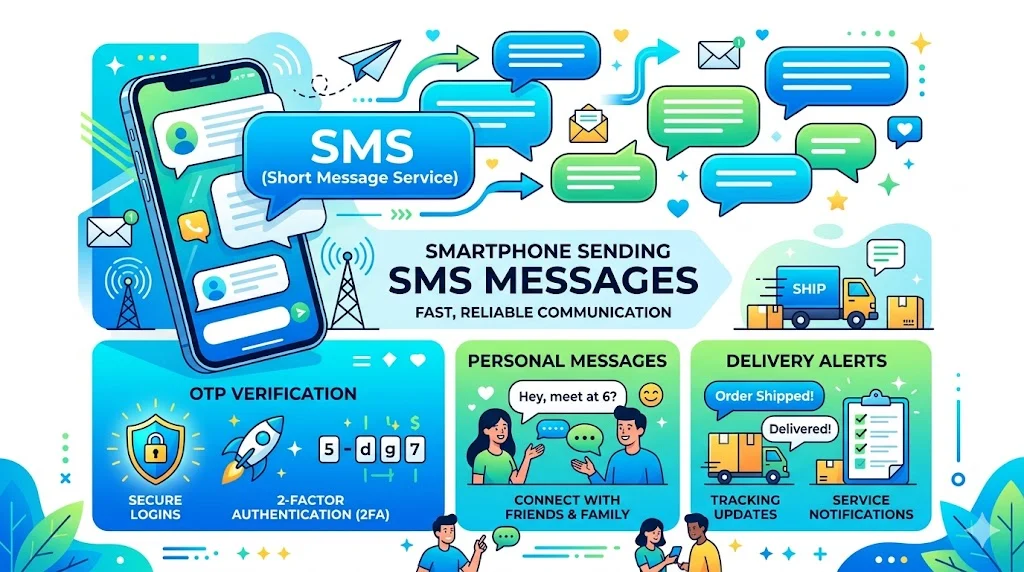
SMS stands for Short Message Service.
It is a text messaging service that allows users to send short written messages between mobile phones or devices over a cellular network.
In simple terms, SMS is the standard way to send text messages without using the internet.
In today’s fast-paced digital world, communication happens in seconds. One of the most common terms you’ve likely come across is SMS. Whether you are sending a quick message to a friend, receiving a bank alert, or verifying an online account, SMS plays a major role in everyday communication.
Even though messaging apps are everywhere now, SMS is still widely used across the globe. Understanding what SMS means, how it works, and where it is used can help you communicate more effectively and safely.
Understanding SMS in Simple Terms
SMS is the original form of texting. It works through your mobile carrier instead of relying on WiFi or mobile data. This means you can send and receive SMS messages even when you do not have internet access, as long as you have a cellular signal.
Each SMS message is typically limited to 160 characters, although modern phones may combine multiple messages automatically to send longer texts.
SMS is supported by nearly every mobile phone, from basic feature phones to the latest smartphones. This universal compatibility is one of the reasons it remains relevant even today.
Origin and Evolution of SMS
SMS technology dates back to the early days of mobile communication. The first SMS message was sent in 1992, and it simply read “Merry Christmas.” At that time, mobile phones were not designed for texting, and messages were limited and basic.
Over time, SMS became a standard feature in mobile networks. As mobile phones became more advanced, texting grew in popularity, especially in the early 2000s. It quickly became one of the most widely used forms of communication worldwide.
Even with the rise of apps like WhatsApp and Facebook Messenger, SMS remains essential because it does not depend on internet connectivity and works on all devices.
How SMS Works
SMS messages are sent through a cellular network using a system called a Short Message Service Center. When you send a message, it travels from your phone to this center, which then forwards it to the recipient’s device.
This process happens almost instantly, making SMS a fast and reliable way to communicate.
Here is a simplified breakdown:
| Step | What Happens |
|---|---|
| 1 | You type and send a message |
| 2 | Message goes to your mobile network |
| 3 | Network sends it to SMS center |
| 4 | SMS center delivers it to recipient |
This system works even when the recipient’s phone is turned off. The message is stored and delivered once the phone is back online.
Common Uses of SMS
SMS is used in many different ways, both personally and professionally.
Personal Communication
People use SMS to send quick messages like:
- “I’m on my way”
- “Call me when you’re free”
- “See you at 6”
It is simple, fast, and does not require an internet connection.
Business and Marketing
Businesses use SMS to communicate with customers. Common examples include:
- Promotional offers
- Appointment reminders
- Delivery updates
Security and Verification
SMS is widely used for one-time passwords (OTP) and account verification. For example, when logging into Gmail or Instagram, you may receive a code via SMS to confirm your identity.
Emergency Alerts
Governments and organizations use SMS to send emergency notifications such as weather warnings or safety alerts.
Types of SMS Messages
There are a few different types of SMS messages used today.
| Type | Description |
|---|---|
| Standard SMS | Basic text message up to 160 characters |
| Concatenated SMS | Longer messages split into multiple parts |
| Flash SMS | Messages that appear directly on screen without saving |
| Binary SMS | Messages used for technical or system purposes |
Each type serves a different purpose depending on the context.
SMS vs Messaging Apps
Many people wonder how SMS compares to modern messaging apps.
| Feature | SMS | Messaging Apps |
|---|---|---|
| Internet Required | No | Yes |
| Cost | May be charged per message | Usually free with data |
| Media Sharing | Limited | Advanced (photos, videos, files) |
| Availability | Works on all phones | Requires app installation |
Apps like WhatsApp and Telegram offer more features, but SMS remains more reliable in areas with weak internet connectivity.
Advantages of SMS
SMS continues to be widely used because of its unique benefits.
- Works without internet
- Supported on all mobile phones
- Fast and reliable delivery
- Ideal for urgent communication
- Widely used for security verification
These advantages make SMS an essential communication tool even today.
Limitations of SMS
Despite its usefulness, SMS does have some drawbacks.
- Character limit for messages
- Limited multimedia support
- Possible charges depending on carrier
- Less interactive compared to modern apps
Because of these limitations, many people use SMS alongside other messaging platforms.
Real-World Examples of SMS
Here are some everyday examples of SMS usage:
| Scenario | Example Message |
|---|---|
| Banking | “Your OTP is 456789” |
| Delivery | “Your package will arrive today” |
| Personal | “I’ll call you later” |
| Appointment | “Reminder: Doctor visit at 3 PM” |
These examples show how SMS is used in daily life for both personal and professional communication.
Tone and Context in SMS
SMS messages can vary in tone depending on how they are written.
Friendly Tone 😊
“Hey! Are you free tonight?”
Neutral Tone
“Meeting starts at 10 AM.”
Urgent Tone
“Call me ASAP.”
Since SMS messages are short, tone is often conveyed through wording, punctuation, or emojis.
Alternate Meanings of SMS
While SMS usually means Short Message Service, it can have other meanings depending on the context.
| Field | Meaning |
|---|---|
| Technology | Short Message Service |
| Education | School Management System |
| Business | Safety Management System |
| Healthcare | Senior Medical Staff |
In most everyday situations, SMS refers to text messaging.
Professional Alternatives to SMS
In formal or business settings, SMS may be referred to as:
- Text message
- Mobile message
- Messaging service
- Notification message
Using clear language helps avoid confusion, especially in professional communication.
Tips for Using SMS Effectively
- Keep messages short and clear
- Avoid misunderstandings by using simple language
- Use SMS for urgent or important updates
- Be mindful of tone, especially in professional settings
- Avoid sharing sensitive information unless necessary
These tips help ensure effective and secure communication.
FAQs
What does SMS stand for?
SMS stands for Short Message Service, a system used to send text messages between mobile devices.
Do you need internet for SMS?
No, SMS works through cellular networks and does not require internet access.
What is the character limit for SMS?
A standard SMS message is limited to 160 characters, though longer messages may be split into multiple texts.
Is SMS still used today?
Yes, SMS is widely used for communication, verification codes, and business messaging.
What is the difference between SMS and MMS?
SMS is for text messages, while MMS allows sending multimedia like images and videos.
Is SMS secure?
SMS is generally safe for basic communication but may not be fully secure for sensitive information.
Can SMS be sent internationally?
Yes, SMS can be sent globally, though charges may apply depending on your carrier.
Why do businesses use SMS?
Businesses use SMS because it is fast, reliable, and reaches customers instantly without needing internet access.
Conclusion
SMS remains one of the most reliable and widely used communication methods in the world. Even with the rise of modern messaging apps, it continues to play a vital role in personal communication, business messaging, and security verification.
Understanding what SMS means and how it works allows you to use it more effectively in your daily life. Whether you are sending a quick message, receiving an OTP, or staying connected in areas with limited internet, SMS provides a simple and dependable solution.
Read More Related Articles:
- GPI Meaning in Text: What This 3-Letter Slang Really Says (2026)
- Collate Means When Printing | Step-by-Step Guide In 2026
- What Does Woke Mean: Origin, Usage and Cultural Context In 2026

Luna Hartley is a content creator at TextSprout.com, where she specializes in explaining word meanings, modern phrases, and everyday language used in texts and online conversations. Her writing focuses on clarity and context, helping readers understand how words are actually used in real communication.