
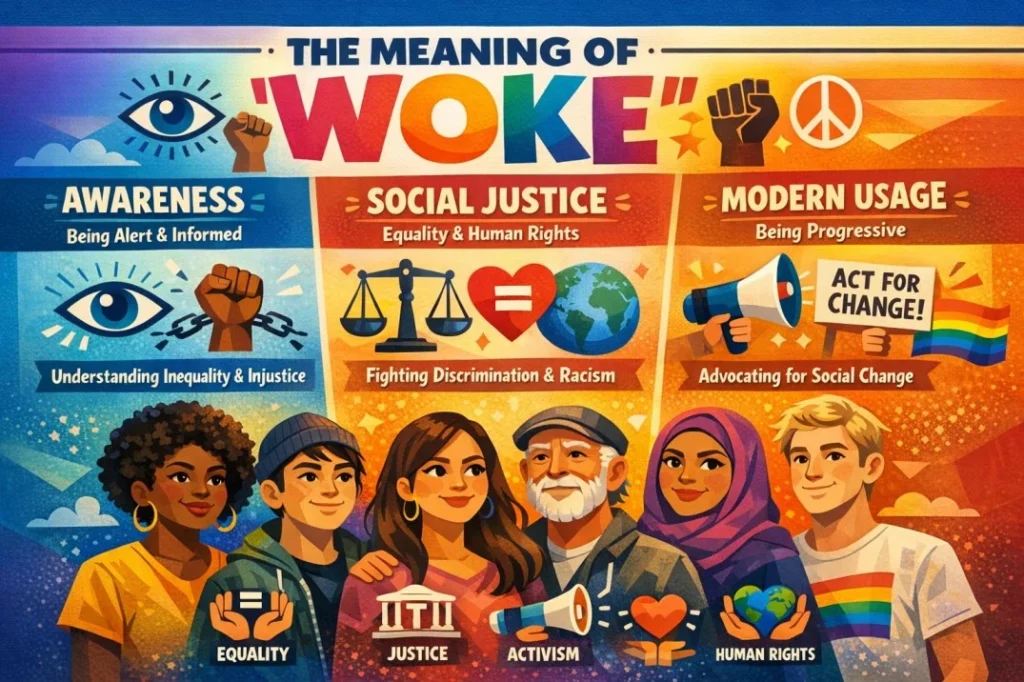
Woke means being aware of social issues, especially those related to injustice, inequality, and discrimination.
Originally, it referred to staying alert to problems like racism and unfair treatment. Over time, its meaning has expanded and can now be used either positively to describe awareness or negatively to criticize certain views or behaviors.
Language changes constantly, and few words show that shift as clearly as the term woke. You might hear it in social media debates, news discussions, or everyday conversations, sometimes used positively and sometimes critically. Because of its evolving meaning, many people wonder what “woke” actually means and how it should be used.
Understanding this word requires looking at its history, how it became popular, and how its tone can change depending on context. Today, “woke” can carry different meanings based on who is using it and why.
Origin and History of the Word Woke
The word “woke” comes from African American Vernacular English and originally meant simply the past tense of “wake,” as in being awake. Over time, it took on a deeper meaning, referring to being socially aware and conscious of injustice.
The term gained wider recognition during discussions around civil rights and social justice movements. It became especially popular in the 2010s as social media amplified conversations about inequality, discrimination, and activism.
In its early usage, being “woke” was seen as a positive trait. It suggested that a person was informed, thoughtful, and paying attention to important societal issues.
How Woke is Used Today
Today, the meaning of “woke” depends heavily on context. It is no longer just a neutral or positive term. It can carry different tones depending on how it is used.
Positive Usage
In a positive sense, “woke” describes someone who is aware of social issues and cares about fairness and equality.
Example
“She is very woke and speaks out against injustice.”
In this context, the word reflects awareness, empathy, and engagement.
Neutral Usage
Sometimes, the term is used simply to describe a perspective without strong emotion.
Example
“The film has a woke message about equality.”
Here, it just means the content focuses on social awareness.
Negative or Critical Usage
In some conversations, “woke” is used critically or even sarcastically. It may imply that someone is overly focused on social issues or being performative.
Example
“That policy is too woke.”
In this case, the tone suggests disagreement or criticism rather than praise.
Why the Meaning of Woke Has Changed
Language evolves as society changes, and “woke” is a good example of that evolution. As the term became more popular, it was adopted by different groups with different viewpoints.
Some people continue to use it as a positive term linked to awareness and activism. Others use it more critically, often in political or cultural debates.
This shift has made the word more complex. Its meaning is no longer fixed and depends heavily on tone, context, and the speaker’s intent.
Real World Examples of Woke in Context
Understanding how “woke” is used becomes easier when you see it in real situations.
| Situation | Example Sentence | Meaning |
|---|---|---|
| Social awareness | “He tries to stay woke about global issues.” | Being informed and aware |
| Media discussion | “The show has a woke storyline.” | Focus on social themes |
| Criticism | “That brand is too woke now.” | Suggesting overemphasis on social issues |
| Casual conversation | “People are more woke these days.” | General awareness of issues |
These examples show how flexible the word can be depending on tone and context.
Tone and Interpretation of Woke
Unlike many straightforward terms, “woke” carries emotional and cultural weight. The same word can feel supportive or critical depending on how it is used.
Friendly or Supportive Tone
“She’s really woke and advocates for fairness.”
This shows respect and admiration.
Neutral Tone
“The campaign includes woke messaging.”
This is descriptive and balanced.
Dismissive or Negative Tone
“He’s just trying to sound woke.”
This suggests skepticism or criticism.
Because of these variations, it is important to pay attention to context when interpreting or using the word.
Comparison With Related Terms
“Woke” is often compared with other words related to awareness and social issues.
| Term | Meaning | Difference |
|---|---|---|
| Aware | Having knowledge of something | Broader and more neutral |
| Conscious | Understanding and thoughtful | More formal |
| Activist | Someone who takes action | Focuses on action, not just awareness |
| Progressive | Supporting social reform | Often political in tone |
| Woke | Aware of social injustice | Can be positive or critical depending on context |
While these terms overlap, “woke” stands out because of its cultural and emotional nuance.
Alternate Meanings of Woke
Although “woke” is primarily used in a social or cultural context today, it still has its original literal meaning.
| Context | Meaning |
|---|---|
| Everyday language | Past tense of wake |
| Slang or cultural use | Awareness of social issues |
For example
“I woke up early today” uses the original meaning, while
“Stay woke” uses the modern, figurative sense.
Professional Alternatives to Woke
In formal or professional settings, people often avoid using “woke” because of its mixed interpretations. Instead, they may choose more neutral language.
Here are some alternatives:
- socially aware
- informed about social issues
- culturally sensitive
- inclusive
- equity focused
For example, instead of saying
“Our company is woke”
A professional version might be
“Our company promotes inclusivity and social awareness”
Using neutral language helps avoid misunderstanding.
How to Use Woke Appropriately
Because the word can be interpreted in different ways, it is important to use it carefully.
- Consider your audience and setting
- Be aware of tone and possible interpretations
- Use more precise language in professional communication
- Avoid using it in a way that may cause confusion or offense
Understanding context is key to using the word effectively.
Cultural Impact of the Word Woke
“Woke” has become more than just a word. It is now part of broader conversations about culture, politics, and society.
It appears in:
- social media discussions
- news debates
- entertainment and film
- branding and marketing
Its widespread use reflects how language can shape and reflect social attitudes. The word has become a symbol of how people engage with important issues, even if they disagree on its meaning.
Common Misconceptions About Woke
There are several misunderstandings about the word.
- Some believe it only has a positive meaning, while others think it is always negative
- Some assume it is purely political, even though it began as a general term for awareness
- Some think it has a fixed definition, when in reality it continues to evolve
Recognizing these misconceptions can help you understand the word more clearly.
FAQs
What does woke mean in simple terms?
It means being aware of social issues like inequality, discrimination, and injustice.
Is woke a positive or negative word?
It can be both. The meaning depends on how it is used and the tone of the speaker.
Where did the term woke come from?
It originated from African American Vernacular English and became widely used in discussions about social awareness.
Why do people use woke in a negative way?
Some people use it critically to suggest that others are overly focused on social issues or being performative.
Is woke a political term?
It is often used in political discussions today, but its original meaning was about general social awareness.
Can woke be used in professional settings?
It is usually better to use neutral alternatives like socially aware or inclusive in formal communication.
What is the difference between woke and aware?
Aware is a general term, while woke specifically relates to awareness of social justice issues.
Is the meaning of woke changing?
Yes, the meaning continues to evolve as different groups use it in different ways.
Conclusion
The word “woke” has evolved from a simple expression meaning awake to a powerful and sometimes controversial term related to social awareness. It can describe someone who is informed and conscious of important issues, but it can also be used critically depending on the context.
Understanding what “woke” means requires paying attention to tone, intent, and cultural context. Whether used positively, neutrally, or negatively, it reflects ongoing conversations about society, fairness, and change.
By using the term thoughtfully and recognizing its different meanings, you can communicate more clearly and avoid misunderstandings in both casual and professional settings.
Read More Related Articles:
- KK Mean in Texting: Why It Can Sound Passive-Aggressive (2026)
- POG Mean in Gaming: From Epic Wins to Gaming Chat Reactions (2026)
- What Is the Meaning of “Ahora” in Spanish? Full Guide In 2026

Ivy Madison is a content creator at TextSprout.com, specializing in word definitions, internet slang, acronyms, and text abbreviations. She delivers clear and engaging explanations, helping readers quickly understand modern digital language and trending terms.