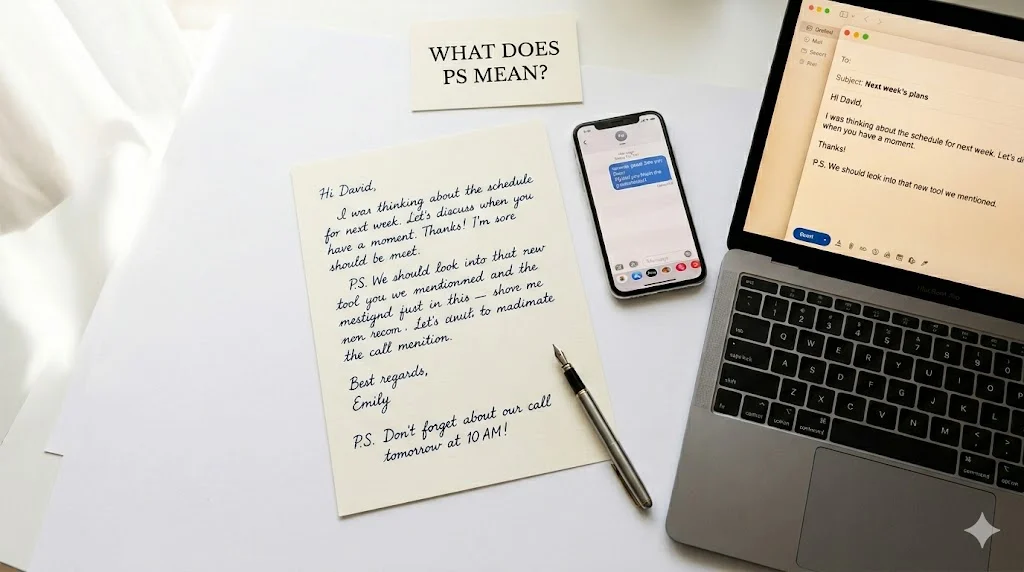
You’ve seen it a thousand times. At the bottom of an email. The end of a letter. Even squeezed into an Instagram caption. Two little letters: PS.
But what does PS actually mean? And more importantly are you using it right?
Here’s the short answer: PS stands for postscript. It comes from the Latin phrase post scriptum, which literally means “written after.”
Think of it like a director’s cut commentary. The main movie (your message) ends. The credits roll (your signature). Then PS pops up with one final thought.
This guide covers everything. The PS meaning across email, text, and social media. How to use it without looking like an amateur. And why this centuries-old abbreviation refuses to die.
The Real PS Full Form (No, It’s Not “Please See”)
Let’s kill a myth immediately. PS does not stand for “please see” or “post script” as two separate words. The full form is postscript one word.
| Abbreviation | Full Form | Language Origin |
|---|---|---|
| PS | Postscript | English (from Latin) |
| Latin origin | Post scriptum | Latin |
| PPS | Post postscript | English adaptation |
| PPPS | Post post postscript | Rare / humorous |
Key fact: The term postscript entered English around the 1500s. But people used the concept long before that. Monks added postscripts to manuscripts. Kings added them to royal decrees. The need to say “oh, one more thing” is older than printing presses.
Today, the PS abbreviation meaning hasn’t changed. You’re still adding a thought after finishing the main message. The only difference is the medium: paper, screen, or thumb-typed text.
Why Do People Use PS: The Psychology Behind It
You might wonder: With backspace and edit buttons, why does PS still exist?
Great question. Here’s why PS won’t go away.
Attention economics. Readers often scan the beginning and end of a message. The middle gets fuzzy. A PS sits at the very bottom prime real estate for a final punch.
Softening tough news. Want to ask a favor without sounding demanding? Slip it into a PS. It feels less formal, almost like an afterthought. Even when it’s not.
Human connection. A PS breaks the stiff structure of a letter or email. It says, “Hey, I’m not a robot. Here’s a personal note.”
Classic example from direct response marketing: Legendary copywriter Gary Halbert once said the PS is the second most read part of a sales letter. The first? The headline. So smart marketers put their call-to-action in the PS.
And it works. People remember the last thing they read.
PS Meaning in Different Contexts: Email, Letters, Texting, Social Media
One abbreviation. Many battlefields. Here’s how PS behaves across formal and informal writing.
PS Meaning in Email
Email is where PS lives most comfortably today. You’ll see it in casual workplace notes, client follow-ups, and even some marketing emails.
Example (workplace email):
Thanks for jumping on the call today, Sarah. I’ll send over the revised timeline by Thursday.
Best,
AlexPS The client loved the mockups. Great work.
Why use PS here? Alex could have tacked that compliment onto the main paragraph. But placing it in the PS gives it extra weight. It feels spontaneous. Genuine.
Formal email rule: Avoid PS in legal documents, official complaints, or job applications. It reads as sloppy. Save PS for friendly or neutral correspondence.
PS Meaning in a Letter
Handwritten letters feel almost nostalgic now. But PS started here.
In a traditional letter, you’d write the body, sign your name, then add PS below the signature. People used PS for one of two reasons:
- They genuinely forgot something and didn’t want to rewrite the whole page.
- They wanted to emphasize a point by separating it from the main argument.
Example (personal letter):
Dearest Margaret,
The cottage feels quiet without you. I fed the cats and watered your roses. Don’t worry about a thing.
With love,
EleanorPS Your scarf is hanging by the back door. I’ll keep it safe.
Grammar rule: In formal letters, place PS after your signature. Not before. And don’t indent it. Just left-align below your name.
PS Meaning in Texting (WhatsApp, iMessage, SMS)
Texting changed the rules. Nobody cares about Latin origins when they’re typing one-handed.
In chat, PS meaning shifts slightly. It still signals an afterthought. But now it also adds humor, sarcasm, or a quick question without sending a separate message.
WhatsApp example:
Be there in 10. PS bring the good wine.
iMessage example:
Can’t make it tonight. PS you owe me $12 from lunch lol.
Key difference from formal use: In texting, you can put PS anywhere. Middle of the chat? Fine. Before your name? Doesn’t matter. Texting killed the signature-first rule.
PS Meaning in Instagram Captions & Comments
Social media turned PS into a stylistic tool. You’ll see it in captions, comments, and even bios.
Instagram caption example:
Golden hour hit different today. PS my photographer was a very patient stranger.
YouTube comment example:
Great breakdown of the finale. PS did anyone catch the easter egg at 12:04?
Why social media loves PS: It breaks up long blocks of text. It signals a shift in tone from serious to funny, or informative to personal.
PS Meaning in WhatsApp Groups
Group chats get chaotic. A PS helps you cut through the noise without starting a new thread.
Example:
Meeting’s at 3 PM tomorrow. PS whoever left their charger here I have it.
Simple. Clear. No extra fluff.
How to Use PS Correctly: Active Grammar Rules
Let’s get practical. Here’s exactly how to write PS so you never look confused.
Rule 1: Always Put PS After Your Signature
In formal writing, the signature marks the end. PS comes after. Not before. Not in the middle.
Correct:
Sincerely,
James
PS Don’t forget the attachments.
Incorrect:
PS Don’t forget the attachments.
Sincerely,
James
Rule 2: Punctuation Is Flexible
You have three good options:
PS:(with colon)PS(with em dash)PS(nothing at all)
All three work. Pick one and stay consistent.
Pro tip: In formal letters, use PS: or PS . In texts, use nothing. PS alone feels cleaner.
Rule 3: Capitalization Matters in Formal Writing
Formal letters, business emails: Use PS (both caps).
Texts, social media, casual chat: Use p.s. or ps. Nobody will correct you.
Example of casual: Had fun tonight. p.s. you snore.
Rule 4: Don’t Overuse PS in One Message
One PS is effective. Two is confusing. Three is a meme.
If you need a second afterthought, use PPS (post postscript).
Example:
Best,
Lisa
PS Call me tomorrow morning.
PPS Actually before 9 AM. I have a meeting at 9:30.
A third afterthought? Send a new message. Or rewrite the original.
PS vs PPS vs Note: What’s the Real Difference?
People mix these up constantly. Here’s a clear table to settle it.
| Term | Meaning | Placement | When to Use |
|---|---|---|---|
| Note | Clarification | Before signature | To explain something in the main body |
| PS | First afterthought | After signature | For a new, separate thought |
| PPS | Second afterthought | After PS | For another new thought |
| PPPS | Third afterthought | After PPS | Almost always humor |
Real example showing the difference:
Dear Hiring Manager,
Attached is my resume and portfolio. I’ve also included three references.
Note: One reference will only be available after March 10th.
Sincerely,
PriyaPS I’ll be traveling next week but still reachable by email.
PPS Thank you again for considering my application.
See the flow? The note clarifies something inside the letter. PS adds a new logistical detail. PPS adds a polite thank-you after the fact.
Common PS Mistakes: And How to Fix Them
Even experienced writers mess up PS. Avoid these traps.
Mistake 1: Using PS before the signature
Why it’s wrong: PS means “written after.” Putting it before the signature breaks the definition.
Fix: Move PS below your name. Every time.
Mistake 2: Writing “PSS” instead of PPS
Why it’s wrong: PSS isn’t standard. It confuses readers.
Fix: Use PPS for a second afterthought. Never PSS.
Mistake 3: Using PS in a one-sentence email
Example: Meeting at 3. PS see you then.
Why it’s wrong: The PS adds nothing. Just include it in the main sentence.
Fix: Rewrite. Meeting at 3. See you then.
Mistake 4: Adding three or more PS lines
Why it’s wrong: You lose the “afterthought” magic. It becomes clutter.
Fix: Send a follow-up message or revise the original.
Real-Life PS Examples for Every Situation
Sometimes you just need to see PS in action. Here are clean, usable examples.
Casual Texting Examples
- On my way. PS grab ice on your way over.
- That movie was awful. PS your laugh made it worth it.
- Can’t talk right now. PS don’t forget to feed the cat.
Formal Letter Examples
- Respectfully yours, Dr. Chen. PS The enclosed document requires your signature by Friday.
- Sincerely, Marcus. PS I’ve also included a prepaid return envelope.
Business Email Examples
- Best regards, Nina. PS The Q3 report is now live on the shared drive.
- Thanks, Derek. PS Let me know if you want me to sit in on the client call.
Instagram Caption Examples
- Sunday reset mode. PS yes those are homemade bagels.
- Throwback to warmer days. PS my hair will never look this good again.
WhatsApp Group Examples
- Dinner at 8, my place. PS someone bring dessert.
- Pool day tomorrow. PS don’t forget sunscreen unless you want to look like a lobster.
Why PS Still Matters in the Age of Editing
You can edit a text before sending. You can rewrite an email three times. So why does anyone still use PS?
Because editing kills spontaneity.
A perfect message feels rehearsed. A PS feels real. It’s the written equivalent of turning around at the door and saying, “Oh, hey, one more thing.”
Marketers know this trick. In sales letters, the PS often holds the main offer. Why? Because readers skip to the bottom. They scan the headline. They skim the body. Then their eyes land on the PS.
Example from a fundraising letter:
PS Even $5 helps a child get a meal today. Click here to give.
That PS works better than the same sentence buried in paragraph four.
Personal letters benefit too. A PS lets you add a joke, a memory, or a soft confession without disrupting the main tone.
PS I still owe you that bottle of wine from your birthday. I haven’t forgotten.
That feels human. Because it is.
Quick Reference Table: PS Usage by Platform
| Platform | PS Meaning | Formality Level | Example |
|---|---|---|---|
| Gmail / Outlook | Postscript afterthought | Medium | PS The file is attached. |
| Handwritten letter | Forgotten or emphasized point | High | PS Write soon. |
| WhatsApp / iMessage | Casual aside or joke | Low | PS bring chips |
| Instagram caption | Personal or funny tag | Low | PS my dog stole the show |
| LinkedIn message | Friendly follow-up | Medium-High | PS Enjoyed your article. |
| YouTube comment | Additional observation | Low | PS at 3:42 you see the cameo |
The Latin Origin: For the Curious
Let’s get specific. Post scriptum breaks down cleanly.
- Post = after (same root as postwar, postpone, postgame)
- Scriptum = written (same root as scripture, manuscript, subscribe)
So post scriptum = “after written.”
Romans used the phrase in letters and legal documents. Scholars carried it into medieval manuscripts. English adopted it as “postscript” around the 1500s.
Fun fact: Before printing presses, scribes would add postscripts in the margins or at the bottom of pages. They’d write “PS” to flag the reader: This part came after the main text.
That’s it. No mystery. Just practical writing.
FAQs
What does PS mean in a text message?
In a text message, PS meaning stays close to the original: an afterthought. But texting made it looser. You can use PS mid-conversation, before your name, or even as a joke. Example: I’m here. PS you left your lights on.
What does PS mean at the end of a letter?
At the end of a letter, PS means you forgot something or you want to emphasize something. It sits below the signature. Example: Yours truly, Anna. PS Send my love to the kids.
How do you use PS correctly in English?
Use PS after your signature. Capitalize both letters in formal writing. Don’t add more than two PS lines. Example: Best, Leo. PS See you at the airport.
What is the difference between PS and PPS?
PS is the first afterthought. PPS is the second afterthought. Use PS first, then PPS if you need another one. Example: PS Call me. PPS Actually, text me instead.
Can I start a letter with PS?
No. Starting a letter with PS breaks the definition. PS always comes after the main message and signature. If you want to add a note before your signature, label it “Note:” instead.
Conclusion:
PS survived five centuries for one reason: it works. It’s simple. It’s human. And it cuts through the noise of perfectly polished writing. Next time you write an email, a letter, or even a caption, ask yourself: Does this need a PS?
If the answer is yes go for it. Just keep it short. Keep it real. And put it after your name. Now go write something worth reading.
And hey PS: You’ve got this.
Read More Related Articles:
- 2nd and 10 Mean in Football: Complete Guide for Beginners 2026
- What Does WLC Mean in Text? Full Meaning and Examples In 2026
- Code White Mean in a Hospital: Real Life Usage In 2026

Luna Hartley is a content creator at TextSprout.com, where she specializes in explaining word meanings, modern phrases, and everyday language used in texts and online conversations. Her writing focuses on clarity and context, helping readers understand how words are actually used in real communication.