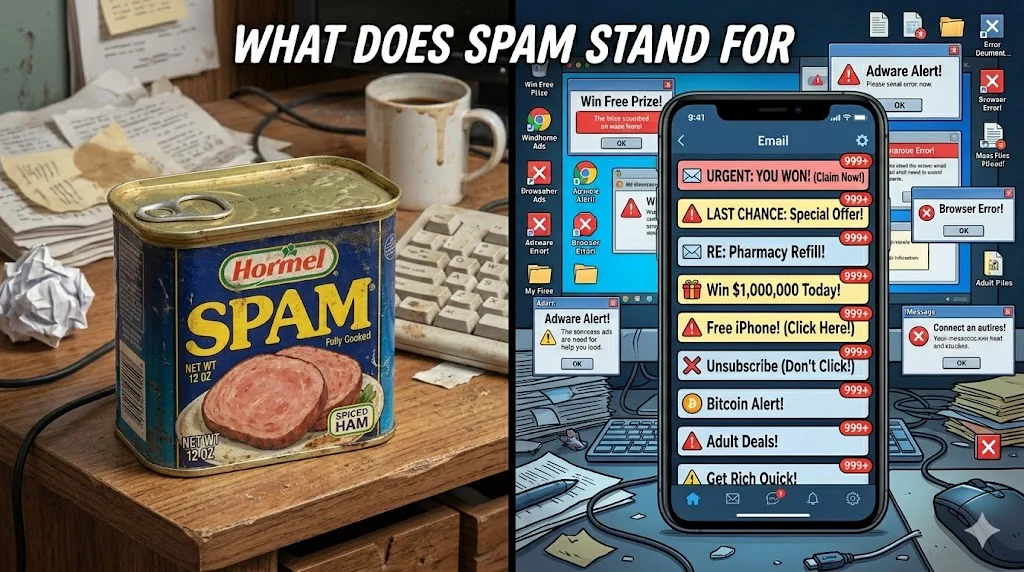
You check your phone. Twelve new emails. Three of them are real. The rest? Loan offers, fake invoices, and someone promising to grow your business overnight. See What Does Spam Stand For here.
Then you open WhatsApp. A number you don’t recognize says, “Hi dear, join this investment group.” Another one sends a blurry gift card image.
You sigh. “More spam,” you mutter.
But here’s a weird question you’ve probably never stopped to ask: What does spam stand for?
Is it an acronym? Does it have a full form? Did some tech executive in the 90s coin it during a boring meeting?
The answer might surprise you. Spoiler alert: Spam doesn’t actually stand for anything. But the real story involves canned pork, British comedians, and a handful of internet pioneers who just wanted a funny word for noise.
Let’s break it all down. No fluff. Just facts, stories, and practical know-how you can actually use.
So What Does Spam Stand For: The Honest Answer
Let’s cut straight to it.
Spam is not a standard acronym.
There’s no official “full form” hiding in some tech dictionary. You won’t find a government document or university textbook that defines “spam” as a set of initials.
But wait you’ve definitely seen those internet memes, right?
- “Inconsiderate Pointless Annoying Messages”
- “Sending Particularly Annoying Mail”
- “Spiced Pork and… uh… Meat”
Those are backronyms. People invented them after the fact because our brains love patterns. We see a short word like SPAM and automatically assume it must stand for something.
It doesn’t.
| Fake Acronym | Meaning | Real or Fake? |
|---|---|---|
| SPAM | inconsiderate Pointless Annoying Messages | Fake (backronym) |
| SPAM | Sending Particularly Annoying Mail | Fake (backronym) |
| SPAM | Spiced Ham | Real (but for the food, not the internet) |
The only legitimate acronym here is Spiced Ham. That’s what Hormel Foods named their canned meat product back in 1937. And yes, that’s a real acronym. But it has nothing to do with email, texting, or social media.
So why on earth do we call junk messages “spam”?
That’s where the story gets good.
The Real Spam Meaning: Two Origins Collide
Understanding spam meaning requires looking at two completely different worlds: a meatpacking plant in Minnesota and a British comedy troupe from the 1970s.
Strange combo, right? Stick with me.
Origin One: Hormel Foods and Canned Meat (1937)
Jay Hormel wanted a new product. Something cheap, shelf-stable, and easy to sell during the Great Depression. He came up with a block of spiced chopped pork and ham. The company held a naming contest. A Hormel executive’s brother won with the name “SPAM.”
The spam full form for the can? Spiced Ham.
That’s it. Simple. Boring even.
But here’s the key: That product became massive. American soldiers ate it during WWII. Families in the UK and Asia grew up on it. Today, over 8 billion cans of Spam have sold worldwide. That’s not a typo. Eight billion.
So by the 1970s, “Spam” was already a famous brand name in millions of kitchens. Everyone recognized the blue-and-yellow can.
Origin Two: Monty Python’s Flying Circus (1970)
Now jump to BBC Television. December 1970. Monty Python’s Flying Circus airs a sketch called “Spam.”
Here’s what happens:
A couple walks into a café. The man tries to order something without Spam. But almost every dish on the menu contains Spam. Eggs and Spam. Spam and chips. Spam, eggs, sausage, and Spam.
The man insists: “I don’t like Spam.”
The waitress ignores him. A group of Vikings in the corner starts chanting:
“Spam, spam, spam, spam. Spam, spam, spam, spam. Lovely spam! Wonderful spam!”
The chant gets louder and louder. It drowns out all conversation. The sketch ends in total chaos.
That’s the birth of the modern spam meaning. Spam = repetitive, overwhelming, unwanted noise.
No acronym. No technology. Just Vikings and canned meat.
How Did “Spam” Jump From a TV Sketch to Your Inbox?
So we’ve got a canned meat product and a comedy sketch. How does that become the word for 300 billion junk emails per day?
The answer is early internet culture.
The 1980s: MUDs and Multi-User Dungeons
Before the web, people played text-based online games called MUDs (Multi-User Dungeons). Players could type commands and chat in real time.
Some users figured out that repeating the same word over and over would flood the screen. They’d type “SPAM SPAM SPAM SPAM” until no one could read anything else.
Why “Spam”? Because of Monty Python. The chant was funny. The reference was obvious to anyone who’d seen the sketch.
The 1990s: Usenet and the First Junk Messages
Usenet was a massive collection of online discussion groups. Think Reddit but way older and uglier.
In the early 90s, a lawyer named Joel Furr started noticing people posting the same message to dozens of groups. One famous incident involved a couple of lawyers promoting their green card lottery service. They posted the exact same ad everywhere.
Users called it “spam.” The term stuck.
By 1998, the Oxford English Dictionary added a new definition: “Irrelevant or unsolicited messages sent over the internet, typically to a large number of users.”
No acronym. No official “spam abbreviation meaning.” Just a borrowed joke that became permanent tech slang.
Spam Definition Across Different Platforms
The core spam definition stays the same: unsolicited, repeated, or irrelevant messages sent in bulk.
But spam looks different depending on where you find it.
Email Spam (The Classic)
Email spam is what most people picture. You open your inbox and see promises of Nigerian prince inheritances, weight loss miracles, and fake package deliveries.
Key facts about email spam:
- Over 45% of all global email traffic is spam (Statista, 2024)
- The most common email spam topics: fake invoices, sextortion scams, and cryptocurrency giveaways
- Google blocks roughly 100 million spam emails every day just for Gmail users
- Spam filters catch about 99.9% of junk mail before you ever see it
Example: An email claiming to be from Netflix says your payment failed. The link goes to a fake login page. That’s spam + phishing combined.
Text Message Spam (SMS)
SMS spam feels more dangerous because we trust phone numbers more than email addresses. Scammers know this.
Common SMS spam types:
- “Your package cannot be delivered. Click here to reschedule.”
- “Bank alert: unusual activity. Verify your account now.”
- “You won a $1,000 gift card. Claim it here.”
Real data: The FTC received over 220,000 complaints about SMS spam in 2023 alone. That’s only the people who bothered to report it.
Why SMS spam works: Texts feel urgent. They land in a notification you almost always check. And links are harder to inspect on a small screen.
Social Media Spam (Instagram, Facebook, TikTok)
Social platforms run on engagement. Spammers know that leaving comments or direct messages can drive traffic to scam sites or fake products.
Examples of social media spam:
- “Wow amazing! Check my bio for free followers” (on a random nature photo)
- “I made $10,000 in one week. Ask me how.” (with a sketchy link)
- A bot account follows you, then unfollows three days later to trick you into following back
Instagram alone removes over 100 million spam comments every month. Most are generated by automated scripts.
WhatsApp and Messenger Spam
Encrypted messaging apps create a new challenge. Spammers can’t be easily scanned like email. So they rely on phone numbers and group invites.
Common WhatsApp spam:
- Fake job offers (“Earn $500/day working from home”)
- Investment group invites (cryptocurrency or forex trading scams)
- Chain messages (“Send this to 10 friends or you’ll have bad luck”)
Key difference: WhatsApp spam often comes from a real person’s hacked account. That makes it feel more trustworthy at first glance.
Spam vs Phishing vs Scam: Don’t Confuse Them
People mix these up all the time. They’re related but not the same.
| Term | Definition | Intent | Example |
|---|---|---|---|
| Spam | Unsolicited bulk messages | Annoying, promotional, or fraudulent | A fake real estate email blasted to 10 million people |
| Phishing | Impersonating a trusted entity | Steal passwords or financial data | An email that looks exactly like your bank’s login page |
| Scam | Any scheme to defraud someone | Steal money or personal info | A call saying “your grandson is in jail, send gift cards” |
Think of it this way:
Spam is the delivery method. Phishing is a type of malicious content inside spam. A scam is the overall criminal goal.
So you can receive a spam email that contains a phishing link designed to run a scam. One message can be all three.
Real example from 2024: A spam text claiming to be from USPS says your package is missing address info. The link takes you to a fake USPS form. You enter your credit card to pay a “redelivery fee” of $3. That’s spam + phishing + a $3 scam that works on thousands of people.
Why Do People Keep Asking for the Spam Full Form?
You’ll see this question everywhere:
- “What is the spam full form?”
- “Spam abbreviation meaning please?”
- “Does spam stand for something in texting?”
Here’s why people keep asking.
Reason One: Acronyms Dominate Tech
Think about all the tech terms that are acronyms:
- SCUBA – Self-Contained Underwater Breathing Apparatus
- RADAR – Radio Detection and Ranging
- LASER – Light Amplification by Stimulated Emission of Radiation
- CAPTCHA – Completely Automated Public Turing test to tell Computers and Humans Apart
We’re trained to assume every short tech word has a backstory. Spam looks like it should, too. But it doesn’t.
Reason Two: Backronyms Spread Fast on Social Media
Someone posts a funny image: “SPAM stands for inconsiderate Pointless Annoying Messages.” It gets 50,000 shares. People believe it’s real.
Another post says “Actually SPAM means Sending Particularly Annoying Mail.” That spreads too.
Neither is true. But misinformation repeats itself. And once a fake “spam abbreviation meaning” goes viral, it’s hard to kill.
Reason Three: Hormel’s Real Acronym Confuses Things
Remember: SPAM does stand for Spiced Ham if you’re buying the canned product.
So when someone searches “spam full form,” they get two contradictory answers:
- Food websites say “Spiced Ham”
- Tech websites say “there is no full form”
That contradiction makes people search harder. And search engines show both results. Confusion continues.
How Spam Detection Works (Without the Boring Tech Jargon)
Ever wonder how Gmail knows a message is spam before you even open it?
It’s not magic. It’s a combination of rules, patterns, and machine learning.
Filter Method One: Blocklists
A blocklist is exactly what it sounds like. A running list of known spam senders their email addresses, domain names, and server IP addresses.
If a message comes from a blocked IP, it goes straight to spam. No questions asked.
Real-time example: Spamhaus is one of the biggest blocklist operators. They track over 300 million spam-sending IP addresses at any given time.
Filter Method Two: Keyword Scanning
Old-school filters looked for trigger words:
- “FREE”
- “You’ve been selected”
- “Wire transfer”
- “Urgent response required”
Modern filters still use keywords, but they’re smarter. They look at combinations and context. “Free” in an email from your favorite store is fine. “Free” from an unknown sender with a weird attachment is suspicious.
Filter Method Three: Bayesian Filtering
This is the clever one.
Bayesian filters learn from your behavior. You mark an email as spam. The filter asks: “What’s in this message that made you say no?”
It tracks words, phrases, senders, and even punctuation patterns. Then it updates its internal rules so future similar messages get blocked.
Example: You mark three different emails as spam that all contain the phrase “double your investment.” The filter learns. Next time that phrase appears in your inbox, the message lands in spam without you lifting a finger.
Filter Method Four: Sender Reputation
Every email sender has a reputation score. It’s calculated using:
- How many people mark their emails as spam
- How many emails bounce back as undeliverable
- Whether they send to invalid addresses often
Low reputation = spam folder. High reputation = primary inbox.
Big email senders (like newsletters or banks) work hard to maintain high reputation. One complaint spike can tank their deliverability for weeks.
How to Stop Spam: Practical Steps That Actually Work
You can’t eliminate spam entirely. No one can. But you can reduce it by 95% with these habits.
For Email Spam
Use email aliases.
Most email services let you add a + sign and a keyword to your address. For example: yourname+shopping@gmail.com.
When spam arrives at that alias, you know exactly who sold or leaked your address. Then you block that alias.
Never unsubscribe from suspicious emails.
This sounds counterintuitive. But here’s the truth: When you click “unsubscribe” on a spam email, you confirm that a real human reads messages at that address. Spammers sell that information as “verified active user.” You’ll get more spam, not less.
Only unsubscribe from newsletters you actually signed up for.
Use a secondary email address.
Keep one address for banking, work, and real life. Use a second free address for online shopping, forum signups, and downloading ebooks.
The second address will get spam. Who cares? You don’t check it often anyway.
For SMS Spam
Forward spam texts to 7726 (SPAM).
In the US and UK, that number goes directly to mobile carriers. They investigate and block the sender behind the scenes.
Don’t click links. Ever.
Even if the text looks real. Even if it says “your package.” Open your delivery app manually. Or go to the website directly. That one second of effort can save you from a phishing scam.
Block and report the number.
On iPhone: tap the number > Info > Block this Caller.
On Android: tap the three dots > Block number > Report spam.
For WhatsApp and Messenger Spam
Turn off “Add to Groups” for everyone except your contacts.
- WhatsApp: Settings > Privacy > Groups > My Contacts
- Telegram: Settings > Privacy and Security > Groups > My Contacts
This single setting stops 90% of WhatsApp group spam cold.
Never reply to unknown messages.
Even a “Who is this?” tells the scammer your number is active. They’ll share it with other spammers. Just delete and block.
For Social Media Spam
Limit comments on old posts.
On Instagram and Facebook, you can restrict comments on posts older than a certain number of days. Bots often target old posts because engagement has died down.
Use comment filters.
Instagram lets you hide comments containing specific keywords. Add words like “giveaway,” “followers,” “bio link,” and “free money.”
What Does Spam Mean for You Today?
Let’s pull all this together.
That annoying email in your promotions folder? Spam.
The random text about a package you never ordered? Spam.
The weird comment on your cousin’s vacation photo selling knockoff sneakers? Also spam.
Here’s what you actually need to remember:
- Spam doesn’t stand for anything. Stop looking for a secret acronym.
- The word comes from a 1970 Monty Python sketch and a can of spiced ham from 1937.
- Email spam makes up nearly half of all global email traffic.
- SMS spam is growing fast because people trust phone numbers more than email.
- You can’t kill spam completely, but you can reduce it to almost nothing with aliases, filters, and a few smart habits.
- When in doubt: block, report, and never click the link.
One final thought before you go.
Next time someone asks you, “What does spam stand for?” you’ve got two answers.
The short answer: “Nothing. It’s not an acronym.”
The fun answer: “It stands for a bunch of Vikings yelling about canned meat. Want me to explain?”
Now go clean out your spam folder. And maybe don’t buy that “miracle weight loss” supplement. It’s probably just more spam.
FAQs
Q1: What does spam stand for in email?
Nothing. It’s not an acronym. Email spam gets its name from a Monty Python comedy sketch about canned meat. The sketch featured Vikings chanting “spam” repeatedly to drown out conversation just like junk mail drowns out real messages.
Q2: Is there an official spam full form?
No. The only real acronym is “Spiced Ham,” which refers to the Hormel Foods product. That has nothing to do with internet spam. All other “full forms” you see online are backronyms invented after the fact.
Q3: Why is junk mail called spam?
Early internet users borrowed the term from Monty Python’s “Spam” sketch. In the sketch, Vikings repeat the word so many times that no one can talk over them. Usenet users in the 1990s applied the same logic to repetitive, unwanted posts.
Q4: What’s the difference between spam and phishing?
Spam is unwanted bulk messaging. Phishing is a specific type of attack where a scammer pretends to be a trusted company or person to steal your passwords or money. Phishing often arrives through spam emails or texts.
Q5: Does spam stand for “inconsiderate Pointless Annoying Messages”?
No. That’s a backronym a made-up meaning added after the word already existed. It’s clever and easy to remember, but it has no historical basis. The real origin is the Monty Python sketch, not a tech acronym.
Q6: Can spam ever be legal?
Yes. Some bulk messaging is legal if the sender follows regulations like the CAN-SPAM Act in the US or GDPR in Europe. Legal requirements include a clear way to unsubscribe, a valid physical address in the message, and honest subject lines. Illegal spam violates those rules.
Conclusion:
Spam started as a practical joke in a British comedy show. Today, it’s a billion-dollar problem for tech companies and an everyday annoyance for you.
But now you know the truth.
No secret committee created an official spam abbreviation. No tech manual lists a spam full form. The word simply evolved from a can of Spiced Ham, to a Viking chant, to a Usenet insult, to your pocket.
That’s rare in technology. Most terms are engineered. Spam is organic. It’s messy. It’s human.
And honestly? That’s way more interesting than another boring acronym.
So the next time you see a suspicious message, smile a little. You’re looking at internet history. Then block it and move on with your day.
Read More Related Articles:
- “Dar” Means in Spanish : The Verb That Means More Than “To Give” In 2026
- What Is NSF in Banking? Non-Sufficient Funds Explained Simply (2026)
- Enmity Mean in the Bible: Powerful Biblical Word (2026)

Neon Samuel is a digital content creator at TextSprout.com, dedicated to decoding modern words, slang, and expressions. His writing helps readers quickly grasp meanings and understand how terms are used in real conversations across text and social platforms.