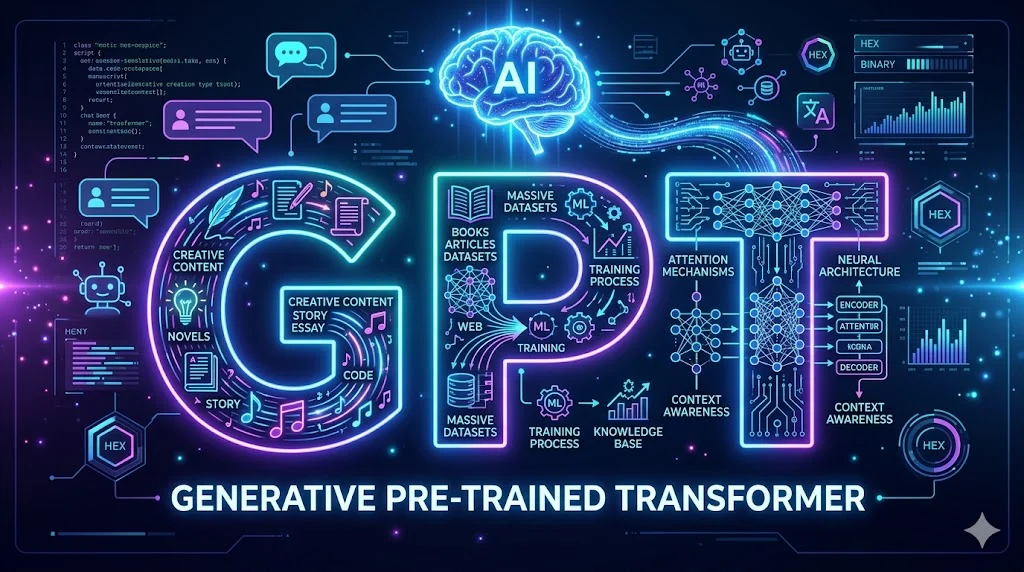
GPT stands for Generative Pre trained Transformer.
It is a type of artificial intelligence model designed to generate human-like text by learning patterns from large amounts of data. GPT models are trained in advance on massive datasets and can then produce responses, write content, answer questions, and carry out conversations in a natural way.
If you use ChatGPT or follow anything related to artificial intelligence, you’ve probably come across the term GPT many times. It appears in product names, tech discussions, and even everyday conversations about AI tools. But despite how common it is, many people still wonder what GPT actually stands for and why it matters so much in modern technology.
Understanding this term is helpful not just for tech enthusiasts, but for students, professionals, and anyone using AI tools in daily life. It gives you a clearer idea of how systems like ChatGPT work behind the scenes and why they are so powerful.
In simple terms, GPT is an AI system that learns from text and then uses that knowledge to generate new, meaningful responses.
Understanding the Meaning of GPT
The abbreviation GPT is made up of three important parts, each describing how the technology works.
Generative
This means the model can create or generate content. It does not just copy existing text. Instead, it produces new sentences, paragraphs, and ideas based on what it has learned.
For example, GPT can:
- Write essays
- Create stories
- Answer questions
- Summarize information
- Generate emails or reports
Pre trained
Pre trained means the model is trained in advance before being used by the public. It learns from a huge amount of text data such as books, articles, websites, and more.
This training helps the model understand:
- Grammar
- Language structure
- Facts and general knowledge
- Context and meaning
Once pre training is complete, the model can be used for different tasks without needing to be trained again from scratch.
Transformer
A transformer is a special type of machine learning architecture. It helps the model understand relationships between words in a sentence, even if they are far apart.
This is what allows GPT to:
- Understand context
- Keep conversations coherent
- Generate fluent and natural responses
Transformers are the core technology that makes modern AI language models so powerful.
How GPT Works in Simple Terms
To understand GPT easily, think of it like a very advanced prediction system.
When you type a sentence, GPT:
- Looks at the words you wrote
- Predicts what comes next based on patterns it has learned
- Builds a response word by word
It does not think like a human, but it is extremely good at recognizing patterns in language.
Step by Step Process
- You enter a prompt or question
- The model analyzes your input
- It searches learned patterns from training data
- It predicts the most suitable next words
- It generates a complete response
This process happens in seconds, which is why GPT feels like a real conversation.
Evolution of GPT Models
GPT has improved significantly over time. Each version has become more advanced, more accurate, and more capable of handling complex tasks.
| Version | Description | Key Improvement |
|---|---|---|
| GPT 1 | First experimental model | Basic language generation |
| GPT 2 | Larger dataset training | Better sentence structure |
| GPT 3 | Major leap in capability | Human-like text generation |
| GPT 4 | Improved reasoning and accuracy | More reliable and context-aware |
| GPT 5 and beyond | Advanced multimodal AI | Better understanding and creativity |
Each generation expands the model’s ability to understand and generate language more naturally.
Where GPT is Used in Real Life
GPT is not just a research concept. It is widely used in many real-world applications.
1. Chatbots
GPT powers conversational AI systems like ChatGPT that help users answer questions, write content, and solve problems.
2. Content Creation
Writers and marketers use GPT to:
- Generate blog posts
- Create product descriptions
- Write emails and ads
3. Education
Students use GPT for:
- Learning explanations
- Summarizing topics
- Practicing writing
4. Customer Support
Companies use GPT to handle customer queries quickly and efficiently.
5. Programming Help
Developers use GPT to:
- Write code
- Debug errors
- Explain programming concepts
Advantages of GPT Technology
GPT has transformed how people interact with technology. Some of its key benefits include:
Fast Information Processing
GPT can generate answers in seconds.
Human Like Communication
It produces natural and easy to understand language.
Versatility
It can be used in writing, coding, teaching, and more.
Accessibility
Anyone can use GPT tools without technical knowledge.
Limitations of GPT
Despite its power, GPT also has limitations.
No Real Understanding
It does not truly understand meaning like humans do. It works based on patterns.
Possible Errors
Sometimes GPT can generate incorrect or outdated information.
Context Limits
Very long or complex conversations may reduce accuracy.
Dependence on Training Data
It can only work based on what it has been trained on.
GPT vs Other AI Models
| Feature | GPT | Traditional AI |
|---|---|---|
| Language ability | Highly advanced | Limited |
| Context understanding | Strong | Weak |
| Flexibility | Very high | Low |
| Learning method | Pre trained on large datasets | Rule based or task specific |
GPT stands out because it can handle multiple language tasks in a single system, unlike older AI models.
Why GPT is Important in Modern Technology
GPT is a major breakthrough in artificial intelligence because it allows machines to communicate in a way that feels natural and human like. It has changed how people write, learn, code, and interact with digital systems.
It also serves as the foundation for many modern AI tools used in business, education, healthcare, and entertainment.
Common Misunderstandings About GPT
Many people have misconceptions about GPT technology.
It is not conscious
GPT does not think or feel emotions.
It does not browse the internet in real time
Unless connected to external tools, it relies on trained data.
It is not always correct
It can make mistakes and should not be treated as an absolute source of truth.
Future of GPT Technology
The future of GPT is expected to be even more advanced. Future models may include:
- Better reasoning abilities
- More accurate responses
- Improved understanding of emotions and context
- Integration with voice, images, and video
As technology continues to evolve, GPT will likely become even more integrated into everyday life.
FAQs
What does GPT stand for?
GPT stands for Generative Pre trained Transformer, an AI model that generates human like text.
Is GPT the same as ChatGPT?
No. GPT is the underlying model, while ChatGPT is a product built using GPT technology.
How does GPT learn?
It learns by analyzing large amounts of text data during a training process called pre training.
Can GPT think like a human?
No. It does not think or feel. It generates responses based on patterns in data.
What is GPT used for?
It is used for writing, chatting, coding assistance, customer support, and educational tools.
Is GPT always accurate?
No. It can make mistakes, so information should be verified when necessary.
Why is GPT important?
It allows machines to communicate in natural language, making technology more accessible.
Will GPT replace humans?
No. It is a tool designed to assist humans, not replace them.
Conclusion
GPT stands for Generative Pre trained Transformer, and it represents one of the most important advancements in artificial intelligence today. It enables machines to understand and generate human like text, making it useful for communication, education, business, and technology.
While it has limitations, its ability to generate natural language responses has transformed how people interact with AI systems. Understanding what GPT means helps you better appreciate the technology behind tools like ChatGPT and how they are shaping the future of digital communication.
Read More Related Articles:
- What Does LS Mean in Dating: Uses and Real Meaning In 2026
- What Does || Mean in Math? Definition, Uses, and Examples 2026
- What Does 808 Mean in Music: History, Usage & Influence 2026

Neon Samuel is a digital content creator at TextSprout.com, dedicated to decoding modern words, slang, and expressions. His writing helps readers quickly grasp meanings and understand how terms are used in real conversations across text and social platforms.