
Ever read a quote that made your chest feel warm? You probably said, “Wow, that really resonates with me.” Here you will surely got to learn Resonate Meaning In Text in detail.
But here’s the funny thing. Most people use the word resonate every day yet can’t explain what it actually means. They just know it feels right.
Let’s fix that.
This guide covers everything: the resonate definition, pronunciation, grammar, emotional use, physics roots, synonyms, common mistakes, and real-world examples. No fluff. No boring lectures. Just clear, useful answers.
By the end, you’ll know what does resonate mean in any situation. You’ll also use it correctly without sounding like a robot.
Let’s dive in.
Quick Look: Resonate at a Glance
| Feature | Details |
|---|---|
| Word | resonate |
| Part of speech | Verb (intransitive) |
| Pronunciation | REZ-oh-nate (rhymes with “featherweight”) |
| Syllables | 3 |
| Literal meaning | To produce or fill with a deep, echoing sound |
| Figurative meaning | To evoke shared emotion or personal understanding |
| Past tense | resonated |
| Present participle | resonating |
| Common synonym | strike a chord, echo, connect |
| Common antonym | disconnect, alienate, fall flat |
That table gives you the skeleton. Now let’s put some meat on them bones.
What Does Resonate Mean: Two Core Definitions
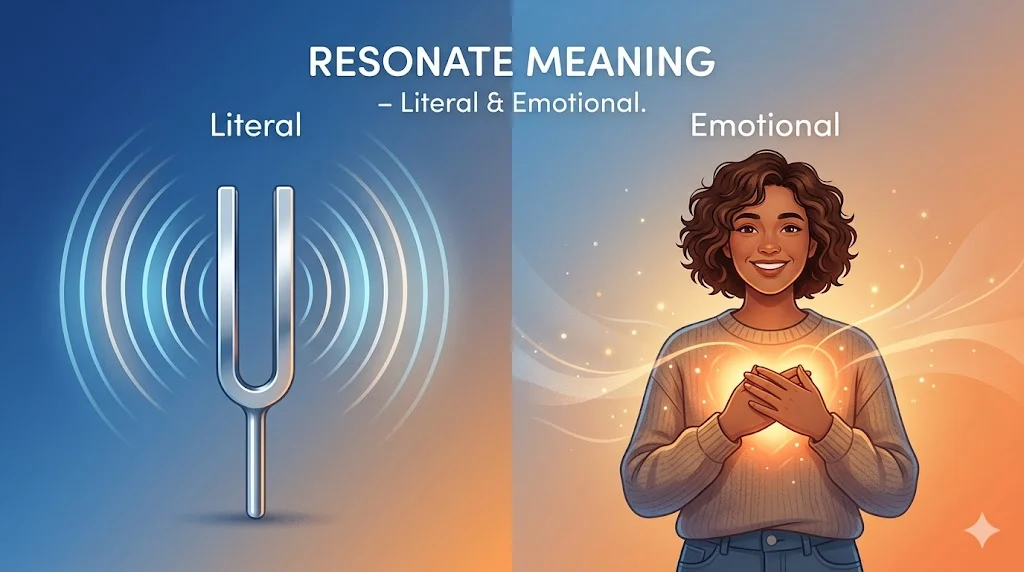
The word resonate lives in two completely different worlds. One is physics. The other is human emotion.
You need both to fully understand resonate meaning.
Literal Meaning: The Physics of Sound
In science, resonance meaning in physics is straightforward. An object resonates when it vibrates at the same natural frequency as an incoming sound wave. That matching causes the vibration to grow stronger and last longer.
Think of pushing a child on a swing. You push at just the right moment each time. The swing goes higher with less effort. That’s mechanical resonance.
Sound resonance definition works the same way. A tuning fork vibrates at a specific frequency. When you strike it near another fork with the same frequency, the second fork starts humming on its own. No touch needed.
Here’s a famous example. An opera singer hits a high note. A wine glass across the room shatters. Why? The singer’s voice matches the glass’s natural frequency. The vibrations grow too intense for the glass to handle.
That’s literal resonance.
Figurative Meaning: Emotional Connection
Now for the version you’ll use every day.
When someone says a message resonates, they don’t mean it’s loud. They mean it feels deeply true. It matches their own thoughts or experiences.
Emotionally resonate meaning is all about alignment. A story, a speech, a song, or even a single sentence can resonate if it hits something real inside you.
For example, you read: “You are not your productivity.” If you’ve been working too hard and feeling guilty for resting, that sentence might resonate hard. It echoes what you already feel but couldn’t put into words.
That’s figurative resonance. No vibrations. Just recognition.
Key takeaway: literal resonance = matching frequency. Figurative resonance = matching feeling.
Pronunciation: How to Say Resonate Correctly
Let’s clear this up fast. Many people mispronounce resonate.
Correct pronunciation: REZ-oh-nate
Break it down:
- REZ – rhymes with “fez”
- oh – like the letter O
- nate – rhymes with “great”
Say it slow: REZ – oh – nate. Then speed up.
Common wrong versions:
- REE-zone-ate (no)
- REZ-uh-nut (no)
- REE-suh-nate (definitely no)
Now say it out loud three times: resonate, resonate, resonate.
Good. You’ve got it.
Resonate Definition in English: Simple & Clear
If you need a resonate simple meaning for a child or a non-native speaker, try this:
“When something resonates with you, it feels like it was made just for you.”
For an older student or professional, use this:
“Resonate means to evoke a strong feeling of shared understanding or emotional connection.”
And for the grammar lovers:
“Resonate is an intransitive verb meaning to be filled with a deep sound or to produce a strong emotional response in someone.”
That third one is technically airtight. But the first two are more useful in real life.
The Grammar of Resonate: How to Use It Right
Here’s where most people slip up.
Resonate is intransitive. That means it never takes a direct object. You don’t “resonate something.” Something resonates with someone or something else.
Let me show you.
✅ Correct: “Her message resonates with me.”
❌ Incorrect: “I resonate her message.”
✅ Correct: “That idea resonates across different cultures.”
❌ Incorrect: “They resonate that belief.”
See the pattern? The thing doing the resonating comes first. The person feeling it comes after “with.”
Verb Forms You’ll Actually Use
| Tense | Example |
|---|---|
| Present | “His words resonate with our team.” |
| Third person singular | “That song resonates deeply.” |
| Past | “Her story resonated with millions.” |
| Present participle | “A theme resonating across generations.” |
Can You Say “I Resonate With”?
This is controversial. In casual conversation, people say “I resonate with that” all the time. It sounds fine. No one will correct you at a coffee shop.
But in formal writing? Avoid it. Strict grammar says “that resonates with me” is correct. “I resonate with that” flips the subject and object incorrectly.
Safe rule: Use “X resonates with me” in professional or academic contexts. Use “I resonate with X” only in casual speech or social media captions.
Resonate vs Relate: What’s the Difference?
People confuse these two constantly. Here’s the clean breakdown.
Relate means you’ve shared a similar experience. It’s logical and memory-based.
Resonate means you feel an emotional alignment. It’s visceral and feeling-based.
| Scenario | Use “relate” | Use “resonate” |
|---|---|---|
| You lost a job last year. Your friend loses theirs. | “I relate to your situation.” | (Not quite right) |
| A speaker talks about fear of failure, and you tear up. | “I relate to that.” | “That resonated with me.” |
| Your sibling describes a difficult parent. You grew up together. | “I totally relate.” | (Possible, but less precise) |
| A poem describes loneliness exactly how you feel it. | (Too weak) | “That poem resonated deeply.” |
Quick test: If you can say “I’ve been there,” use relate. If you say “That shook me,” use resonate.
Resonate in a Sentence: 20 Real Examples
Seeing resonate in a sentence beats memorizing definitions. Here are 20 real-world examples divided by context.
Everyday Conversation
- “That podcast about procrastination really resonated with me.”
- “His joke didn’t resonate with the crowd. Total silence.”
- “Why does this random quote resonate so much? I can’t explain it.”
- “Her calm voice resonates more than any shout ever could.”
Work & Marketing
- “A brand’s values must resonate with its customers or they’ll leave.”
- “This ad campaign isn’t resonating. Let’s rewrite the script.”
- “Leaders who share their own failures resonate more than perfect ones.”
- “Does this email tone resonate with our older audience?”
Media & Art
- “That movie’s ending didn’t resonate with critics but hit home for parents.”
- “Certain lyrics resonate for decades because they name a universal truth.”
- “The film’s silence resonated louder than any explosion.”
- “That meme resonated so hard I saved it for a bad day.”
Psychology & Self-Help
- “In therapy, a single metaphor can resonate and unlock buried memories.”
- “Childhood nicknames sometimes resonate with lifelong shame.”
- “Affirmations only work if they resonate with your actual beliefs.”
Abstract & Literary
- “A theme of isolation resonates across every chapter of the novel.”
- “That historical speech still resonates because it names our current fears.”
- “Certain color combinations resonate differently across cultures.”
- “Her silence resonated as agreement.”
- “Not every good idea will resonate. Timing and audience matter.”
Resonate Synonyms: Other Ways to Say It
Sometimes “resonate” feels too heavy or too fancy. Swap in one of these resonate synonym options.
Strongest Matches (Emotional + Accurate)
- Strike a chord – most natural replacement
- Echo – good for ideas that repeat across time
- Connect – simpler but works
- Ring true – excellent for honesty or accuracy
Decent Matches (Use with Caution)
- Reverberate – closer to literal sound
- Mirror – more about reflection than feeling
- Align with – logical, not emotional
Weak or Incorrect Matches
- Relate to – different meaning (see table above)
- Agree with – too intellectual
- Like – way too shallow
Antonyms (Opposites)
- Disconnect
- Alienate
- Fall flat
- Repel
- Miss the mark
Example swap: Instead of “His speech resonated,” try “His speech struck a chord with the audience.”
Resonate Meaning Across Languages
Many non-native speakers search for resonate meaning in Urdu, Hindi, Tamil, or Bengali. Here’s a quick translation guide.
| Language | Approximate meaning |
|---|---|
| Urdu | گونجنا (goonjna) – to echo; ذہنی ہم آہنگی (zehni hum ahangi) – mental harmony |
| Hindi | गूंजना (goonjna) – to echo; भावनात्मक जुड़ाव (bhavnatmak judav) – emotional connection |
| Tamil | எதிரொலி (ethiroli) – echo; உணர்வு ஒற்றுமை (unarvu ottrumai) – emotional unity |
| Bengali | প্রতিধ্বনি করা (protidhwoni kora) – to echo; অনুভূতিতে স্পর্শ করা (onubhutite sporsho kora) – to touch emotionally |
Important note: No single word in these languages perfectly captures the figurative “resonate.” You often need a short phrase instead.
Literal Resonance in Physics: Deeper Dive
Let’s go a bit deeper into resonance meaning in physics because it helps you understand the metaphor.
Resonance happens when a system vibrates at its natural frequency. Every physical object has at least one natural frequency. A guitar string. A bridge. A glass. Even your eardrum.
When an external force pushes at that exact frequency, the vibration amplifies. Energy transfers efficiently. The result? Larger oscillations.
Famous Examples of Literal Resonance
- Tacoma Narrows Bridge (1940): Wind matched the bridge’s natural frequency. It twisted violently and collapsed. Engineers learned a hard lesson.
- Microwave oven: Water molecules resonate at 2.45 GHz. The microwave uses that frequency to heat your food.
- MRI machines: They use radio waves to resonate hydrogen atoms in your body. That resonance creates detailed images of your organs.
Resonance vs. Reverberation vs. Echo
| Term | Definition | Example |
|---|---|---|
| Resonance | Matching frequency, amplification | Opera singer breaking glass |
| Reverberation | Sound persisting after source stops | Clapping in a tiled bathroom |
| Echo | Delayed reflection of sound | Shouting into a canyon |
Most people mix these up. Now you won’t.
Emotional Resonance: Why Some Ideas Stick
Why does one sentence change your life while another disappears instantly?
Emotional resonance is the answer. It’s not about logic. It’s about feeling.
Neuroscience shows that emotionally charged events get encoded more deeply in memory. Your brain’s amygdala tags certain experiences as “important.” Then your hippocampus saves them long-term.
That’s why a personal story resonates more than a dry statistic. A story activates emotion. A stat activates only the analytical parts of your brain.
Three Elements That Make an Idea Resonate
- Specificity – Vague ideas feel hollow. “I felt lonely” is okay. “I ate dinner alone for 400 straight nights” resonates.
- Vulnerability – People don’t resonate with perfection. They resonate with struggle.
- Unexpected truth – A twist on a common belief grabs attention. Example: “Procrastination isn’t laziness. It’s fear.”
How to Test If Something Will Resonate
Ask yourself three questions before sharing an idea:
- Have I felt this myself?
- Would I say this out loud to a friend?
- Does this contradict a comfortable lie?
If you answer yes to all three, it will probably resonate.
How to Use Resonate in Daily Conversation
You don’t need a thesaurus to use resonate naturally. Just follow these three rules.
Rule 1: Use It Only When You Mean It
Don’t say “that resonates” about your coffee order or a mildly interesting documentary. Save it for moments that actually land emotionally. Overusing it drains the power.
Rule 2: Pair It With “With”
Always follow “resonates” with “with” plus a person or group.
- “That resonates with me.”
- “Her message resonated with the audience.”
- “Does this policy resonate with voters?”
Rule 3: Keep the Rest Simple
Don’t surround “resonate” with other fancy words. It stands alone fine.
Too much: “That profoundly and exquisitely resonates with my internal phenomenological state.”
Just right: “That resonates with me.”
Natural Conversation Scripts
Friend: “I hate when people ask ‘how are you’ but don’t wait for an answer.”
You: “Wow, that really resonates. I’ve never said it out loud but yes.”
Coworker: “This new process feels like extra work for no reason.”
You: “Yeah, that’s not resonating with me either.”
Partner: “I feel like we’ve been talking past each other lately.”
You: “That resonates. Let’s sit down tonight.”
See? No formality. Just real speech.
Resonate in Psychology: Deeper Than You Think
Psychologists use resonate in a specific way. It’s not just pop self-help.
Cognitive Resonance
This happens when new information fits perfectly with existing mental models. Your brain doesn’t have to work hard to accept it. The “click” you feel is cognitive resonance.
Emotional Resonance in Therapy
Therapists look for moments when a client responds non-defensively to an interpretation. If you say “I never thought of it that way, but yes” with a softened expression – that’s emotional resonance. It often precedes real change.
Vicarious Resonance
Ever cry during a movie even though nothing bad happened to you? That’s vicarious resonance. Your mirror neurons fire as if the event happened to you. It’s empathy on a biological level.
Why It Matters
Resonance in psychology signals readiness for change. Forced advice falls flat. Resonant insights transform.
Resonate in Marketing: How to Make Your Message Stick
Marketers overuse “resonate” so much it almost lost its meaning. But when used correctly, it’s the whole ballgame.
What Does It Mean for a Brand to Resonate?
A brand resonates when a customer thinks, “This company gets me.” Not intellectually. Emotionally.
Example: Dove’s “Real Beauty” campaign resonated because it named a secret shame millions of women felt: I don’t look like the models, and that makes me less valuable.
The campaign didn’t create that feeling. It echoed it.
How to Write Copy That Resonates
- Start with a hidden frustration. Not a surface problem. A secret one.
- Name the feeling first. “You’re exhausted from pretending everything’s fine.”
- Offer relief, not a lecture. “This is not another productivity system.”
- Use “you” more than “I” or “we.” The reader is the hero.
Checklist Before You Publish Anything
- Would my ideal reader save this?
- Does this contradict a lie they believe about themselves?
- Does it sound like a human wrote it at 10 PM, not a committee at 10 AM?
If you checked all three, your message will likely resonate.
Common Mistakes
Let’s clean up the most frequent errors once and for all.
Mistake 1: Using “Resonate” as a Transitive Verb
❌ “I resonate your pain.”
✅ “Your pain resonates with me.”
Mistake 2: Using “Resonate” for Mild Agreement
❌ “I like pizza. That resonates.”
✅ Save it for stronger connections.
Mistake 3: Overusing in One Paragraph
❌ “Her story resonated. The theme resonated. Every word resonated.”
✅ “Her story resonated from the first sentence to the last.”
Mistake 4: Confusing Resonate with Relate in Formal Writing
❌ “I resonate with the character’s struggle” (in an academic essay).
✅ “The character’s struggle resonates with the reader.”
Mistake 5: Mispronouncing It
❌ REE-zone-ate
✅ REZ-oh-nate
FAQs:
Here are the resonate meaning questions that get searched every single day.
What does resonate mean in text or social media?
It means a post, tweet, or caption feels personally true. “This tweet resonates” = “I feel seen.” You’ll see it in replies like “Hard same” or “This hit different.”
What does resonate mean emotionally?
Emotionally, it means a message triggers a strong feeling of recognition or alignment. It’s not happiness or sadness specifically. It’s accuracy of feeling.
How do you pronounce resonate?
REZ-oh-nate. Three syllables. Never “REE-zone-ate.”
Can you say “resonate with me”?
Yes in casual speech. For formal writing, say “That resonates with me” instead of “I resonate with that.” Small difference but grammatically cleaner.
What is a simple meaning of resonate for a child?
“When something feels like it was made just for you. Like your favorite song knows exactly how you feel.”
What does resonate mean in psychology?
It refers to a moment when new information fits so well with existing feelings or beliefs that it creates a non-defensive “click” of recognition. Often a gateway to real change.
What is the difference between resonate and reverberate?
Resonate implies a matching of frequency (literal or emotional). Reverberate implies repeated echoing, often with less emotional weight. “The hall reverberated with applause” works. “Her words reverberated with me” sounds odd.
Why do people say “resonate” so much now?
The word exploded in the 2010s because self-help, marketing, and social media all needed a verb for emotional alignment. “Relate” felt too weak. “Agree” felt too logical. “Resonate” filled the gap.
Conclusion:
Let’s quickly recap what you learned.
Resonate meaning splits into two clear paths:
- Literal: matching sound frequencies, vibration amplification
- Figurative: emotional alignment, deep recognition
Know the grammar rules: intransitive verb, use “resonates with,” avoid “I resonate that.”
You have 20+ resonate in a sentence examples. Understand resonate vs relate. You can pronounce it correctly. You’ve seen its use in psychology, marketing, and daily conversation.
Most importantly, you know when not to use it. That’s the real skill.
Next time something truly hits you, you’ll say “that resonates” with full confidence. And you’ll mean it.
Now go find something worth resonating with.
Final Quick Reference Card
| Need | Go here |
|---|---|
| Short definition | “Feels like it was made for you” |
| Grammar rule | “X resonates with Y” |
| One synonym | strike a chord |
| One antonym | fall flat |
| Pronunciation | REZ-oh-nate |
| Past tense | resonated |
| Avoid saying | “I resonate that” |
| Best test | Would you say it out loud to a friend? |
Read More Related Articles:
- What Does ISTG Mean | Used When People Are Fed Up In 2026
- What Does IG Mean | From Instagram to Slang Usage In 2026
- What Does SMS Mean | Messaging Feature You Use Every Day In 2026

Luna Hartley is a content creator at TextSprout.com, where she specializes in explaining word meanings, modern phrases, and everyday language used in texts and online conversations. Her writing focuses on clarity and context, helping readers understand how words are actually used in real communication.