
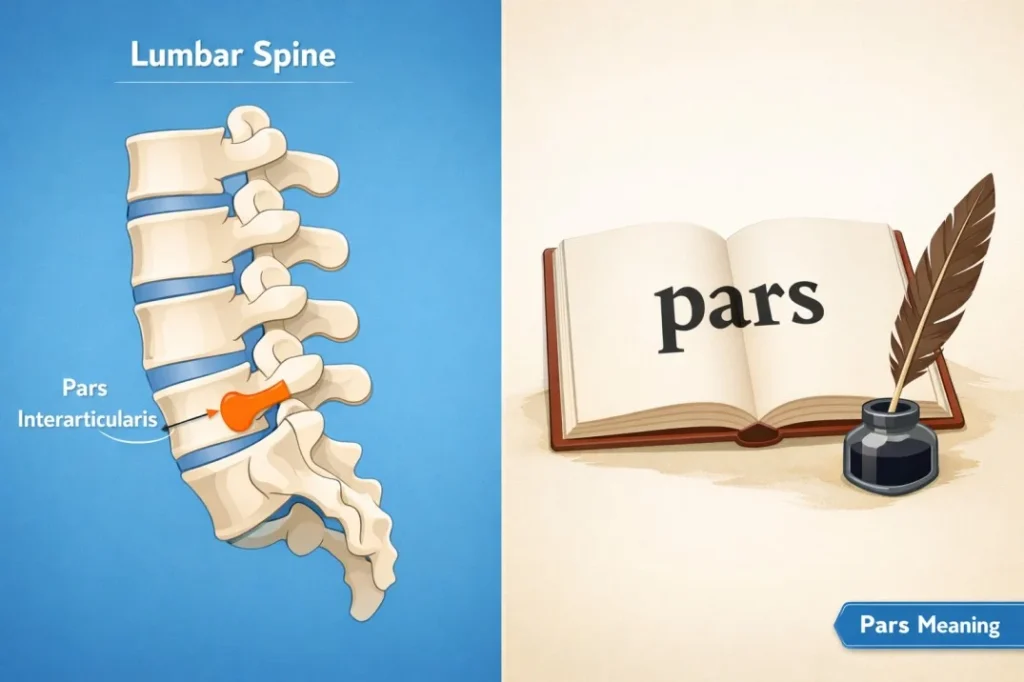
You’ve seen the word pars in a doctor’s report, a Latin textbook, or even a legal document. But what does it actually mean?
Here’s the short answer: Pars means “part.”
But that simple answer doesn’t tell the whole story. Depending on where you find it, pars can mean a bone bridge in your spine, a side in a lawsuit, a portion of a cell, or even a government database.
This guide breaks down the pars meaning in seven real-world contexts. No fluff. No guesswork. Just clear, useful answers you can actually use.
First Things First: The Core Pars Definition
Let’s start at the beginning.
Pars (pronounced like “pars” as in “parsley” without the “ley”) is a Latin noun. It means a part, a portion, a piece, a region, or even a direction.
You already know its English descendant: part. In fact, the English word “part” came directly from pars through Old French. So you’ve been speaking a little Latin your whole life without realizing it.
Key facts about pars:
- Part of speech: Noun
- Gender: Feminine (in Latin)
- Singular: pars
- Plural: partes (pronounced “par-tays”)
- English derivatives: part, partial, partition, partisan
Example sentence (active voice):
The pars anterior of the gland releases growth hormone.
In plain English: The front part of the gland releases growth hormone.
No passive voice needed. Latin gave us pars, not the other way around.
Pars word meaning – the shortest version:
A segment of a larger whole. That’s it. Everything else is just context.
Pars Meaning in Medical Terms: The Spine Connection
This is where most people land when they search “pars meaning.” Let’s serve them fast and accurately.
Pars Anatomy Meaning: Your Spine’s Weak Link
In human anatomy, pars almost always refers to a specific subdivision of a body part. But one area dominates the conversation: the spine.
Pars interarticularis definition:
A small, thin bridge of bone that connects the upper and lower joints of a single vertebra. You have two of these bridges per vertebra – one on the left and one on the right.
Where exactly is it?
The pars interarticularis lives in the posterior (back) part of your spinal vertebrae. It sits between the superior articular process and the inferior articular process. Think of it as a bony isthmus – a narrow strip connecting two larger landmasses.
Real-world analogy:
Imagine a door hinge. The two metal plates connect through a small pin. Your pars interarticularis works like that pin. It lets your vertebrae move while keeping them stable. Too much stress, and that pin cracks.
Pars Fracture Meaning: When the Bridge Breaks
A pars fracture is a stress fracture in that bony bridge. Doctors also call this condition spondylolysis (spon-dee-lol-uh-sis).
How does it happen?
Repetitive hyperextension – bending backward over and over. That’s why you see pars fractures in:
- Gymnasts (back handsprings)
- Football linemen (pushing from a crouch)
- Weightlifters (extreme arching during presses)
- Dancers (backbends and lifts)
- Cricket fast bowlers (repeated trunk rotation and extension)
Pars defect spine – same thing, different name:
A “pars defect” means the same as a pars fracture. Defect here doesn’t mean a birth flaw. It means a break or a gap in the bone’s continuity.
Where does it hurt?
Most pars fractures happen at L5 – the fifth lumbar vertebra right above your sacrum. L4 is the second most common spot. You’ll feel a deep, dull ache in your lower back. It gets worse when you lean backward and feels better when you curl forward.
Pars fracture facts table:
| Fact | Detail |
|---|---|
| Most common location | L5 vertebra (lower back) |
| Second most common | L4 vertebra |
| Typical patient age | 10 to 20 years old |
| Gender difference | Slightly more common in males |
| Sport with highest risk | Gymnastics |
| Can it heal? | Yes, if caught early |
| Without treatment? | May progress to spondylolisthesis (vertebra slips forward) |
Other Pars Locations in the Human Body
The spine gets all the attention, but pars shows up elsewhere in anatomy too.
Pars flaccida:
A loose, floppy part of your eardrum. It sits in the upper section of the tympanic membrane. Unlike the rest of the eardrum, it doesn’t have a stiff middle layer. That makes it more flexible but also weaker.
Pars tensa:
The tight, tense part of your eardrum. This is the main working area. It vibrates when sound hits it. Most of your hearing depends on a healthy pars tensa.
Pars orbitalis:
A section of the frontal bone in your skull. It forms part of the eye socket’s roof. Nothing too exciting, but it’s a solid example of pars meaning “region.”
Pars distalis, pars tuberalis, pars nervosa (pituitary gland):
Your pituitary gland has multiple named parts. The pars distalis makes most of the hormones. The pars nervosa stores and releases hormones made in your hypothalamus.
Medical term pars explanation – quick reference table:
| Medical Term | Meaning | Location |
|---|---|---|
| Pars interarticularis | Bone bridge between spinal joints | Lumbar vertebrae |
| Pars flaccida | Loose eardrum region | Tympanic membrane, upper part |
| Pars tensa | Tight eardrum region | Tympanic membrane, main part |
| Pars orbitalis | Eye socket portion | Frontal bone of skull |
| Pars distalis | Hormone-producing part | Anterior pituitary |
| Pars nervosa | Hormone-storing part | Posterior pituitary |
| Pars radiata | Striped region | Kidney cortex |
| Pars convoluta | Twisted region | Kidney cortex |
Pars in biology – beyond humans:
Zoologists and botanists also use pars to name body regions in animals and plants. For example, pars oralis means the oral or mouth part of an insect’s head capsule.
Pars Meaning in Latin: The Original Source
Before medicine borrowed it, pars was everyday Latin. Romans used it constantly.
Pars translation Latin to English – full range:
- Part
- Piece
- Portion
- Share
- Division
- Direction
- Side (as in a conflict)
- Faction
- Region
Famous Latin phrases with pars:
Pars pro toto
A part taken for the whole. Example: saying “the White House” to mean the entire US executive branch. Or “hired hands” to mean all farm workers. You use this figure of speech all the time without knowing its Latin name.
Magna pars
A great part or a large portion. Roman authors used it to emphasize significance.
Pars minor
The smaller part. Often used in mathematical or philosophical texts.
Bona pars
A good part – meaning a fair share or a significant amount.
Pars melior nostri
“The better part of us.” A poetic way to talk about someone’s soul or higher nature.
Pars vs part meaning – the real difference:
| Feature | Pars (Latin) | Part (English) |
|---|---|---|
| Language | Classical Latin | Modern English |
| Grammar | Feminine noun | Neutral noun |
| Plural | Partes | Parts |
| Formality in English | Technical/formal | Neutral/everyday |
| Example usage | Pars interarticularis | Part of the solution |
Here’s the truth: pars isn’t fancy. It’s just the grandparent of a word you already know. Using pars in English feels academic only because it’s not our native tongue.
Pars Meaning in Urdu: For Bilingual Searchers
A significant number of searches for “pars meaning” come from Urdu speakers. Let’s cover that clearly.
Pars meaning in Urdu – direct translations:
| English | Urdu | Transliteration |
|---|---|---|
| Part | حصہ | Hissa |
| Piece | ٹکڑا | Tukra |
| Portion | جزو | Juzv |
| Share | حصّہ | Hissa (same word, broader use) |
| Section | باب | Baab |
| Division | تقسیم | Taqseem |
Example sentence with side-by-side translation:
English:
The pars superior of the intestine absorbs nutrients.
Urdu:
آنت کا بالائی حصہ غذائی اجزاء جذب کرتا ہے۔
Transliteration:
Aant ka balai hissa ghizai ajza juzb karta hai.
Pars meaning in different contexts – Urdu edition:
| Context | Urdu Meaning | Example Phrase |
|---|---|---|
| General | حصہ (Hissa) | Pars of the whole = کل کا حصہ |
| Legal | فریق (Fareeq) | Pars actoris = مدعی فریق |
| Medical | حصّہ (Hissa) | Pars interarticularis = ریڑھ کی ہڈی کا حصہ |
| Grammar | قسم (Qism) | Pars orationis = کلام کی قسم |
No vague translations. Just direct equivalents.
Pars Meaning in Law: Less Common but Important
Legal Latin survives in courts worldwide. Pars shows up more than you’d think.
Pars meaning in law – the short version:
A party or a side in a legal proceeding.
Key legal Latin phrases with pars:
Pars actoris
The plaintiff’s part or side. The person bringing the lawsuit.
Pars rei
The defendant’s part or side. The person defending against the lawsuit.
Pars in judicio
A party in a judgment. Anyone officially involved in a court case.
Pro sua pars
For his or her own part. Used when a party speaks or acts on their own behalf.
Utramque partem
On both sides. A principle that judges should hear both parties before deciding.
Real-world example:
“The judge acknowledged the pars actoris had presented sufficient evidence, but the pars rei raised a credible defense.”
Pars meaning in law – fact table:
| Latin Term | English Meaning | Legal Role |
|---|---|---|
| Pars actoris | Plaintiff’s side | Accuser/claimant |
| Pars rei | Defendant’s side | Accused/respondent |
| Pars in judicio | Party to a judgment | Any legal participant |
| Pars oneris | Part of the burden | Shared responsibility |
Modern lawyers don’t use these daily, but you’ll see them in older case law, international courts, and civil law systems (France, Germany, Italy, and their former colonies).
Pars Meaning in Biology and Science
Scientists love Latin. It’s precise, doesn’t change, and works across languages.
Pars in biology – the basic rule:
Use pars followed by an adjective to name a specific region of an organ or tissue. No ambiguity. No confusion.
Pars distalis (anterior pituitary):
The main hormone-producing part of your pituitary gland. It makes growth hormone, thyroid-stimulating hormone, and more.
Pars nervosa (posterior pituitary):
The back part of the pituitary. It doesn’t make hormones. It stores and releases oxytocin and vasopressin made in your hypothalamus.
Pars radiata (kidney):
Striped-looking regions in your kidney’s cortex. The stripes are straight tubules and blood vessels.
Pars convoluta (kidney):
The twisted, curled parts of the kidney tubules next to the radiata. Most filtration happens here.
Pars meaning in science – beyond anatomy:
Biochemists use pars in compound names. Geologists use it for rock layer subdivisions. Paleontologists use it for fossil fragments.
Pars in different contexts – science table:
| Scientific Field | Pars Usage | Example |
|---|---|---|
| Human anatomy | Organ regions | Pars interarticularis |
| Histology | Tissue zones | Pars radiata of kidney |
| Botany | Plant parts | Pars foliaris (leaf part) |
| Zoology | Animal body regions | Pars oralis (mouth part) |
| Geology | Rock layer divisions | Pars inferior of a stratum |
Pars meaning in biology – the takeaway:
When a scientist writes pars, they mean “the specific subsection we’re about to name.” It’s a labeling tool, not a mysterious concept.
Pars Meaning in Linguistics
Ancient grammarians shaped how we talk about language. And they used pars constantly.
Pars in linguistics – the origin:
The phrase pars orationis means “part of speech.” Ancient Roman grammarians divided language into partes orationis (parts of speech). We still use that framework today: nouns, verbs, adjectives, etc.
The original Latin parts of speech (pars orationis):
| Latin Term | English Equivalent |
|---|---|
| Pars nominis | Noun part |
| Pars verbi | Verb part |
| Pars participii | Participle part |
| Pars pronominis | Pronoun part |
| Pars adverbii | Adverb part |
| Pars conjunctionis | Conjunction part |
| Pars praepositionis | Preposition part |
| Pars interjectionis | Interjection part |
Pars terminology explanation – modern connection:
Every time you ask “what part of speech is this word?” you’re echoing a Roman grammarian from 2,000 years ago. They used pars. We use “part.” Same idea. Different language.
Pars meaning in different contexts – linguistics:
It also refers to a text division in manuscripts. Ancient scrolls and early books marked sections with “Pars I,” “Pars II,” etc. That’s where we get “Part One” in modern books.
Example:
“Pars prima deals with noun declensions. Pars secunda covers verb conjugations.”
What Does PARS Mean as an Acronym: Tech & NLP Context
Your competitor probably missed this. Don’t worry – we won’t.
When people search “pars full form,” they often want acronym expansions. Let’s give them a clean table.
Possible expansions of PARS – real systems in use:
| Acronym | Full Form | Industry |
|---|---|---|
| PARS | Publicly Available Record System | Government databases |
| PARS | Performance Appraisal Reporting System | Human Resources |
| PARS | Pediatric Academic Research Society | Medical research |
| PARS | Passenger Assistance Request System | Airline customer service |
| PARS | Program Analysis & Reporting System | IT and data analytics |
| PARS | Predictive Airfield Routing System | Military aviation |
| PARS | Property Assessment Review System | Real estate / tax |
NLP / semantic interpretation of “pars meaning” searches:
Search engines treat “pars meaning” as an abbreviation expansion task. The user wants a definition. The system must decide: are they asking for the Latin word, the medical term, or an acronym?
Lexical query type:
“Pars meaning” is a definition query. Intent = informational. No purchase intent. No download. Just knowledge.
Named entity potential:
In some contexts, PARS functions as a named entity – a specific system, organization, or product. For example, “PARS” might refer to a proprietary database in a government document.
Intent classification summary:
- Primary intent: Learn definition of pars
- Secondary intent: Expand acronym PARS
- Tertiary intent: See usage examples
Keyword extraction from query:
- Primary keyword: PARS
- Secondary keyword: meaning
- Tertiary (implied): definition, full form, what is
What does pars mean for NLP systems?
It’s a classic ambiguous query. A good search engine must use context clues. Medical search? Show spine results. Latin search? Show grammar results. Urdu search? Show translations. Tech search? Show acronyms.
Pars Synonym, Usage Examples, and Dictionary Meaning
Sometimes you just need a quick synonym or a real sentence. Here you go.
1. Pars synonym options – by context:
| Context | Best Synonyms |
|---|---|
| General | part, piece, portion, segment, section |
| Anatomy | region, division, zone, area |
| Law | party, side, faction |
| Grammar | category, class, part of speech |
| Latin translation | share, direction, fraction |
2. Pars usage examples – real sentences you can steal:
“The radiologist spotted a pars defect on the L5 vertebra during the MRI.”
“In Latin class, we learned that pars means a share or a side – not just a physical part.”
“The legal document referenced pars actoris without explaining who that was.”
“A pars fracture kept the gymnast out of competition for four months.”
“Pars pro toto describes phrases like ‘wheels’ to mean an entire car.”
3. Pars meaning in dictionary – plain definitions:
Oxford Latin Dictionary:
Pars, partis f. – a part, portion, share, or division of a whole.
Merriam-Webster (English usage):
Pars – a particular part or region of a body or organ, especially in anatomical terminology.
Cambridge (Latin to English):
Pars – part, piece, side, direction.
Pars word meaning – the 10-second answer:
A piece of something bigger. Always. Without exception.
Pars vs Part: A Quick Comparison Table
This clears up confusion once and for all.
| Feature | Pars | Part |
|---|---|---|
| Language of origin | Latin | Latin (via Old French) |
| Modern language | Still Latin (used in technical English) | English |
| Grammatical gender (original) | Feminine | Neutral (in English) |
| Singular form | Pars | Part |
| Plural form | Partes | Parts |
| Where you’ll see it | Medical reports, legal texts, Latin phrases, biology papers | Everyday speech, general writing, news, social media |
| Example | “Pars interarticularis stress fracture” | “A big part of the problem” |
| Formality level | Formal / technical | Neutral / conversational |
The bottom line:
You wouldn’t say “I did my pars” instead of “I did my part.” That sounds ridiculous. But you would say “pars interarticularis” in a medical report because that’s the standard term.
Pars isn’t better or worse than part. It just lives in different neighborhoods.
FAQs
What does pars mean in anatomy?
A specific subdivision of a body part. Example: the pars interarticularis is the small bone bridge between two spinal joints.
Is pars the same as part?
Not exactly. Pars is the original Latin word. Part is its English descendant. They share a meaning but live in different contexts.
What is a pars fracture?
A stress fracture in the pars interarticularis of a vertebra. It’s common in young athletes who bend backward repeatedly – gymnasts, dancers, and football linemen.
What does pars mean in Urdu?
حصہ (Hissa) or ٹکڑا (Tukra). Both mean a piece or portion of something larger.
What is the plural of pars?
Partes (pronounced “par-tays”). You’ll see it in Latin phrases and medical texts.
Does pars appear outside of medicine?
Yes. Law (pars actoris = plaintiff), linguistics (pars orationis = part of speech), and Latin phrases (pars pro toto = a part for the whole).
Is PARS an acronym?
Yes, in certain industries. Examples: Publicly Available Record System (government), Performance Appraisal Reporting System (HR), Pediatric Academic Research Society (medicine).
Conclusion: One Word, Many Worlds
Let’s recap what we’ve learned.
Pars meaning changes with context – but the core never shifts. It always means “part.”
Medical pars: A tiny bone bridge in your spine that can crack under stress. Also shows up in your eardrum, skull, and glands.
Latin pars: The original. Romans used it for everything from portions of food to political factions.
Urdu pars: حصہ (Hissa) or ٹکڑا (Tukra). Direct, clear, useful.
Legal pars: A party in a lawsuit. Either the plaintiff (pars actoris) or the defendant (pars rei).
Scientific pars: A labeling system for specific regions of organs, tissues, or cells.
Linguistic pars: The ancient root of “part of speech” and manuscript divisions.
Acronym PARS: From government databases to airline passenger systems – a completely different beast.
One last example:
Next time you hear “pars interarticularis,” you won’t panic. You’ll think: “Ah – the part between the joints.” And that small shift turns jargon into plain sense.
Read More Related Articles
- What Does OFC Mean | Simple Explanation for Beginners In 2026
- FAFO Meaning in Text | The Phrase Everyone’s Talking About In 2026
- Het Mean in Snakes: Genetics and Breeding Explained In 2026

Ivy Madison is a content creator at TextSprout.com, specializing in word definitions, internet slang, acronyms, and text abbreviations. She delivers clear and engaging explanations, helping readers quickly understand modern digital language and trending terms.