
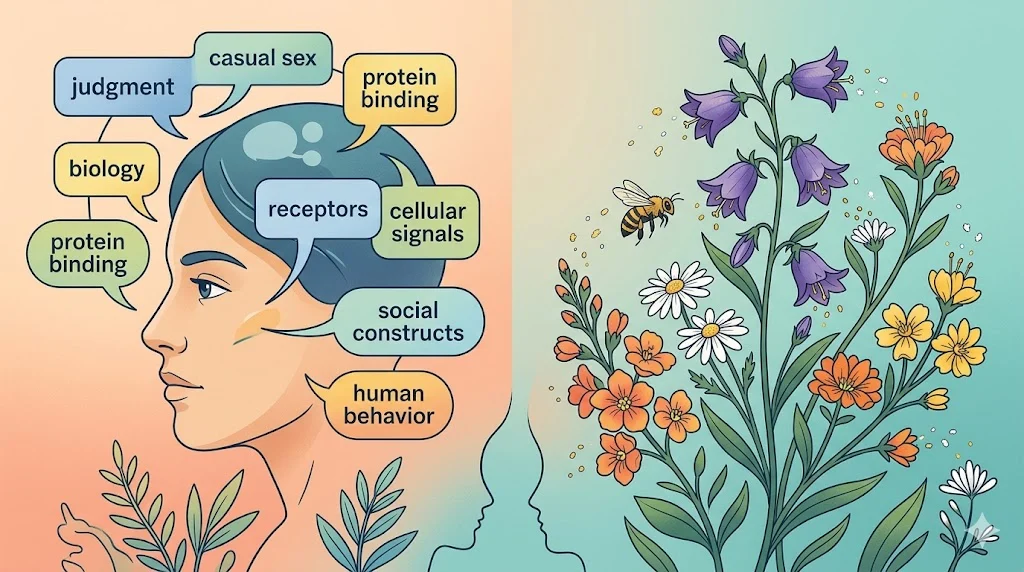
You just heard someone called “promiscuous.” Your brain probably jumped straight to sex. That’s normal. Most people do. It is the perfect place to know about Promiscuous Meaning | Beyond the Bedroom In 2026.
But here’s something you might not expect. Biologists use this word for plants. Chemists use it for proteins. And those uses carry zero shame.
So what is the promiscuous meaning, really? Let’s strip away the gossip and look at the facts. You’ll learn the definition of promiscuous across different contexts and see how a promiscuous person gets judged differently based on gender. You’ll even understand promiscuous pollination and promiscuous protein binding.
No fluff. Just clear, useful knowledge.
Quick Definitions: Your Starting Point
Let’s ground ourselves with the basics. You’ll need these before we dig deeper.
- Promiscuous (adjective) – Engaging in casual sex with multiple partners. Also means indiscriminate mixing in biology, chemistry, or general behavior.
- Promiscuity (noun) – The state or practice of being promiscuous.
- Promiscuous person – Someone who has casual sexual partners without requiring emotional commitment.
- Sexually promiscuous – The most common modern usage; often carries moral or social judgment.
- Promiscuous woman meaning – A woman who has multiple casual sexual partners; historically judged more harshly than men.
- Promiscuous man meaning – A man with multiple casual sexual partners; often labeled less harshly or even admired.
- Casual sex meaning – Sexual activity outside of a committed romantic relationship, with no expectation of ongoing emotional attachment.
Example sentence: “No one called him promiscuous when he had three partners last month, but they used that exact word for her after two.”
See the problem already? Good. Let’s unpack it.
Where the Word Came From: A Quick Etymology Lesson
The promiscuous etymology surprises most people. It didn’t start in the bedroom.
Latin promiscuus breaks down like this:
- Pro- meaning “forward” or “away from”
- Miscere meaning “to mix”
Put them together: “mixed indiscriminately.” That’s it. No sex. No judgment. Just mixing stuff up without a careful filter.
Early English used “promiscuous” to describe crowds, collections, or mixtures. A promiscuous pile of books meant you threw everything together. A promiscuous crowd meant people of all types mingled.
The sexual meaning crept in during the 18th and 19th centuries. By the 20th century, it had taken over completely. Now most people forget the original definition of promiscuous ever existed.
But here’s why this matters. Knowing the root kills unnecessary shame. The word just meant “mixing things up.” You can choose to own that or reject it. Either way, you’re informed.
Promiscuous Behavior: What Actually Counts?
Let’s get specific. What does promiscuous behavior look like in real life?
Common characteristics of promiscuous behavior:
- Multiple sexual partners within a relatively short time frame
- Little to no emotional attachment before or after sex
- Partners who are often not friends or established acquaintances
- No expectation of future contact or relationship
- Behavior that repeats as a pattern, not a one-time event
But here’s where it gets fuzzy. How many partners count as “multiple”? A week? A month? A year?
Table: Frequency and the Promiscuous Label
| Time Frame | Number of Partners | Commonly Called Promiscuous? |
|---|---|---|
| 1 month | 1 | No |
| 1 month | 3-4 | Sometimes (depends on context) |
| 1 month | 8+ | Often yes |
| 1 year | 2-3 | Rarely |
| 1 year | 10+ | Usually yes |
| 1 year | 20+ | Almost always |
These aren’t scientific cutoffs. They’re social averages. And they change based on who you ask and where they live.
Real talk: A promiscuous person isn’t automatically unhappy or broken. Some people genuinely prefer short-term, casual connections. Others cycle through promiscuity during specific life phases (post-divorce, after trauma, during young adulthood) and then stop.
The behavior itself isn’t a diagnosis. It’s just a pattern.
The Double Standard: Promiscuous Woman vs Promiscuous Man
You can’t talk about promiscuous meaning without addressing this elephant in the room.
Society judges promiscuous women and promiscuous men completely differently. The facts are ugly but clear.
Table: Side-by-Side Comparison
| Aspect | Promiscuous Woman | Promiscuous Man |
|---|---|---|
| Common labels | Slut, whore, easy, loose | Player, stud, ladies’ man, Casanova |
| Social consequence | Shame, reputation damage, harassment | Often admiration or envy from peers |
| Family reaction | Worry, disappointment, intervention | Nodding, winking, “that’s my boy” |
| Media portrayal | Tragic, desperate, mentally ill | Successful, powerful, enviable |
| Self-reporting | Less likely to admit freely | More likely to brag |
| Long-term dating impact | Significant negative effect | Minor to neutral effect |
Example scenario: Two coworkers, one woman and one man, each have seven sexual partners in a single year. The man’s friends high-five him. The woman’s coworkers whisper behind her back. Same behavior. Different judgment.
Why does this happen? Evolutionary psychology offers one explanation (parental investment theory). Feminism offers another (control over female sexuality). Both agree the double standard is real and harmful.
Bolded truth: The promiscuous woman meaning carries social punishment that the promiscuous man meaning simply does not.
Promiscuous vs Polyamorous: Two Completely Different Things
People mix these up all the time. Let’s kill that confusion right now.
Promiscuous:
- No ongoing emotional bonds required
- Partners may be one-time or anonymous
- Consent exists, but communication is minimal
- Often no disclosure to other partners
Polyamorous:
- Multiple loving relationships simultaneously
- Honesty and emotional connection required
- Everyone involved knows about everyone else
- Rules, boundaries, and communication are constant
Real example:
A promiscuous person might hook up with three strangers at a club. No names exchanged. No follow-up texts.
A polyamorous person might have two girlfriends and one boyfriend. They all meet for dinner sometimes and negotiate calendars. They talk about feelings.
Can someone be both? Sure. A polyamorous person can also have casual sex outside their established relationships. That’s called “poly + casual.” But the words describe different structures, not just different partner counts.
Key takeaway: Promiscuity isn’t a relationship orientation. It’s a behavior pattern. Polyamory is a relationship orientation (or practice, depending who you ask). Don’t use them interchangeably.
Casual Sex Meaning: Where Does Promiscuity Start?
You need to understand casual sex before you fully grasp promiscuous behavior.
Casual sex meaning: Sexual activity outside a committed romantic relationship, without expectation of ongoing attachment.
But casual sex covers a wide spectrum.
Types of casual sex:
- One-night stand – Single encounter, no prior relationship, no contact after
- Booty call – Repeated sexual encounters with no emotional dating
- Friends with benefits – Sexual activity between friends, often with some friendship care
- Hookup – Broad term covering most non-relationship sexual activity
- Fling – Short-term, intense, but still casual
So where does promiscuous behavior fit?
Most researchers define promiscuity as high frequency of casual sex across multiple partners with low selectivity. One hookup in six months isn’t promiscuous. Five hookups in two weeks probably is.
But frequency alone misses context. Consider these two people:
- Person A: 12 partners in 12 months. All one-night stands. No repeat partners. No emotional involvement. This fits the promiscuous label.
- Person B: 12 partners in 12 months. All friends with benefits. Each lasts 4-6 weeks. Some emotional care. This fits less cleanly.
The same number. Different labels. Human judgment is messy.
Promiscuous in a Sentence: Real Examples
Sometimes the best way to learn is just seeing the word in action. Here are realistic promiscuous example sentences across different contexts.
Sexual context:
- “After his divorce, he became promiscuous for about eighteen months. Then he met someone and stopped.”
- “She rejected the promiscuous label entirely. ‘I’m single and honest,’ she said.”
- “Clinicians avoid calling patients promiscuous. It’s judgmental and vague.”
- “The study defined promiscuous behavior as five or more partners in a single year.”
General behavior (less common but correct):
- “The dog showed promiscuous affection, jumping on every stranger equally.”
- “His reading was promiscuous – philosophy, romance, cookbooks, all mixed together.”
Biology context:
- “That plant’s promiscuous pollination strategy lets it survive where specialists fail.”
- “Promiscuous pollinators transfer pollen between completely unrelated species.”
Protein science context:
- “This kinase’s promiscuous binding makes it a poor drug target.”
- “Promiscuous antibodies recognize multiple antigens, which causes autoimmune problems.”
See the range? The word works everywhere. But only in sexual contexts does it trigger emotional reactions.
Promiscuous Synonyms and Antonyms: Choose Wisely
Words carry weight. Here’s your quick reference guide.
Table: Synonyms for Promiscuous (Ranked by Harshness)
| Synonym | Tone | When to Use |
|---|---|---|
| Free-spirited | Positive, gentle | Describing someone who rejects traditional monogamy without shame |
| Uninhibited | Neutral to positive | Focusing on lack of restraint rather than partner count |
| Non-monogamous | Neutral, clinical | Describing any relationship structure outside monogamy |
| Indiscriminate | Slightly negative | Highlighting lack of selectivity |
| Loose | Dated, offensive | Avoid unless quoting historical texts |
| Wanton | Very harsh, archaic | Almost never appropriate today |
| Promiscuous itself | Neutral to negative | Acceptable in clinical or descriptive writing |
Antonyms for Promiscuous:
- Monogamous – The direct opposite in relationship structure
- Chaste – No sexual activity at all
- Faithful – Sticking to one partner within a committed relationship
- Selective – Choosy about partners, whether one or many
- Abstinent – Voluntarily no sex
Bolded advice: Pick synonyms carefully. “Free-spirited” feels like a compliment. “Loose” starts a fight. Know the difference before you speak.
Promiscuous Biology: Plants Do It Too
Let’s leave human judgment behind for a moment. The promiscuous meaning in biology is clean, useful, and completely neutral.
Promiscuous pollination describes plants that accept pollen from many different species. Most plants are picky. They evolved specific shapes, colors, and scents to attract one type of pollinator (bees, birds, bats, etc.). A promiscuous plant doesn’t care.
Real example: Some orchid species produce generalist flowers that multiple insect species can pollinate. If one insect population crashes, the plant still reproduces. That’s survival intelligence.
Benefits of promiscuous pollination:
- Higher chance of reproduction in changing environments
- Less dependent on a single pollinator species
- Can colonize new territories more easily
Downsides:
- More hybrid offspring (which may be weaker)
- Less efficient pollen transfer (generalists are clumsier)
In a sentence: “The dandelion’s promiscuous pollination strategy explains why you see it on every continent.”
Promiscuous plant meaning: A plant that hybridizes freely with related species. This happens in agriculture too. Corn, wheat, and brassicas (broccoli, cabbage, kale) all show promiscuous crossing when different varieties grow too close.
Farmers care about this. Home gardeners should too. Plant your peppers far apart if you want pure seeds next year.
Promiscuous Protein Binding: The Scientific Superpower
Here’s where the promiscuous meaning gets truly fascinating. Protein scientists use this word constantly. And they mean it as a compliment about half the time.
Promiscuous protein binding means a single protein can bind to many different molecular partners. Most proteins are specialists. They lock onto one specific molecule like a key in a lock. Promiscuous proteins are master keys.
Why this matters for medicine:
Table: Promiscuous vs Selective Protein Binding in Drug Design
| Feature | Selective Binding | Promiscuous Binding |
|---|---|---|
| Drug target | Very precise | Hard to target |
| Side effects | Fewer (usually) | Many possible |
| Drug development difficulty | Moderate | Very high |
| Natural function | Specialized tasks | Broad signaling or backup roles |
Real example: The protein p53 (a tumor suppressor) binds promiscuously to many DNA damage signals. That’s good. It acts as a central alarm system. But if you try to design a drug that affects p53, that promiscuity becomes a nightmare. Your drug might cause unintended effects everywhere.
In a sentence: “This enzyme’s promiscuous binding explains its side effect profile. It hits twenty off-target proteins, not just the one we wanted.”
Promiscuous antibody: An antibody that recognizes multiple different antigens. Sometimes this causes autoimmune disease (the immune system attacks too many targets). Sometimes it’s protective (one antibody blocks several viruses).
Bolded fact: Drug companies spend millions trying to reduce promiscuous protein binding. But for some natural cellular processes, promiscuity is the whole point.
The Word Sense Disambiguation Problem
Let’s get technical for a minute. This matters for anyone writing content, training AI, or studying linguistics.
Word sense disambiguation (WSD) is the problem of figuring out which meaning of a word someone intends. The promiscuous meaning has at least three major senses:
- Sexual sense (highest frequency in everyday English)
- Biological sense (pollination, hybridization)
- Chemical/protein sense (binding, molecular interactions)
Example sentence pairs:
- “He’s promiscuous.” → Sexual sense. (Nearly 100% certainty without other context.)
- “This pollen is promiscuous.” → Biological sense. (“Pollen” kills ambiguity.)
- “The binding domain is promiscuous.” → Protein sense. (“Binding domain” signals chemistry.)
How humans solve this: You don’t even notice doing it. Surrounding words (collocates) trigger the right meaning automatically.
How machines solve it: Trained models look at nearby words. “Partner,” “sex,” “relationship” push toward sense 1. “Flower,” “pollen,” “plant” push toward sense 2. “Protein,” “enzyme,” “binding” push toward sense 3.
Why you should care: If you’re writing for search engines or AI training data, include clear context words. Don’t just say “promiscuous meaning.” Say “promiscuous meaning in biology” or “promiscuous person meaning in relationships.” You’ll get better results.
Promiscuous Lifestyle: What It Actually Looks Like Day to Day
Let’s get practical. What does a promiscuous lifestyle mean for someone living it?
Common traits (not universal):
- High social rotation – New people enter and exit their life frequently
- Low emotional entanglement – They avoid situations that demand deep emotional investment
- Minimal future planning with partners – No “where is this going” conversations
- Active dating app use – Tinder, Hinge, Feeld, or similar
- Comfort with uncertainty – They don’t need to know what happens tomorrow
- Often single by choice – Not “between relationships” but actively not seeking one
What a promiscuous lifestyle is NOT:
- Not necessarily unhappy – Many promiscuous people report high life satisfaction
- Not automatically addictive – Patterned behavior isn’t the same as compulsion
- Not a mental illness – The DSM-5 has no “promiscuity disorder”
- Not permanent – Most people cycle in and out of promiscuous phases
Real talk: A promiscuous person might have sex with someone new every weekend for six months. Then they might date monogamously for two years. Then back to casual. Human sexuality is fluid. Labels freeze a moment in time.
The hidden cost: Promiscuous people face stigma even from healthcare providers. Studies show doctors spend less time with patients they judge as promiscuous. They order fewer tests. They prescribe less pain medication. That’s real harm.
Bolded truth: A promiscuous lifestyle doesn’t make you a bad person. But living one in a judgmental culture does carry real social risks. Know the facts. Make your own choices.
FAQs
What is the simplest definition of promiscuous?
A promiscuous person engages in casual sex with multiple partners. No long-term commitment. No deep emotional attachment required. That’s the core meaning in everyday language.
Is being promiscuous always a bad thing?
Not automatically. The word carries judgment, but the behavior itself isn’t inherently harmful. Some people genuinely prefer short-term connections. Others cycle through promiscuous phases and then stop. The problem isn’t the behavior. It’s the shame society piles on top.
What’s the difference between a promiscuous woman meaning and a promiscuous man meaning?
Same behavior. Different judgment.
A promiscuous woman gets called harsh names. People shame her. She faces real social consequences. A promiscuous man often gets high-fives or admiration. His reputation might even improve.
The double standard is real, unfair, and well-documented.
How many partners counts as promiscuous?
There’s no official number. But in research and common conversation:
- 1–2 partners per year → rarely called promiscuous
- 5–10 partners per year → sometimes labeled promiscuous
- 10+ partners per year → often labeled promiscuous
- 20+ partners per year → almost always labeled promiscuous
Context matters more than the exact count. A person with 15 partners over ten years isn’t promiscuous. A person with 15 partners in two months probably is.
What does casual sex mean exactly?
Casual sex means sexual activity outside a committed romantic relationship. No strings. No expectation of ongoing emotional attachment.
Examples:
- One-night stand
- Booty call
- Friends with benefits
- Hookup
Casual sex isn’t always promiscuous. One casual hookup in six months doesn’t make someone promiscuous. Patterned frequency does.
Conclusion:
The promiscuous meaning has range. It covers plants, proteins, people, and pollination. But in daily conversation, it almost always lands on sexual behavior with a side of judgment.
Ask yourself before you use it:
- Am I describing behavior or condemning a person?
- Would I use this word differently for a man versus a woman?
- Is there a more precise word available?
Sometimes “promiscuous” is the right tool. Clinical writing. Historical description. Scientific contexts.
But often? You can just describe what someone actually does.
Instead of “She’s promiscuous,” try:
- “She has casual sex with multiple partners.”
- “She prefers short-term relationships right now.”
- “She doesn’t do monogamy.”
Instead of “He leads a promiscuous lifestyle,” try:
- “He sees new people every week.”
- “He’s not looking for a relationship.”
- “He dates casually and openly.”
See the difference? One judges. The other informs.
Read More Related Articles:
- What Does Herpes Look Like: Symptoms, and What to Expect In 2026
- STG Meaning in Texting | Promise or Just Slang In 2026
- What Does Nonce Mean | From Tech Term to Slang Meaning In 2026

Neon Samuel is a digital content creator at TextSprout.com, dedicated to decoding modern words, slang, and expressions. His writing helps readers quickly grasp meanings and understand how terms are used in real conversations across text and social platforms.