
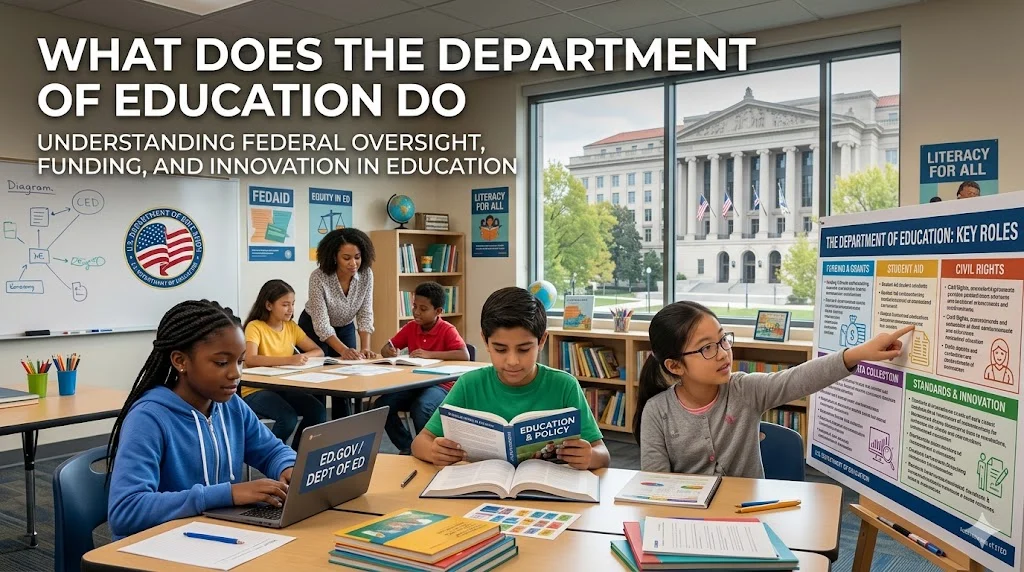
Most people think the Department of Education runs schools. That sounds logical. It isn’t true.
Here’s the reality. The Department of Education shapes education without directly controlling it. It influences funding, protects student rights, and builds systems that affect millions of learners every single day.
If you’ve ever applied for student aid, heard about Title IX, or wondered why some schools get more funding, you’ve already seen its impact.
This guide breaks everything down in plain language. No fluff. No vague statements. Just clear answers about what the Department of Education does, how it works, and why it matters.
What Is the Department of Education? A Clear, No-Nonsense Explanation
The Department of Education is a federal agency. It operates under the national government. Its main job revolves around improving access to education and ensuring fairness across the system.
It was officially established in 1979. Before that, education responsibilities existed but were scattered across different departments. The goal was simple. Centralize efforts and create a focused approach to education policy.
Core Mission
- Ensure equal access to education
- Improve the quality of education nationwide
- Provide financial support to students
- Enforce education laws
Unlike what many assume, it does not manage day-to-day school operations. States and local districts handle that.
Federal vs State Control
| Function | Federal Department | State & Local Governments |
|---|---|---|
| Policy Guidance | Yes | Yes |
| School Curriculum | No | Yes |
| School Operations | No | Yes |
| Funding Support | Yes | Yes |
| Law Enforcement | Yes | Limited |
This distinction clears up most confusion.
What Does the Department of Education Do? Core Responsibilities Explained
Let’s get straight to the point. The Department of Education focuses on six major areas. Each one plays a critical role in shaping education across the country.
Sets National Education Policies
The department develops policies that guide how education works at a national level.
These policies don’t force schools to follow exact rules. Instead, they create frameworks. States then adapt these frameworks to their own systems.
For example:
- Setting accountability standards
- Encouraging curriculum improvements
- Promoting equal education access
Think of it like a blueprint. The federal government designs the structure. States build the house.
Manages Federal Education Funding
Money drives education. The Department of Education distributes billions of dollars each year.
This funding supports:
- Low-income schools
- Special education programs
- Teacher training initiatives
- School improvement projects
One of the most important funding programs is Title I. It directs resources to schools with high numbers of disadvantaged students.
How Funding Flows
- Federal government allocates funds
- Department distributes to states
- States pass funds to local districts
- Schools use funds based on needs
This layered approach ensures targeted support.
Administers Student Financial Aid Programs
This is where most students directly interact with the department.
The Department of Education runs federal student aid programs, including:
- Pell Grants
- Federal student loans
- Work-study programs
Types of Student Aid
| Type | Description | Repayment Required |
|---|---|---|
| Grants | Free money for education | No |
| Loans | Borrowed money | Yes |
| Work-Study | Part-time jobs | No |
The FAFSA system acts as the gateway. Students submit financial details. The system calculates eligibility.
This single process impacts millions of students every year.
Enforces Education Laws and Civil Rights
The department protects students from discrimination. It ensures every student gets equal opportunities.
Key areas include:
- Gender equality (Title IX)
- Disability rights (IDEA)
- Racial equality
What Enforcement Looks Like
- Investigating complaints
- Monitoring institutions
- Taking legal action when necessary
Without this enforcement, access to education would vary widely.
Collects and Publishes Education Data
Data drives decisions. The Department of Education gathers massive amounts of information.
This includes:
- Graduation rates
- Student performance
- School funding statistics
Why This Matters
- Helps policymakers improve systems
- Guides funding decisions
- Identifies struggling schools
Accurate data leads to smarter policies.
Supports Education Research and Innovation
The department funds research to improve learning outcomes.
Examples include:
- New teaching methods
- Technology integration
- School reform strategies
Innovation doesn’t happen randomly. It requires funding and direction.
What the Department of Education Does NOT Do
Let’s clear up the biggest myths.
It Does Not Control Curriculum
States decide what students learn. Local school boards often refine those decisions.
It Does Not Run Schools
Teachers, principals, and districts manage daily operations.
It Does Not Set Teaching Methods
Educators choose how they teach.
Why People Get Confused
The department influences funding and policies. That influence feels like control. In reality, it shapes direction rather than dictating actions.
How the Department of Education Helps Students Directly
This is where things get personal.
Financial Support Changes Lives
Imagine a student from a low-income family. College feels impossible. Then financial aid steps in.
That student receives:
- A Pell Grant
- A subsidized loan
- Work-study opportunities
Suddenly, education becomes accessible.
Protecting Student Rights
Students don’t always realize this protection exists.
If a student faces discrimination, the department provides:
- Complaint systems
- Legal protection
- Institutional accountability
This creates safer learning environments.
Improving Education Quality
Programs funded by the department aim to:
- Increase graduation rates
- Improve literacy
- Enhance STEM education
These initiatives shape long-term outcomes.
How the Department of Education Affects Schools and Colleges
Even without direct control, the department influences institutions in powerful ways.
Funding Shapes Resources
Schools receiving federal funds often gain:
- Better facilities
- Updated learning materials
- Additional staff support
Accountability Systems Drive Performance
Schools must meet certain benchmarks to maintain funding.
This pushes institutions to:
- Improve test scores
- Reduce dropout rates
- Enhance teaching quality
Teacher Training and Support
The department funds programs that help teachers:
- Learn new methods
- Stay updated with trends
- Improve classroom outcomes
Better teachers lead to better students.
Higher Education Oversight
Colleges must meet federal standards to qualify for funding programs.
This ensures:
- Academic credibility
- Financial accountability
- Student protection
Who Controls the Department of Education? Power Structure Explained
The Department of Education operates under federal authority.
Key Players
- President: Sets broad priorities
- Congress: Controls funding and legislation
- Secretary of Education: Leads the department
How Decisions Flow
- Congress passes laws
- President approves
- Department implements
This system creates checks and balances.
Key Programs Run by the Department of Education
Several major programs define its impact.
Federal Student Aid (FSA)
- Largest provider of student financial aid
- Manages loans, grants, and work-study
Title I Programs
- Supports low-income schools
- Reduces education inequality
Special Education Programs
- Ensures support for students with disabilities
School Improvement Grants
- Helps struggling schools improve performance
Each program targets specific challenges.
How the Department of Education Funds Education
Funding remains one of its most powerful tools.
Where the Money Comes From
- Federal taxes
- Congressional budgets
Where the Money Goes
- State education agencies
- Local school districts
- Colleges and universities
Federal vs State Funding Comparison
| Category | Federal Role | State Role |
|---|---|---|
| Funding Share | Smaller | Larger |
| Distribution | Targeted programs | General funding |
| Control | Limited | Direct |
Federal funding usually targets specific needs rather than covering all costs.
Major Education Laws Enforced by the Department
Laws form the backbone of its authority.
Title IX
- Prevents gender discrimination
- Applies to schools receiving federal funding
IDEA (Individuals with Disabilities Education Act)
- Guarantees education for students with disabilities
- Requires tailored learning plans
ESSA (Every Student Succeeds Act)
- Replaced No Child Left Behind
- Focuses on accountability and flexibility
Why the Department of Education Is Important
Without it, education would look very different.
It Promotes Equal Access
Students from all backgrounds get opportunities.
It Supports Low-Income Communities
Funding helps bridge resource gaps.
It Maintains National Standards
Consistency improves overall education quality.
It Drives Reform
Policies push systems to evolve.
Real-World Example: How It Impacts a Student’s Life
Let’s walk through a realistic scenario.
A student wants to attend college but lacks financial support.
- They complete FAFSA
- They receive a Pell Grant
- They take a subsidized loan
- They enroll in college
Without federal aid, this path might not exist.
That’s real impact.
Pros and Cons of the Department of Education
Advantages
- Expands access to education
- Provides essential funding
- Protects student rights
Criticisms
- Bureaucratic processes can slow progress
- Limited control creates gaps in enforcement
- Political influence affects policies
FAQs
What does the Department of Education do exactly?
It funds education, enforces laws, supports students, and guides policy.
Does it control schools?
No. States and local districts control schools.
How does it help students?
Through financial aid, legal protections, and education programs.
Why is it important?
It ensures fairness, access, and quality in education.
Conclusion:
The Department of Education doesn’t run classrooms. It doesn’t decide what teachers say each day.
Instead, it shapes the entire system from behind the scenes.
It funds opportunities. It protects rights and builds frameworks that influence millions of lives.
If you strip it down to one idea, it’s this:
The Department of Education exists to make education more fair, more accessible, and more effective.
That’s not small. That’s foundational.
Read More Related Articles:
- What Does Te Amo Mean in English? Definition & Examples (2026)
- What Does -3.5 Mean in a Point Spread? Betting Guide (2026)
- 12:12 Love Meaning: Signs from the Universe You Can’t Ignore (2026)

Ivy Madison is a content creator at TextSprout.com, specializing in word definitions, internet slang, acronyms, and text abbreviations. She delivers clear and engaging explanations, helping readers quickly understand modern digital language and trending terms.