
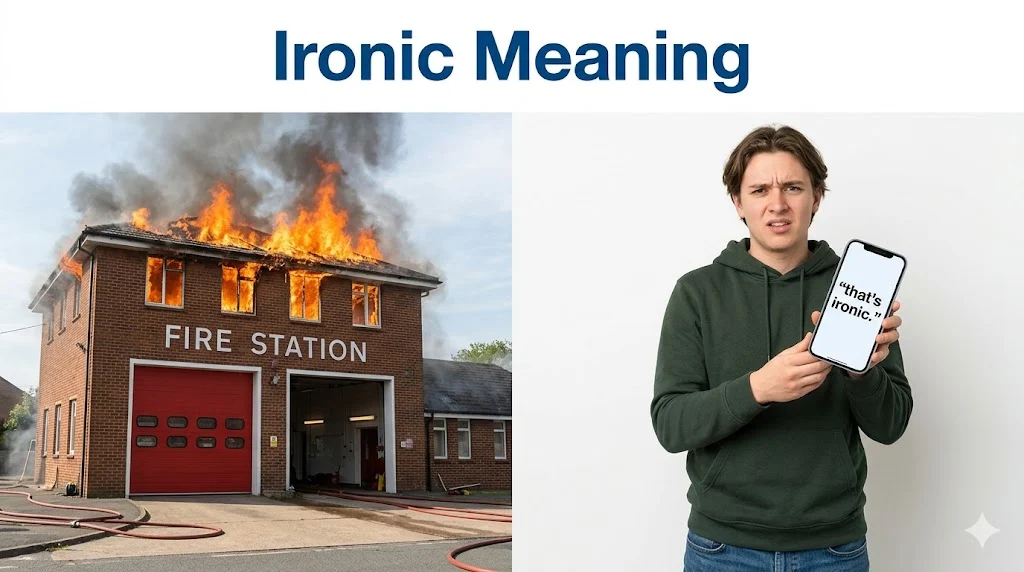
You call a rainy picnic “ironic.” Alanis Morissette did too. And honestly? You’re both wrong.
That stings a little. I get it.
But here’s the thing. Misusing the word “ironic” happens constantly. You see it on social media. You hear it in conversations. Even professional writers mess this up.
Let’s fix that.
By the end of this guide, you will understand ironic meaning clearly. You will spot irony in movies, books, and real life. And you will never embarrass yourself at a dinner party by calling a parking ticket “ironic.”
Ready? Let’s go.
What Does Ironic Mean? The Human Definition
Forget the textbook for a minute.
Ironic means a clear gap between what you expect and what actually happens.
That’s it. No magic. No secret handshake.
If nothing surprises you, it’s not irony. If the outcome mocks the original intention, you are in irony territory.
Let me give you the fastest example you will ever remember.
You hire a bodyguard to protect you. That bodyguard then steals your wallet.
That’s ironic. The person meant to keep you safe becomes the danger.
See how that works? The result flips the expectation completely.
Now contrast that with bad luck. You hire a bodyguard. He does his job perfectly. But a bird poops on your head as you leave the building. That’s not ironic. That’s just a bad Tuesday.
So keep this rule in your back pocket.
Irony requires a meaningful opposite outcome. Not randomness. Not inconvenience.
The 3 Real Types of Irony: No Textbook Boredom
Most guides list irony types like a grocery list. Boring. Forgettable.
We will do this differently. Each type gets one sharp definition and one example that sticks in your brain like a catchy song lyric.
Verbal Irony (Saying the Opposite)
This is the easiest type to understand. Verbal irony happens when you say the exact opposite of what you mean.
You walk outside into a pouring thunderstorm. You look at your friend and say, “Beautiful weather we’re having.”
That’s verbal irony.
You don’t mean the weather is beautiful. You mean it’s miserable. But you use the opposite words to make a point.
Where verbal irony lives:
- Text messages
- Casual conversation
- Twitter and TikTok captions
- Comedy shows
Key distinction coming up: Sarcasm is a type of verbal irony. But not all verbal irony is sarcastic. Sarcasm requires a sharp, often nasty, tone meant to mock or insult. Verbal irony can be gentle or even affectionate.
Example of gentle verbal irony: Your toddler draws a scribble on the wall. You say, “Wow, what a masterpiece.” And you are not mocking the child. You are using irony to soften a frustrating moment.
Example of sarcasm: Someone cuts you in line. You say, “Great manners.” That’s sarcasm. It stings.
Situational Irony (Outcome Mocks the Plan)
This is the one people mess up most often.
Situational irony happens when the final result directly contradicts the intended goal. The universe plays a practical joke. The outcome makes the original plan look ridiculous.
Classic examples that actually work:
- A fire station burns down.
- A therapist loses their temper during a therapy session.
- A traffic cop gets a speeding ticket.
- A lifeguard drowns.
- A nutritionist gets caught eating junk food in secret.
Notice a pattern? Each example has a built-in expectation. Fire stations fight fires. Therapists stay calm. Cops follow traffic laws. Lifeguards save swimmers. When the opposite happens, irony appears.
What situational irony is NOT:
| Situation | Is it irony? | Why or why not |
|---|---|---|
| You buy an umbrella. It doesn’t rain. | No | That’s just bad luck. No opposite outcome occurred. |
| You avoid a specific street to dodge traffic. You get stuck in worse traffic on the new route. | No | That’s inconvenience and poor planning. The outcome doesn’t mock the intention. |
| You study all night for a test. You fail because the teacher gave the wrong exam. | Yes | Your effort to succeed led to failure through no fault of your own. The opposite happened. |
| You wear your favorite shirt. Someone spills coffee on it. | No | That’s a bummer. Not irony. |
Dramatic Irony (Audience Knows More)
This type dominates movies, TV shows, and books.
Dramatic irony happens when the audience knows something important that the characters do not know. You sit there screaming at the screen. You want to warn them. But you can’t.
The classic example:
Horror movie. The audience sees the killer hiding in the closet. The hero walks toward the closet, completely unaware. You shout, “Don’t open the door!”
That’s dramatic irony.
Everyday version you have definitely experienced:
You see your friend’s ex at a party. You already know the ex plans to ask for another chance. Your friend has no idea. They walk over happily to say hello. You cringe internally. You know what is coming. They do not.
Why writers love dramatic irony:
- Creates tension
- Makes you feel smart (you know more than the character)
- Adds dark humor
- Keeps you emotionally invested
The Most Common Mistake: Irony vs. Coincidence vs. Bad Luck
This section alone will save you years of embarrassment.
People call things “ironic” every single day. Most of those things are not ironic. They are coincidences. Or bad luck. Or just mildly annoying moments.
Let me give you a simple test.
Ask two questions before you say “that’s ironic”:
- Did the opposite of the intended result actually happen?
- Would a typical person find it surprising and a little twisted?
If you answer no to either question, pick a different word.
The Comparison Table You Will Actually Use
| You say “That’s ironic” when… | What it actually is | Real example |
|---|---|---|
| Two unrelated things happen at the same time | Coincidence | You think about an old childhood friend. Five minutes later, they text you out of nowhere. |
| Something mildly annoying occurs | Bad luck | You bring an umbrella to work. It doesn’t rain. You leave it home the next day. It pours. |
| A small inconvenience happens at the wrong time | Unfortunate timing | Your phone dies right as you need to make an important call. |
| The opposite of the expected result happens | Irony | A swimming instructor drowns in a kiddie pool. |
| An outcome makes the original plan look ignorant | Irony | A sign company goes out of business. Their last billboard reads “We Never Close.” |
Why People Misuse Ironic So Often
Three reasons.
First, “coincidental” sounds too formal. People reach for “ironic” because it feels smarter.
Second, Alanis Morissette’s song “Ironic” confused an entire generation. The song lists situations like rain on your wedding day and a traffic jam when you are already late. None of those are actually ironic. The song itself became ironic because it claimed to be about irony but contained zero irony. That fact alone is genuinely ironic.
Third, language changes. Some dictionaries now accept a looser definition of irony to include “strange or funny coincidences.” Linguists call this descriptive linguistics. Old-school grammar lovers call it a tragedy.
Here is my honest take. You can use the looser definition in casual texting. No one will arrest you. But if you want to sound educated and precise, stick to the real meaning. People notice. And they appreciate it.
Where People Use Irony Every Day: Without Naming It
Irony hides in plain sight. You see it constantly. You just don’t label it.
Social Media Irony
Look at any viral tweet or TikTok caption.
Someone posts a flawless selfie with the caption “I look terrible today.” That’s verbal irony. They say the opposite of the truth for humor.
Someone films themselves crying while a happy song plays in the background. That’s situational irony mixed with dark comedy. The emotional tone contradicts the audio.
Marketing Fails That Are Actually Ironic
Companies spend millions on branding. Sometimes their own campaigns backstab them.
- A billboard for safe driving collapses onto a car. That’s irony.
- A fast food chain runs a “healthy eating” promotion. The same week, health inspectors shut them down for mold. That’s irony.
- A cybersecurity company gets hacked. Customer data leaks. That’s painfully ironic.
Everyday Conversation Examples
You use irony more often than you realize.
Verbal irony in daily speech:
- “Brilliant idea” when someone suggests something ignorant.
- “I’m having a great day” after spilling coffee on your shirt.
- “Perfect timing” when the bus leaves right as you arrive.
Situational irony you might have lived through:
- You clean your house for guests. They cancel five minutes before arriving.
- You buy a backup charger because your phone always dies. You lose the backup charger.
- You take a shortcut to save time. The shortcut adds thirty minutes.
Notice how these are not just bad luck. The outcome directly contradicts the intention. You cleaned for guests. No guests came. The intention and result are opposites.
Irony vs. Sarcasm vs. Satire: The Quick Cheat Sheet
People use these three words like interchangeable synonyms. They are not.
Let me break this down so you never confuse them again.
Sarcasm
Sarcasm is verbal irony with a sharp edge. It intends to mock, insult, or hurt.
Examples of sarcasm:
- Someone shows you their new haircut. You say, “Love what you did with the place.”
- A coworker misses a deadline. You say, “Wow, you really earned that bonus.”
Sarcasm has a target. The target feels it.
Satire
Satire uses irony, exaggeration, or humor to criticize something. Usually politics, culture, or social norms. Satire has a point. It wants to change minds or expose stupidity.
Examples of satire:
- The Onion articles. Fake news that mocks real news.
- Jonathan Swift’s “A Modest Proposal.” He suggested eating poor children to solve hunger. Obviously satire. He wanted to mock how England ignored Irish poverty.
- The Daily Show or Last Week Tonight. They use real clips and ironic commentary to expose political nonsense.
Irony
Irony is the big umbrella term. It covers verbal irony, situational irony, and dramatic irony. Irony does not require a mean tone. It does not have to criticize anything. It just needs that gap between expectation and reality.
One Example to Lock It All In
Imagine a hospital wins a national safety award. One week later, a preventable infection outbreak makes ten patients sick.
- Irony: The award and the outbreak directly contradict each other. The outcome mocks the intention.
- Sarcasm: A nurse says, “Really earning that award now, huh?”
- Satire: A fake news site runs a headline: “Hospital Wins ‘Cleanest Beds’ Award, Celebrates by Not Changing Sheets for a Month.”
See the difference? Irony is the situation. Sarcasm is the mean-spirited comment. Satire is the exaggerated critique.
Real-Life Ironic Situations People Actually Experience
Let me give you ten real examples. You have probably lived through a version of at least half of these.
- A dating coach files for divorce. Their entire career is teaching others how to maintain relationships. Their own marriage fails. That’s situational irony.
- A minimalist influencer rents three storage units. They built a following on owning almost nothing. But they secretly hoard items in a storage facility. Oops.
- Your phone battery dies while reading an article called “How to Extend Your Phone Battery.” You needed the information. The device you used to access it betrayed you. Ironic.
- A cybersecurity expert gets hacked. Their personal accounts leak online. They spent years telling everyone else to use strong passwords. They used “password123.”
- A firefighter’s own house burns down while they are out saving someone else’s house. They protected others. Their own home paid the price.
- You take a “relaxing vacation” and come back more exhausted than before. The goal was rest. The result was more stress.
- A doctor smokes two packs a day. They know exactly what cigarettes do to lungs. They keep lighting up anyway.
- You avoid social media for a week to “be more present.” Then you post seventeen photos of your “digital detox” on Instagram.
- A school teaches a class on “How to Avoid Student Debt.” The tuition for that class costs $3,000.
- You complain loudly about how annoying loud chewers are. Then you become the loudest chewer at dinner. No one says anything. But everyone notices.
Each of these fits the definition. The result flips the intention. Expectation meets reality. Reality loses.
FAQs
What does it mean when something is ironic?
It means the opposite of the expected outcome happens in a way that feels meaningful, not random.
What is ironic with an example?
A traffic cop gets a speeding ticket. That’s ironic because the cop enforces the law they just broke.
Can you give examples of irony in real life?
Yes. A therapist who cannot control their anger. A marriage counselor who gets divorced. A lifeguard who needs saving.
What are the 3 types of irony and examples?
Verbal (saying “great job” after a disaster), situational (fire station burns down), dramatic (audience knows the killer is inside).
Is irony the same as coincidence?
No. Coincidence is two unrelated events happening at the same time. Irony requires the outcome to mock the original intention.
How to use ironic in a sentence correctly?
“It was ironic that the safety instructor locked their keys in the car during a lesson on emergency preparedness.”
What is the difference between irony and paradox?
Irony involves an outcome or statement that contradicts expectations. A paradox is a statement that seems self-contradictory but might hold truth. Example: “This statement is false” is a paradox. Not irony.
Why do people call things ironic when they are not?
Because “ironic” sounds more intelligent than “unfortunate” or “coincidental.” And the Alanis Morissette song normalized incorrect usage.
How to Spot Irony in Writing, Movies and Speech
You can train yourself to spot irony like a pro. Here is how.
In Literature
Look for moments where the character expects one thing but gets another. Or where you as the reader know something the character does not.
Famous ironic moments in books:
- The Gift of the Magi by O. Henry. A wife sells her hair to buy her husband a watch chain. He sells his watch to buy her combs for her hair. Each sold what the other bought. Ironic and heartbreaking.
- *1984* by George Orwell. The Ministry of Truth rewrites history. The Ministry of Peace wages war. The names are the opposite of reality. Verbal irony embedded into the setting.
In Movies
Movies love dramatic irony. It keeps you engaged.
Examples you have seen:
- Frozen. The audience knows Prince Hans is the villain long before Anna does. You watch her trust him. You want to scream.
- Titanic. The audience knows the ship will sink. The characters dance and laugh. Dramatic irony on a massive scale.
- The Sixth Sense. On a second watch, you realize the clues were always there. The audience could have known. The characters did not.
In Speech and Conversation
Listen for verbal irony constantly. People use it to be funny, to vent, or to soften hard news.
Examples you hear weekly:
- “Well, that went well.” (It did not go well.)
- “Nothing like a Monday morning.” (Everything about Monday morning is terrible.)
- “Fantastic.” (Said with a flat tone after bad news.)
Your ear already recognizes these. Now you have a name for them.
Final Rule Before You Call Something Ironic
Ask yourself two questions every single time.
Question one: Did the opposite of the intended result actually happen?
Question two: Would a typical person find it surprising and a little twisted?
If you answer yes to both, say “ironic” with confidence. If you answer no to either, stop. Choose a different word.
Better alternatives to “ironic” when you are not sure:
- Coincidental
- Unfortunate
- Bad timing
- Funny (in a strange way)
- Unexpected
None of those sound weak. They sound accurate. Accuracy beats fancy vocabulary every time.
Conclusion:
Understanding ironic meaning does not require a PhD in English literature. It just requires attention.
Pay attention to expectations versus outcomes. Notice when the universe plays a practical joke. Watch how movies and books use dramatic irony to hook you. Listen to how your friends use verbal irony to make you laugh.
And for the love of clear communication, stop calling a rainy day ironic. Rain happens. That is not irony. That is weather.
But if you plan an outdoor wedding specifically because “it never rains here in June,” and then the sky opens up the moment you say “I do”? That is irony. Pure, beautiful, miserable irony.
Now go impress your friends. Correct them gently. Share a real ironic example. And never misuse the word again.
You have the tools. Use them well.
Read More Related Articles:
- ADU Mean in Housing: Human Guide to Accessory Dwelling Units 2026
- Constant Mean in Science: Uses and Real-Life Examples In 2026
- Ara Ara Mean in English: Usage, Tone and Cultural Context In 2026

Ivy Madison is a content creator at TextSprout.com, specializing in word definitions, internet slang, acronyms, and text abbreviations. She delivers clear and engaging explanations, helping readers quickly understand modern digital language and trending terms.