
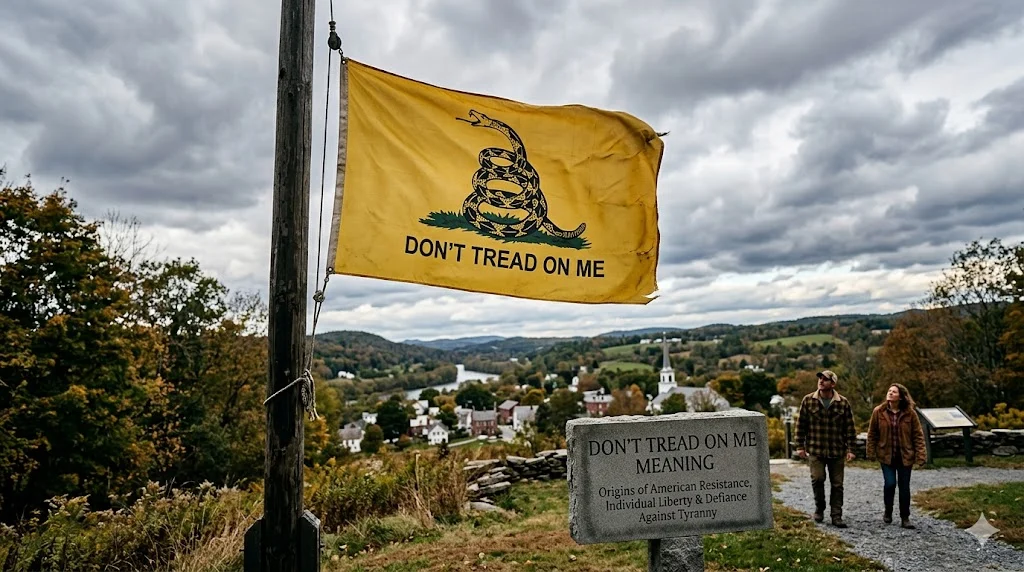
Few phrases in American history hit as hard or travel as far as four simple words: Don’t Tread on Me. Learn more information about Don’t Tread on Me Meaning.
You’ve seen it on a yellow flag. Maybe on a bumper sticker, a tattoo sleeve, a soldier’s patch, or a protest sign. It shows up at gun rallies and libertarian conventions. It flew from U.S. Navy ships after 9/11. Metallica put it on one of the best-selling albums of all time. And in 2016, it landed in a federal workplace discrimination case that had the whole country arguing about what a flag actually means.
So what does “Don’t Tread on Me” actually mean? Where did it come from? And why does a 250-year-old warning still make people this emotional?
That’s exactly what this guide unpacks. Every layer of it.
What Does “Don’t Tread on Me” Mean?
Let’s start simple. The word “tread” means to step on something, to crush it underfoot, to trample it. So the phrase means exactly what it sounds like: Don’t step on me. Don’t crush me. Don’t push me around.
But here’s what makes it so sharp. It isn’t a plea. It isn’t a request. It’s a warning delivered with total calm, from someone who’s already made peace with what comes next if you ignore it.
Think of it as a “No Trespassing” sign with consequences attached.
The phrase carries two layers of meaning that are easy to collapse into one but actually very different:
Literal meaning: Stop. Back off. Don’t encroach on my space, my rights, or my freedom.
Symbolic meaning: I am patient. I am not looking for a fight. But I have limits, and if you cross them, the result will be entirely your fault.
That second layer is what gives the phrase its staying power. It’s defensive aggression, not offensive posturing. The person (or nation, or movement) saying it isn’t charging forward. They’re drawing a line.
Don’t Tread on Me Meaning in Simple Terms
Strip away the history for a second. Imagine someone walks up to you, looks you in the eye, and says calmly: “I’ve warned you. Don’t test me.”
That’s the Don’t Tread on Me definition in its purest form. It communicates sovereignty, self-respect, and a quiet readiness to defend both.
Colonial Americans in the 1770s felt exactly this way toward the British Crown. They weren’t trying to conquer Britain. They wanted to be left alone. The phrase captured that perfectly, which is why it spread so fast and stuck so hard.
Where Did “Don’t Tread on Me” Come From? The Full Origin Story
Colonial America’s Breaking Point
To understand the phrase, you need to understand the tension that produced it.
By the early 1770s, American colonists had been living under escalating British pressure for decades. The Stamp Act of 1765 taxed newspapers, legal documents and pamphlets. The Townshend Acts taxed glass, paper, paint and tea. British troops were quartered in colonists’ homes. Courts operated without juries. The colonists had no seats in Parliament and no legal voice in the laws governing them.
The slogan “no taxation without representation” was their rallying cry but it didn’t capture their frustration completely. What they felt went deeper. They felt trod upon. Physically, economically, politically. And they needed a symbol that said: we see what you’re doing and we will not tolerate it much longer.
Enter the rattlesnake.
Benjamin Franklin and the Snake That Started It All
In 1751, Benjamin Franklin published a satirical piece in the Pennsylvania Gazette suggesting that since Britain kept shipping its convicted criminals to the American colonies, perhaps the colonists should return the favor by sending rattlesnakes to Britain.
It was a joke. But it planted a serious seed.
Three years later, in 1754, Franklin published his famous “Join or Die” cartoon, which showed a snake cut into eight segments, each representing a colonial region. The message was about colonial unity, not yet about defiance. But the snake was now firmly planted in the American political imagination.
Franklin also wrote directly about why the rattlesnake was the perfect symbol for America. His argument was surprisingly detailed:
The rattlesnake is found in no other quarter of the world besides America. She never begins an attack. She never surrenders. She has sharp eyes and generous warning before she strikes.
That case was compelling. The rattlesnake wasn’t a random choice. It was a deliberate argument about American character: patient, fair, deadly when necessary and native to this land in a way no British symbol could ever be.
Christopher Gadsden and the Birth of the Flag
By 1775, the American Revolution was no longer a thought experiment. It was happening.
In October 1775, the Continental Congress authorized the creation of the first American naval force, the Continental Navy. They needed ships, sailors, leadership and symbols. Commander Esek Hopkins was appointed to lead the fleet.
One of the delegates most involved in this effort was Christopher Gadsden of South Carolina. Born in Charleston in 1724, Gadsden was a merchant, a brigadier general, and one of the most outspoken voices for American independence. He was, in every sense, a man who did not want to be tread upon.
Gadsden designed a flag for Hopkins’s flagship. It featured a bold yellow background, a coiled timber rattlesnake at center, and four words below it: DONT TREAD ON ME (note: no apostrophe in the original). The flag was presented to the South Carolina Provincial Congress in February 1775, making it one of the earliest American military flags in history.
It wasn’t just decorative. It was a statement of intent, sent to the British Navy before a single cannon was fired.
The Gadsden Flag: Every Symbol Explained
The Gadsden Flag looks simple. It isn’t. Every element was chosen deliberately, and each one carries meaning that rewards a closer look.
The Yellow Background
Gold and yellow have carried symbolic weight across cultures for centuries. In the American colonial context, the yellow background did several things at once:
It made the flag highly visible at sea, a practical military consideration. It evoked gold, valor, and authority. And against that bright background, the dark coiled snake stood out with unmistakable menace.
There’s also an interpretive layer worth noting. Yellow, unlike red or black, isn’t a color of war. It’s a color of warning. Like a yellow traffic light. Like the rattle of a snake before it strikes. The flag’s very color reinforces its message: this is your warning.
The Coiled Rattlesnake
This is the heart of the flag and the Don’t Tread on Me snake meaning deserves serious attention.
The rattlesnake chosen was the timber rattlesnake, native to the eastern American colonies. Gadsden and Franklin’s contemporaries knew this animal well, and they chose it for reasons that were almost philosophical:
| Rattlesnake Trait | Symbolic Meaning |
|---|---|
| Native only to North America | Purely American, no British parallel |
| Never attacks without warning | Fair, honorable, but firm |
| Rattle sounds before striking | Transparent warning given |
| Eyes never close | Eternal vigilance |
| Doesn’t retreat | Courage, no surrender |
| Venom is lethal | Consequences are real |
The snake is coiled, not stretched out. That posture matters. It isn’t fleeing. It isn’t attacking. It’s ready, which is the most psychologically unsettling position of all.
The Text
“DONT TREAD ON ME” was printed in bold, black letters beneath the snake. No apostrophe, no softening punctuation. The grammar choice wasn’t an error. It was assertiveness on the page, stripped of any decorative flourish.
- Four words.
- No explanation.
- No apology.
- No negotiation.
The Rattlesnake as an American Symbol: Going Deeper
The rattlesnake symbolism in American history goes far beyond the Gadsden Flag. It was everywhere in colonial protest culture, and for good reason.
Why the Rattlesnake, Not the Eagle?
The bald eagle became the official national bird in 1782, but before that was settled, the rattlesnake had a strong claim. Franklin himself reportedly preferred it. And when you look at his reasoning, it’s hard to entirely disagree.
The eagle, Franklin argued, was a bird of “bad moral character.” It stole food from other birds. It was lazy. The rattlesnake, by contrast, was vigorous, self-reliant, never surrendered and never struck without warning. Whether you agree with Franklin’s animal character assessments or not, the rattlesnake fit the revolutionary moment in ways the eagle didn’t.
The eagle was regal. Distant. Imperial, even. The rattlesnake was scrappy, American, and deeply personal. It spoke to individuals, not empires.
The Rattlesnake on Other Colonial Flags
The Gadsden Flag wasn’t the only colonial flag to feature the rattlesnake. Several others used the same imagery:
The First Navy Jack showed an uncoiled rattlesnake stretched across thirteen red and white stripes with the same phrase, “Don’t Tread on Me.” This flag predates the Gadsden Flag slightly and was flown on American naval vessels.
The Culpeper Minutemen Flag from Virginia showed a coiled rattlesnake on a white background, paired with the phrase “Liberty or Death” and “The Culpeper Minute Men.” It combined the rattlesnake’s warning with Patrick Henry’s all-or-nothing declaration.
The Bedford Flag, though slightly older, also used serpent imagery to communicate colonial defiance.
The pattern is clear. The snake wasn’t Christopher Gadsden’s personal quirk. It was a movement.
Don’t Tread on Me in the American Revolution
How the Phrase Was Used in Battle
Once the Revolution began in earnest, the Gadsden Flag and the Don’t Tread on Me motto spread quickly through the Continental military.
The Continental Marines, established in November 1775 at Tun Tavern in Philadelphia, adopted it as one of their first symbols. Drummers in the Marine corps wore yellow uniforms with rattlesnake imagery. The flag appeared on cannons, military drums and officers’ personal standards.
It also served a psychological purpose. The British Army was the most powerful military force on earth in 1775. The colonists were farmers, merchants and tradespeople with muskets. Flying a flag that said “Don’t Tread on Me” was an act of psychological warfare. It told the enemy: we know who we are, we know what we’re capable of, and we’re not intimidated by your numbers.
That confidence, real or performed, mattered enormously in a war where morale was often the deciding factor.
Comparing Revolution-Era Slogans
The phrase occupies a unique position among American Revolution slogans. Each major slogan had a different emotional register:
| Slogan | Author/Source | Emotional Register |
|---|---|---|
| Don’t Tread on Me | Gadsden/Franklin tradition | Warning, sovereignty, restraint |
| Give Me Liberty or Give Me Death | Patrick Henry, 1775 | Passionate ultimatum |
| Join or Die | Benjamin Franklin, 1754 | Unity, collective survival |
| No Taxation Without Representation | James Otis Jr., 1761 | Legal grievance, political demand |
| We Must All Hang Together | Benjamin Franklin (attributed) | Solidarity, dark humor |
“Don’t Tread on Me” is the only one in that list that speaks to the individual rather than the collective. It isn’t about joining together or making political arguments. It’s one entity drawing one line. That individualism is exactly why it outlasted many of the others.
After the Revolution: Where the Phrase Went
Once independence was secured, the phrase faded from daily political life. The new nation had new symbols to build, a Constitution to ratify, and a government to establish. The rattlesnake gave way to the eagle. The Gadsden Flag wasn’t forgotten, but it moved into military tradition rather than mainstream culture.
For over a century, it lived primarily in naval history. The U.S. Navy maintained a connection to the rattlesnake imagery, and the phrase persisted in military communities as shorthand for American toughness.
Then the 20th century happened, and the phrase started traveling again.
The Political Meaning of “Don’t Tread on Me” Today
The Libertarian Adoption
The modern political life of “Don’t Tread on Me” begins in earnest with the rise of the American libertarian movement in the late 20th century.
Libertarianism, at its core, argues that individual freedom is the highest political value and that government power should be minimized wherever possible. The phrase fit that ideology like a tailored coat. It’s anti-authoritarian without being anti-American. It’s defiant without being destructive. It gives a name to the central libertarian fear: that government, like a boot, will eventually come down on your neck.
Ron Paul, the Texas congressman who ran for president in 2008 and 2012 on a libertarian-leaning Republican platform, made the Gadsden Flag a centerpiece of his campaigns. His supporters wore it on shirts and hats, carried it at rallies, and used it as their online avatar. For that generation of libertarian activists, “Don’t Tread on Me” wasn’t a historical artifact. It was a live political statement.
The Tea Party Movement (2009 to 2012)
If libertarians quietly adopted the phrase over decades, the Tea Party movement made it loud.
The Tea Party emerged in 2009 as a populist conservative movement opposing the federal government’s stimulus spending, bank bailouts and the Affordable Care Act. It drew heavily from libertarian ideas while also appealing to traditionally conservative voters.
The Gadsden Flag became the movement’s signature symbol almost immediately. At rallies from Washington D.C. to small town America, the yellow flag was everywhere. It was on t-shirts and bumper stickers, lawn signs and phone cases. For Tea Party members, the Don’t Tread on Me slogan meaning was direct: the federal government had overstepped its boundaries and it needed to back off.
This was the moment the flag crossed from niche libertarian symbol to mainstream American political icon. And crossing into the mainstream meant crossing into controversy.
Second Amendment and Gun Rights Culture
The overlap between “Don’t Tread on Me” symbolism and Second Amendment advocacy is substantial and not accidental.
The argument runs like this: the right to bear arms is the physical mechanism by which an individual resists being tread upon. A government that disarms its citizens has removed the rattle from the snake. The phrase, for many gun rights advocates, captures precisely what the Second Amendment was designed to protect.
“Come and Take It,” another historical phrase dating back to the 1835 Texas Revolution, is often paired with “Don’t Tread on Me” in gun rights contexts. The two phrases occupy the same emotional territory: sovereign individuals warning authority not to cross a line.
The Gadsden Flag appears regularly at Second Amendment rallies, on firearms accessories, in gun shop decor and in the social media profiles of gun rights advocates. It’s become one of the most recognizable symbols of the American gun culture’s self-image.
Military Community Use
Perhaps the deepest and least politically charged use of the flag lives in the American military community.
For veterans and active-duty service members, “Don’t Tread on Me” often has nothing to do with partisan politics. It represents military service, national pride, toughness, and the American warrior tradition. The flag’s connection to the Continental Marines and the early Navy gives it a legitimacy in military culture that predates every modern political movement.
After September 11, 2001, the U.S. Navy ordered that all commissioned vessels fly the First Navy Jack, featuring the rattlesnake and “Don’t Tread on Me,” until the end of the Global War on Terror. That decision connected the flag to an entire generation’s military experience.
For many veterans, wearing or displaying the flag is simply a statement of who they are and what they served. The political noise around it, in their view, is a civilian misunderstanding of something older and more serious.
Why Is “Don’t Tread on Me” Controversial?
The 2016 EEOC Case
The moment the controversy went fully national came in 2016.
A federal employee filed a workplace complaint after a coworker wore a cap displaying the Gadsden Flag. The employee, who was Black, argued that the flag had been adopted by racist groups and therefore constituted a hostile work environment.
The Equal Employment Opportunity Commission took the complaint seriously enough to open an investigation. Their ultimate finding was carefully worded:
The EEOC concluded that the Gadsden Flag’s origins are not racially motivated. It was designed during the Revolutionary War by a South Carolinian, presented to a naval commander, and used as a symbol of colonial resistance to British authority. There is no racial element in its historical origin.
However, the EEOC also noted that the flag had been adopted by some groups whose motivations were racially charged, and that in certain workplace contexts, displaying it could constitute harassment depending on the specific circumstances.
This nuanced finding satisfied almost nobody. Conservatives saw it as government overreach into free expression. Critics of the flag saw it as insufficient protection for workers who found the symbol threatening.
The case crystallized an ongoing American debate: what happens when a symbol’s original meaning and its contemporary associations diverge? Who owns the meaning of a symbol?
The Association Problem
Here is the core of the controversy, stated plainly.
The Gadsden Flag has been adopted, at various points, by groups whose views extend well beyond libertarian politics or patriotism. Some militia movements, white nationalist groups and far-right organizations have displayed it alongside other symbols with far darker histories.
Critics argue that this association taints the flag by proximity. If bad actors march under a banner, the banner carries their mark.
Defenders of the flag respond with a distinction that is worth taking seriously: a symbol is not responsible for who picks it up. The American flag itself has been carried by groups with reprehensible views. The Christian cross has been used as a weapon of intimidation. Co-option doesn’t equal contamination, they argue.
Both positions have merit. And neither resolves the underlying tension, which is why the debate keeps recurring.
The Racial Justice Critique
A more substantive critique goes beyond the flag’s modern associations to its historical roots.
Some historians and activists point out that the freedom Christopher Gadsden and his colleagues were fighting to protect was not universal. The colonists who rallied around “Don’t Tread on Me” included slaveholders. The individual liberty they defended did not extend to enslaved people. South Carolina, Gadsden’s home state, had one of the highest enslaved populations in colonial America.
This critique isn’t about the flag’s design. It’s about the gap between the stated values of the Revolution and their actual application. The phrase says “don’t tread on me” but a significant portion of the population building that Revolution was being tread upon with no flag, no slogan and no defense.
This is a legitimate historical observation. It doesn’t erase the phrase’s meaning but it does complicate it, and honest engagement with the symbol requires acknowledging that complication.
Is the Gadsden Flag Offensive? A Balanced Assessment
Here is where most people want a clean answer. There isn’t one.
What is clear:
Historically, the flag is not a symbol of racial hatred. Its origin is documented, its designer is known, and its Revolutionary War context is well-established.
Symbolically, it represents individual liberty, resistance to oppression, and a warning to those in power. These are values that cut across racial and political lines.
Contextually, its meaning has been shaped by who uses it and how. The same flag that a veteran wears as a service patch can read very differently when carried at a rally alongside extremist symbols.
The flag itself doesn’t change. Context does. And context is where the controversy lives.
Don’t Tread on Me in Modern Culture
Metallica’s Black Album (1991)
In 1991, Metallica released The Black Album, one of the best-selling rock albums in history with over 35 million copies sold worldwide. Track eight was titled “Don’t Tread on Me.”
The lyrics drew directly from the flag’s imagery and from patriotic themes. Lines referencing the Statue of Liberty’s torch and the spirit of American defiance brought the phrase to an entirely new audience, millions of rock fans who may have had no particular interest in American history or libertarian politics.
For that generation, “Don’t Tread on Me” became associated with hard rock toughness as much as with colonial history. It added a cultural layer that sits alongside the political and historical ones.
Don’t Tread on Me Tattoo Meaning
The tattoo has become one of the most popular patriotic ink choices in America. Walk into almost any tattoo parlor and you’ll find it in the portfolio.
Common design variations include:
- A coiled rattlesnake alone, without text
- The full Gadsden Flag reproduced as a sleeve or back piece
- Just the text “Don’t Tread on Me” in bold lettering
- The snake wrapped around an American flag or an AR-15
- Minimalist versions with just the rattlesnake’s head
When people are asked what it means to them, the answers cluster around a few themes:
Military service pride. Veterans who served under the First Navy Jack or who encountered the flag in their unit culture get it as a permanent marker of that identity.
Personal freedom. Many people describe it as a statement about their own boundaries, their refusal to be controlled or diminished by others. This reading is deeply personal and often has nothing to do with politics.
American identity. For some, it’s simply patriotism, a love of the country’s founding ideals expressed permanently on the skin.
Political statement. A smaller but vocal group gets it specifically as a libertarian or Second Amendment declaration.
The First Navy Jack: Still Flying Today
The First Navy Jack deserves its own recognition in this story because it represents the most official ongoing use of the Don’t Tread on Me motto.
The flag features a timber rattlesnake stretched across thirteen alternating red and white stripes, with “DONT TREAD ON ME” below the snake. It predates the Gadsden Flag slightly and has a continuous history in the U.S. Navy.
Current policy designates the First Navy Jack to be flown by the U.S. Navy’s oldest active commissioned vessel. As of 2024, that is the USS Constitution, the famous wooden-hulled frigate docked in Boston Harbor and the oldest commissioned naval vessel in the world still afloat.
After September 11, 2001, as a symbol of national resolve, every commissioned U.S. Navy ship flew the First Navy Jack instead of the union jack. That decision lasted through the active combat phase of the Global War on Terror. It put “Don’t Tread on Me” on every American warship sailing the world’s oceans simultaneously. Few symbols have ever received a more dramatic endorsement.
Merchandise, Social Media and Pop Culture Presence
The commercial life of “Don’t Tread on Me” is enormous. It appears on:
- Baseball caps and beanies
- T-shirts and hoodies
- Phone cases and laptop stickers
- Vehicle decals and license plate frames
- Firearm grips, stocks and slings
- Coffee mugs, flags and wall art
- Patches for tactical gear and military uniforms
It trends on social media whenever a major political event touches on government overreach, gun legislation, or American military action. During the COVID-19 pandemic lockdowns of 2020, searches for the phrase and flag spiked sharply as some Americans used it to express opposition to government restrictions.
The phrase has become a kind of shorthand for a very specific American emotional register: fed up, sovereign, warning issued.
Don’t Tread on Me vs. Similar American Symbols and Phrases
American history is full of defiant slogans. Here is how “Don’t Tread on Me” compares to its closest relatives:
| Phrase | Origin | Core Message | Primary Community Today |
|---|---|---|---|
| Don’t Tread on Me | Gadsden, 1775 | Individual liberty, resist oppression | Libertarians, veterans, conservatives |
| Give Me Liberty or Give Me Death | Patrick Henry, 1775 | Freedom as non-negotiable ultimatum | General patriotic use |
| Join or Die | Benjamin Franklin, 1754 | Colonial unity through collective action | Historical education |
| Live Free or Die | NH state motto, 1809 | Freedom as foundational value | New Hampshire, libertarians |
| Come and Take It | Texas Revolution, 1835 | Defiance of disarmament | Second Amendment advocates |
| Don’t Tread on Me (Navy Jack) | Continental Navy, 1775 | Naval defiance, American military pride | U.S. Navy, veterans |
What separates “Don’t Tread on Me” from all of these is its individual voice. “Join or Die” is about collective survival. “Give Me Liberty or Give Me Death” is an all-or-nothing personal declaration. “Come and Take It” is a direct challenge. But “Don’t Tread on Me” is a boundary. It’s not asking for anything. It isn’t challenging anyone to a fight. It’s simply saying: here is the line. You’ve been warned.
That distinction is why it has proven so versatile across contexts and centuries.
Key Facts About the Don’t Tread on Me Flag and Phrase
Here is a quick-reference fact sheet for everything covered in this guide:
| Fact | Detail |
|---|---|
| Designer | Christopher Gadsden (1724 to 1805) |
| Year Created | 1775 |
| Presented to | Commodore Esek Hopkins, Continental Navy |
| Background Color | Yellow/gold |
| Snake Species | Timber rattlesnake |
| Original Text | DONT TREAD ON ME (no apostrophe) |
| First military use | Continental Marines, 1775 |
| Modern official use | U.S. Navy First Navy Jack |
| Current official flyer | USS Constitution, Boston Harbor |
| EEOC ruling | 2016, found origins are not racially motivated |
| Metallica song | Track 8, The Black Album, 1991 |
| Estimated tattoo popularity | One of top 10 patriotic tattoo designs in the U.S. |
FAQs
What does “Don’t Tread on Me” mean?
It means: don’t oppress me, control me, or interfere with my freedom. It’s a warning, not a threat, issued by someone who’d prefer to be left alone but is fully prepared to defend themselves if that boundary is crossed. The phrase communicates individual sovereignty with zero ambiguity.
Where did “Don’t Tread on Me” come from?
The phrase emerged from the American Revolutionary period of the 1770s. Benjamin Franklin popularized the rattlesnake as an American symbol in 1751 and 1754. Christopher Gadsden formalized it on his famous yellow flag, which he designed for the first Continental Navy fleet in 1775 and presented to the South Carolina Provincial Congress.
Why is “Don’t Tread on Me” controversial today?
The controversy has two sources. First, the 2016 EEOC workplace case in which a federal employee argued that a coworker’s Gadsden Flag cap created a hostile environment. Second, the flag’s adoption by some far-right and extremist groups, which has led critics to associate it with those movements even though its historical origins have no racial component.
What does “Don’t Tread on Me” mean as a tattoo?
For most people who get it inked, it represents personal freedom, military service pride, or a defiant independent spirit. Veterans often connect it to their service under the First Navy Jack. Many others use it as a statement about personal boundaries entirely separate from politics.
What did Benjamin Franklin say about the rattlesnake as a symbol?
Franklin argued that the rattlesnake was the ideal symbol for America because it was found nowhere else on earth, never attacked without provocation, always gave warning before striking, and never surrendered once in conflict. He made this case in the Pennsylvania Gazette and in other writings during the pre-Revolutionary period.
Conclusion
Four words. A coiled snake. A yellow background. It shouldn’t still be making news in 2025, and yet here we are.
The staying power of “Don’t Tread on Me” isn’t an accident. It’s a product of the phrase’s extraordinary precision. It captures something that never goes away: the feeling of being pushed, of having limits tested, of drawing a line that you mean to hold.
The phrase was born in a specific historical moment, colonial Americans at the end of their patience with an empire that treated them as subjects rather than citizens. Christopher Gadsden gave that feeling a flag. Benjamin Franklin gave it a snake. Together, they created a symbol so perfectly calibrated to its purpose that two and a half centuries haven’t dulled it.
Whether you see the Gadsden Flag as a patriotic heirloom, a libertarian manifesto, a military badge of honor, or a complicated artifact that carries both noble origins and troubling associations, the underlying message hasn’t changed.
Read More Related Articles:
- Tesoro Mean in English: A Word of Love and Affection In 2026
- FGA Mean in Basketball: Stat Every Fan Should Understand In 2026
- Bonnie Mean in Scottish: Definition and Explanation

Neon Samuel is a digital content creator at TextSprout.com, dedicated to decoding modern words, slang, and expressions. His writing helps readers quickly grasp meanings and understand how terms are used in real conversations across text and social platforms.