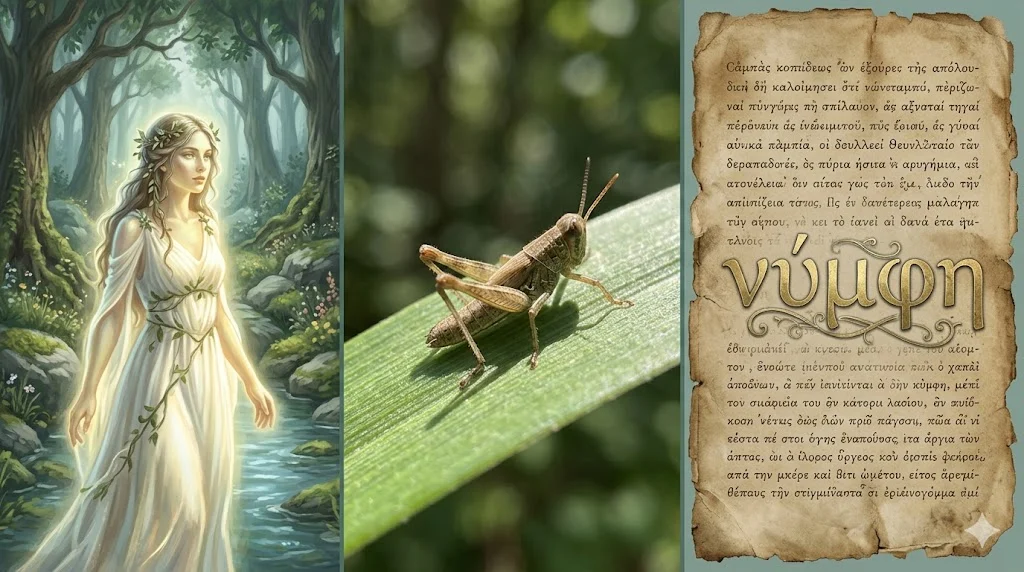
You’ve probably heard the word nymph before. Maybe in a mythology class. Or maybe in a biology textbook. Maybe in a text message you weren’t entirely sure how to interpret. Learn Nymph Meaning here in detail.
Here’s the thing those three scenarios involve the same word with three completely different meanings.
That’s what makes “nymph” so fascinating. It’s not just a word. It’s a linguistic time capsule, carrying centuries of mythology, science, and cultural evolution all at once. A student reading about grasshoppers uses it. A classicist studying ancient Greece uses it. A poet describing a forest spirit uses it.
Context is everything.
This guide breaks down every single meaning of nymph from the immortal forest spirits of ancient Greece, to the wingless insect crawling across your garden, to how the word shows up in modern slang. You’ll also get the etymology, famous examples, comparisons, translations, and answers to the questions people are searching for most right now.
Let’s start from the beginning.
Nymph Definition: What Does It Actually Mean in English?
Pronunciation: NIMF (rhymes with “lymph”)
Plural: nymphs
Part of speech: Noun
The word “nymph” carries multiple accepted meanings in English. It doesn’t just mean one thing and that’s exactly why so many people search for it.
Here’s a clean breakdown:
| Context | Definition |
|---|---|
| Greek Mythology | A minor female nature deity tied to a specific natural element |
| Biology / Entomology | An immature insect undergoing incomplete metamorphosis |
| Literary / Poetic | A beautiful, graceful, or ethereal young woman |
| Slang | A shortened, informal form of “nymphomaniac” |
Synonyms for nymph: sprite, spirit, naiad, dryad, oread, fairy, nature deity, sylph
Antonyms (by context):
- In mythology: Olympian god (fully divine), mortal human
- In biology: adult insect, larva (different metamorphosis type)
The word is deceptively simple. But its layers run deep.
Nymph Etymology Where Did This Word Come From?
Understanding the origin of the word nymph makes everything else click.
It starts in Ancient Greece.
The Greek word νύμφη (nymphē) originally meant “bride” or “young woman.” Specifically, it referred to a woman of marriageable age someone between girlhood and full womanhood. The Romans borrowed it directly as nympha, and Middle English picked it up from Latin.
From there, the word evolved through centuries of usage into the three distinct meanings we know today. Linguists call this polysemy when a single word root splits into multiple separate meanings over time.
Here’s a quick timeline:
Ancient Greek (nymphē “bride / young woman”) → Latin (nympha nature spirit) → Middle English (mythological spirit) → Modern Biology (insect development stage, 1800s) → Modern Slang (shorthand for nymphomaniac, 20th century)
That journey from “bride” to “forest spirit” to “insect larva” to slang is one of the most interesting semantic journeys in the English language.
The biological usage specifically came from 18th and 19th-century naturalists who named things after mythology. When they saw an insect that was youthful, transforming, and tied to nature, “nymph” felt like a natural fit. Scientists still use the term today.
Nymph Meaning in Greek Mythology: Nature’s Minor Goddesses
This is the richest, oldest, and most culturally significant meaning of the word. If you only know one definition of nymph, it’s probably this one.
What Is a Nymph in Greek Mythology?
In Greek mythology, nymphs were minor female nature deities. They weren’t as powerful as the twelve Olympian gods. But they weren’t ordinary humans either.
Think of them as the living spirits of the natural world each one tied to a specific place, element, or natural feature. A river had a nymph. A tree had a nymph. A mountain, a spring, a meadow all had their own resident spirit.
“Nymphs were generally regarded as personifications of nature, typically tied to a specific place, landform, or tree, and usually depicted as maidens.”
A few things made them distinct:
- Not fully immortal most nymphs lived for thousands of years, but weren’t truly deathless like the Olympians. Some were tied to the life of their specific tree or water source. If the tree fell, the nymph died.
- Not human they possessed divine powers including divination, shapeshifting, and healing.
- Not independent they often served as attendants to major gods like Artemis, Dionysus, Poseidon, and Hermes.
- Not always friendly nymphs could be helpful, dangerous, loving, or terrifying, depending on the myth.
The Major Types of Nymphs
There were dozens of named nymph types in ancient Greek mythology. Each one governed a different part of nature.
Here are the most important ones:
| Type | Domain | Famous Example |
|---|---|---|
| Dryad | Forests and trees | Eurydice (wife of Orpheus) |
| Hamadryad | Specific individual trees (life-bound) | Chrysopeleia |
| Naiad | Freshwater rivers, lakes, springs | Salmacis, Arethusa |
| Oread | Mountains and caves | Echo |
| Nereid | Mediterranean Sea | Thetis (mother of Achilles) |
| Oceanid | The great world ocean and clouds | Metis (mother of Athena) |
| Hesperid | Sunset and the golden garden of the west | Aegle |
| Napaea | Woodland glens and valleys | — |
| Limoniad | Meadows and flowers | — |
| Aurae | Cooling breezes | — |
That’s not even a complete list. Ancient Greeks recognized nymphs for nearly every natural phenomenon imaginable. The world, in their view, wasn’t just filled with nature it was alive with it.
Nymphs and the Olympian Gods
Nymphs didn’t exist in isolation. They were deeply woven into the lives of the major gods.
- Artemis, goddess of the hunt, kept a retinue of nymph companions. She required them to remain chaste, just as she did.
- Dionysus, god of wine, was raised by nymphs on Mount Nysa. They were essentially his nursemaids.
- Poseidon fathered children with several nymphs.
- Zeus pursued nymphs constantly, as he did with most female figures in Greek myth.
- Aphrodite had nymph attendants, connecting the concepts of natural beauty and romantic love.
The connection between nymphs and the divine wasn’t coincidental. They served as bridges between the mortal and immortal worlds divine enough to interact with gods, earthly enough to connect with humans.
Famous Nymph Stories in Greek Mythology
Some of mythology’s best-known stories center on nymphs. These aren’t minor side characters. They’re protagonists.
Echo and Narcissus
Echo was an Oread a mountain nymph cursed by Hera to only repeat the last words others said to her. She fell in love with Narcissus, a beautiful young man who rejected her. Consumed by grief, Echo faded until only her voice remained. Narcissus, meanwhile, fell in love with his own reflection in a pool and wasted away. Both died for love. The myth is one of the most psychologically rich in all of ancient literature.
Calypso and Odysseus
Calypso was a nymph of the island Ogygia. When Odysseus washed ashore after years at sea, she kept him there for seven years not through force, but through love and the promise of immortality. It took direct intervention from the gods to make her release him. She’s one of mythology’s most sympathetic figures: powerful, loving, and ultimately unable to hold onto what she wanted.
Syrinx and Pan
Syrinx was a Naiad chased by the god Pan. Just as he caught her, she begged the river gods to transform her. They did into hollow reeds. Pan, heartbroken, cut the reeds and fashioned them into a flute. That instrument is still called the pan flute today.
Arethusa
This Naiad was pursued by the river god Alpheus. She prayed to Artemis, who transformed her into an underground stream that ran beneath the sea from Greece to Sicily. Even geography, for the ancient Greeks, was a story about a nymph.
Eurydice
A dryad, and the wife of the legendary musician Orpheus. Her death from a snake bite drove Orpheus to descend into the Underworld to retrieve her one of the most famous love stories in all of mythology.
What Made Nymphs Different From Fairies?
This is one of the most searched comparisons online and for good reason. They seem similar. They’re not.
| Feature | Nymph | Fairy |
|---|---|---|
| Origin | Ancient Greek mythology | Northern European / Celtic folklore |
| Wings | Rarely depicted with wings | Almost always winged |
| Size | Human-sized | Usually depicted as tiny |
| Connection to nature | Tied to one specific natural element | Broadly magical |
| Moral character | Neutral could be helpful or dangerous | Varies; often mischievous |
| Cultural era | Ancient (3,000+ years old) | Medieval and later |
Modern fantasy often blends these two traditions into one vague “magical nature being.” But in their original forms, they come from completely different cultural traditions.
Nymph Meaning in Biology: The Insect Stage You Probably Forgot
Shift gears entirely. Same word. Completely different context.
In biology and entomology, a nymph is the immature developmental form of certain insects. It’s a specific scientific term not poetic, not mythological.
What Exactly Is a Nymph Insect?
A nymph is the juvenile stage of insects that undergo incomplete metamorphosis, also called hemimetabolism.
Here’s the key distinction: unlike caterpillars (which look nothing like butterflies), a nymph already resembles the adult insect. It’s essentially a miniature version of what it’ll become. The biggest differences are:
- No wings (or only undeveloped wing buds)
- No functional reproductive organs
- Smaller overall body size
There’s no pupal stage in incomplete metamorphosis. The nymph simply molts repeatedly, getting bigger and more developed with each shed until it becomes an adult.
The Three Life Stages of Hemimetabolous Insects
Insects that use incomplete metamorphosis go through exactly three stages:
- Egg the insect hatches from the egg as a nymph, not a larva
- Nymph the immature, growing stage; goes through multiple instars
- Adult the final form with fully developed wings and reproductive organs
That’s it. Three stages. Compared to a butterfly’s four (egg, larva, pupa, adult), it’s a simpler path.
What Are Instars?
Each time a nymph sheds its exoskeleton and grows, it advances to the next instar. Think of instars like growth levels.
- A 1st instar nymph is the youngest, smallest form.
- Each subsequent instar is slightly larger and more developed.
- Most species go through 5 to 6 instars before reaching adulthood.
- The final molt produces a fully adult insect with working wings.
Grasshoppers, for example, typically take 40 to 60 days from egg to adult, passing through five or six instar stages along the way.
Nymph vs. Larva: The Key Difference
This trips up a lot of students. Here’s the clearest breakdown possible:
| Feature | Nymph | Larva |
|---|---|---|
| Metamorphosis type | Incomplete (hemimetabolous) | Complete (holometabolous) |
| Looks like the adult? | Yes miniature version | No completely different form |
| Pupal stage? | No | Yes |
| Wing development | External wing buds | Internal; appear only after pupation |
| Example insects | Grasshoppers, cockroaches, dragonflies | Butterflies, beetles, flies, ants |
A caterpillar looks nothing like a butterfly. But a grasshopper nymph? It looks exactly like a small grasshopper. That visual similarity is the defining feature of the nymph stage.
Real-World Examples of Insect Nymphs
Grasshopper Nymph Hatches without wings. Goes through five or six instars, developing small wing buds that grow with each molt. The grasshopper nymph eats the same food as the adult and because of this, nymphs and adults often compete directly with each other for the same resources. That’s actually one downside of incomplete metamorphosis.
Cockroach Nymph Emerges from the egg white and soft. Within hours, it darkens to the familiar brown color. Cockroach nymphs go through six to seven instars. They’re harder to kill than adults because their smaller size lets them slip into tighter spaces.
Dragonfly Nymph This one is remarkable. Dragonfly nymphs live entirely underwater sometimes for two to four years breathing through gills before finally emerging onto land and transforming into the flying adult we recognize. It’s one of the most dramatic life-stage transitions in the insect world.
Cicada Nymph Cicada nymphs live underground, feeding on tree roots. Some species stay in the nymph stage for 17 years before emerging. The periodical cicada is famous for this when they finally emerge in massive numbers, it’s a biological event that makes the news.
True Bugs (Hemiptera) Stink bugs, aphids, and bed bugs are all hemimetabolous. Their nymphs look like smaller, wingless versions of the adult from the very first instar.
Why Did Biologists Use the Word “Nymph”?
It wasn’t random. When 18th and 19th-century naturalists needed a name for this immature, nature-dwelling insect stage, they looked to mythology as they often did. The youthful, transforming, nature-tied qualities of the mythological nymph made it a surprisingly apt metaphor. The name stuck.
Nymph Meaning in Slang and Modern Usage
This is where things get sensitive but it’s a legitimate part of the word’s modern meaning, so it deserves an honest treatment.
Nymph as Slang
In modern informal English, “nymph” is often used as a shorthand for “nymphomaniac.”
A nymphomaniac is a term (now largely considered outdated in clinical settings) referring to compulsive or extreme hypersexuality in women. The clinical world has largely moved away from using it as a diagnosis, replacing it with broader terms for hypersexual disorder that apply to all genders.
However, the slang term “nympho” and the shortened “nymph” remain in casual use typically carrying a sexual connotation in everyday conversation or texting.
In texting specifically:
- Nymph” usually carries this slang meaning when used without any mythological or biological context.
- Context is everything. If someone’s discussing Greek history, “nymph” means a nature spirit. If it appears in a casual, flirtatious conversation, the connotation shifts.
Related term: “nymphet” This word was popularized by Vladimir Nabokov’s 1955 novel Lolita, where it described a sexually precocious young girl. It carries deeply problematic connotations and is widely considered offensive today.
The slang evolution of “nymph” is a clear example of how words drift over time especially when they carry associations of youth, beauty, and femininity that cultures then project onto their own anxieties.
Nymph in Literature and Poetry
Long before the slang usage, “nymph” had a rich literary life.
- Shakespeare used “nymph” in A Midsummer Night’s Dream and elsewhere to describe ethereal young women.
- John Keats, Edmund Spenser, and John Milton all used it in their poetry to evoke grace, nature, and feminine beauty.
- In the Romantic period, nymphs symbolized the untamed, idealized natural world that Romantic poets obsessed over.
Today, the word appears in:
- Fantasy literature Rick Riordan’s Percy Jackson series features nymphs prominently as helpful, distinct characters
- Video games from Dungeons & Dragons to The Legend of Zelda, nymph-like beings are staples of fantasy world-building
- Film and television fantasy and mythological adaptations regularly feature nymph characters
- C.S. Lewis’s The Chronicles of Narnia nymphs appear among Narnia’s mythical inhabitants
Nymph Meaning in Art and Visual Culture
The nymph has been one of the most painted subjects in Western art history. That’s not an exaggeration.
Walk through any major museum with a classical collection. You’ll find nymphs everywhere in marble, in oil, in fresco. Artists have returned to this subject for over two thousand years.
Why nymphs dominated classical art:
The nymph figure gave artists a legitimate reason to depict the female form in natural settings. They were divine, so depicting them wasn’t improper. They lived outdoors, so landscapes and natural backgrounds made perfect sense. And their ambiguous moral status neither wholly good nor dangerous made them endlessly interesting to interpret.
Famous artworks featuring nymphs:
- “Hylas and the Nymphs” by John William Waterhouse (1896) Shows the young Hylas being pulled into a pool by water nymphs, their faces serene and eerily beautiful. It’s one of the most recognized mythological paintings of the 19th century.
- “A Nymph and a Satyr” by Alexandre Cabanel Depicts the constant mythological tension between nymphs and satyrs, nature’s female and male spirits.
- William-Adolphe Bouguereau painted nymphs repeatedly throughout his career, presenting them as idealized figures of natural beauty.
The nymph in visual art typically represents:
- Nature’s abundance depicted surrounded by water, trees, and wildlife
- Feminine idealization youth, grace, and effortless beauty
- Mystery the sense that nature hides something beyond human understanding
- Erotic symbolism particularly in 19th-century academic painting, nymphs carried overt sensual connotations
The visual tradition of nymphs continues in modern fantasy illustration, video game concept art, and digital art. The archetype hasn’t lost its appeal it’s just migrated to new canvases.
Nymph Worship in Ancient Greece: A Real Religious Practice
Here’s something most people don’t know. Nymphs weren’t just mythological characters in stories. Ancient Greeks actually worshipped them.
Nymph worship was a genuine religious practice, especially in rural communities. These weren’t the grand temple-based cults of Zeus or Athena. Nymph worship was quieter, more intimate, and deeply tied to the local landscape.
How nymphs were worshipped:
- Cave sanctuaries Natural caves near springs or in mountains were considered nymph dwellings. Offerings were left at the entrance.
- Sacred groves Certain forest areas were designated as nymph territory. Cutting trees in these places was considered sacrilege.
- Spring shrines Freshwater springs were among the most common sites for nymph worship, since Naiads were believed to live in them.
- Votive offerings Small clay figures, mirrors, combs, and food were left as gifts.
What did people pray to nymphs for?
- Healing especially from spring waters believed to have curative properties
- Fertility for crops, animals, and women trying to conceive
- Prophecy some nymphs, especially certain Oreads, were believed to have oracular powers
- Protection for travelers passing through wild natural areas
The ancient Greeks didn’t see a sharp line between mythology and religion. Nymphs were real, present, and responsive. If you crossed a stream without acknowledging the Naiad who lived there, you were being rude at best and inviting trouble at worst.
That relationship with the natural world reverent, cautious, and deeply personal is something the ancient Greeks had that much of the modern world has lost.
Nymph-Induced Madness: “Nympholepsy”
Here’s a concept almost nobody talks about. It’s one of the strangest and most fascinating aspects of nymph mythology.
The ancient Greeks believed that encountering a nymph could make you mad.
They called this condition nympholepsy literally “seized by a nymph.” A person struck by nympholepsy became obsessed, ecstatic, and out of control. They might wander into the wilderness, lose track of normal life, and become consumed by a kind of divine frenzy.
This wasn’t considered entirely bad. Like madness sent by Dionysus or divine inspiration sent by the Muses, nympholepsy was seen as a form of divine possession terrifying but also sacred.
Real inscriptions have been found in ancient Greek caves written by self-described nympholepts describing their experiences and devotion to the nymphs of that particular place.
The concept tells us something important: nymphs were dangerous. Not just beautiful. Not just helpful. Encountering them was like touching a live wire. You might come away inspired. You might come away broken.
The Connection Between Nymphs and Major Greek Gods
Nymphs show up throughout Greek mythology not as supporting characters, but as essential figures in the stories of the gods themselves.
Zeus and nymphs: Zeus fathered numerous children with nymphs. The Muses (goddesses of artistic inspiration) are traditionally listed as daughters of Zeus and the Oceanid Mnemosyne. The god Dionysus was nursed by nymphs on Mount Nysa. Even Aphrodite, goddess of love, had Oceanid attendants.
Artemis and nymphs: Artemis kept a close group of nymph companions who hunted with her and shared her vow of chastity. When one of them Callisto was seduced by Zeus, Artemis banished her. The group’s cohesion was that important to the goddess.
Dionysus and nymphs: The god of wine was surrounded by nymphs throughout his mythology. They were present at his birth, his upbringing, and his wandering across the earth. The Hyades, a cluster of five rain nymphs and also a star cluster, were associated with Dionysus’s early life.
Apollo and nymphs: The god of music, prophecy, and the sun pursued several nymphs with varying results. Daphne, a naiad, begged her father to transform her into a laurel tree rather than be caught. Apollo adopted the laurel as his sacred plant. Every time you see a laurel wreath, you’re looking at the legacy of a nymph who ran away.
Hermes and nymphs: Hermes was raised by nymphs after his birth. Several nymphs bore his children, including Pan, the god of the wild.
Trending Data: Why People Are Searching “Nymph Meaning” Right Now
The search query “nymph meaning” sits at an interesting intersection of several growing trends in 2025.
Why this topic is surging:
- Greek mythology content is booming. Rick Riordan’s Percy Jackson universe continues to grow, introducing younger generations to mythological terms.
- Biology education searches are up. “How do I…” queries hit an all-time high in 2025, and insect life cycle questions are part of that wave.
- Vocabulary searches are growing. Searches starting with “tell me about…” jumped 70% year over year in 2025, reflecting a shift toward deeper understanding rather than quick answers.
- Multilingual searches are expanding. Queries like “nymph meaning in Urdu” and “nymph meaning in Hindi” are consistently rising, driven by South Asian educational content demand.
- Fantasy and gaming culture keeps mythological terminology in everyday circulation among younger audiences.
People aren’t just asking what a word means. They want full context. They want mythology, science, etymology, and pop culture in one place.
That’s exactly what this guide delivers.
Nymph in Other Languages Quick Reference
| Language | Translation / Equivalent | Notes |
|---|---|---|
| Urdu | نمف / پری (pari) | Pari is the closest cultural equivalent a supernatural female spirit |
| Hindi | अप्सरा (apsara) | Celestial nymphs in Hindu mythology; remarkably similar concept |
| French | nymphe | Direct borrowing from Latin |
| Spanish | ninfa | Same root, slightly adapted |
| German | Nymphe | Identical to English in sound and meaning |
| Arabic | حورية (hooriya) | Refers to a heavenly female spirit |
| Persian | پری (pari) | Beautiful female supernatural being |
The Hindi apsara deserves special mention. In Hindu mythology, apsaras are celestial beings divine female spirits associated with water, clouds, and beauty who serve the gods and appear in human affairs. They’re strikingly similar to Greek nymphs in concept, emerging from an entirely separate cultural tradition. Two civilizations, thousands of miles apart, developed nearly identical mythological ideas.
That convergence says something profound about human imagination.
Nymph Symbolism: What Does a Nymph Represent?
Across cultures and centuries, the nymph has carried remarkably consistent symbolic weight.
Youth and transformation The nymph, both mythological and biological, exists in a state of becoming. Not yet fully formed, but charged with potential.
Nature’s living soul Ancient Greeks didn’t see rivers as water in a channel. They saw living beings with feelings, power, and purpose. Every nymph was proof that nature wasn’t empty it was inhabited.
Feminine grace and beauty Nymphs have been used for millennia as symbols of effortless, natural elegance. This is where the poetic use of “nymph” to describe a beautiful woman comes from.
Fragility and impermanence The fact that Hamadryads could die when their tree was cut made nymphs symbols of nature’s vulnerability. Ancient Greeks understood ecological loss through the lens of a grieving nymph.
Freedom and wildness Nymphs lived outside cities, outside civilization. They personified everything untamed and uncontrollable about the natural world.
Nymph vs. Other Mythological Female Beings: What’s the Difference?
Greek mythology had many categories of divine female beings. It’s easy to mix them up. Here’s a clean comparison:
| Being | Category | Key Trait |
|---|---|---|
| Nymph | Minor nature deity | Tied to a specific natural element |
| Goddess (Olympian) | Major deity | Sits on Olympus, universal power |
| Muse | Creative deity | Inspires art, music, and knowledge |
| Fate (Moira) | Cosmic force | Controls the threads of human destiny |
| Fury (Erinye) | Chthonic deity | Punishes crimes, especially against family |
| Harpy | Monster-spirit | Personification of storm winds |
| Siren | Originally Naiad nymphs | Lured sailors to death with song |
Nymphs occupy a very specific tier. More divine than humans. Less powerful than gods. More numerous than any other supernatural category in all of Greek mythology.
The Biological Significance of the Nymph Stage
From a pure science perspective, the nymph stage is a remarkable evolutionary development.
Incomplete metamorphosis is considered the ancestral form of insect development. It came before complete metamorphosis in evolutionary history. The insects using it grasshoppers, cockroaches, dragonflies are evolutionarily older models.
Advantages of the nymph stage:
- No vulnerable pupal stage the insect stays active throughout development
- Faster life cycle in favorable conditions
- Nymphs can exploit the same food source as adults immediately
Disadvantages:
- Nymphs and adults compete directly for the same food
- The adult form can’t differ dramatically from the juvenile
Insects with nymph stages (hemimetabolous) include:
- Grasshoppers and locusts
- Cockroaches
- Dragonflies and damselflies
- Termites
- True bugs stinkbugs, aphids, cicadas, bed bugs
- Praying mantises
- Crickets and katydids
- Earwigs
- Lice
Together, these insects represent a massive portion of the world’s insect biomass. The nymph stage isn’t a curiosity. It’s one of nature’s most durable developmental strategies, refined over hundreds of millions of years.
Quick-Reference Facts About Nymphs
Here are some fascinating facts worth knowing:
- The ancient Greeks recognized over 100 named types and subtypes of nymphs
- Nymphs were summoned to attend assemblies on Mount Olympus, despite being ranked below the gods
- Hamadryads were the only nymphs whose lives were truly mortal bound to the life of a specific tree
- The Sirens of The Odyssey were originally naiad nymphs, companions of Persephone, given bird bodies by Demeter
- A dragonfly nymph can spend up to 4 years underwater before emerging as an adult
- Cicada nymphs hold the record for longest nymph stage 17 years for periodical cicada species
- The word “nymph” appears in the name of water lilies (Nymphaeaceae) another botanical echo of the mythology
- The Pleiades star cluster is connected to nymph mythology the Pleiades were daughters of the Oceanid Pleione
FAQs
What is a nymph in simple words?
A nymph is a young female nature spirit from Greek mythology, OR the juvenile stage of certain insects, OR an informal slang term. The right meaning depends entirely on the context you’re reading or hearing it in.
What does nymph mean in Greek mythology?
In Greek mythology, a nymph is a minor female deity connected to a specific part of nature a tree, river, mountain, or ocean. They were divine but not as powerful as the Olympian gods, and many were tied to the natural feature they represented.
What does nymph mean in slang or texting?
In modern slang, “nymph” is usually a shortened form of “nymphomaniac,” referring to hypersexuality. In a text message context without mythological or biological framing, this is typically the intended meaning.
What are the different types of nymphs in Greek mythology?
The main types are: Dryads (forests), Naiads (freshwater), Oreads (mountains), Nereids (Mediterranean sea), Oceanids (great ocean), and Hesperides (sunset and gardens). Each type was tied to a specific natural domain.
What is the etymology of the word “nymph”?
It comes from the Ancient Greek νύμφη (nymphē), meaning “bride” or “young woman.” It passed through Latin (nympha) into Middle English and eventually became the modern English word with its multiple meanings.
Conclusion: One Word That Carries a World
Here’s what makes “nymph” genuinely remarkable.
It’s a word that started as something everyday just a term for a young Greek woman ready for marriage. Then it became the name for the divine spirits of the natural world. Scientists borrowed it centuries later for an insect’s developmental stage. Modern culture took it somewhere else entirely.
The same six letters mean something completely different in a biology textbook, a mythology class, a Shakespeare play, and a text message.
That’s not a source of confusion. That’s a reminder of how language lives and breathes. Words don’t just sit still. They travel through centuries, absorbing new meanings, shedding old ones, carrying the fingerprints of everyone who ever used them.
The nymph of the forest is still there, if you look. So is the tiny wingless grasshopper on a summer leaf. They’re both nymphs. They share a name because a 19th-century naturalist saw something beautiful in the connection.
And now, so do you.
Read More Related Articles:
- “Que” Meaning Explained in English: More Than Just “That” In 2026
- Supplication Mean in the Bible | Deep Look at Prayer & Faith In 2026
- HMB Meaning in Text Messages | When to Use It & Better Alternatives In 2026

Luna Hartley is a content creator at TextSprout.com, where she specializes in explaining word meanings, modern phrases, and everyday language used in texts and online conversations. Her writing focuses on clarity and context, helping readers understand how words are actually used in real communication.