
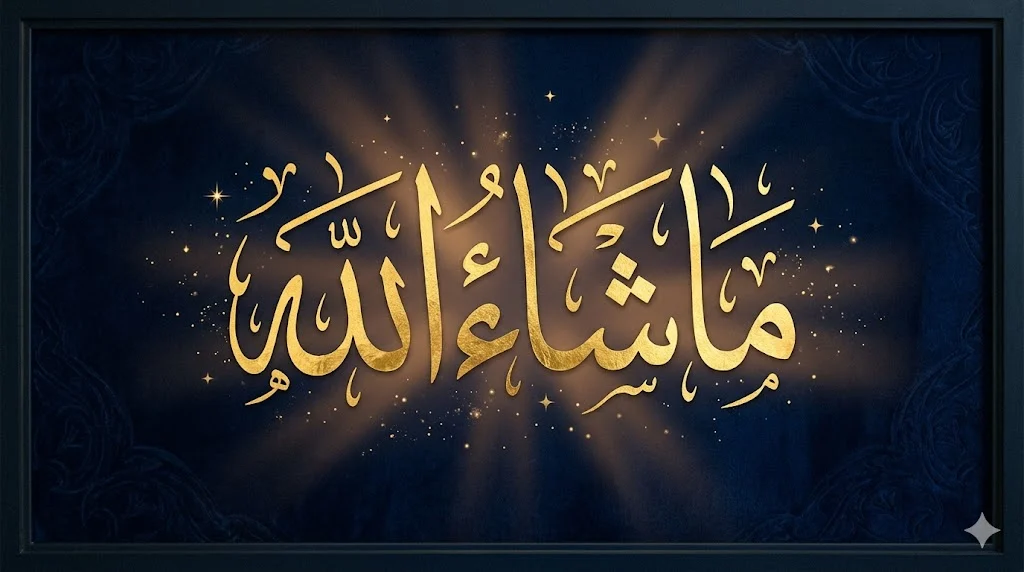
You just saw something beautiful. A friend’s newborn baby. A perfect sunset. Someone’s new home. Your immediate reaction? “Wow.” It is best space to know more about Mashallah Meaning.
But for over 1.8 billion Muslims worldwide, one word replaces that “wow.” That word is Mashallah.
It sounds simple. But this small Arabic phrase carries massive weight. It praises, protects and humbles. And most people even some who say it daily don’t fully understand how it works.
Let’s fix that.
By the end of this guide, you’ll know the exact Mashallah meaning, when to say it, when not to say it, and why it’s way more powerful than just saying “nice job.”
Quick Reference Table
Before we dive deep, here’s your cheat sheet.
| Question | Short Answer |
|---|---|
| Literal Mashallah meaning | “God has willed it” |
| Primary use | Admiration + protection from evil eye |
| When to say it | After seeing or hearing something good |
| Tense in Arabic | Past (what already happened) |
| Opposite phrase | Inshallah (future hope) |
| Can non-Muslims say it? | Yes, respectfully |
| Common misspelling | Mashalla, Mashaallah |
Keep this table handy. You’ll see these ideas unpacked below.
What Does Mashallah Mean? The Simple Definition
Let’s start with the Mashallah meaning in plain English.
The phrase breaks down into three parts:
- Ma – “What” or “that which”
- Sha’a – “He willed” (from the root letters ش ي أ)
- Allah – God
Put together: “What God has willed.”
That’s the literal translation. But the real meaning of Mashallah in English goes deeper. It’s an acknowledgment. You’re saying, “This good thing exists because God wanted it to exist. Not because of luck. Not because of my skill alone.”
That shift matters.
When you say Mashallah, you redirect praise away from yourself or the person you’re admiring. You point it upward. That’s humility in four syllables.
Mashallah Meaning in Islam: More Than Just Words
In Islamic theology, words carry spiritual weight. Mashallah isn’t a casual “cool.” It’s a protective affirmation.
Here’s why.
The Evil Eye Concept
Islam teaches that excessive admiration or envy can harm the person or thing being admired. This isn’t superstition. It’s a recognized spiritual reality called al-‘ayn (the evil eye).
The Prophet Muhammad said: “The evil eye is real. If anything could overtake destiny, it would be the evil eye.” (Sahih Muslim)
So how do you prevent that harm?
You say Mashallah.
By saying “God willed it,” you remind yourself and others that the beauty or success came from God. You neutralize envy before it takes root. You place a spiritual shield around the thing you just praised.
That’s the core Mashallah meaning in Islam. Praise + protection. One word, two jobs.
When to Say Mashallah: Real-Life Scenarios
Knowing the definition is one thing. Using it naturally is another.
Here’s a practical breakdown of when to say Mashallah in daily life.
After Seeing Something Beautiful
- A newborn baby
- A bride on her wedding day
- A well-decorated home
- A field of flowers
- Someone’s weight loss progress
After Hearing Good News
- “I got the promotion.”
- “My father recovered from surgery.”
- “We just bought our first house.”
- “My son memorized five chapters of the Quran.”
When You Admire Your Own Possessions
This one surprises people. You can say Mashallah about your own things.
Got a new car? Say Mashallah.
Look in the mirror and feel good? Say Mashallah.
Why? Because even your own pride can attract envy or bring bad luck if you don’t acknowledge God’s role. Humble yourself. Protect your blessings.
When You See Something Impressive in Nature
A mountain range. A lightning storm. A quiet lake at dawn. Nature’s beauty isn’t random. Saying Mashallah turns a scenic view into a moment of gratitude.
When Not to Say Mashallah
Just as important as knowing when to say it is knowing when to avoid it.
Don’t say Mashallah for:
- Bad news or tragedy (say Inna lillahi wa inna ilayhi raji’un instead)
- Something sinful or harmful
- Future hopes (that’s Inshallah territory)
Example of wrong use:
“I might get that job tomorrow. Mashallah.”
No. That should be Inshallah (“if God wills it”).
Mashallah looks backward. Inshallah looks forward. Mix them up, and you confuse the whole meaning.
Mashallah vs Inshallah vs Barakallah: Stop Confusing Them
This is the #1 mistake people make. Let’s settle it with a clear table.
| Phrase | Tense | Meaning | When to Use |
|---|---|---|---|
| Mashallah | Past | God willed it | After something good happens |
| Inshallah | Future | If God wills it | Before something you hope will happen |
| Barakallah | Present blessing | May God bless you/this | After praising someone (adds extra blessing) |
| Alhamdulillah | Present praise | All praise to God | General gratitude anytime |
Real-Life Dialogue Example
Ahmed: “I’m starting a small bakery next month.”
You: “Inshallah it succeeds.”
(One month later)
Ahmed: “We opened last week. Sold out every day.”
You: “Mashallah! That’s amazing. Barakallah fi your business.”
See the flow? Future hope. Then past acknowledgment. Then an added blessing. Three phrases. One smooth conversation.
The Correct Spelling of Mashallah
You’ll see this phrase written multiple ways. Which one is right?
Correct spellings:
- Mashallah (most common in English)
- Masha’Allah (with an apostrophe for the glottal stop)
- Ma sha Allah (spaced out)
Incorrect spellings:
- Mashalla (missing the second ‘h’)
- Mashaallah (double ‘a’ after sh is non-standard)
- Mash’Allah (missing the ‘a’ after sh)
The correct spelling of Mashallah in Arabic is: مَا شَاءَ ٱللَّٰهُ
Pronunciation tip for English speakers:
Say Ma (like “father” but shorter). Then sha (like “shut” without the ‘t’). Then LLAH (stress this part. Strong ‘L’ sound. Soft ‘ah’ at the end).
Not “mash” like mashed potatoes. And not “muh-shalla.”
Ma-sha-LLAH.
Mashallah Meaning for Non-Muslims: A Simple Guide
If you’re not Muslim, you might feel awkward using this phrase. Don’t worry. Here’s what you need to know.
Can you say it?
Yes. Arabic phrases belong to the language, not just one religion. Many Arab Christians say Mashallah too.
When should you say it?
When you genuinely admire something related to a Muslim friend or context. Their new baby, home and achievement.
What to avoid:
Don’t use it as a trend. Saying Mashallah over every Instagram food photo looks performative. Use it with meaning, not as a hashtag.
Example of respectful use:
Your Muslim coworker shows you their wedding photo. You say: “Mashallah, you both look so happy.”
That lands well. It shows cultural awareness. It shows respect.
Cultural vs Religious Use: Important Nuance
Here’s where things get interesting.
The Mashallah meaning shifts slightly depending on where you are.
Religious Use (Global Islam)
- Acknowledges divine will
- Protects from evil eye
- Expresses humility before God
Cultural Use (Region-Specific)
Arab countries: Almost like saying “wow” + “God bless it.” Very common. Very casual.
South Asia (Pakistan, India, Bangladesh): Extremely common. Often said reflexively after any compliment. “Mashallah, beta, you look so thin now.”
Turkey: Maşallah (spelled with a ‘ş’). Used the same way. Very protective. Parents say it constantly over children.
Indonesia & Malaysia: Less intense but still present. Often combined with local phrases.
Bosnia & Albania: European Muslims use it too. A quiet Mashallah after seeing something beautiful crosses cultures easily.
The core stays the same. The flavor changes slightly. But everywhere, it means admiration + protection.
Linguistic Breakdown for Curious Readers
Want to get nerdy? Let’s go.
Tokenization in Arabic
Arabic writes Mashallah as three separate words smashed together in script:
- ما (Ma)
- شاء (Sha’a)
- الله (Allah)
But in English transliteration, we write it as one word or two.
Morphological Structure
- Ma – A relative pronoun. Connects the action to its cause.
- Sha’a – Past tense verb. Third person masculine singular. Root letters: ش ي أ. These letters appear in words related to “will,” “want,” or “thing.”
- Allah – The divine name. Never changes form.
Collocation Example
In linguistics, collocation means words that naturally pair together. Mashallah almost always appears next to:
- Nouns of beauty (baby, garden, face, home)
- Success nouns (job, grade, business, marriage)
- Nature nouns (moon, sky, tree, river)
You rarely hear Mashallah next to neutral or negative nouns. That would feel strange.
Word Sense Disambiguation
Here’s a cool fact. Without context, Mashallah could mean two things:
- Simple praise (“Wow, nice car.”)
- Praise + protection (“Wow, nice car, and may no harm come to it.”)
Context tells you which one. In Muslim communities, it’s almost always #2. In non-Muslim contexts, it might be just #1.
That’s word sense disambiguation in action. Same phrase. Different meaning. Context decides.
5 Real Sentences Using Mashallah
Need examples for your own writing or speech? Here are five clean sentences.
- Mashallah, your daughter memorized the entire Quran at age ten.
- I saw your new shop’s interior design. Mashallah. So clean and inviting.
- They whispered Mashallah when the baby took her first unsteady step.
- Even the taxi driver said Mashallah when he saw the bride’s dress.
- You lost twenty kilograms? Mashallah. That took real discipline.
Notice how each sentence pairs Mashallah with a specific good thing. No vagueness. No filler.
Busting 3 Common Myths About Mashallah
Let’s kill some misinformation.
Myth 1: “Mashallah brings good luck.”
Truth: No. That’s not the Mashallah meaning at all. The phrase acknowledges good that already exists. It doesn’t summon future luck. Luck isn’t even an Islamic concept. God’s will replaces luck.
Myth 2: “Only Arabs say it.”
Truth: Indonesian, Turkish, Bosnian, Indian, Pakistani, Bangladeshi, Malaysian, Nigerian, and Albanian Muslims use it daily. Many non-Arab Muslims have never spoken a full sentence in Arabic but say Mashallah instinctively. It’s a pan-Islamic phrase, not an ethnic one.
Myth 3: “You say Mashallah when you want something.”
Truth: That’s Inshallah. Huge difference.
Mashallah = past. Already happened.
Inshallah = future. Hope to happen.
Mix them up and you sound confused, not spiritual.
Protection from Evil Eye: How Mashallah Acts as a Shield
Let me give you a concrete analogy.
Imagine you have a beautiful garden. You invite a friend over. Your friend says, “Wow, I’ve never seen such perfect roses.”
That’s a compliment. Feels good, right?
But in Islamic belief, that compliment if said without Mashallah carries a hidden risk. The admirer’s strong emotion (even positive envy) can unintentionally harm your garden. Leaves wilt. Pests appear. Color fades.
Sounds strange to a modern ear. But millions of Muslims have witnessed this pattern across centuries.
Now imagine the same friend says: “Mashallah, what a beautiful garden.”
That tiny addition changes everything. You’ve now acknowledged God as the source and deflected any hidden envy. You’ve placed a verbal shield around those roses.
That’s the Mashallah meaning in action. Not magic. But a real spiritual practice with real psychological effects too. When people believe something protects them they act differently. They worry less. They enjoy more.
Mashallah in Urdu Meaning and South Asian Context
Since you asked for Mashallah in Urdu meaning, here’s the breakdown.
Urdu speakers (Pakistan, India) use the same Arabic phrase. The Mashallah meaning in Urdu is identical: “جو اللہ نے چاہا” (Jo Allah ne chaha – What God willed).
But culturally, South Asians add extra flavor.
- Parents say Mashallah constantly over children. Exams? Mashallah. Marriage? Mashallah. First job? Mashallah.
- It’s common to write “Mashallah” on social media bios, car bumpers, and shop signs.
- Some families say it after every compliment, almost like punctuation.
One unique South Asian practice: saying Mashallah after a sneeze? No. That’s Alhamdulillah. Don’t mix them.
The Difference Between Mashallah and Tabarakallah
Here’s a bonus comparison few articles include.
Tabarakallah (تَبَارَكَ ٱللَّٰهُ) means “Blessed is God.” It’s a stronger, more intense version of praise.
| Phrase | Intensity | Usage |
|---|---|---|
| Mashallah | Moderate | Everyday praise + protection |
| Tabarakallah | High | Awe-inspiring beauty or power |
Example:
You see a normal nice car. Mashallah.
You see a million-dollar hypercar that defies logic. Tabarakallah.
Both work. Tabarakallah just cranks up the reverence.
10 Quick Facts About Mashallah
- Mashallah appears in the Quran indirectly through the concept of divine will.
- The phrase predates Islam. Arab Christians and Jews used similar constructions.
- You don’t have to say it aloud. Whispering counts.
- Forgetting to say it isn’t a sin. But some cultures consider it careless.
- You can say Mashallah to yourself in the mirror without arrogance.
- The evil eye affects adults, children, animals, and even plants in traditional belief.
- Some Muslims say Mashallah before cutting their child’s hair for the first time.
- In parts of North Africa, they add Mashallah before starting a long car trip.
- The phrase appears in Turkish pop songs, Indonesian dramas, and British Muslim comedy sketches.
- Non-Muslim Arabic speakers in Lebanon, Syria, and Palestine use it as a casual “wow.”
FAQs:
1. What does Mashallah mean in English?
It means “What God has willed.” It expresses admiration for something good while acknowledging God as the source.
2. When should you say Mashallah?
Say it immediately after seeing or hearing something beautiful, impressive, or positive. A baby, a new home, a promotion, a sunset.
3. Can I say Mashallah for myself?
Yes. Look at your own success or appearance and say Mashallah to stay humble and protect your blessings.
4. What’s the difference between Mashallah and Inshallah?
Mashallah = past (God willed it).
Inshallah = future (if God wills it).
One looks back. One looks forward.
5. Is Mashallah only for Muslims?
No. Non-Muslims can say it respectfully. Arab Christians use it. But don’t treat it as a trend or meme.
6. How do you write Mashallah correctly?
Common correct forms: Mashallah, Masha’Allah, Ma sha Allah. Avoid “Mashalla” (missing the second ‘h’).
7. What does Mashallah protect from?
It protects from al-‘ayn (the evil eye) harm caused by envy or excessive admiration.
8. Do I have to say Mashallah out loud?
No. A quiet whisper or even a sincere mental acknowledgment works. God knows your intention.
Conclusion:
You now know the full Mashallah meaning. Not just a dictionary definition. But the cultural weight. The spiritual protection. The everyday usage.
Here’s the bottom line.
Mashallah isn’t decoration. It isn’t a good luck charm. And it’s definitely not just “cool” in Arabic.
It’s a past-tense acknowledgment of divine will wrapped inside a protective shield against envy. You say it to stay humble and keep blessings safe. You say it to redirect praise where it belongs.
Next time you see something beautiful a child laughing, a friend succeeding, a sky on fire don’t just say “wow.”
Say Mashallah. Mean it. And watch how one small word changes your perspective.
Read More Related Articles:
- Open Interest Mean in Options: How It Impacts Options Trading In 2026
- What Does Evergreen Mean in Business: Long-Term Growth Explained In 2026
- GPT Meaning in Chat GPT: What the Letters Actually Stand In 2026

Ivy Madison is a content creator at TextSprout.com, specializing in word definitions, internet slang, acronyms, and text abbreviations. She delivers clear and engaging explanations, helping readers quickly understand modern digital language and trending terms.