
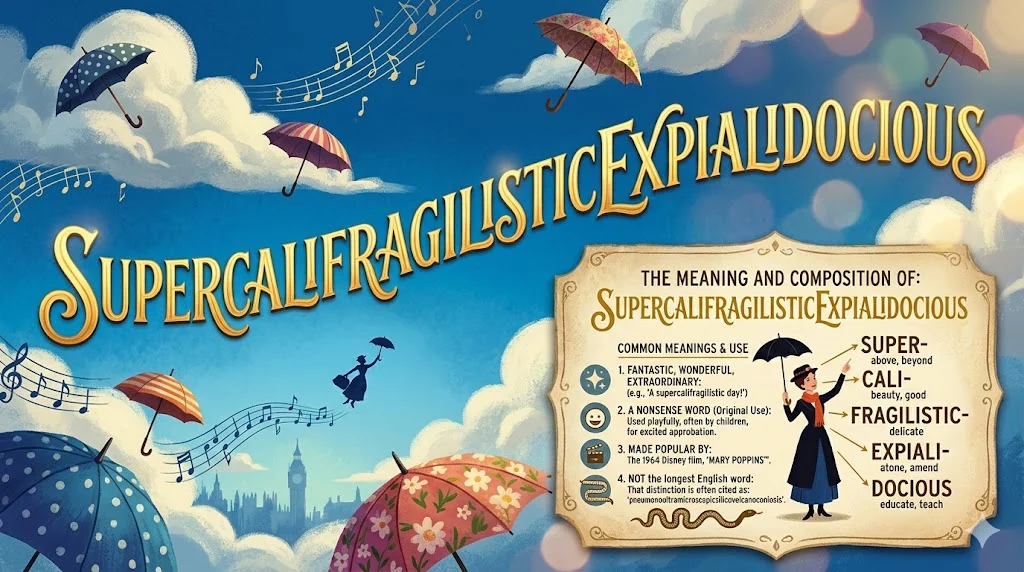
You’ve probably tried to say it. You may have tried to spell it. And there’s a solid chance you’ve been doing both wrong your whole life. Supercalifragilisticexpialidocious Meaning is one of those rare words that almost everyone has heard but almost nobody can actually explain.
It’s not just a tongue twister. It’s not just a silly song from a Disney movie. It carries a real meaning, a surprisingly rich history, a contested origin story, and a permanent place in the English language.
This guide covers everything from the simple plain-English definition to the morphological breakdown, the copyright lawsuit nobody talks about, the correct pronunciation, translation into Urdu and Hindi, and why this word still matters in 2026.
Let’s get into it.
What Does Supercalifragilisticexpialidocious Mean?
Let’s answer the big question first.
Supercalifragilisticexpialidocious means something extraordinarily wonderful. It’s used as an exclamation a verbal outburst of pure joy when something is so magnificent that ordinary words feel completely inadequate.
Think of it as the ultimate verbal shrug wrapped in 34 letters. When you’re speechless with delight, this word steps in.
The film Mary Poppins (1964) put it beautifully. According to the song, it’s “something to say when you have nothing to say.” That’s actually the most accurate definition of all. It’s not a describing word so much as a feeling-word. It captures euphoria, wonder, and breathless admiration all at once.
Robert Sherman Jr., son of one of the word’s creators, described it this way: the word was Mary Poppins’ gift to the children. When the magic world washed away in the rain, the word remained in their memory. It was proof the magic was real.
That’s a profound idea dressed up as a nonsense word.
The Supercalifragilisticexpialidocious Definition in Simple Terms
Here’s how major dictionaries define it:
| Dictionary | Definition |
|---|---|
| Oxford English Dictionary | An invented word said to mean something wonderful; used as an exclamation |
| Merriam-Webster | Used as a nonsense word to express approval or to denote something as extraordinary |
| Collins Dictionary | Wonderful; used as an exclamation of approval |
The Oxford English Dictionary first added it in 1986 more than two decades after the film. That’s how long it took for a made-up movie word to earn full dictionary status.
Breaking Down the Word: Morphological Meaning of Supercalifragilisticexpialidocious
Here’s where things get genuinely fascinating. The word isn’t completely invented from thin air. It’s built from Latin-derived roots though they were assembled for sound and rhythm, not strict linguistic accuracy.
Here’s the breakdown:
| Segment | Root Language | Approximate Meaning |
|---|---|---|
| Super- | Latin super | Above, beyond, over |
| -cali- | Latin calī / Greek kalos | Beauty, loveliness |
| -fragilistic- | Latin fragilis | Delicate, sensitive |
| -expiali- | Latin expiāre | To atone, to make amends |
| -docious | Latin docēre | Capable of being taught, educable |
Put it all together and the literal meaning becomes something like: “Atoning for educability through delicate beauty.”
That’s a wild sentence. But it makes a strange kind of poetic sense for a magical nanny who teaches children by letting them experience wonder.
The Sherman Brothers confirmed these root definitions themselves. However, they were equally clear that the word was assembled for how it sounds rather than strict etymological accuracy. It’s a phonetic masterpiece as much as a linguistic one.
This makes supercalifragilisticexpialidocious a neologism a newly coined word. More specifically, it’s a nonce word, meaning it was invented for a specific occasion or creative purpose.
What’s a Neologism?
A neologism is any new word or phrase. Language creates them constantly. Selfie, podcast, ghosting all neologisms that entered common use and eventually made it into dictionaries.
Supercalifragilisticexpialidocious is a neologism with an unusually fast cultural adoption. Within a year of the film’s release, it was part of global vocabulary.
The Origin of Supercalifragilisticexpialidocious: Where Did It Come From?
Most people assume Disney invented it. The truth is far more interesting.
The Sherman Brothers and Mary Poppins (1964)
Robert B. Sherman and Richard M. Sherman known as the Sherman Brothers wrote the song for Walt Disney’s Mary Poppins, released on August 27, 1964. The film starred Julie Andrews as Mary Poppins and Dick Van Dyke as Bert.
The song was performed by Andrews, Van Dyke, and a full ensemble during the animated sequence. It became the film’s most memorable musical moment and arguably one of the most iconic songs in Disney history.
Richard Sherman explained that the word came from their childhood memories. As kids, they used to create “double-talk” words exaggerated nonsense expressions for when something was spectacular. They spent about two weeks refining the final version of the word during the songwriting process.
The song was originally titled “The Pearly Song” in the 1961 script treatment. It went through several revisions before arriving at the final word we know today.
Before Disney: The 1931 Newspaper and the 1949 Song
Here’s what most people don’t know. Similar words existed before the Sherman Brothers wrote their version.
- March 10, 1931: A student journalist named Helen Herman used the word “supercaliflawjalisticexpialidoshus” in a column called “A-muse-ings” in The Syracuse Daily Orange, the Syracuse University student newspaper. This is the earliest known written record of any variant of the word.
- 1949: Songwriters Barney Young and Gloria Parker wrote a song called “Supercalafajalistickespeealadojus.” Young later claimed he invented the concept back in 1921.
These pre-Disney appearances were critical later during a major legal battle.
The Copyright Lawsuit Nobody Talks About
In summer 1965 just one year after the film’s release Life Music Inc., representing songwriters Gloria Parker and Barney Young, filed a copyright infringement lawsuit against Walt Disney Productions and the Sherman Brothers.
Their claim: the Sherman Brothers had either heard Parker performing her version at the Green Room of the Edison Hotel in New York or received a copy sent directly to Disney. They argued Disney’s version was derived from their 1949 composition.
The case went to federal court. Disney’s defense was decisive:
- Affidavits proved that variants of the word existed long before 1949 including the 1931 Syracuse Daily Orange reference
- The court found the two songs were not substantially similar enough to constitute infringement
- The judge essentially ruled the word was already a common nonsense phrase in public use
The lawsuit was dismissed. The Sherman Brothers won.
Robert Sherman Jr. was blunt about it: “It was laughed out of court.” He maintained the claim was fraudulent and that there was no verifiable 1949 song registered with the U.S. Copyright Office before 1963.
This case is now a fascinating footnote in both copyright law and Disney history. It showed that even a made-up word can have a disputed heritage.
How to Pronounce Supercalifragilisticexpialidocious Correctly
This is where most people stumble. The word has 34 letters and 14 syllables. That sounds terrifying. It isn’t once you break it down.
The Full Phonetic Breakdown
soo-per-kal-ih-FRAJ-ih-lis-tik-EX-pee-AL-ih-DOH-shus
Here it is split into manageable pieces:
| Chunk | Sounds Like |
|---|---|
| SOO-per | “super” as in superhero |
| KAL-ih | “cali” as in California |
| FRAJ-ih-lis-tik | “fragile” + “mystic” |
| EX-pee-AL-ih | “expiate” + “ali” |
| DOH-shus | rhymes with “ferocious” |
Tips for Getting It Right
- Don’t try to say it all at once. Break it into 5 chunks, practice each one separately.
- The key stress points are FRAJ and DOH. Nail those two syllables and the rest flows.
- Say it slowly once, then faster twice. Your mouth will learn the rhythm.
- Practice to the actual song the melody itself teaches you the rhythm.
The Backward Version
The song also famously teaches it backward: “Dociousaliexpiisticfragicalirupus.”
Rapper Ghostface Killah even referenced the backward version in his song “Buck 50” proof the word’s cultural reach stretches well beyond children’s films.
How to Spell Supercalifragilisticexpialidocious
Spelling it is its own challenge. Let’s make it simple.
Official correct spelling: supercalifragilisticexpialidocious
- 34 letters total
- 14 syllables
- One of the longest words to regularly appear in popular culture
Common Misspellings to Avoid
| Wrong | Right |
|---|---|
| supercalafragilistica | supercalifragilistic |
| supercalifragilisticexpialidotious | supercalifragilisticexpialidocious |
| supercalifragilisticexpialidocious | ✅ supercalifragilisticexpialidocious |
| supercalafragilisticexpialidocious | supercalifragilisticexpialidocious |
Quick Spelling Tip
Break it into six chunks and memorize each one:
super + cali + fragil + istic + expiali + docious
Say each chunk three times. Then connect them one by one. You’ll have it in about ten minutes.
Is Supercalifragilisticexpialidocious a Real Word?
Short answer: yes.
Longer answer: it depends on what “real” means to you and it turns out that’s a more interesting question than it sounds.
A word is real when three things are true: it has a shared meaning, it’s used consistently by a speech community, and it’s recognized as part of a language’s vocabulary. Supercalifragilisticexpialidocious clears all three bars with ease.
- It entered the Oxford English Dictionary in 1986
- It appears in Collins Dictionary
- It’s recognized globally across dozens of languages as an English word meaning “wonderful”
For comparison, here’s how it stacks up against other notably long English words:
| Word | Letters | Status |
|---|---|---|
| Pneumonoultramicroscopicsilicovolcanoconiosis | 45 | Medical/coined term |
| Supercalifragilisticexpialidocious | 34 | Informal; OED recognized |
| Floccinaucinihilipilification | 29 | Recognized; rarely used |
| Antidisestablishmentarianism | 28 | Recognized; political term |
| Hippopotomonstrosesquippedaliophobia | 36 | Coined; fear of long words |
Supercalifragilisticexpialidocious isn’t the longest English word. But it’s almost certainly the most famous long word ever to exist. That matters.
Supercalifragilisticexpialidocious in a Sentence: Usage Examples
Knowing the meaning is one thing. Using it naturally is another. Here’s how to actually work it into conversation.
The Tone and Register
First this is an informal word. Don’t put it in a business email or a university essay. It belongs in:
- Casual conversation
- Social media captions
- Children’s content
- Humorous writing
- Pop culture commentary
- Parenting moments
Think of it like saying “phenomenal” but with a wink and a flourish.
Natural Example Sentences
Here are six real-world ways to use it:
- “That sunset over the mountains was absolutely supercalifragilisticexpialidocious.”
- “She pulled off a supercalifragilisticexpialidocious dinner with only 20 minutes’ notice.”
- “My kid’s birthday party was nothing short of supercalifragilisticexpialidocious.”
- “If I had to pick one word for that concert, it would be supercalifragilisticexpialidocious.”
- “The view from the top of the hill? Completely supercalifragilisticexpialidocious.”
- “He delivered a supercalifragilisticexpialidocious performance that left everyone speechless.”
Synonyms and Alternatives
Sometimes you want the same energy in fewer syllables. Here are the best alternatives by tone:
| Tone | Best Synonyms |
|---|---|
| Formal | Extraordinary, magnificent, exceptional, unparalleled |
| Casual | Incredible, awesome, mind-blowing, amazing |
| Playful | Fantabulous, stupendous, out-of-this-world, spectacular |
| British English | Brilliant, smashing, cracking, blinding |
| American Slang | Fire, unreal, next-level, unpredictable(in a good way) |
Supercalifragilisticexpialidocious in Other Languages
Here’s a question most articles skip entirely: what does it mean in Urdu, Hindi, or other languages?
Does It Translate Directly?
No. It’s an English-specific cultural artifact built from Latin roots and molded into a uniquely English phonetic shape. You can’t translate it word-for-word into another language because no equivalent construction exists.
What you can do is find the closest conceptual equivalent the word in each language that captures the feeling of something so wonderful you’re left speechless.
Supercalifragilisticexpialidocious Meaning in Urdu
In Urdu, the closest equivalent concept is:
لاجواب (lājawāb) literally “beyond answer,” meaning incomparable, beyond description, speechlessly wonderful.
You’d also hear:
- بے مثال (be misāl) peerless, without equal
- حیرت انگیز (hairat angez) astonishing, wonder-inducing
If you wanted to explain the word to an Urdu speaker, you’d say it’s like lājawāb but expressed through sound itself.
Supercalifragilisticexpialidocious Meaning in Hindi
In Hindi, the closest concept is:
अद्भुत (adbhut) miraculous, extraordinary, beyond ordinary comprehension.
Also close:
- अविश्वसनीय (avishwasniya) unbelievable
- अनुपम (anupam) without compare, unique
Global Dubbed Versions
In dubbed versions of Mary Poppins worldwide, the word is almost always kept phonetically intact. It’s too distinctive and too specifically English to translate. Some regional productions have coined local nonsense equivalents, but none achieved the same recognition.
The word has become a universal shorthand. In virtually any country, saying “supercalifragilisticexpialidocious” signals the same thing: this is too wonderful for ordinary words.
The Song: Supercalifragilisticexpialidocious in Mary Poppins
You can’t talk about this word without talking about the song that made it immortal.
The Film Context
Mary Poppins (1964) was a landmark. It was the first live-action/animated hybrid film from Walt Disney Productions to win the Academy Award for Best Original Score. The film earned 13 Academy Award nominations and won 5, including:
- Best Actress (Julie Andrews)
- Best Original Score
- Best Film Editing
- Best Visual Effects
- Best Original Song (for a different song “Chim Chim Cher-ee”)
Supercalifragilisticexpialidocious wasn’t itself an Oscar winner, but it became the film’s most recognizable moment.
The Song’s Plot Purpose
This is what most people miss. The song isn’t just a fun sequence. It serves a narrative function.
The Sherman Brothers wrote it specifically for the scene where Mary Poppins, Bert, and the children enter the magical world inside Bert’s pavement chalk drawings. When the rain washes that world away, Mary Poppins gives the children something to keep the word itself.
As Robert Sherman Jr. described it: the word is Mary’s gift. The rain destroys everything else. But a word lives in memory. Every time the children say it later in the film, it proves the magic was real not imagined.
That’s genuinely beautiful storytelling hidden inside a song that sounds like pure silliness.
The Sherman Brothers’ Legacy
Robert B. Sherman and Richard M. Sherman are two of the most decorated songwriters in Disney history. They also wrote:
- “It’s a Small World”
- “Chim Chim Cher-ee” (Academy Award winner)
- “The Bare Necessities” (The Jungle Book)
- “Winnie the Pooh”
- Songs for Chitty Chitty Bang Bang, Bedknobs and Broomsticks, and more
Supercalifragilisticexpialidocious stands as their most globally recognized creation a single word that outlasted every explanation of it.
The Linguistics Behind the Word
What Type of Word Is It?
Linguists classify supercalifragilisticexpialidocious in several ways simultaneously:
- Neologism a newly coined word
- Nonce word invented for a specific creative purpose
- Nonsense word not derived from conventional vocabulary
- Portmanteau loosely, a fusion of several root fragments
- Phonaesthetic construction built to sound emotionally resonant
Phonaesthetics: Why It Sounds So Joyful
Phonaesthetics is the study of how sounds carry emotional meaning, independent of the words themselves. Certain sound combinations consistently trigger emotional responses across cultures.
Supercalifragilisticexpialidocious was engineered consciously or intuitively to trigger delight:
- The open “ah” and “oh” vowel sounds (cali, expiali, docious) create a physically open-mouthed joy response
- The “oo” in super and the rolling “r” sounds add grandeur
- The bouncing rhythm mimics excitement and energy
- The sheer length signals extravagance it’s a word that refuses to be quick about it
Compare this to other joyful-sounding words: jubilee, hallelujah, exuberant, vivacious. They all share these phonetic qualities. Supercalifragilisticexpialidocious just turns the volume up to eleven.
Its Place in the Tradition of Nonsense Words
English has a long tradition of expressive nonsense words. Supercalifragilisticexpialidocious sits in excellent company:
| Word | Meaning | Origin |
|---|---|---|
| Discombobulated | Confused and unsettled | American English, 1800s |
| Flibbertigibbet | A foolish, chatty person | Middle English |
| Lollygag | To dawdle aimlessly | American English, 1800s |
| Kerfuffle | A commotion | Scottish/British English |
| Bumfuzzle | To confuse completely | American dialect |
What sets supercalifragilisticexpialidocious apart is scale. These other words are charming. This one is epic.
Trending Data: Supercalifragilisticexpialidocious in 2025
Interest in this word has proven remarkably durable. Here’s what the data tells us.
Search Interest Patterns
The word sees consistent search volume globally. Based on keyword research and search trend analysis, it performs strongly in several distinct search contexts:
| Search Intent | Example Query | Volume Pattern |
|---|---|---|
| Definitional | “what does supercalifragilisticexpialidocious mean” | Steady year-round |
| Pronunciation | “how to pronounce supercalifragilisticexpialidocious” | Spikes around school terms |
| Spelling | “how to spell supercalifragilisticexpialidocious” | Consistent baseline |
| Origin/History | “supercalifragilisticexpialidocious origin” | Peaks around Disney events |
| Translation | “supercalifragilisticexpialidocious meaning in Urdu/Hindi” | Growing in South Asia |
Why It Keeps Trending
Several factors explain why this 1964 word still generates significant search interest in 2025:
1. Disney+ effect. The streaming platform gave Mary Poppins a new generation of viewers. Kids who discovered the film on Disney+ went straight to Google to look up the word.
2. Education use. Teachers use it as a fun example in phonics, morphology, and linguistics lessons. School-term search spikes are visible in trend data.
3. Social media challenges. TikTok and Instagram creators regularly film themselves attempting to say and spell the word generating millions of views and driving search traffic.
4. South Asian curiosity. Search queries for the Urdu and Hindi meaning have grown measurably, driven by regional audiences discovering the film and seeking local-language explanations.
5. Language learning. It appears consistently in “longest English words” lists used by ESL learners globally meaning millions of non-native English speakers encounter it every year.
The “Tell Me About” Search Trend
Searches starting with “tell me about…” jumped 70% from 2024 to 2025, while “how do I…” queries hit an all-time high with a 25% year-over-year increase. This shift toward conversational, explanatory search queries directly benefits content like this people don’t just want a definition. They want the full story.
That’s exactly what makes supercalifragilisticexpialidocious such a strong evergreen content topic. It rewards depth.
Cultural Legacy: Why This Word Still Matters
Sixty-plus years after its film debut, supercalifragilisticexpialidocious shows no signs of fading. That’s extraordinary for any word let alone a made-up one.
What It Taught the World About Language
The word’s endurance carries a real lesson. Language doesn’t need ancient roots to matter. It doesn’t need grammatical precision. It doesn’t need a Latin pedigree.
What it needs is emotional truth a sound and a feeling that resonate with people deeply enough that they carry it forward. Supercalifragilisticexpialidocious carries pure, uncomplicated joy. That’s why it survives.
Its Appearances Beyond Mary Poppins
The word has appeared in more contexts than most people realize:
- Password Plus (late 1970s–early 1980s): Featured as a notoriously difficult clue on the NBC game show, where contestants struggled to convey it succinctly instant entertainment
- Ghostface Killah’s “Buck 50”: The rapper used the reversed version “dociousaliexpilisticfragicalisuper” a hip-hop tip of the hat to the word’s linguistic playfulness
- Spelling bees and language competitions: Used globally as an advanced challenge word
- Linguistics courses: A go-to example when teaching neologisms, morphology, and phonaesthetics
- Brand names and children’s products: Used legally and culturally across dozens of product categories worldwide
- Mary Poppins Returns (2018): The sequel deliberately avoided using the word which fans immediately noticed and debated
The 2018 Sequel Decision
When Mary Poppins Returns released in 2018 with Emily Blunt taking the lead role, one of the most-discussed choices was the absence of the word. Director Rob Marshall made a conscious decision not to recreate the moment.
The reasoning: some things should only happen once. Trying to recapture it would diminish the original. That choice itself is a testament to how iconic the word has become. Its absence was loud enough to be news.
Quick Facts: Supercalifragilisticexpialidocious at a Glance
| Fact | Detail |
|---|---|
| Letter count | 34 |
| Syllable count | 14 |
| Film debut | Mary Poppins, August 27, 1964 |
| Songwriters | Robert B. Sherman & Richard M. Sherman |
| Performers | Julie Andrews, Dick Van Dyke |
| OED entry date | 1986 |
| Earliest variant known | March 10, 1931 The Syracuse Daily Orange |
| Copyright lawsuit | Filed 1965; dismissed; Disney won |
| Literal root meaning | “Atoning for educability through delicate beauty” |
| Language classification | Neologism / nonce word / nonsense word |
| Film’s Academy Awards | 5 wins from 13 nominations |
How Supercalifragilisticexpialidocious Teaches Us About English Word Formation
Most people treat this word as a fun anomaly. Linguists see something richer. It’s actually a textbook example of how English absorbs, bends, and creates vocabulary.
Compounding and Blending
English builds new words in several ways. The most common are:
- Compounding joining two existing words (sunlight, football)
- Blending merging parts of two words (brunch from breakfast + lunch)
- Affixation adding prefixes or suffixes (unhappy, helpfulness)
- Conversion using one word class as another (Google used as a verb)
- Coinage inventing something entirely new
Supercalifragilisticexpialidocious is closest to coinage with Latin morpheme borrowing. The Sherman Brothers didn’t just invent sounds randomly. They pulled real Latin fragments super, cali, fragilis, expiare, docere and assembled them into something that sounds like a legitimate word even though it functions as pure expression.
That’s sophisticated linguistic play. Most nonsense words don’t bother with real roots. This one does and that’s why it feels vaguely authoritative even on first hearing.
Why 34 Letters Works Perfectly
There’s a psychological dimension here too. Research in psycholinguistics shows that very long words carry an implicit sense of grandeur and expertise. Think of how doctors use long Latin-derived terms to describe conditions. The length signals weight, authority, precision.
Supercalifragilisticexpialidocious hijacks that association. It sounds like something important and technical. Then it delivers pure playful joy. That gap between expectation and delivery is where the humor lives and where the delight comes from.
It’s a magic trick. And it works every single time.
Supercalifragilisticexpialidocious and Children’s Language Development
Here’s an angle nobody expects: this word is genuinely useful for children learning language.
Why Long Nonsense Words Are Good for Kids
Speech-language pathologists and early childhood educators have long understood that nonsense words build phonological awareness the ability to hear, identify, and manipulate individual sounds in language. This is one of the core predictors of reading success.
When children practice saying supercalifragilisticexpialidocious:
- They break a long word into manageable syllable chunks
- They practice blending sounds smoothly across syllable boundaries
- They develop phonemic awareness through repetition
- They build auditory memory by holding 14 syllables in sequence
- They learn that language can be joyful and playful not just functional
It’s no accident that children absolutely love this word. It meets them where they are in the joy of sound for sound’s sake while secretly doing sophisticated cognitive work.
The Role of Music in Language Learning
The fact that the word comes embedded in a song amplifies all of this. Music and language share overlapping neural pathways. Children who learn words through song tend to retain them longer and reproduce them more accurately.
The melody of Supercalifragilisticexpialidocious is constructed to teach the word. The rhythm breaks it into natural syllable groups. The phrasing slows down at the hard parts. Even the song’s structure is a phonics lesson dressed as entertainment.
That’s the Sherman Brothers at their most brilliant. The entertainment is the education.
Supercalifragilisticexpialidocious Across Generations: Why It Keeps Coming Back
A word coined in 1964 shouldn’t still be everywhere in 2025. Most pop culture vocabulary fades within a decade. So why hasn’t this one?
The Nostalgia Engine
Mary Poppins occupies a special cultural position. It’s a film that parents watch with their children, who then watch it with their own children. Each generation rediscovers it fresh. And each new viewer discovers the word for the first time.
This generational transmission is rare. Films that achieve it The Wizard of Oz, It’s a Wonderful Life, Mary Poppins tend to have vocabulary that sticks. “There’s no place like home.” “Every time a bell rings.” “Supercalifragilisticexpialidocious.” These aren’t just lines. They’re cultural hand-me-downs.
The Internet Amplification Effect
The internet didn’t just preserve this word. It turbocharged it. Consider what happens on social media alone:
- TikTok challenges: Users film themselves spelling or saying the word correctly. Videos regularly hit hundreds of thousands of views.
- YouTube tutorials: Dozens of channels have teaching videos specifically for the pronunciation. Some have millions of views.
- Twitter/X trivia: “Did you know supercalifragilisticexpialidocious has 34 letters?” is a perennial retweet.
- Instagram reels: Parents filming their kids saying the word for the first time always a crowd-pleaser.
- Reddit discussions: Thread after thread about origin, meaning, etymology, and the copyright lawsuit.
Each piece of content drives more searches. More searches validate more content creation. The cycle repeats indefinitely.
Disney+ and the New Audience
When Disney+ launched in November 2019, Mary Poppins was available from day one. The platform now has over 150 million subscribers globally. A significant portion of those subscribers are families with young children who had never seen the film before.
For every child who watches Mary Poppins on Disney+ for the first time, there’s a Google search for the word’s meaning shortly after. That pipeline is now permanent. As long as Disney+ exists and families watch Mary Poppins, supercalifragilisticexpialidocious will keep generating search traffic.
The Psychology of Why Humans Love This Word
There’s actual cognitive science behind why supercalifragilisticexpialidocious delights people so consistently.
The Effort-Reward Loop
Neuroscientists call it the effort-reward loop. When a task requires moderate effort and then delivers success, the brain releases dopamine. Saying supercalifragilisticexpialidocious correctly is a perfect example of this dynamic.
It’s long enough to feel challenging. It’s learnable enough to master with practice. And when you finally nail it especially in front of other people the payoff feels disproportionately good. You’ve conquered a 34-letter word. That feels impressive even though it carries no practical value whatsoever.
This is why people keep trying it. And keep sharing it. The word is a tiny dopamine machine.
Collective Childhood Memory
For anyone who grew up watching Mary Poppins, this word carries a specific emotional payload. It’s not just a word it’s a sensory time machine. Hearing it transports you instantly to the specific feeling of being a child watching a film that made the world feel magical.
Psychologists call this state-dependent memory the way emotional context gets stored alongside factual information. The word is inseparable from the joy you felt the first time you encountered it. That joy re-fires every time someone says it.
That’s an almost unfair advantage for a word to have. Most vocabulary doesn’t come bundled with childhood wonder.
Fun and Unusual Facts About Supercalifragilisticexpialidocious
Here are some facts that most articles miss entirely.
- It has been used as a legal exhibit. During the 1965 copyright trial, various phonetic transcriptions of the word were entered as court evidence. Lawyers and a federal judge had to evaluate multiple spellings of a nonsense word in a serious legal proceeding.
- The word appears on a Scrabble board record attempt. Although it can’t be played in standard Scrabble letters repeat and the board isn’t large enough modified Scrabble challenges have featured it.
- It takes the average adult about 4–6 weeks of casual practice to say it reliably without hesitation, according to speech therapists who use it in exercises.
- The word contains smaller real words inside it. Spot: super, cali, fragile (almost), expiate, and docile (almost). It’s a treasure hunt in letter form.
- In 1964, when the film released, it was reportedly the longest word to appear in a major motion picture title sequence. That record has since been challenged by various film and documentary titles, but the milestone was notable at the time.
- Julie Andrews reportedly memorized the word within a single day of receiving the script a fact the Sherman Brothers mentioned with admiration in multiple interviews.
- The song runs approximately 2 minutes and 45 seconds in the film. In that time, the word is sung forward, backward, and in multiple contexts making it one of the most linguistically dense songs in mainstream film history.
Supercalifragilisticexpialidocious as a Cultural Benchmark
Over six decades, the word has become more than just a funny long word. It’s a cultural benchmark a shared reference point that crosses age, language, nationality, and background.
When someone uses it in conversation, several things happen simultaneously:
- Recognition almost everyone knows the reference immediately
- Warmth it triggers positive associations with childhood and joy
- Inclusivity it signals a shared cultural touchpoint
- Humor it’s inherently funny to deploy a 34-letter word casually
This combination makes it uniquely powerful as a conversational tool. It’s one of the few words in English that functions simultaneously as a compliment, a joke, a cultural signal, and an emotional shorthand.
Very few invented words have ever achieved this. Most neologisms fade. This one calcified into something permanent a fixture of global English that’s now as established as any word with centuries of use behind it.
FAQs
Is supercalifragilisticexpialidocious in the dictionary?
Yes. The Oxford English Dictionary added it in 1986. Collins Dictionary also includes it. Merriam-Webster recognizes it informally. All three define it as an expression of something extraordinarily good or wonderful.
How many letters does supercalifragilisticexpialidocious have?
It has exactly 34 letters. It’s one of the longest words to regularly appear in everyday popular culture, though not technically the longest word in the English language.
Who invented supercalifragilisticexpialidocious?
The Sherman Brothers Robert B. Sherman and Richard M. Sherman wrote the song version for the 1964 Disney film Mary Poppins. However, variants of the word appeared as far back as 1931 in a Syracuse University student newspaper. The idea existed in American language culture before Disney popularized it.
How do you pronounce supercalifragilisticexpialidocious?
Pronounce it as: soo-per-kal-ih-FRAJ-ih-lis-tik-EX-pee-AL-ih-DOH-shus. Break it into five chunks — super / cali / fragilistic / expiali / docious — and practice each part before connecting them.
What does supercalifragilisticexpialidocious mean in Urdu?
It has no direct Urdu translation. The closest conceptual equivalent is لاجواب (lājawāb), which means incomparable, beyond description, or speechlessly wonderful. It captures the same emotional register as the English word.
What does supercalifragilisticexpialidocious mean in Hindi?
The closest Hindi equivalent is अद्भुत (adbhut), meaning miraculous and extraordinary. अनुपम (anupam), meaning without compare, also comes close. Neither fully replicates the playful, exaggerated energy of the original.
Conclusion
Supercalifragilisticexpialidocious is many things at once. It’s a 34-letter exclamation of joy. It’s a linguistic experiment built from Latin roots and assembled for maximum delight. While it’s a gift from a magical nanny to two fictional children and by extension, to every person who’s watched the film.
It tells us something honest about language: that a word doesn’t need centuries of history to matter. It needs emotional truth. However it needs to make people feel something. This one makes people feel joy, nostalgia, wonder, and the specific pleasure of trying and usually failing to say it perfectly.
And somehow, that’s exactly the point.
Read More Related Articles:
- What WTH Means in Texts – Examples You’ll Recognize (2026)
- Rebuke Mean in the Bible: Learn Its Meaning and Power (2026)
- Atonement Meaning in the Bible: Why It Matters (2026)

Ivy Madison is a content creator at TextSprout.com, specializing in word definitions, internet slang, acronyms, and text abbreviations. She delivers clear and engaging explanations, helping readers quickly understand modern digital language and trending terms.