
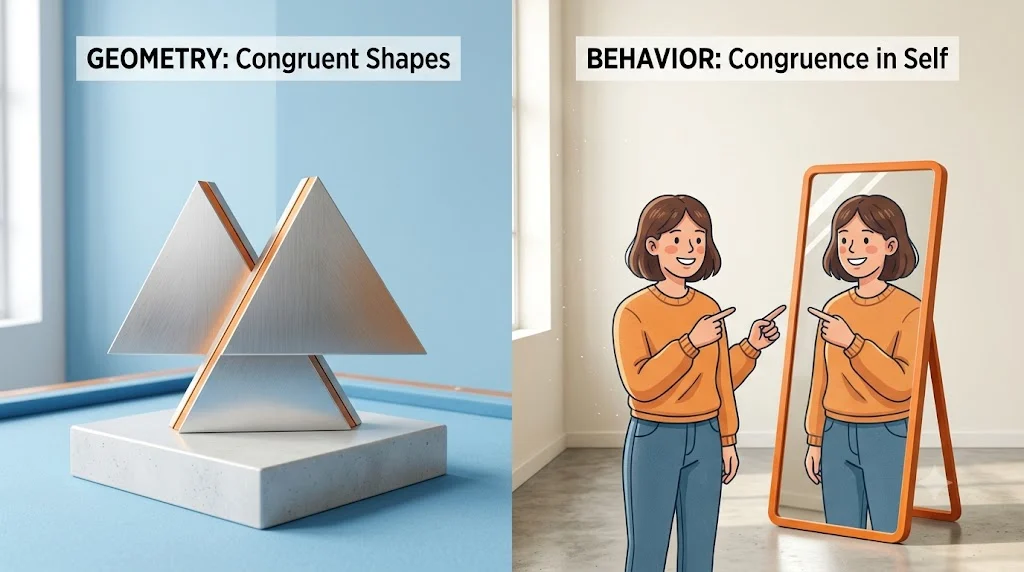
You’ve seen the word before. Maybe in a geometry textbook. Maybe in a psychology article. Or perhaps someone said your actions weren’t “congruent” with your words.
That last one stings a little, doesn’t it?
Here’s the short version: Congruent means two things match perfectly. In math, that means identical size and shape. In life, that means harmony between beliefs and actions. No stretching. No faking. Just alignment.
This guide covers every meaning of congruent.
- You’ll learn the triangle rules (SSS, SAS, ASA, AAS, RHS).
- You’ll understand congruent vs similar.
- You’ll even see how therapists use the word to describe emotional honesty.
Let’s dive in.
The Core Definition: One Word, Two Main Lives
Before jumping into complex examples, let’s nail the basics. Congruent splits into two major contexts.
In geometry: Two shapes are congruent if you can move one (flip, slide, or turn) and it lands exactly on the other. Same size. Same shape. No exceptions.
In everyday English: Congruent means “in agreement,” “consistent,” or “harmonious.” If a witness’s story is congruent with security footage, you believe them. If a brand promises sustainability but uses plastic packaging, that’s incongruent.
Think of it this way:
| Context | Meaning | Quick Test |
|---|---|---|
| Math | Same size + same shape | Can I place one on top of the other perfectly? |
| Language | Agreeing / matching | Do these two things contradict each other? |
Pronunciation first: Say “KUHN-groo-ent.” Three syllables. Not “con-GRU-ent.” Not “cong-rent.” Practice it once: KUHN-groo-ent.
The symbol (≅): You’ll see this squiggly equal sign in geometry proofs. It separates congruence from simple equality. Two dollars equal two dollars ($2 = $2). But two triangles? They’re congruent (△ABC ≅ △DEF).
Congruent in Math: Where It All Starts
Most people first meet congruent in a geometry classroom. Usually around 8th or 9th grade. Usually with a diagram of two triangles that look identical but sit on opposite sides of a page.
Here’s what’s actually happening.
Congruent Shapes and Figures
Two shapes are congruent if one transformation or a series of them maps exactly onto the other. Rigid transformations keep size and shape intact. You get three moves:
- Translation (slide): Push the shape left, right, up, or down.
- Rotation (turn): Spin it around a point.
- Reflection (flip): Mirror it across a line.
No stretching, no squishing and no shrinking.
Real-world congruent shapes:
- Two sheets of paper from the same printer batch
- A stack of identical coins
- Car tires of the same model and size
- Floor tiles in a grid pattern
Not congruent (but often confused):
- Your left and right hands (mirror images, not identical)
- A photo and its enlarged poster (similar, not congruent)
- A circle and an oval (different shapes)
The Critical Distinction: Congruent vs Similar
This trips up almost everyone at first. Here’s the rule you’ll remember forever.
Similar: Same shape, different size. Think of a baby photo blown up to poster size. The proportions stay the same. The nose is still centered. But the measurements change.
Congruent: Same shape and same size. Two identical coffee mugs from the same factory line. Stack them. They match perfectly.
| Feature | Similar | Congruent |
|---|---|---|
| Same shape | Yes | Yes |
| Same size | No | Yes |
| Can scale one to match the other? | Yes (multiply by a factor) | No scaling needed |
| Real example | A model car and a real car | Two identical chess pawns |
A quick test: Grab two sticky notes. Are they congruent? Yes, if they’re the same size. Now cut one in half. Those two halves? Still congruent if you cut precisely. But a sticky note and a poster board? Similar at best.
Congruent Triangles: The Heavy Lifter of Geometry Proofs
Triangles get special attention. Why? Because triangles are rigid. You can’t change a triangle’s shape without changing its side lengths. A square? You can squish it into a rhombus. A triangle? No chance. Once you fix its three sides, the angles lock in place.
That rigidity makes triangles perfect for construction, engineering, and you guessed it congruence proofs.
The Five Triangle Congruence Rules
You don’t need to measure every side and angle to prove two triangles are congruent. Just check a specific combination. Here are the five shortcuts.
SSS (Side-Side-Side)
All three sides of one triangle equal all three sides of the other.
- Example: Triangle ABC has sides 3cm, 4cm, 5cm. Triangle DEF has sides 3cm, 4cm, 5cm. They’re congruent by SSS.
- Real use: Building roof trusses. Same side lengths = same strength.
SAS (Side-Angle-Side)
Two sides and the angle between them match in both triangles.
- Warning: The angle must sit between the two sides you measure. No exceptions.
- Real use: Car frame manufacturing. Measure two connecting beams and their joint angle.
ASA (Angle-Side-Angle)
Two angles and the side between them match.
- Why it works: If two angles match, the third angle automatically matches (triangle angles sum to 180°). The side locks the size.
- Real use: Surveying land. Measure two corners and the distance between them.
AAS (Angle-Angle-Side)
Two angles and a non-included side match. That means the side isn’t between the two angles.
- Note: AAS and ASA often confuse students. Draw them. If the side touches both angles, it’s ASA. If it touches only one, it’s AAS.
- Real use: Navigation. Two bearing angles and one distance.
RHS (Right Angle-Hypotenuse-Side)
Special rule just for right triangles. If the hypotenuse and one other side match, the triangles are congruent.
- Hypotenuse: The longest side, opposite the right angle.
- Why it works: Pythagorean theorem locks in the third side automatically.
- Real use: Checking right-angle corners in carpentry.
What Doesn’t Work: AAA and ASS
AAA (three equal angles) proves similarity, not congruence. Imagine a tiny triangle and a huge one. Both have 30°, 60°, and 90° angles. Same shape. Different size. Not congruent.
ASS (two sides and a non-included angle) is unreliable. With certain measurements, you can draw two different triangles. Geometry teachers call this the “ambiguous case.” Just avoid it.
Triangle Congruence Quick Reference
| Rule | What You Need | Minimum Measurements |
|---|---|---|
| SSS | Three sides | 3 |
| SAS | Two sides + the included angle | 3 |
| ASA | Two angles + the included side | 3 |
| AAS | Two angles + any non-included side | 3 |
| RHS | Right angle + hypotenuse + one side | 3 |
One sentence to remember: “People Say So Many Silly Arguments At Restaurants” – P(PPP) = SSS, S(SA) = SAS, M(AN) = ASA, S(A) = AAS, A(AR) = RHS. (Okay, that’s a stretch. But you’ll remember it now, won’t you?)
Congruent in Everyday Language: Beyond the Math Classroom
Walk out of geometry class, and congruent follows you. People use it to mean “consistent,” “aligned,” or “in harmony.” It sounds more precise than “matching.” And it carries a subtle weight like you’ve thought carefully about the comparison.
Common Uses in English
Congruent with (preferred phrasing):
- “The data is congruent with our initial hypothesis.”
- “Her calm voice felt congruent with the peaceful setting.”
Congruent to (less common but acceptable):
- “His actions are congruent to his stated values.”
Synonyms: consistent, compatible, harmonious, aligned, matching, coherent, corresponding.
Antonyms: incongruent, inconsistent, contradictory, mismatched, discordant, incompatible.
Real Sentences You Might Actually Say
“I thought we agreed on the budget. But your request isn’t congruent with that conversation.”
“The two witness accounts were almost perfectly congruent. No contradictions at all.”
“That paint color isn’t congruent with the warm tones in the rest of the house.”
Notice a pattern? Congruent often appears in negative or comparison contexts. We point out when things don’t match. Congruence stands out because it’s rarer than you’d think.
A Quick Test for Everyday Use
Ask yourself: Do these two things agree or contradict?
- Agree without tension → congruent
- Minor agreement → somewhat congruent
- Contradiction → incongruent
- Unrelated → neither (don’t force the word)
Bad example: “The color blue is congruent with the number seven.” (No. Those aren’t comparable.)
Good example: “His cheerful tone wasn’t congruent with the bad news he delivered.”
Congruent in Psychology: Actions, Words, and Emotional Honesty
Psychologists borrowed congruent to describe a specific kind of integrity. Not moral integrity necessarily. But internal integrity when your thoughts, feelings, and actions all line up.
Congruent Behavior Defined
Congruent behavior means you act in alignment with your true beliefs and emotions. No faking, no masking and no “customer service smile” while you’re fuming inside.
Incongruent behavior creates tension. You say “I’m fine” but your arms are crossed and your jaw is tight. Everyone notices. Even if they don’t say anything.
Carl Rogers and Person-Centered Therapy
Humanistic psychologist Carl Rogers made congruence a cornerstone of his therapy approach. He believed therapists must be genuine and authentic with clients. No professional mask. No hiding behind jargon.
Rogers listed three core conditions for effective therapy:
- Congruence (the therapist is real and transparent)
- Unconditional positive regard (acceptance without judgment)
- Empathy (understanding the client’s perspective)
Without congruence, Rogers argued, therapy becomes a performance. And performances don’t heal.
Signs You’re Living Congruently (or Not)
You’re likely congruent when:
- Your words match your body language
- You don’t pretend to like things you hate
- You speak up when something feels wrong
- Your decisions reflect your actual priorities
You’re likely incongruent when:
- You say “yes” when you mean “no
- You laugh at jokes that offend you
- You feel drained after social interactions (from pretending)
- People often say “You seem upset” and you reply “I’m fine”
Emotional Congruence in Relationships
Couples therapists watch for congruence constantly. One partner says “I’m not angry.” But their tone says otherwise. That mismatch creates confusion. Over time, the other partner stops trusting words. They start reading only body language. Communication breaks down.
Try this instead:
“I feel a little frustrated right now. Not at you just at the situation. Give me five minutes.”
That’s congruent.
- You name the emotion honestly.
- You don’t blame.
- You offer a clear path forward.
Congruent in Computer Science & Logic
Yes, congruent shows up in code and formal logic too. Usually in two specific places.
Logical Congruence (Equivalence Relations)
In logic, a congruence relation is an equivalence relation that respects operations. That sounds fancy, but here’s the simple version.
An equivalence relation must be:
- Reflexive: A is congruent to A
- Symmetric: If A is congruent to B, then B is congruent to A
- Transitive: If A is congruent to B and B is congruent to C, then A is congruent to C
Think of “same shape and size” for triangles. It passes all three tests. That’s why congruence is an equivalence relation.
Modular Congruence (Number Theory)
In modular arithmetic, two numbers are congruent modulo n if they have the same remainder when divided by n.
Example: 17 and 5 are congruent modulo 12. Why? 17 ÷ 12 = 1 remainder 5. 5 ÷ 12 = 0 remainder 5. Same remainder.
We write this as: 17 ≡ 5 (mod 12)
Real use: Clocks. 3 o’clock and 15 o’clock are congruent modulo 12. Both point to the same position. That’s why 24-hour time converts to 12-hour time with simple modular math.
Another real use: Cryptography. RSA encryption relies heavily on modular congruence. Every time you shop online securely, you’re using congruence in prime-number fields.
| Numbers | Modulo | Congruent? | Remainder |
|---|---|---|---|
| 22 and 10 | 12 | Yes | 10 and 10 |
| 33 and 8 | 5 | Yes | 3 and 3 |
| 14 and 7 | 6 | No | 2 and 1 |
Real-Life Congruent Examples You See Every Day
Let’s make this concrete. You already use congruence without realizing it.
At home:
- Stack of dinner plates (congruent circles)
- Batteries in a remote (congruent cylinders, same size)
- Matching socks from a pair (congruent rectangles)
- Keys on a keyring (identical cuts on duplicates)
At school or work:
- Photocopies of a document (congruent rectangles of paper)
- Standardized test forms (same questions, same layout)
- Cubicles in an office (congruent workspaces)
- Shipping boxes from the same supplier
In nature:
- Snowflakes? No. Each one is unique. Not congruent.
- Leaves from the same tree? Rarely. Slight variations in size.
- Twins? Fraternal twins are not congruent (different genetics). Identical twins start congruent but develop small differences.
In pop culture:
- A band playing a cover song exactly as recorded (congruent performance)
- A movie remake shot-for-shot (congruent to the original)
- A counterfeit handbag trying to look congruent to the real one (but usually failing)
Common Congruent Mistakes: And How to Fix Them
Even smart people mix these up. Here’s how to avoid the most common errors.
1: Saying “congruent” when you mean “equal”
- Wrong: “2 + 2 is congruent to 4.”
- Right: “2 + 2 equals 4.”
- Fix: Use “equal” for numbers and values. Save “congruent” for shapes or abstract alignment.
2: Confusing similar and congruent
- Wrong: “These two photos are congruent because they look the same.” (Different sizes? Not congruent.)
- Right: “These two photos are similar. Their proportions match, but one is larger.”
- Fix: Ask yourself: “Could I place one directly on top of the other with zero overlap issues?” If yes, congruent. If no, similar.
3: Mispronouncing it
- Wrong: “con-GRU-ent” or “cong-rent”
- Right: “KUHN-groo-ent”
- Fix: Break it into parts: KUHN (like “cunning” without the -ing) + groo (like “grew”) + ent (like “ant” without the t).
4: Using “congruent to” incorrectly
- Fine: “The symbol is congruent to the original design.
- Better: “The symbol is congruent with the original design.”
- Fix: “Congruent with” sounds more natural. Use “to” only in strict math contexts.
5: Forgetting the symbol
- Wrong: “Triangle ABC = Triangle DEF” (Use the squiggly line for shapes.)
- Right: “Triangle ABC ≅ Triangle DEF”
- Fix: In plain text, write “is congruent to.” In formal work, use ≅.
Practical Applications: Why You Should Actually Care About Congruence
You might never write a geometry proof again after this article. That’s fine. But congruence thinking helps in surprising ways.
In design and manufacturing: Engineers create congruent parts so they can swap or replace them. Your car’s left and right side mirrors? Usually not congruent (they’re mirrored). But the four bolts holding each mirror? Congruent. One bolt fits any corner.
In user experience (UX): Buttons on a website should behave congruently. If a blue button submits a form on page one, a blue button on page two should also submit something. Changing behavior without changing appearance confuses users.
In leadership: The best managers act congruently. They don’t preach work-life balance while emailing at midnight. They don’t demand honesty while punishing bad news. Teams trust congruent leaders because there’s no hidden agenda.
In personal growth: Check for congruence between your calendar and your values. Say family is your top priority. But your calendar shows 60 hours of work and 2 hours of family time. That’s incongruent. The fix isn’t to claim different values. It’s to change the calendar.
A Final Analogy to Lock It In
Imagine a key and a lock. A congruent key matches the lock’s pins perfectly. It slides in. Turns smoothly. Opens the door.
An incongruent key? Maybe it’s too thick. Maybe the cuts are off by a millimeter. It won’t work. You can force it, but you’ll break something.
Now imagine a person. A congruent person’s actions match their words like that key matches the lock. No forcing. No pretending. Just smooth alignment.
That’s congruence. In math, in language and in life.
The next time you see the word or the symbol (≅) you’ll know exactly what it means. Same size, same shape and same page. Perfect match.
FAQs
“What does congruent mean in math for kids?”
Two shapes are congruent if you can put one on top of the other and they match perfectly. No gaps. No overlaps.
“Is congruent the same as similar?”
No. Similar means same shape, different size. Congruent means same shape and same size.
“What is a real life example of congruent?”
Two identical soda cans from the same factory. Same height, same diameter, same shape.
“How to prove triangles are congruent without a diagram?”
Use the rules: SSS, SAS, ASA, AAS, or RHS. Measure the required sides and angles. No picture needed.
“What does incongruent mean?”
The opposite of congruent. Mismatched. Inconsistent. In geometry, shapes that don’t match perfectly. In life, words that don’t match actions.
“Why is congruence important in geometry?”
Congruence proves two shapes are identical without measuring everything. That saves time in proofs and helps engineers build matching parts.
“What does congruent mean in a relationship?”
It means your actions align with your words. You don’t say “I love you” while acting distant. You don’t promise something and then ignore it.
“Can circles be congruent?”
Yes. Any two circles with the same radius are congruent. Same size, same shape. A circle’s shape never changes, so only radius matters.
Conclusion:
You don’t need to memorize every triangle rule today. But remember this: Congruence is about perfect matching. Shapes match. Stories match. Actions match words. When something feels off, ask yourself: Is this congruent? Most of the time, the answer will tell you exactly where the problem lives.
Now go find some congruent things. Stack two identical mugs. Notice when someone’s words and body language align. Or catch that incongruent moment the one everyone feels but nobody names.
You’ll see the word everywhere now. That’s the funny part about learning something new. It was always there. You just didn’t have the label for it. Now you do.
Read More Related Articles:
- What Does Blitz Mean in Football? Game-Changing Examples In 2026
- What Does DPO Mean in Pregnancy? Full Guide for Expecting Moms (2026)
- What Does ONB Mean in Slang? Viral Meaning Behind the Phrase (2026)

Ivy Madison is a content creator at TextSprout.com, specializing in word definitions, internet slang, acronyms, and text abbreviations. She delivers clear and engaging explanations, helping readers quickly understand modern digital language and trending terms.