You’ve seen the word “masque” on a skincare jar. Or maybe you spotted it in a Shakespeare footnote. So is it just a fancy way to spell “mask”? Get to know What Does Masque Mean here.
Not even close.
Stick around for five minutes. You’ll learn the real masque meaning. You’ll find out why kings spent fortunes on these wild performances. And you’ll never confuse a masque with a masquerade again.
Let’s dive in.
A Quick Masque Meaning Nobody Explains
Here’s the cleanest masque definition you’ll find.
A masque is a form of festive courtly entertainment from the 16th and 17th centuries. It combines poetry, music, dance, acting, and elaborate costumes. Performances happened indoors for royalty. They always ended with the audience joining the dance. Heavy allegory and symbolism ran through every scene.
Think of it as a billionaire’s private theater party. The Met Gala meets a Broadway musical. But with more Greek gods and less red carpet.
Where did the word come from? The origin of the word masque traces to Middle French masque (mask) and Italian maschera. English borrowed it around 1510. The -que spelling signals French influence. Writers kept that spelling to separate the art form from a simple face covering.
So no. You cannot call your clay face mask a masque. Not if you want to sound like you know what you’re talking about.
Masque in Literature and Drama: The Real Stage
You won’t find many masques in your local theater today. But you’ll definitely see them in old books and Shakespeare plays.
Masque Meaning in Literature
In literary terms a masque is an allegorical play within a play. Poets used masques to praise monarchs or teach moral lessons. Common themes include order versus chaos and virtue versus vice.
Famous literary example: Shakespeare’s The Tempest includes a wedding masque for Ferdinand and Miranda. Goddesses sing. Spirits dance. Then the whole thing vanishes like a dream.
Other major works:
- Ben Jonson wrote multiple court masques. He didn’t just write poetry. He staged full productions.
- John Milton’s Comus is a literary masque. It was never performed at court. People read it as a poem.
What Does Masque Mean in Drama?
Good question. Drama uses masques as spectacle breaks. Think of them as musical numbers in a play. But instead of pop songs you get mythological characters singing about virtue.
Theatrical mechanics:
- Performers wore literal masks on their faces. But the word “masque” names the whole event not just the face wear.
- Stage machines lowered gods from the ceiling. Clouds opened. Palaces rose from trapdoors.
- Elaborate sets cost a king’s ransom. One production could bankrupt a minor noble.
The masque performance meaning shifted around 1700. Public theaters grew more popular. Court masques faded out. But their DNA lives on in opera and ballet.
Masque in English Literature: The Bigger Picture
English literature wouldn’t look the same without the masque. Poets learned how to blend verse with visual storytelling. Allegory became more sophisticated. Even Shakespeare borrowed masque techniques for his romances.
Notable masque elements you still see today:
- A sudden shift from speech to song
- Costumed characters representing abstract ideas (like “Truth” or “Vanity”)
- Audience participation at climactic moments
So when you read a play and a goddess suddenly appears to sing for ten minutes? That’s the masque’s ghost.
Renaissance Masque Meaning: The Golden Age
Let’s travel back to the Renaissance. Specifically England between 1500 and 1650. This was the masque’s golden age.
Court Masque Meaning: Politics in Disguise
A court masque wasn’t just entertainment. It was a political tool.
The king sat in the center of the room. The masque showed him as a sun god or a hero from ancient myth. Flattery with sequins. But underneath the sparkle you’d find real messages about power and obedience.
Who made a masque happen?
| Role | Person | Job |
|---|---|---|
| Poet | Ben Jonson | Wrote the verse |
| Architect | Inigo Jones | Designed the sets |
| Composer | Various | Wrote the music |
| Dancers | Courtiers (yes aristocrats) | Performed the moves |
Example masque you should know: The Masque of Blackness (1605). Queen Anne herself performed. The plot involved British river nymphs who wanted whiter skin. Modern readers cringe. Historians note the colonial attitudes on full display.
Masque History and Meaning: Why It Died
Masques cost too much. Charles I spent fortunes on them. Then the English Civil War broke out. Puritans shut down all theaters in 1642. Masques never fully recovered.
When Charles II returned to the throne in 1660, public theaters had taken over. People wanted professional actors not amateur courtiers. The masque evolved into semi-operas and then proper operas.
Key fact: The last major court masque in England happened in 1640. That’s almost 400 years ago.
Masque vs Mask vs Masquerade: Stop the Confusion
People mix these up constantly. Here’s your cheat sheet.
| Term | Meaning | Real Example |
|---|---|---|
| Masque | Scripted theatrical performance for court | Ben Jonson’s Pleasure Reconciled to Virtue |
| Mask | Face covering (physical object) | Venetian carnival mask or a medical N95 |
| Masquerade | Social ball where guests wear masks | Any costume party with dancing and no script |
Why the confusion happens: All three share roots in disguise. The Latin word masca means “ghost” or “specter.” But a masque has a plot. A masquerade just has a playlist.
Pro tip for sounding smart: If royalty isn’t watching a staged allegory it’s not a masque. If there’s no script it’s not a masque. If someone says “facial masque” they’re wrong. Politely correct them. Or don’t. Your call.
Word Sense Disambiguation: How Computers Understand “Masque”
Here’s where linguistics meets search engines.
Word sense disambiguation (WSD) is the process of figuring out which meaning of a word someone intends. “Masque” has multiple senses so computers need context.
Context clues you and Google use:
- “Shakespeare’s Henry VIII ends with a masque” → theatrical performance
- “Apply a hydrating masque” → face product (incorrect but common)
- “The court masque featured dancing nobles” → historical drama
NLP terms in action:
- Lemmatization: Reduces “masques” to “masque”
- Synonym mapping: Connects “masque” to “masquerade” and “mask”
- Lexical semantics: Studies what “masque” really means in context
- Semantic interpretation: Your brain figuring out if we’re talking theater or skincare
Search engines have gotten good at this. But they still mess up. That’s why typing “masque meaning literature” gives you better results than just “masque definition.”
The Symbolic Meaning of Masque: More Than Just a Party
Masques weren’t shallow flattery. They carried deep symbolic weight.
Common symbols in Renaissance masques:
- Light vs dark: Good vs evil. The king brought light.
- Masques vs antimasques: Order versus chaos. The antimasque showed grotesque creatures. Then the main masque restored harmony.
- Gods and goddesses: Jupiter meant power. Venus meant love. Mercury meant messages.
- Transformation: Characters changed form. This symbolized moral improvement.
The masked performance meaning goes straight to identity. When you wear a mask on stage you become someone else. But Renaissance audiences knew the dancer was really Lord So-and-So. That double awareness created a special kind of magic.
You watched your neighbor play a goddess. And for one night you almost believed it.
Masque vs Masquerade Meaning: A Helpful Analogy
Still fuzzy? Try this.
A masquerade is a party where everyone wears masks. You dance, flirt and drink wine. No script. No plot. Just vibes.
A masque is a show for a party. The king sits. Professionals and courtiers perform. There’s a story. There’s allegory. Then at the end the performers pull the audience onto the dance floor.
Simple breakdown:
- Masquerade = costume party
- Masque = theatrical performance + costume party finale
So if someone invites you to a masque say “What’s the play?” If they look confused say “I’ll bring a mask just in case.”
Masque Word Origin and Usage in Literature: Deeper Dive
Let’s get specific about etymology because word nerds deserve love too.
Timeline of “masque” in English:
| Year | Development |
|---|---|
| 1510 | English borrows masque from French |
| 1530s | First recorded use for face coverings |
| 1550s | Theatrical masques appear in court records |
| 1600–1640 | Golden age under James I and Charles I |
| 1642 | Theaters close under Puritan rule |
| 1660 | Restoration but masques don’t fully recover |
| 1700s | Masque becomes literary rather than performed |
How poets used masque vocabulary:
- Ben Jonson called his scripts “masques” not “plays”
- Milton subtitled Comus “A Masque”
- Later poets used “masque” for any short allegorical drama
Modern literary usage: Professors assign masques as primary texts. Students groan. Then they realize masques have dancing and costumes. Suddenly Renaissance literature isn’t so boring.
Masque Theatre Explanation: How It Worked On Stage
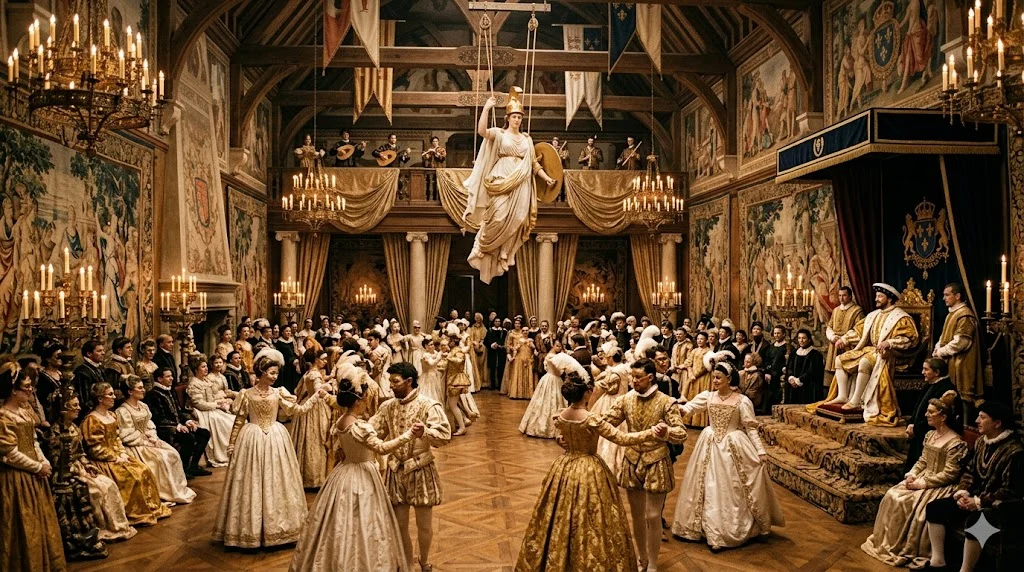
Let me walk you through an actual masque performance.
Before the show:
The great hall is packed. Nobles sit on benches. The king has the best chair in the center. Candles everywhere. Musicians tune their instruments.
The antimasque (opening act):
A clown or beast enters. Maybe a drunk satyr. Chaos. Laughter. The audience thinks this is silly.
The main masque:
A curtain draws back. A golden palace appears. Gods and goddesses step out in gorgeous costumes. They sing in perfect harmony. The king smiles.
The revels (dance time):
The performers finish their scripted parts. Then they walk into the audience. They pull nobles onto the dance floor. Everyone dances together. The line between performer and spectator disappears.
The finale:
One final song. The gods ascend back into the clouds. The palace sinks into the floor. The king claps. Everyone goes to eat a massive feast.
No intermission. No bathroom breaks. Just two hours of pure Renaissance spectacle.
Masque Renaissance Entertainment: The Party Budget
Let’s talk money because masques cost a fortune.
What a single masque required:
- A team of poets and composers (months of work)
- A set designer and carpenters
- Costume makers (gold thread imported from Italy)
- 20 to 50 performers
- 30 to 60 musicians
- Stage machinery specialists
- Candles by the thousand
Estimated cost for one masque: Up to £3,000 in 1630s money. Adjusted for inflation that’s roughly $1.2 million today. For one night.
Who paid? The king or a very wealthy noble. Charles I spent so much on masques that Parliament complained. Public money for private parties didn’t sit well. That tension contributed to the Civil War.
So yes. A fancy party helped start a war. History is weird.
FAQs
What does masque mean in English literature?
A masque in English literature is a short allegorical play with verse, music, and dance. Writers like Ben Jonson and John Milton created them. They often appeared inside longer plays like Shakespeare’s The Tempest.
Is masque the same as masquerade?
No. A masquerade is a social party where guests wear masks. A masque is a staged theatrical performance with a script. Masques happened at royal courts. Masquerades happen in ballrooms.
Why do people spell it “masque” instead of “mask”?
The -que spelling comes from French. English writers adopted it in the 1500s. They used the different spelling to separate the art form (masque) from the face covering (mask).
Did Shakespeare write masques?
Shakespeare included masque scenes in his plays. The Tempest has a famous wedding masque. A Midsummer Night’s Dream has masque-like elements. But he didn’t write standalone court masques like Ben Jonson did.
What’s a simple explanation of masque meaning?
Think of a masque as a fancy Renaissance play for kings. It has masks, poetry, dancing, and music. The audience joins the final dance. It only happened for royalty.
What does masque mean in drama specifically?
In drama a masque is a spectacle within a larger play. Characters stop talking and start singing or dancing. Mythological figures appear. The tone shifts from realistic to magical.
Where did the word masque originate?
The origin of the word masque comes from Middle French masque (mask) and Italian maschera. English borrowed it around 1510. Theatrical and literary uses followed soon after.
What is the difference between a masque and a mask?
A mask is a physical object you wear on your face. A masque is an entire theatrical performance. Masques use masks. But the word “masque” never means just the face covering.
Conclusion
Let’s wrap this up.
A masque isn’t a mask. It isn’t a masquerade. It isn’t a skincare product. A masque is a Renaissance court entertainment. It mixes poetry, music, dance, and allegory. Kings watched. Nobles performed. Everyone danced at the end. Then it cost a fortune and disappeared.
Next time you see “masque” in a book, don’t think clay face mask. Think gold costumes, flattering poems for King James and think a party so expensive it helped start a war. You’re welcome.
Want to sound smart at your next dinner party? Say “The masque as a form declined after 1640 but its influence on English drama never really faded.” Then take a sip of wine. Don’t explain further. Let them wonder.
Read More Related Articles:
- MMCHT in Texts: Meaning, Tone, and How to Use It in 2026
- What Does Te Amo Mean in English? Here’s the Truth (2026)
- SG in Text: The Meaning Changes More Than You Think (2026)

Ivy Madison is a content creator at TextSprout.com, specializing in word definitions, internet slang, acronyms, and text abbreviations. She delivers clear and engaging explanations, helping readers quickly understand modern digital language and trending terms.