
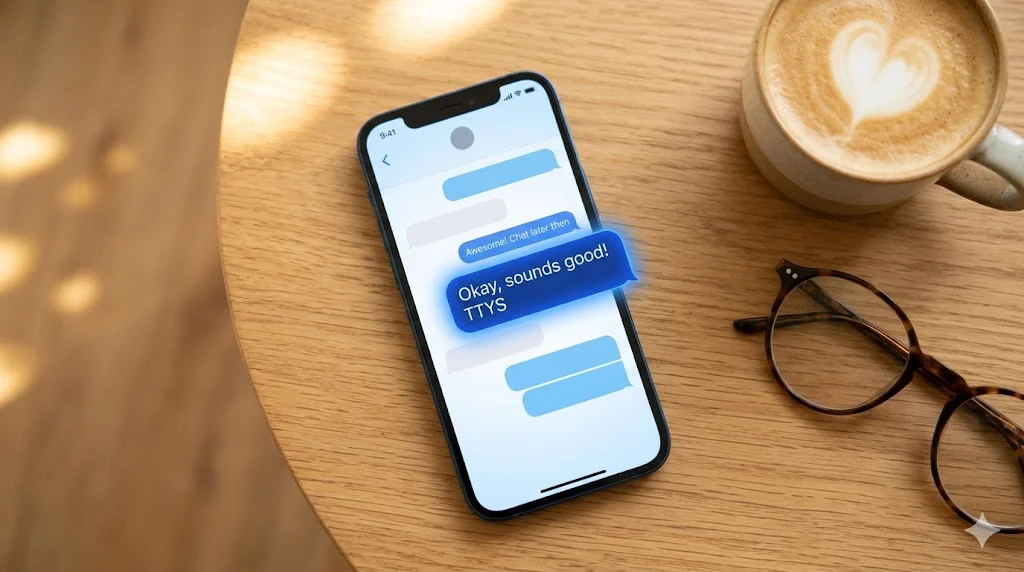
You’re texting a friend. The conversation flows easily. Then they type four letters: TTYS.
You pause. What does that even mean?
Don’t worry. You’re not alone. Millions of people see TTYS every day and wonder the same thing.
Here’s the short answer:
TTYS stands for “Talk To You Soon.”
But there’s more to it than just the definition. When should you use it? How is it different from TTYL? Does it work on WhatsApp? What about Instagram DMs?
This guide answers all of that. No fluff. Just real, useful information you can actually use.
Let’s dive in.
What Does TTYS Mean in Text? The Simple Definition
TTYS is an acronym. Each letter stands for a word.
- T = Talk
- T = To
- Y = You
- S = Soon
Put together: Talk To You Soon
People use TTYS to end a conversation. But here’s the key: it’s not a hard goodbye. It’s a soft exit. Think of it like saying, “I’m leaving for now, but I’ll be back soon.”
You wouldn’t use TTYS to end a serious relationship. You wouldn’t type it after a breakup. That would be weird.
Instead, TTYS works best in casual moments.
Real example:
“Hey, my pizza just arrived. TTYS!”
Another one:
“Class is starting. TTYS.”
See the pattern? The person isn’t angry. They aren’t disappearing forever. They’re just busy for a short while.
TTYS carries a warm tone. It’s friendlier than “goodbye.” It’s more specific than “see you later.” And it’s shorter than typing out “talk to you soon” every single time.
TTYS Full Form in Texting: Breaking It Down
Let’s get technical for a second. Not too technical. Just enough to understand what you’re actually saying.
Full form: Talk To You Soon
Part of speech: Acronym (specifically an initialism)
Formality level: Extremely informal
Primary users: Teenagers, young adults, and anyone comfortable with texting slang
First known usage: Early 2000s text messaging and online chat rooms
Some people think TTYS came from AOL Instant Messenger (AIM). That’s partly true. AIM popularized TTYL. TTYS showed up shortly after as a warmer alternative.
Today, TTYS appears everywhere. SMS. iMessage. WhatsApp. Instagram. Snapchat. Even some Discord servers.
But here’s a hard rule: never use TTYS in professional emails. Just don’t. Your boss will not appreciate “TTYS” at the end of a client update. Write “Talk soon” instead. It takes one extra second and saves you from looking unprofessional.
What Is TTYS in Texting? The Context You Need
Context changes everything. TTYS can feel perfect in one situation and completely wrong in another.
Let me give you three real scenarios.
Scenario 1: Good context
You and a friend are planning to meet for coffee. You confirm the time and place. Then you say, “Awesome. See you then. TTYS!”
Feels natural, right? That’s because you genuinely will talk soon. The plan is set.
Scenario 2: Bad context
Your friend texts: “I just lost my job. Feeling terrible.”
You reply: “That sucks. TTYS.”
Ouch. That’s cold. TTYS here sounds like you don’t care. A better response would be: “I’m so sorry. Call me when you can.”
Scenario 3: Neutral context
You’re in a group chat. Someone asks a question you can’t answer right now. You type: “Not sure. TTYS when I find out.”
This works. You’re being honest about your availability. No harm done.
The rule is simple: match your tone to the situation. TTYS works for light, cheerful, or neutral exits. It fails for emotional, serious, or high-stakes conversations.
TTYS Meaning in WhatsApp Chats
WhatsApp users love TTYS. The app’s casual, message‑heavy environment makes short abbreviations feel right at home.
Here’s how TTYS typically appears in WhatsApp:
- One-on-one chats – Most common. Friends use it to pause conversations without ending them.
- Group chats – Also common, but be careful. In a group of 10 people, “TTYS” might mean you’ll talk to everyone soon. Or just one person. Context matters.
- Voice note follow‑ups – Someone sends a long voice note. You can’t listen yet. You reply: “Can’t listen now. TTYS.”
Real WhatsApp example:
Person A: “You free later?”
Person B: “Let me check my schedule. TTYS”
Person A: “Kk 👍”
Notice how natural that flows. No awkwardness. No over‑explaining.
WhatsApp also shows read receipts (those two blue checkmarks). Sometimes people use TTYS to acknowledge they saw your message but can’t respond fully.
“I see your question. TTYS with an answer.”
That’s a pro move. It reassures the other person without forcing a long reply.
TTYS Meaning in Social Media: Instagram, Snapchat, TikTok
Social media platforms each handle TTYS a little differently. Let’s break them down.
Instagram DMs
Instagram Direct Messages feel half‑public, half‑private. TTYS works well here, especially when you’re jumping between DMs and your feed.
Example:
“Gotta check my feed. TTYS!”
People also use TTYS on Instagram when they’re about to post a story or go live. It’s a polite way to say, “I’m switching modes.”
Snapchat
Snapchat moves fast. Conversations disappear. TTYS fits perfectly because Snapchat users don’t expect long, thoughtful goodbyes.
Example:
A snap of your face with “TTYS” written over it. Then you close the app.
Short. Simple. Effective.
Snapchat streaks (those fire emojis) change things a bit. If you’re maintaining a streak, “TTYS” means you’ll send another snap soon but not immediately.
TikTok Comments and DMs
TikTok isn’t primarily a messaging app. But people still DM each other about videos. TTYS in a TikTok DM usually means, “I’m going back to scrolling.”
Example:
“That video was hilarious. TTYS.”
One important note: TikTok’s audience skews younger. Gen Z uses TTYS slightly differently than millennials. Millennials treat it as a warm goodbye. Gen Z sometimes uses it ironically or sarcastically. Pay attention to tone.
TTYS vs TTYL: What’s the Actual Difference?
This confuses almost everyone. Let me clear it up.
TTYL = Talk To You Later
TTYS = Talk To You Soon
They look similar. They sound similar. But they are not the same.
| Feature | TTYS | TTYL |
|---|---|---|
| Time gap | Short (hours, not days) | Longer (could be days) |
| Tone | Warmer, more intentional | Colder, more open‑ended |
| Certainty | High (you will talk soon) | Low (you might talk later) |
| Best for | Close friends, active chats | Casual acquaintances, busy periods |
| Emotional weight | Light but positive | Neutral to distant |
Example comparison:
“I’m grabbing lunch. TTYS!” (You’ll probably text again after eating.)
“Busy week. TTYL.” (Could be days before you reach out.)
See the difference? TTYS promises a shorter gap. TTYL leaves it vague.
When to choose TTYS over TTYL:
- You actually plan to text again within a few hours
- You want to sound friendly and engaged
- You’re ending a good conversation on a high note
When to choose TTYL over TTYS:
- You don’t know when you’ll be free
- You’re talking to someone you’re not very close with
- You want to end the conversation without making a promise
One more thing: some people use TTYL and TTYS interchangeably. That’s fine in casual speech. But if you want to be precise, use the distinction above. It makes you sound more intentional.
How to Use TTYS in a Sentence: Real Chat Examples
Theory is good. Examples are better. Here are 15 real sentences using TTYS the right way.
Friendly exits:
- “My battery is at 3%. TTYS!”
- “Dinner’s ready. TTYS.”
- “Going for a run. TTYS.”
- “Movie’s starting. TTYS after.”
- “Mom needs help with groceries. TTYS.”
Planning ahead:
- “Let me check my calendar. TTYS.”
- “I’ll ask my partner. TTYS with an answer.”
- “Waiting on my boss to reply. TTYS.”
Acknowledging without full response:
- “I see your message. TTYS properly.”
- “Can’t type much right now. TTYS.”
- “Driving. TTYS when I park.”
Group chat examples:
- “Gotta jump on a call. TTYS everyone.”
- “This convo is great but I have to go. TTYS!”
- “I’ll catch up on these messages later. TTYS.”
Playful or humorous:
- “You win this round. TTYS for round two.”
Notice something? Almost every example gives a reason for leaving. That’s the secret sauce. TTYS alone feels abrupt. “TTYS, my battery is dying” feels human.
Pro tip: Add an emoji about half the time. Not every time. A simple 😊 or 👋 or 💬 softens the exit even more.
“Gotta go. TTYS! 👋”
Perfect.
When Should You NOT Use TTYS?
Let me save you from embarrassment. Here are seven situations where TTYS is the wrong choice.
1. After delivering bad news
If someone tells you something sad, hard, or scary, do not type TTYS. It sounds dismissive. Instead, say something like, “I’m here for you” or “Call me anytime.”
2. In professional settings
- No work email.
- No Slack message to your manager.
- No LinkedIn DM.
Not ever. Professionals read “TTYS” and think, “This person doesn’t take communication seriously.”
3. When you’re genuinely angry
If you’re upset with someone, TTYS comes across as passive‑aggressive. The other person won’t think, “Oh, they’ll talk soon.” They’ll think, “They’re mad and pretending not to be.”
4. After a first date
You just met someone. You’re texting afterward. Don’t use TTYS. It’s too casual for early dating. Write “Talk soon” or “Looking forward to next time” instead.
5. When you actually won’t talk soon
Don’t lie with acronyms. If you have no intention of texting back in the near future, don’t say TTYS. That’s misleading. Just say nothing or use a neutral “Take care.”
6. In a formal apology
Apologizing requires sincerity. Abbreviations undermine that. Write full sentences. Show effort.
7. With someone who doesn’t know slang
- Your grandmother probably doesn’t know TTYS.
- Your boss doesn’t either.
- Your young cousin might.
Know your audience.
Quick test: If you have to explain what TTYS means after using it, you shouldn’t have used it.
Other Slang Like TTYS: A Quick Reference Table
TTYS doesn’t exist alone. It’s part of a whole family of texting abbreviations. Here are the most common ones you’ll encounter.
| Abbreviation | Full Meaning | When to Use It |
|---|---|---|
| TTYL | Talk To You Later | Longer gaps, less certain return |
| BRB | Be Right Back | Very short gaps (minutes) |
| GTG | Got To Go | Urgent or abrupt exits |
| AFK | Away From Keyboard | Gaming contexts mostly |
| CYA | See Ya | Casual but slightly aggressive |
| BBL | Be Back Later | Medium gaps, informal |
| HMU | Hit Me Up | Request to contact you later |
| IRL | In Real Life | Contrasting online vs offline |
| DM | Direct Message | Social media specific |
| PM | Private Message | Forum or chat specific |
Pro tip: Don’t mix these up in a single message. No one says, “BRB, TTYS, GTG.” That’s confusing. Pick one.
Why Do People Use TTYS Instead of Full Words?
Three real reasons. No psychology jargon. Just facts.
Reason 1: Speed
Typing “Talk To You Soon” takes about two seconds. Typing “TTYS” takes half a second. Multiply that by 50 texts a day, and you save real time. Thumbs get tired. People optimize for comfort.
Reason 2: Tone
Full sentences feel formal. “Talk to you soon” sounds like something you’d say to a client or an aunt you don’t know well. “TTYS” sounds like something you’d say to a friend while eating pizza on a couch. The abbreviation softens the tone. It signals, “We’re close enough to use shortcuts.”
Reason 3: Social Proof
When everyone in your group chat uses abbreviations, you use them too. That’s just how humans work. No one wants to be the person typing full paragraphs while everyone else types acronyms. TTYS spreads because people copy each other.
Bonus reason: Novelty. New slang feels fresh. Using TTYS instead of TTYL makes you feel slightly cooler. That feeling matters, even if no one consciously notices.
TTYS Meaning for Beginners: One Simple Rule
If you take nothing else from this guide, remember this:
If you’d say “Bye, talk soon” to someone’s face, type TTYS in text.
That’s it.
Would you look at a friend and say, “Talk to you soon” with a smile? Then TTYS works.
Would you say it to your boss? Your dentist? A stranger on the bus? Probably not. So don’t text it to them either.
This rule solves 90% of confusion around TTYS.
The other 10% comes from sarcasm, irony, and inside jokes. You’ll learn those naturally over time.
The Psychology Behind TTYS: Why It Feels Good to Receive
Have you ever received a TTYS and felt… fine? Even good? There’s a reason for that.
TTYS does three things psychologically:
1. It promises connection. The word “soon” implies future interaction. Your brain relaxes because the relationship isn’t ending.
2. It respects your time. The person isn’t disappearing without explanation. They’re signaling a pause, not a stop.
3. It feels low pressure. No one expects a long reply after TTYS. The conversation door stays open without obligation.
Compare that to no response at all. Silence creates anxiety. “Did they see my message? Are they ignoring me?” TTYS removes that doubt.
Compare it to “Goodbye.” That sounds final. Permanent. A little scary in text form.
TTYS sits in the sweet spot. Friendly. Warm. Reassuring.
Common Mistakes People Make With TTYS
Even experienced texters mess this up sometimes. Here’s what to avoid.
Mistake 1: Using TTYS without context
Bad: “TTYS.”
Good: “Phone’s dying. TTYS.”
The first version leaves the other person confused. The second version explains why you’re leaving.
Mistake 2: Overusing TTYS in one conversation
If you say TTYS three times in 10 minutes, you look flaky. Either leave or stay. Don’t keep fake‑leaving.
Mistake 3: Using TTYS to avoid conflict
This is the biggest one. If you’re mad at someone, don’t hide behind TTYS. Address the issue or take space honestly. TTYS as a conflict‑avoidance tool never works.
Mistake 4: Capitalizing it wrong
- “ttys” (lowercase) looks lazy.
- “TTYS” (uppercase) looks standard.
- “Ttys” looks like a typo.
Stick to all caps.
Mistake 5: Adding a period at the end
“TTYS.” looks weird. Acronyms don’t need sentence punctuation in casual text. Save the period for full sentences.
TTYS and Digital Etiquette: The Unwritten Rules
Every piece of slang comes with hidden rules. No one writes them down. Everyone expects you to know them. Here they are, written down.
Rule 1: TTYS requires a response eventually
You can’t TTYS someone and then ghost them for a week. “Soon” means soon. A few hours. Maybe a day. Not seven days.
Rule 2: Match the other person’s energy
If they type full sentences, don’t hit them with TTYS. If they use abbreviations, TTYS is fine. Mirroring builds rapport.
Rule 3: Don’t TTYS first in a new conversation
Wait until the conversation has naturally peaked. Using TTYS as an opener? That doesn’t make sense. “Hey, TTYS” as a first message just confuses people.
Rule 4: Double text exceptions exist
Sometimes you say TTYS and then immediately remember something important. That’s fine. Double text with “Oh wait, one more thing…” No one will be mad.
Rule 5: Read receipts change things
If you have read receipts on, and you leave someone on read after TTYS, that’s fine. If you leave them on read without TTYS, that’s rude. TTYS basically gives you permission to not reply immediately.
How Younger Generations Use TTYS Differently
Slang evolves. TTYS today isn’t exactly the same as TTYS in 2005.
Millennials (born 1981‑1996): Use TTYS sincerely. Warm, genuine exits. Often paired with emojis.
Gen Z (born 1997‑2012): Use TTYS sincerely AND ironically. Sometimes they mean it. Sometimes they’re joking about how overused the acronym is. Tone is harder to read.
Gen Alpha (born 2013‑present): Barely use TTYS. They have newer slang. But they understand it when they see it.
Key difference: Millennials see TTYS as a standard tool. Gen Z sees it as slightly retro but still acceptable. Gen Alpha sees it as “old internet.”
If you’re texting someone under 20, watch for sarcasm. A TTYS from them might mean the opposite. They might be mocking the very idea of signing off politely.
“Okay, I’m going to stare at my wall for three hours. TTYS.”
That’s probably sarcasm. Probably.
TTYS in Group Chats vs One-on-One
These two scenarios feel completely different. Let me explain.
One-on-One TTYS
You and one other person. The conversation flows between just you two. TTYS here acts like a pause button.
Example:
You: “What do you think about the movie?”
Friend: “Haven’t seen it yet. TTYS after I watch tonight.”
You: “Cool, enjoy!”
Clean. Clear. No confusion.
Group Chat TTYS
Three or more people. Multiple conversations happening at once. TTYS here can mean different things.
Possibility 1: You’re talking to the whole group. “TTYS everyone” means you’ll rejoin the group conversation soon.
Possibility 2: You’re talking to one person within the group. “TTYS” without a name attached creates ambiguity. Better to say, “TTYS [Name]” or tag them.
Possibility 3: You’re overwhelmed. Group chats get chaotic. Some people use TTYS as a polite way to say, “This is too much for me right now.”
Best practice for group chats: Add a name or context. “TTYS, gotta walk my dog” tells everyone why you’re leaving. No one feels ignored.
How to Teach TTYS to Someone Who Doesn’t Know It
Eventually, you’ll encounter someone who doesn’t understand TTYS. A parent. An older coworker. A friend who lives under a rock.
Here’s a script you can use:
“TTYS stands for ‘Talk To You Soon.’ People use it in texts to end a conversation when they’ll be back in a little while. It’s friendlier than ‘goodbye’ but faster than typing the whole phrase out.”
Then give an example:
“Like if I said, ‘Gotta go eat dinner. TTYS,’ that just means I’ll text you again after I finish eating.
That’s all they need. No history lesson. No comparison to TTYL unless they ask.
If they still look confused, just say, “Think of it as a digital wave goodbye that means ‘I’ll be back.'”
That works every time.
FAQs
What does TTYS mean in text from a guy?
It usually means the same thing regardless of gender: “Talk To You Soon.” From a guy, TTYS typically signals a friendly or neutral exit. If he likes you, TTYS might mean he’ll text again soon. If he doesn’t, it’s just a polite way to end the chat. Context matters more than the acronym itself.
What does TTYS mean in text from a girl?
Same definition applies. A girl using TTYS is ending the conversation warmly without being abrupt. If you’re unsure about her interest level, look at whether she actually texts back “soon” like she promised. Actions matter more than words.
Is TTYS flirty?
Not usually. TTYS leans friendly, not romantic. But in the right context, anything can be flirty. If someone adds a heart emoji or a wink, TTYS might carry extra meaning. On its own, assume it’s just polite.
Can you use TTYS in a professional email?
No. Never. Write “Talk soon” or “Looking forward to connecting.” TTYS belongs in personal texts only. Using it professionally makes you look immature or careless.
What’s the difference between TTYS and TTYL?
TTYS promises a shorter time gap (hours). TTYL leaves it open (possibly days). TTYS feels warmer and more intentional. TTYL feels more distant or neutral. Choose based on when you actually plan to talk next.
What should I reply when someone says TTYS?
You have several good options. “Sounds good” works perfectly. So does “Talk soon” or a simple thumbs‑up emoji. You can also just say nothing if the conversation naturally ended. But a quick acknowledgment is always polite.
Conclusion:
You made it to the end. That means you actually care about communicating well. Good for you.
Here’s what to remember:
TTYS stands for Talk To You Soon. Use it to end casual conversations when you’ll genuinely be back within a few hours. Pair it with a quick reason for leaving. Avoid it in serious, professional, or emotional situations.
TTYS differs from TTYL. One promises soon. The other leaves it vague. Choose wisely.
Use TTYS on WhatsApp, Instagram, Snapchat, and SMS. Skip it on LinkedIn, Slack work channels, and anywhere formality matters.
And when in doubt, ask yourself: would I say “Talk to you soon” to this person’s face? If yes, type TTYS. If no, write something else.
Now go text someone. Use TTYS correctly. They might not notice. But you’ll know.
And that feels pretty good.
Read More Related Articles:
- PP Meaning in Text: Everything You Need to Know (2026)
- WYF Meaning in Texting and Slang: Full Guide with Examples and Tips (2026)
- SG in Text: The Meaning Changes More Than You Think In 2026

Neon Samuel is a digital content creator at TextSprout.com, dedicated to decoding modern words, slang, and expressions. His writing helps readers quickly grasp meanings and understand how terms are used in real conversations across text and social platforms.