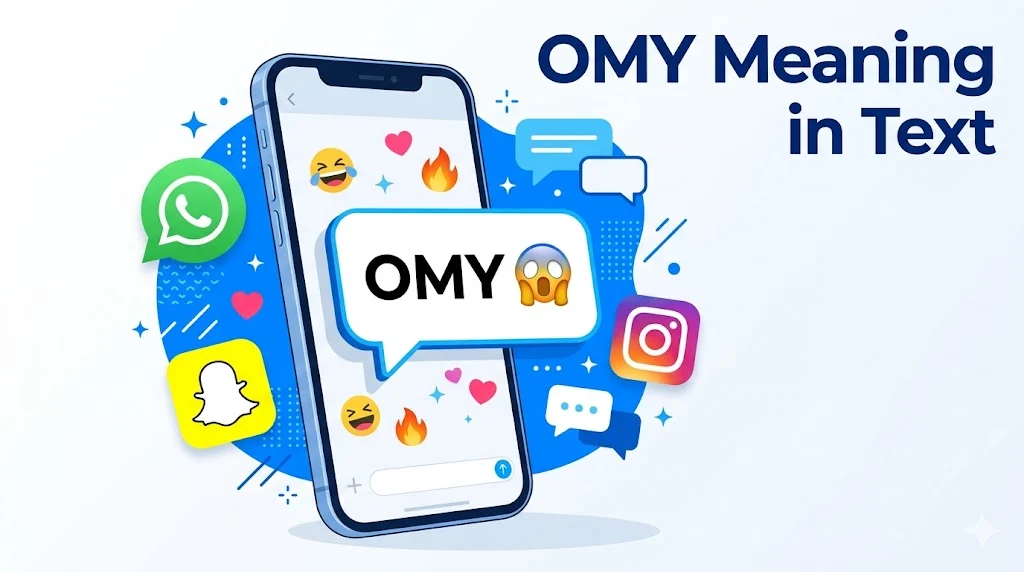
You’re mid-conversation with a friend. The message comes in: “OMY that’s incomprehensible.” You pause. You get the vibe but do you actually know what OMY means in text? Is it surprise? Shock? Is it even the same as OMG?
Don’t worry. You’re not alone. Texting slang evolves at a ridiculous pace and keeping up feels like a full-time job. That’s exactly what this guide is for. By the time you finish reading, you’ll know every definition, every context, and exactly when and when not to use OMY in a conversation.
Let’s get into it.
What Does OMY Mean in Text?
At its core, OMY stands for “Oh My” in most text conversations. It’s a short, punchy expression of surprise, shock, disbelief, or excitement. Think of it as the slightly more understated sibling of OMG same energy, just dialed back a notch.
But here’s where it gets interesting. Depending on who’s texting whom and in what situation, OMY can actually carry a second meaning: “On My Way.” That version shows up when someone’s rushing to reply fast and doesn’t have time to type out OMW.
So yes same three letters, two completely different messages. Context is everything.
“In digital communication, a single abbreviation can carry entirely different meanings depending on tone, timing, and the relationship between the people involved.”
Here’s a clean breakdown of both core meanings:
| Meaning | Full Form | Tone | Typical Context |
|---|---|---|---|
| OMY | Oh My | Surprised, playful, emotional | Reacting to news, gossip, or something shocking |
| OMY | On My Way | Practical, hurried | Letting someone know you’re en route |
| OMY | Oh My (God) variant | Expressive, dramatic | Casual social media reactions |
The “Oh My” interpretation is by far the more common one. You’ll encounter it constantly on platforms like Snapchat, Instagram DMs, and WhatsApp. The “On My Way” reading pops up more in quick SMS exchanges especially when someone’s literally typing on the move.
OMY Meaning in Texting Slang: A Deeper Look
The phrase “Oh My” has existed in spoken English for centuries. It’s an expression rooted in surprise, often tinged with a mix of awe or mild distress. When digital messaging took off in the early 2000s and people started abbreviating everything to save keystrokes, “Oh My God” became OMG almost instantly.
OMY followed later as a softer, less intense version. It strips away the religious reference entirely and leaves just the raw emotional beat that oh my moment when something catches you off guard.
What makes OMY particularly versatile is its tonal flexibility. It can mean:
- Genuine shock “OMY they actually fired him?”
- Playful exaggeration “OMY you look so good in that pic”
- Mild discomfort “OMY that was awkward”
- Excitement “OMY we won the game!!”
- Flirty banter “OMY stop it 😂”
That range is exactly why the abbreviation has stuck around. It doesn’t box you into one emotion. It’s a flexible reaction word the digital equivalent of raising an eyebrow.
OMY vs. Similar Slang: What’s the Real Difference?
People mix these up constantly. Here’s an honest side-by-side so you never confuse them again.
OMY vs. OMG
This is the most common mix-up. Both express surprise but they don’t carry the same weight.
- OMG (Oh My God) hits harder. It’s louder, more dramatic, and has been mainstream since the mid-2000s.
- OMY is softer. It’s the “I’m surprised but not losing my mind” version.
Think of it this way: if a friend tells you they got a promotion, you might text OMY that’s amazing! If they tell you their house is on fire, that’s more of an OMG situation.
OMY vs. OMW
The “On My Way” confusion is real especially because OMW is already the established abbreviation for that phrase.
- OMW = On My Way (standard, widely recognized)
- OMY used as “On My Way” = usually a typo or rushed abbreviation, less common
If you see OMY in a context like “be there soon, omy” it’s almost certainly someone typing in a hurry. Don’t overthink it; just ask if you’re unsure.
OMY vs. OML
- OML = Oh My Lord
- OML tends to be used when someone wants a slightly stronger reaction than “Oh My” but wants to avoid using God
- OMY is less intense and more casual
Here’s a quick comparison table:
| Slang | Full Form | Intensity Level | Common With |
|---|---|---|---|
| OMY | Oh My | Low–Medium | Gen Z, millennials |
| OMG | Oh My God | High | All age groups |
| OML | Oh My Lord | Medium–High | Gen Z |
| OMW | On My Way | Neutral (practical) | All age groups |
| OMFG | Oh My F***ing God | Very High | Adults, informal |
How OMY Is Used Across Different Platforms
The same slang doesn’t always behave the same way on every app. Here’s a platform-by-platform breakdown of what OMY looks like in the wild.
OMY Meaning on WhatsApp
WhatsApp is where most everyday, personal texting happens. Conversations here tend to be between close friends, family, or colleagues which means the emotional range is wide.
On WhatsApp, OMY almost always means “Oh My.” You’ll spot it in group chats reacting to shared news, in one-on-one conversations after someone drops a piece of gossip, or as a quick reaction to a forwarded meme.
Example:
“Did you see what happened at work today?” “No what??” “Sarah quit on the spot. Walked out mid-meeting.” “OMY 😳 she actually did it”
OMY Meaning on Snapchat
Snapchat’s fast-paced, disappearing-message format naturally lends itself to ultra-short reactions. Nobody’s writing paragraphs on a snap reply they’re firing off two or three words at most.
Here, OMY thrives. It’s quick, it’s expressive, and it fits perfectly in the 10-second window of a snap reply. The tone on Snapchat tends to be playful and reactive, so OMY usually carries a lighthearted vibe.
Example:
(Snap of someone’s new haircut) Reply: “OMY you look SO different 😭”
OMY Meaning on Instagram
Instagram DMs and comment sections have their own flavor. Comments are public (or semi-public), which means people lean into more performative reactions. OMY in an Instagram comment often functions as social punctuation a quick, enthusiastic reaction that signals engagement.
In DMs, it’s more personal and mirrors WhatsApp usage.
Example:
(Photo of a sunset view from a rooftop) Comment: “OMY where is this?? 😍”
OMY Meaning in Regular SMS and iMessage
Plain old text messages are where the “On My Way” interpretation is most likely to appear. When someone’s walking out the door, grabbing their keys, and firing off a quick message they’re not carefully selecting abbreviations. Speed matters.
Example:
“Where are you? We’re all here already” “omy leaving now”
In that context, OMY almost certainly means On My Way especially if it’s typed in lowercase, no punctuation, obvious hurry energy.
OMY Meaning From a Girl vs. From a Guy
Let’s be honest people search for this because they’re trying to decode a specific conversation. Fair enough.
The truth is, the sender’s gender changes very little about what OMY means. What matters far more is:
- Your relationship with the person Close friends use slang differently than acquaintances
- The platform Snapchat vs. SMS carry different vibes
- The surrounding conversation What were you talking about before the OMY?
- Tone indicators Emojis, punctuation, capitalization all shift meaning
That said, there are some loose patterns worth noting:
OMY from a girl tends to appear in emotional or reactive contexts responding to surprising news, exciting updates, or playful banter. The “OMY stop it 😂” energy.
OMY from a guy shows up in both emotional reactions and practical messages. You’re slightly more likely to see the “On My Way” usage here, though that’s a soft pattern not a rule.
Bottom line: don’t overanalyze the sender. Analyze the sentence.
Real-Life Examples of OMY in Conversation
Here are five realistic text exchanges that show OMY in action. Each one covers a different context so you can see the full range.
Surprised Reaction Platform: WhatsApp | Tone: Shocked | Meaning: Oh My
Alex: “They announced the concert is in our city next month” Jamie: “OMY are you serious?? 😭” Alex: “Dead serious. Tickets drop Friday” Jamie: “OMY we HAVE to go”
On My Way Usage Platform: SMS | Tone: Hurried | Meaning: On My Way
Mom: “Dinner’s ready, where are you?” You: “omy, 5 mins” Mom: “Okay hurry it’s getting cold”
Flirty/Playful Tone Platform: Instagram DM | Tone: Playful | Meaning: Oh My
Friend: [sends selfie] You: “OMY okay you woke up and chose to slay 😭” Friend: “STOP lmaooo”
Group Chat Reaction Platform: WhatsApp Group | Tone: Collective shock | Meaning: Oh My
Riya: “So apparently the trip got cancelled” Dev: “OMY no way” Sara: “OMY I already packed 😭” Riya: “I know, I’m so sorry guys”
Good News Reaction Platform: Snapchat | Tone: Excited | Meaning: Oh My
Friend: [Snap: holding acceptance letter] You: “OMY YOU GOT IN?? 🎉🎉” Friend: “I literally just found out omg” You: “OMY I’m so proud of you”
Each of these plays out naturally in a real conversation. Notice how the capitalization, emojis, and surrounding words all reinforce which meaning OMY is carrying. That context is your decoder key.
The Origins of OMY: Where Did This Slang Come From?
To understand OMY, you need a quick history of how texting slang evolved.
In the late 1990s and early 2000s, SMS messages were limited to 160 characters. Every letter cost something either in time or, on older pay-per-message plans, actual money. Abbreviations weren’t just trendy; they were practical. LOL, BRB, OMG, GTG all of these emerged from that era of character-count anxiety.
OMG exploded into mainstream culture around 2003–2008. By the time smartphones and unlimited texting arrived, it had already cemented itself as a cultural landmark. It even made it into the Oxford English Dictionary in 2011.
OMY arrived later a natural derivative of OMG. As Gen Z began to dominate online spaces, there was a visible push to strip slang down even further. Why say OMG when OMY captures the “oh my” beat without dragging in extra syllables? It’s linguistic minimalism.
The timeline looks something like this:
| Era | Dominant Slang Style | Example |
|---|---|---|
| Late 1990s | Full abbreviations, caps | LOL, BRB, AFK |
| Early 2000s | Emotional acronyms | OMG, WTF, IDK |
| 2010s | Hybrid slang + emoji | OMG 😂, tbh, ngl |
| 2020s–2026 | Ultra-minimal, lowercase | omy, ngl, istg, iykyk |
The shift toward lowercase slang is particularly telling. Writing “omy” instead of “OMY” signals casual intimacy. It says: I’m not shouting this, I’m just reacting. That’s a distinctly Gen Z move and it’s shaped how the whole texting landscape feels today.
When to Use OMY: and When to Leave It Out
Slang is a social tool. Using it in the right place builds connection. Using it in the wrong place creates confusion or worse, looks unprofessional.
✅ Use OMY When:
- Texting close friends about something surprising, funny, or exciting
- Reacting in a group chat to shared news or memes
- Commenting on social media in a casual, informal space
- Snapping back quickly and you want a fast, expressive reaction
- Letting someone know you’re on your way (only in casual, already-established slang conversations)
❌ Skip OMY When:
- Emailing a coworker or manager stick to professional language
- Messaging someone you’ve just met unfamiliar slang can read as confusing or immature
- Sending formal updates “omy running late to the client meeting” is not a great look
- Texting someone from an older generation who may not recognize it
- Writing anything academic or official obvious, but worth saying
“If you wouldn’t say it in a job interview, don’t text it to your boss.”
The rule of thumb is simple: know your audience. Slang is a dialect. You wouldn’t speak French to someone who only speaks English. Match your language to your context.
Is OMY Common? How Popular Is This Slang in 2026?
Compared to the heavy hitters OMG, LOL, BRB OMY sits in the mid-tier of slang popularity. It’s not ubiquitous, but it’s not obscure either. It lives comfortably in that zone where most people who actively text recognize it even if they don’t use it themselves.
Among Gen Z users (roughly ages 14–28 in 2026), OMY gets decent usage particularly in the “Oh My” sense. The “On My Way” interpretation is less common because OMW already owns that space firmly.
Here’s how OMY stacks up against related slang in terms of everyday usage frequency:
| Slang Term | Popularity Level | Primary Age Group |
|---|---|---|
| OMG | Very High | All ages |
| LOL | Very High | All ages |
| NGL | High | Millennials, Gen Z |
| OMW | High | All ages |
| OML | Medium | Gen Z |
| OMY | Medium | Gen Z, younger millennials |
| ISTG | Medium | Gen Z |
| IKR | Medium-High | Millennials, Gen Z |
OMY isn’t the slang term you’ll see in every conversation but when you do see it, you’ll recognize it instantly. And that recognition matters in fast-moving digital chat.
Full Texting Slang Glossary: Related Terms You Should Know
If you’re learning OMY, it helps to know the neighborhood. Here’s a reference table of the most commonly used abbreviations in the same family:
| Slang | Full Form | Typical Tone |
|---|---|---|
| OMY | Oh My / On My Way | Surprised / Practical |
| OMG | Oh My God | Shocked, expressive |
| OML | Oh My Lord | Strong surprise |
| OMW | On My Way | Practical, informational |
| OMFG | Oh My F***ing God | Very strong reaction |
| IKR | I Know Right | Agreement, validation |
| NGL | Not Gonna Lie | Honesty, admission |
| ISTG | I Swear to God | Emphasis, frustration |
| LMK | Let Me Know | Request for update |
| TTYL | Talk to You Later | Signing off |
| TBH | To Be Honest | Candid statement |
| IDK | I Don’t Know | Uncertainty |
| IYKYK | If You Know You Know | Inside reference |
| FYI | For Your Information | Informational |
| BRB | Be Right Back | Short absence |
Keep this table bookmarked. Digital conversations move fast having a reference like this saves you from staring at a message trying to decode it mid-conversation.
OMY Meaning in Modern Chat Language: The Bigger Picture
It’s easy to look at OMY and see just a random three-letter combo. But zoom out and you’ll see something more interesting: a language system in constant evolution.
Every generation reshapes how it communicates. Formal letters gave way to telegrams. Telegrams gave way to phone calls. Phone calls gave way to texts. And texts are now giving way to a hybrid of voice notes, short-form video reactions, and compressed written language that communicates emotion in the fewest characters possible.
OMY is a small but perfect example of that compression. It takes an already-abbreviated phrase (OMG) and trims it further. It drops a letter and, in doing so, shifts the emotional register from dramatic to casual, from loud to understated.
That’s not laziness. That’s linguistic efficiency. The people who developed and spread this slang weren’t trying to be sloppy; they were optimizing for the speed and tone of digital conversation.
Understanding this puts you ahead in any digital communication context whether you’re trying to connect with a younger audience, decode a colleague’s message, or just keep up with how language actually works in 2026.
FAQs
What does OMY mean in text messages?
OMY most commonly means “Oh My” a short expression of surprise, excitement, or disbelief. In some quick SMS conversations, it can also mean “On My Way,” though OMW is the more standard abbreviation for that.
What does OMY mean from a girl?
It almost always means “Oh My” a surprised, playful, or emotional reaction. The meaning doesn’t change significantly based on who’s sending it. Context (what was said before the OMY) tells you far more than the sender’s identity.
How do you use OMY in a sentence?
Here are a few natural ways:
- “OMY that movie was actually incredible”
- “OMY did you just see that??”
- “omy be there in 10” (On My Way usage)
- “OMY stop you’re making me blush 😭”
Is OMY a Gen Z slang term?
Primarily, yes. OMY is most common among Gen Z users (born roughly 1997–2012) and younger millennials. It reflects the Gen Z tendency toward low-key, lowercase, minimal-expression texting culture.
What’s the difference between OMY and OMW?
OMW (On My Way) is the established, widely understood abbreviation for telling someone you’re headed their way. OMY as “On My Way” is less common and often just a typo or rushed version of OMW. If you want to tell someone you’re coming, OMW is clearer and safer to use.
Conclusion
So what does OMY mean in text? Mostly, it means “Oh My.” It’s a compact, flexible reaction word that Gen Z and younger millennials reach for when something surprising, exciting, or funny lands in their messages. Occasionally, in fast, logistical SMS exchanges, it pulls double duty as “On My Way.”
The real lesson here isn’t just about those three letters. It’s about how digital language works. Slang is context-dependent, emotionally flexible, and constantly evolving. OMY today means something specific but the way people use it, emphasize it, or pair it with emojis gives it different shades of meaning every single time.
Next time OMY lands in your messages, you’ll know exactly how to read it. And if you want to use it yourself? Go for it just make sure you’re in the right conversation for it.
Read More Related Articles:
- Biblical Meaning of Adultery: Scriptural Teaching (2026)
- What Does “No Mames Wey” Mean in English? Cultural Significance (2026)
- What Does -3.5 Mean in a Point Spread? Betting Guide (2026)

Luna Hartley is a content creator at TextSprout.com, where she specializes in explaining word meanings, modern phrases, and everyday language used in texts and online conversations. Her writing focuses on clarity and context, helping readers understand how words are actually used in real communication.