
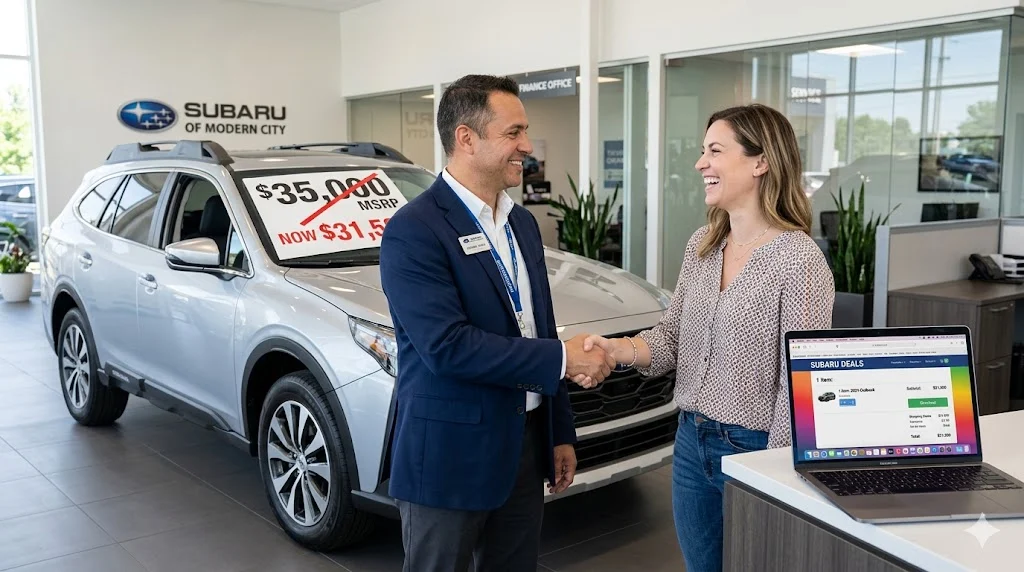
You see “MSRP” on a car window sticker. You spot it on a product listing for a new laptop or a sofa. It looks official. It looks final. Here you will get to know MSRP Meaning.
But is it?
Here’s the truth most websites won’t tell you: MSRP is a suggestion. Nothing more.
Manufacturers print it. Retailers ignore it. And you? You should almost never pay it.
This guide breaks down the real MSRP meaning. You’ll learn what does MSRP stand for, how it works in cars versus retail, and exactly how much you can negotiate below that sticker price. No jargon. No fluff. Just clear, actionable knowledge.
Let’s start with the basics.
What Does MSRP Mean? The Simple Definition
MSRP stands for Manufacturer’s Suggested Retail Price.
That’s the full form. The abbreviation meaning is straightforward: a price tag the brand recommends but does not enforce.
In plain English: the company that makes a product tells stores, “Hey, we think you should sell this for 1,000.”Butthestorecancharge900 or $1,200. Both are completely legal.
Active voice example:
Sony sets the MSRP for a new TV at 1,500.BestBuysellsitfor1,299. A small electronics shop sells it for $1,600. All three follow the rules.
So the MSRP definition isn’t “final price.” It’s “starting point.”
That’s the core MSRP price meaning you need to remember.
MSRP Full Form and Acronym Breakdown
Let’s spell it out clearly:
- M – Manufacturer (the company making the product)
- S – Suggested (recommended, not required)
- R – Retail (selling to the end customer)
- P – Price (the dollar amount)
So the MSRP abbreviation meaning never includes words like “final,” “mandatory,” or “minimum.” The word “suggested” does all the heavy lifting.
Bold truth: Some retailers use MSRP to make discounts look huge. They inflate the suggested price so a 50itemseemslikea100 value on sale. That’s a classic pricing strategy in marketing.
Now let’s see how MSRP plays out in the real world.
MSRP in Cars vs Retail vs Electronics
Not every industry treats MSRP the same way. Here’s where you’ll see it most often.
MSRP in Cars: The Classic Sticker Price
Walk onto any new car lot. The window sticker shows a bold number labeled “MSRP.” Car people also call it the sticker price.
But here’s what that sticker quietly includes:
- Base price of the vehicle
- Factory-installed options (sunroof, leather seats, upgraded音响)
- Destination charge (shipping the car from factory to dealer)
What’s missing? Taxes, registration fees, and dealer add-ons like window etching or nitrogen tires.
Real example (2025 data):
A new Toyota Camry has an MSRP of 28,400.Thedealeraddsa1,200 destination fee, 500inoptionalfloormatsandtint,anda700 “dealer prep” fee. Suddenly the MSRP price meaning gets fuzzy. The final number before tax is $30,800.
So does MSRP mean final price on a car? No. Never.
MSRP in eCommerce and Retail
Online shopping uses MSRP differently. You’ll see it next to a lower sale price with a strikethrough.
For example:
~~MSRP 199 Today’sprice:129
That 70differencefeelslikeawin.Butwastheproducteversoldat199? Often not. Brands create an artificially high MSRP so the discount looks massive.
Fact: In clothing and furniture, MSRP is typically 2x to 4x the actual manufacturing cost. A sofa with a 2,000MSRPmightcostthestore500 wholesale. They can sell it for $800 and still profit.
MSRP in Electronics
Laptops, phones, and TVs follow a similar pattern. New models launch at MSRP. Six months later, real prices drop 20–30%.
Example from Q2 2025:
Samsung’s 65-inch QLED TV launched with a 1,800MSRP.Eightweekslater,Amazonsolditfor1,399. By Black Friday, it hit $1,099.
That’s the MSRP in retail working as a temporary anchor, not a permanent truth.
MSRP vs Invoice Price vs Sale Price: The Critical Difference
This table gives you instant clarity. Bookmark it mentally.
| Pricing Term | Definition | Who Sets It | Can You Negotiate? |
|---|---|---|---|
| MSRP | Manufacturer’s suggested retail price | Manufacturer | Yes |
| Sticker price | Same as MSRP on cars | Manufacturer | Yes |
| Invoice price | What the dealer pays the manufacturer | Manufacturer | Rarely |
| Sale price | The price you actually pay after discounts | Retailer/Dealer | Already discounted |
| Market price | Current price based on supply and demand | Market forces | Sometimes |
The most important comparison: MSRP vs invoice price.
Let’s say a car’s MSRP is 40,000.Theinvoicepricemightbe37,500. That $2,500 difference is the dealer’s gross profit margin before holdbacks or incentives.
When someone asks “difference between msrp and invoice price,” the answer is simple:
Invoice is dealer cost. MSRP is suggested sell. Your job is to meet in the middle.
How MSRP Is Calculated
You might think MSRP comes from a complex formula. It doesn’t.
Manufacturers consider three main factors:
- Cost of goods sold – materials, labor, shipping
- Desired profit margin – often 30–50% for retail goods, 10–15% for cars
- Competitor pricing – if a rival’s product costs 1,000,youwon’tsetMSRPat2,000
Then they add a buffer for discounts, promotions, and retailer profit.
Example for a $100 MSRP item:
- Manufacturing cost: $25
- Wholesale price to retailer: $50
- Retailer’s cost: $50
- Retailer sells at 100MSRP→50 gross profit
- Retailer runs a 30% off sale → sells at 70→still20 profit
That’s the pricing strategy in marketing at work. MSRP exists to make everyone in the chain money.
Why MSRP Matters
You might wonder, “If MSRP isn’t real, why do we have it?”
Three real reasons.
1. Price anchoring
Consumers see a high MSRP. Then they see a lower selling price. Their brain registers a win. Behavioral economists call this the anchoring effect.
2. Preventing destructive price wars
Without MSRP, some retailers might slash prices so low that others go out of business. MSRP gives a loose ceiling, not a floor.
3. Brand positioning
A luxury watch with a 10,000MSRPsignalsprestige.Adiscountstorewith“Compareat10,000 – Our price $2,000” looks like a miracle. Same watch, same profit. Different perception.
So MSRP matters… just not for the reason most shoppers think.
MSRP vs MAP Pricing: A Hidden Twist
Here’s something most guides skip.
MAP stands for Minimum Advertised Price.
MAP is the lowest price a retailer can show in an ad or display online. But they can sell below MAP in person or inside a shopping cart.
Example:
- MSRP = $100
- MAP = $85
- Retailer advertises $85
- You add to cart and see a coupon for 10off→finalprice75
That’s legal. The retailer broke MAP for the transaction but not for the advertisement.
Why does this matter for you? Because when you see MSRP vs MAP, the real sale price could be much lower than either number. Always click through to checkout.
How Much Below MSRP Should You Pay? Real Numbers by Industry
Stop guessing. Here are the real discount targets based on current market data (2024–2025 trends).
Cars (New)
- Normal sedan or SUV: 8–12% below MSRP
- High-demand EV or truck: 0–3% below MSRP (or pay MSRP)
- End of model year: 15–20% below MSRP
- Previous year leftover: 20–25% below MSRP
Example: A 2025 Honda CR-V has 35,000MSRP.Goodtarget=31,500 to $32,200.
Electronics
- New release (first 4 weeks): Pay MSRP or 5% below
- 2–6 months after launch: 15–25% below MSRP
- Black Friday / Prime Day: 30–50% below MSRP
- Open box or refurbished: 40–60% below MSRP
Clothing & Apparel
- Full retail (non-sale): 0% below MSRP (don’t buy)
- Seasonal sale: 30–50% below MSRP
- Clearance or outlet: 60–80% below MSRP
Furniture
- Regular retail: 20–30% below MSRP (negotiate)
- Holiday sale (Memorial Day, Labor Day): 40–60% below MSRP
- Floor model or scratch-and-dent: 50–70% below MSRP
Online General Retail
- Standard listing: 10–20% below MSRP
- With coupon or promo code: 25–40% below MSRP
- Flash sale or lightning deal: 40–60% below MSRP
Pro tip: Use price history tools like CamelCamelCamel for Amazon. You’ll see the lowest price ever for any product. Then you’ll know if today’s “sale” is real.
Can You Negotiate Below MSRP? Yes. Here’s Exactly How.
Long-tail keyword question: is msrp the final price or negotiable?
Answer: It is always negotiable except for a tiny fraction of products (limited edition sneakers, rare hypercars, some Apple products at launch).
Here are four real scripts you can use tomorrow.
For a New Car
Walk into the dealership. Say this:
“I see the MSRP is 38,500andinvoiceis35,200. I’ll pay $36,000 out the door including tax and fees. Can you make that work?”
They’ll counter. You’ll land around $36,500. That’s still 5% below MSRP.
For Electronics at Best Buy or Target
Pull up a competitor’s lower price on your phone. Say:
“This TV’s MSRP is 1,200.Amazonhasitfor980. Can you match $950 and I’ll buy it right now?”
They often say yes. Price matching is standard policy.
For Furniture at a Local Store
Look for a small scratch or a floor model. Say:
“I like this sofa. The MSRP tag says 1,800.Butthisfloormodelhasasmallmarkontheback.I’llgiveyou1,000 cash including delivery.”
Cash speaks loudly. So does walking away. Be ready to leave.
Online (No Negotiation Needed)
Wait for a sale. Use browser extensions that automatically apply coupon codes. Buy during major shopping holidays.
Trending data (2025): The average discount off MSRP during Prime Day is 34%. For Black Friday, it’s 42%. For Cyber Monday, it’s 39%. Never pay MSRP within two weeks of these events.
MSRP Advantages and Disadvantages
Let’s be fair. MSRP has good and bad sides.
Advantages for Consumers
- Gives a benchmark for comparing prices across stores
- Helps you spot a real discount vs fake markup
- Provides a starting point for negotiation
Disadvantages for Consumers
- Often inflated to make sales look better
- Causes confusion about what’s fair to pay
- Dealers hide fees behind MSRP (destination charges, market adjustments)
Advantages for Retailers
- Protects profit margins across competing stores
- Creates perceived value for the brand
- Simplifies national advertising (everyone shows same “compare at” price)
Disadvantages for Retailers
- Limits ability to undercut competitors on advertised prices (MAP agreements)
- Can feel dishonest if MSRP is wildly unrealistic
- Requires constant adjustment with inflation and supply chain changes
Bottom line: MSRP is a tool. Use it for reference. Don’t worship it as truth.
Why MSRP Is Higher Than Dealer Price
People get confused. They see a dealer advertising $5,000 below MSRP and think it’s charity.
It’s not.
MSRP includes built-in profit for both the manufacturer and the dealer. When you see “$5,000 below MSRP,” the dealer is simply cutting their own profit, sometimes dipping into manufacturer rebates or holdbacks.
Holdback explained: A manufacturer gives the dealer a small percentage (typically 2–3% of MSRP) back after the car sells. That’s pure profit. A dealer can sell below invoice and still make money from holdbacks.
So when you negotiate below MSRP, you’re not stealing from anyone. You’re just removing artificial padding.
MSRP Meaning in Simple Terms: A Final One-Sentence Take
If you forget everything else, remember this:
MSRP is the price the manufacturer hopes you pay, not the price you have to pay.
MSRP in eCommerce: What Changed in 2025
Online retail added a twist. Dynamic pricing algorithms now adjust real-time sale prices while keeping MSRP fixed. You might see:
- Morning price: 149(MSRP199) – 25% off
- Afternoon price (high traffic): $169 – 15% off
- Midnight price: $139 – 30% off
The MSRP never changes. The discount percentage does. That’s why price tracking tools are essential.
Tip: Shop between 1 AM and 5 AM EST for the widest dynamic pricing swings. Data from 2024–2025 shows average discounts are 8% higher during off-peak hours.
Pricing Transparency: What Regulators Are Doing
The FTC proposed new rules in late 2024 targeting “drip pricing” and fake discounts. The key change: any advertised discount must be based on a genuine MSRP that the product actually sold for within the previous 90 days.
No more inflated MSRP that never existed.
If these rules pass in 2025 or 2026, MSRP meaning will shift toward honesty. For now, assume some retailers still stretch the truth.
MSRP and Profit Margins: A Quick Math Lesson
Let’s track a real product from factory to your door.
Item: Blender
- Manufacturing cost: $8
- Brand sells to retailer at: $20
- Retailer’s MSRP: $60
- Retailer’s cost: $20
- Retailer’s gross profit at MSRP: $40 (200% markup on cost)
- Retailer’s sale price: $35
- Retailer’s actual profit: $15 (75% markup on cost)
Still profitable. That’s why they can discount so deep.
Takeaway: When you pay 50% off MSRP, the retailer often still makes money. Don’t feel guilty negotiating.
FAQs
What does MSRP mean when buying a car?
MSRP is the starting price on the window sticker. It includes base price, factory options, and destination fee. It excludes taxes, registration, and dealer add-ons. You should almost never pay it.
Is MSRP the final price or negotiable?
MSRP is never final except for very rare items like限量版 products or some launch-day electronics. For cars, furniture, and most retail goods, you can negotiate 5–50% below MSRP depending on the category.
Difference between MSRP and invoice price?
Invoice price is what the dealer pays the manufacturer. MSRP is what the manufacturer suggests you pay. Your target price sits between them, usually closer to invoice than to MSRP.
Why is MSRP higher than dealer price?
Because MSRP includes room for dealer profit, negotiation, and discounts. A lower dealer price just means they cut their own margin or used manufacturer rebates.
What is a good discount off MSRP for a car?
8–12% below MSRP is solid for a normal car. 15–20% below MSRP is excellent and usually requires end-of-year timing or a previous model year.
Conclusion:
MSRP meaning comes down to one word: suggestion.
Manufacturers suggest. Retailers adjust. You decide.
The smartest shoppers don’t fear MSRP or worship it. They use it as a reference point, a negotiation anchor, and a signal to dig deeper.
Now you know what MSRP really stands for. You know how much to pay below it. And you have the scripts to make it happen.
Go save some money. You’ve earned it.
Read More Related Article:
- What Does Deber Mean in Spanish: Grammar Guide In 2026
- What Does David Mean in Hebrew: Cultural Significance In 2026
- What Does Fulfillment Mean in Shipping: Complete Guide In 2026

Neon Samuel is a digital content creator at TextSprout.com, dedicated to decoding modern words, slang, and expressions. His writing helps readers quickly grasp meanings and understand how terms are used in real conversations across text and social platforms.