
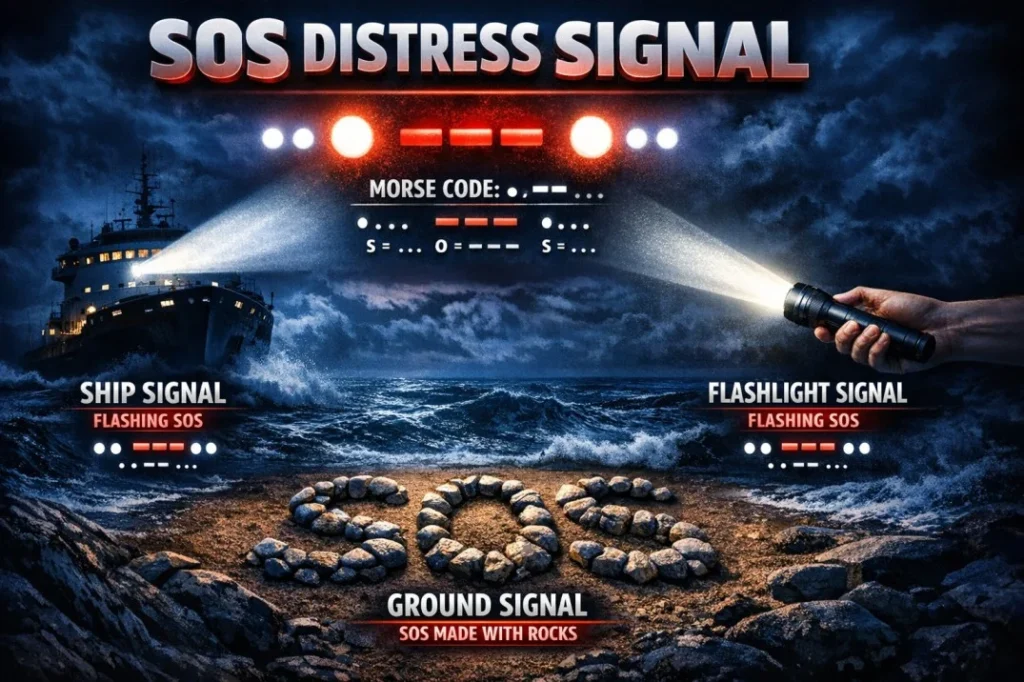
SOS is an internationally recognized distress signal used to request urgent help, especially in emergencies.
It was originally used in Morse code as three short signals, three long signals, and three short signals.
In simple terms, SOS means “someone needs immediate help”, whether at sea, in danger, or even in casual digital communication today.
Few signals in the world are as instantly recognizable as SOS. It is short, simple, and powerful. Whether flashed as a light signal, tapped out in Morse code, or typed in a text message, SOS carries a universal meaning of urgency and distress.
Most people have heard of SOS at some point in their lives. It appears in movies when someone is stranded on an island, in survival stories, and even in everyday conversations online. Despite its widespread use, many people are unsure what SOS actually stands for or where it came from.
The truth is both interesting and surprising. SOS is not an abbreviation in the traditional sense. Instead, it is a carefully chosen signal designed for clarity and ease of recognition. Over time, it has evolved beyond its original purpose and is now used in both serious emergencies and casual communication.
Understanding what SOS means, how it originated, and how it is used today gives deeper insight into one of the most important signals ever created.
What Does SOS Mean?
SOS is a distress signal that indicates someone is in danger and needs immediate assistance.
Originally used in Morse code, SOS is represented as:
- Three short signals
- Three long signals
- Three short signals
This pattern is easy to recognize and difficult to confuse with other signals, which is why it became the standard emergency call.
Although many people believe SOS stands for phrases like “Save Our Souls” or “Save Our Ship,” these interpretations were created later. The signal itself does not officially stand for anything. It was chosen purely because of its simplicity and clarity in Morse code communication.
The Origin of SOS
SOS was officially adopted as a distress signal in the early 20th century. Before that, ships used different signals to request help, which often caused confusion. There was a need for a universal standard that could be recognized across languages and regions.
In 1906, during an international radio conference, SOS was chosen as the global distress signal. It replaced earlier signals because it was easier to transmit and recognize.
The structure of SOS in Morse code made it ideal:
- It is symmetrical and balanced
- It can be sent quickly
- It is easy to identify even in poor conditions
By 1908, SOS became widely used by ships around the world. One of the most famous uses of SOS occurred during the sinking of the Titanic in 1912, which helped solidify its importance in emergency communication.
Why SOS Was Chosen
The selection of SOS was not random. It was based on practical communication needs.
Here are the main reasons why SOS became the standard distress signal:
- Clarity: The pattern is simple and unmistakable
- Speed: It can be transmitted quickly
- Universality: It does not depend on language
- Recognition: It stands out from other signals
In emergency situations, every second matters. A signal that can be quickly sent and easily understood can save lives. SOS fulfilled these requirements perfectly.
Common Misconceptions About SOS
Many people believe that SOS is an abbreviation for certain phrases. While these interpretations are popular, they are not historically accurate.
Here are some common myths:
- Save Our Souls
- Save Our Ship
- Send Out Support
These phrases were created later as backronyms, meaning people assigned meanings to the letters after the signal was already in use.
In reality, SOS does not officially stand for any words. It is simply a signal pattern chosen for effectiveness.
How SOS Is Used in Real Life
SOS has been used in many real world emergency situations.
Maritime Emergencies
Ships at sea use SOS to signal distress when they are in danger, such as during storms, collisions, or equipment failure.
Aviation
Pilots may use SOS or similar distress signals when facing critical issues in flight.
Survival Situations
People stranded in remote areas often create SOS signals using rocks, logs, or fire to attract attention from rescuers.
Emergency Communication
In situations where communication is limited, SOS can be sent using light, sound, or even physical gestures.
Examples of SOS in Context
| Example | Meaning |
|---|---|
| A sailor sends SOS using Morse code | Emergency at sea |
| A hiker arranges rocks in SOS shape | Requesting rescue |
| A flashlight flashes SOS pattern | Distress signal in darkness |
| Someone texts “SOS I need help” | Urgent request in casual communication |
SOS in Modern Digital Communication
Today, SOS is no longer limited to Morse code or emergencies at sea. It has taken on new meanings in everyday communication.
People often use SOS in messages or social media to express urgency or ask for help in a less serious way.
Friendly or Casual Usage
“SOS I forgot my homework”
“SOS I need coffee right now”
In these examples, SOS is used humorously or to exaggerate a situation.
Semi Serious Usage
“SOS can you pick me up”
“SOS I am stuck here”
Here, the person is genuinely asking for help, but the situation may not be life threatening.
Serious Usage
In emergencies, SOS still retains its original meaning and should be treated with urgency.
Tone and Meaning in Different Contexts
The meaning of SOS depends heavily on context and tone.
| Tone | Example | Meaning |
|---|---|---|
| Serious | SOS we are lost in the mountains | Life threatening situation |
| Urgent | SOS I need help with this problem | Immediate assistance needed |
| Casual | SOS I cannot find my keys | Lighthearted frustration |
Understanding tone helps avoid confusion, especially in digital communication where messages can be interpreted differently.
SOS vs Mayday
SOS is often compared to another distress signal known as Mayday.
| Term | Usage | Medium |
|---|---|---|
| SOS | Morse code or visual signals | Light, sound, text |
| Mayday | Spoken distress call | Radio communication |
Mayday is used in voice communication, especially in aviation and maritime radio systems, while SOS is primarily used in Morse code or visual signals.
Both serve the same purpose, which is to signal distress and request help.
Creative and Symbolic Use of SOS
Over time, SOS has become more than just a distress signal. It is now used symbolically in various areas of culture.
- In music, artists use SOS to represent emotional distress
- In movies, it often appears in survival scenes
- In literature, it symbolizes desperation or a call for help
This broader use has made SOS a powerful symbol that people instantly recognize, even outside emergency contexts.
How to Signal SOS
Even today, knowing how to signal SOS can be useful in emergencies.
You can signal SOS using:
- Flashlight or light signals
- Whistles or sound patterns
- Mirrors reflecting sunlight
- Arranging objects on the ground
The key is to repeat the pattern consistently so rescuers can recognize it.
Why SOS Still Matters Today
Despite advances in technology, SOS remains relevant.
Modern devices such as smartphones and smartwatches even include SOS emergency features. With a simple button press, users can send distress signals, share their location, and alert emergency contacts.
SOS continues to be important because:
- It is universally recognized
- It works without advanced technology
- It can be used in extreme conditions
- It saves lives
FAQs
What does SOS stand for?
SOS does not officially stand for any words. It is a Morse code distress signal chosen for its simplicity and clarity.
Is SOS still used today?
Yes, SOS is still used in emergencies and is also built into many modern devices as an emergency alert feature.
Why do people say Save Our Souls for SOS?
This phrase is a backronym created after SOS became popular. It is not the original meaning.
How do you send SOS in Morse code?
It is sent as three short signals, three long signals, and three short signals.
What is the difference between SOS and Mayday?
SOS is used in Morse code or visual signals, while Mayday is used in spoken radio communication.
Can SOS be used in texting?
Yes, people often use SOS in messages to express urgency or ask for help in a casual way.
Is SOS only for emergencies?
Originally yes, but today it is also used informally in everyday communication.
Why is SOS important?
It is a simple and universal signal that helps people communicate distress quickly and effectively.
Conclusion
SOS is one of the most powerful and recognizable signals in the world. What began as a simple Morse code pattern has evolved into a universal symbol of distress and a call for help. Its strength lies in its simplicity, clarity, and ability to cross language barriers.
Although many people associate SOS with phrases like Save Our Souls, its true meaning is rooted in communication efficiency rather than words. Over time, it has expanded beyond emergency situations and become part of everyday language, used to express urgency, frustration, or humor.
Understanding SOS helps us appreciate both its historical importance and its modern relevance. Whether used in a life threatening situation or a casual text message, SOS continues to serve as a powerful reminder of the human need to ask for help and to respond when others do.
Read More Related Articles:
- What Does TMU Mean in Text: The Slang You’ve Probably Seen In 2026
- What Does SOW Mean in Business: Definition and Explanation
- What Does Merde Mean in French: Word You Hear Everywhere In 2026

Luna Hartley is a content creator at TextSprout.com, where she specializes in explaining word meanings, modern phrases, and everyday language used in texts and online conversations. Her writing focuses on clarity and context, helping readers understand how words are actually used in real communication.