
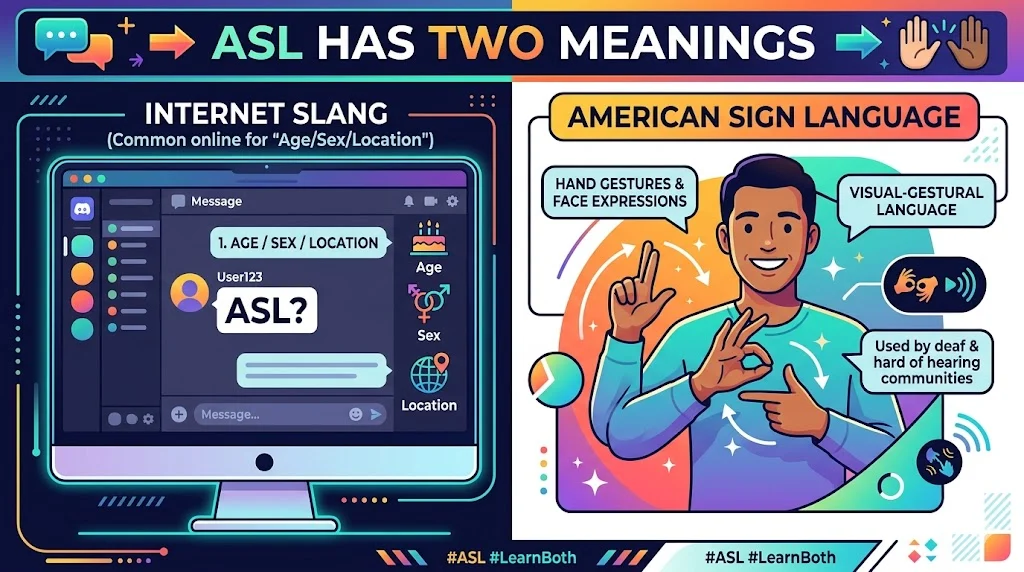
ASL in texting most commonly means “Age, Sex, Location.” It is used in online chats as a quick way to ask someone about their basic personal details. However, ASL can also mean “American Sign Language,” which is a complete visual language used by the deaf and hard of hearing community in the United States and parts of Canada.
If you spend time on social media, texting apps, or online chats, you may have seen the abbreviation ASL used in different conversations. It might look simple, but its meaning can change depending on the context. For some people, ASL is a casual slang question. For others, it refers to a completely different language used by the deaf community.
Because of this dual meaning, ASL is one of those abbreviations that can easily confuse beginners in digital communication. Understanding it properly helps avoid misunderstandings and allows you to respond appropriately in different situations.
This guide breaks down everything you need to know about ASL, including its meanings, origins, usage in texting, real life examples, comparisons, and frequently asked questions.
Both meanings are correct, but the context determines which one is being used.
What ASL Means in Texting
In online conversations, especially in early internet chat rooms, ASL is short for Age, Sex, Location. It is one of the oldest internet slang abbreviations and was commonly used when people met strangers online and wanted quick basic information about them.
For example, someone might type:
“ASL?”
This simply means they are asking:
• How old are you
• Are you male or female
• Where are you from
It was a shortcut used in early messaging platforms like chat rooms, forums, and instant messaging apps.
Today, ASL in this meaning is less common but still appears in casual or nostalgic internet conversations.
What ASL Means in Real Life Language
Outside of texting slang, ASL has a much more important and widely respected meaning. It stands for American Sign Language.
American Sign Language is a complete language that uses:
• Hand movements
• Facial expressions
• Body gestures
• Spatial awareness
It is used primarily by deaf and hard of hearing individuals in the United States and parts of Canada. ASL is not just a translation of English. It is its own language with unique grammar and structure.
For example, in ASL, sentence structure is different from English, and meaning is often conveyed visually rather than through spoken words.
Two Meanings of ASL in One Word
ASL is a perfect example of how internet slang and real world language can overlap.
| Meaning | Context | Description |
|---|---|---|
| Age, Sex, Location | Internet slang | A quick question used in chats to learn basic info about someone |
| American Sign Language | Real language | A visual language used by deaf communities |
Understanding which meaning is intended depends completely on where and how it is used.
Origin of ASL in Texting Culture
The slang version of ASL appeared in the early days of the internet during the 1990s and early 2000s. Chat rooms like AOL Instant Messenger, Yahoo Chat, and IRC were popular places where strangers met online.
People often used ASL as an icebreaker question. Since typing was slower and conversations were short, abbreviations became a necessity.
ASL became one of the most common first messages between strangers online.
However, as internet safety awareness grew, the use of ASL in this way decreased because sharing personal information with strangers became less encouraged.
Origin of ASL as a Language
American Sign Language has a much longer and more meaningful history. It developed in the early 1800s and became standardized in educational institutions for the deaf.
It was influenced by French Sign Language and local signing systems used in the United States.
Today, ASL is:
• A fully recognized language
• Used by millions of people
• Taught in schools and universities
• Used in media and interpretation services
It plays a vital role in accessibility and communication for the deaf community.
How ASL Is Used in Text Conversations
When used in texting, ASL usually appears in short and informal exchanges. It is often one of the first questions asked in older chat formats.
Example Conversations
Example 1 casual chat
Person A: Hey
Person B: Hi
Person A: ASL?
Person B: 21, female, USA
Example 2 friendly tone
“ASL? Just curious where you are from.”
“ASL lol?” used in nostalgic internet conversations about old chat rooms
While still recognizable, this usage is considered outdated in modern messaging culture.
How ASL Is Used in Real Life Communication
In contrast, American Sign Language is used in daily real life communication among deaf individuals and interpreters.
Examples include:
• Conversations between deaf individuals
• Communication in classrooms
• Medical appointments with interpreters
• Public announcements with sign language interpretation
• Online videos and educational content
ASL allows people to communicate fully without spoken words.
Examples of ASL in Different Contexts
| Context | Example | Meaning |
|---|---|---|
| Chat slang | ASL? | Asking age, sex, location |
| Casual conversation | What’s your ASL? | Asking personal info online |
| Education | I am learning ASL | Learning American Sign Language |
| Accessibility | ASL interpreter provided | Sign language translation available |
Why ASL Can Be Confusing
The confusion happens because both meanings are widely recognized but used in completely different environments.
In casual texting, ASL may feel informal or even outdated. In professional or educational contexts, ASL refers to a respected and structured language system.
This difference shows how language evolves in both digital and real world settings.
Is ASL Still Used Today
The usage of ASL depends on meaning:
In texting slang
It is rarely used today because modern social media platforms discourage sharing personal details with strangers. Instead, people prefer usernames, profiles, and bio information.
In language context
ASL is widely used and actively growing. More schools, workplaces, and media platforms include ASL interpretation and learning resources.
So while one meaning is fading, the other is becoming more important.
Comparison With Similar Internet Slang
ASL belongs to a group of early internet abbreviations used in chat rooms.
| Slang | Meaning | Usage |
|---|---|---|
| ASL | Age, Sex, Location | Old chat slang |
| BRB | Be Right Back | Temporary absence |
| LOL | Laugh Out Loud | Expression of laughter |
| IDK | I Don’t Know | Casual response |
| TTYL | Talk To You Later | Ending conversation |
Unlike most slang, ASL is now considered outdated in texting culture.
ASL in Modern Digital Culture
While ASL as slang is fading, American Sign Language is gaining visibility online.
Platforms like YouTube, TikTok, and Instagram feature:
• ASL tutorials
• Deaf creators sharing content
• Educational sign language videos
• Accessibility awareness campaigns
This has helped ASL become more recognized globally as an important language rather than just an abbreviation.
Polite and Modern Alternatives to ASL Slang
Since “ASL” can feel outdated or intrusive in modern chats, people now use safer and more respectful alternatives such as:
• “Where are you from?”
• “How old are you?” (only when appropriate)
• “Tell me about yourself”
• Profile based introductions instead of direct questioning
These alternatives are more polite and aligned with current online communication norms.
FAQs
What does ASL mean in texting?
ASL means Age, Sex, Location and is used to ask basic personal information in online chats.
What does ASL mean in real life?
ASL stands for American Sign Language, a visual language used by deaf and hard of hearing people.
Is ASL still used in chats today?
It is mostly outdated but may still appear in older or casual internet conversations.
Is ASL the same as sign language?
ASL is one type of sign language, specifically used in the United States and parts of Canada.
Is ASL rude to ask?
In modern internet culture, asking ASL can feel intrusive or outdated, especially with strangers.
How many people use ASL language?
Millions of people use American Sign Language in daily communication and education.
Is ASL hard to learn?
It takes practice like any language, but many people find it intuitive because it is visual.
Why does ASL have two meanings?
Because internet slang and real world language evolved separately, leading to multiple interpretations of the same abbreviation.
Conclusion
ASL is a unique abbreviation with two very different meanings depending on context. In early internet slang, it stands for Age, Sex, Location, a quick way to ask personal details in chat rooms. In a more meaningful and widely recognized sense, it stands for American Sign Language, a complete visual language used by millions of people.
Understanding the difference between these meanings helps you interpret conversations correctly and avoid confusion. While the texting version of ASL has mostly faded from modern communication, American Sign Language continues to grow in importance as a vital tool for accessibility and inclusion.
Whether you encounter ASL in a chat message or in a learning environment, knowing its meaning ensures you respond with confidence and clarity.
Read More Related Articles:
- “Le” Means in Spanish: Why This Small Word Matters So Much In 2026
- OP Meaning in Gaming – The Term Every Gamer Uses (2026)
- What Does QHS Stand For? A Clear Medical Definition In 2026

Ivy Madison is a content creator at TextSprout.com, specializing in word definitions, internet slang, acronyms, and text abbreviations. She delivers clear and engaging explanations, helping readers quickly understand modern digital language and trending terms.